ひでりん retweeted

スペシャルBand Member🎸(敬称略)
Piano わたし
Synth 大迫杏子
E.Bass Igo
Drums 坂本暁良(横浜)今井義頼(大阪)
Gt 渡辺裕太、三沢崇篤
Perc 野崎めぐみ、麻生弥絵
Tp 具志堅創(横浜)吉澤達彦(大阪)
Tb 大泉茉弓
Reed 石田愼
#セカイシンフォニー
#プロセカ
4
19
1,479

翌7/5(日)は、開店30周年を迎えられた長野バックドロップへ参ります。㊗️
2件だけの小さな中越ツアー、お近くの方は是非お見逃しなく!
#バックドロップ #30周年 #RHYTHMATRIX
クリヤ・マコト (pf) 安井源之新 (perc) 納浩一 (b) 大槻"kalta"英宣 (ds) 上田裕香 (vo)
makotokuriya.com/index.php/e…
14


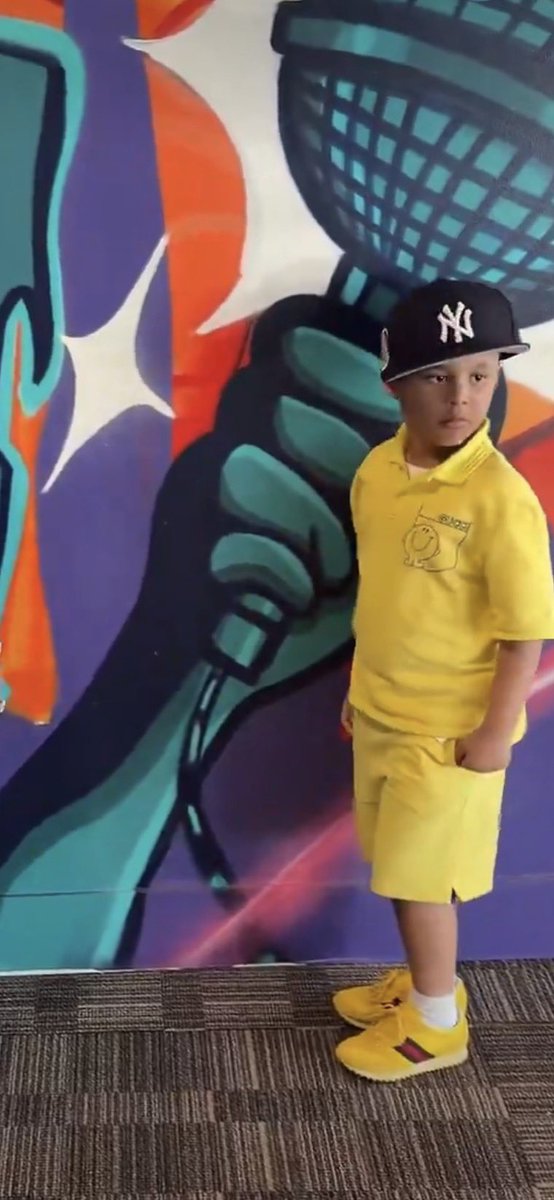
“Talking” and all he said was “Aaaaah” every child makes that noise.. lmaooo papa perc is slow
11
Alf Bianchi retweeted

Ogni mattina, quando sorge il sole, un deputato piddino si sveglia e inizia a gridare contro il pericolo fascista, perché sa che potrebbe arrivare un altro piddino e portargli via la sedia alla Camera.

C'è un presidente del Senato con in casa il busto di Mussolini.
C'è il capogruppo alla Camera del partito della premier che si vestiva da nazista.
C'è un generale che sparge razzismo ogni volta che parla.
Ci sono fascisti e nazisti che sfilano per Roma inneggiando al duce e invocando deportazioni.
Ci sono fascisti amici dei mafiosi che definiscono mafia l'antifascismo.
Ci siamo noi che gli abbiamo impedito di profanare la Camera che veniamo per questo puniti e sospesi.
È questo il mondo alla rovescia.
Ma lo rimetteremo in ordine, pezzo dopo pezzo.
E questo schifo tornerà ad essere coperto dalla vergogna, come è giusto che sia.
Perchè l'Italia non è questa.
E non merita questo osceno spettacolo.
1
5

lyn retweeted

Jun 11
I need to be around more people that are so far removed from societal expectations. People who don’t care how others perceive them as long as they are staying true to themselves
10
1,094
3,901
74,109

Bettybus retweeted

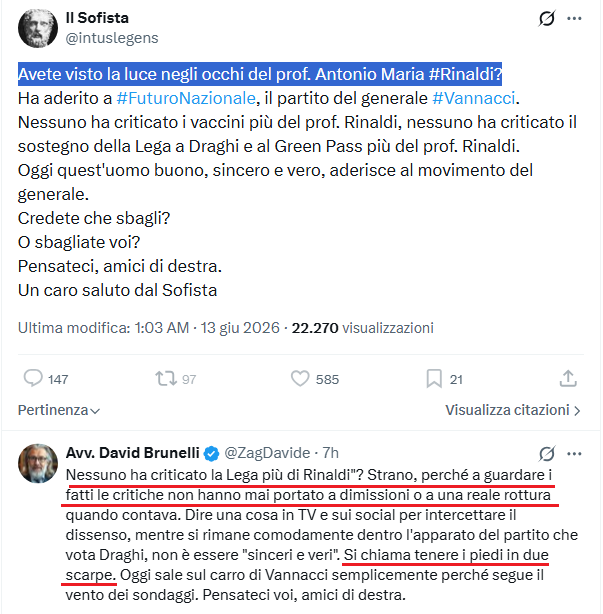
Ha visto la luce!
Tradotto:
Si chiama tenere i piedi in due scarpe. Oggi sale sul carro di Vannacci semplicemente perché segue il vento dei sondaggi. Pensateci voi, amici di destra.
3
8
94

walk in w some bands got fuckin bankroll
walk in w some bands got fuckin bankroll
i got 2 perc 10s my slime go take more
i just aim for head that boy can’t lay low
walk inside that trap i get sum racks for ransom
push up on dat boy dat g3x he dancing
1
19
Margarita retweeted

Reconozco varios tipos de zurdos:
1. El erudito de verdad. Personas con una cosmogonía coherente que integran su percepción y la realidad. Como el caso del magistrado Gaviria q.e.p.d. Brillante y ponderado. No en vano detestaba a petro.
2. El que fue educado en el resentimiento y como consecuencia giro a la izquierda y solo sige una máxima: que los que tienen paguen por lo que el no tiene, culpando al medio que según ellos, los aplastó.
3. El que encontró en la izquierda un discurso fácil de justicia social y lo pulió hasta venderlo como política y se acomodó. Eso le permitió acceder a puestos públicos y llenarse de plata mientras asegura su discurso de desigualdad. Curiosamente esos estan en el pico de capacidad económica, pero detestan la desigualdad.
4. El que desde la seguridad económica que obtuvo gracias a politicas empresariales democráticas y de pronto encontró una vocación de justiciero tardío, y promueve la zurdería siempre que a él no le toque vivir del lado malo del espectro.
5. El que cree que todo lo anterior es carreta barata y se erige cómo valuarte moral porque asume que nadie ve lo lo que ellos como zurdos ven.
6. El bruto por convicción.
Y seguramente hay más, muchos más.
6
16
38
702
GameOfThrones 🇺🇸🩸🕊️ retweeted

10h
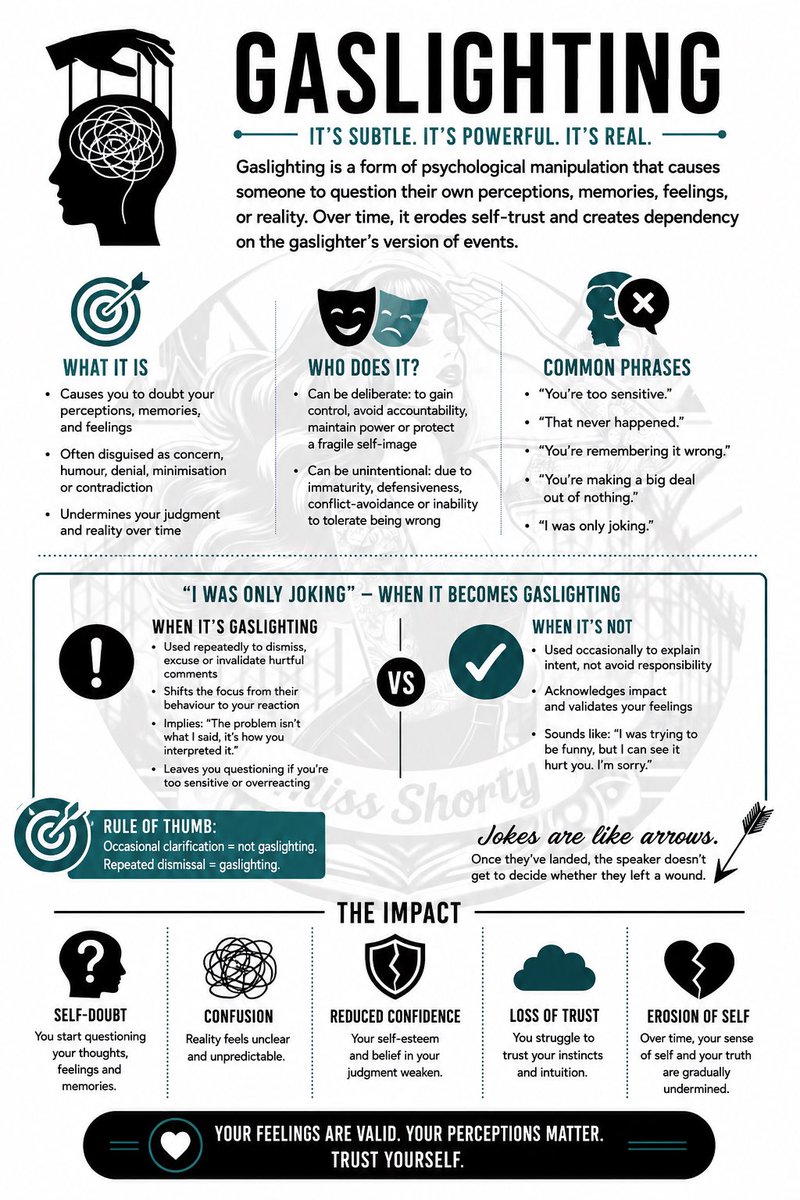
ᴡʜᴀᴛ ɪꜱ ɢᴀꜱʟɪɢʜᴛɪɴɢ?
Gaslighting is a form of psychological manipulation that causes someone to question their own perceptions, memories, feelings, or reality. Its power lies in its subtlety. Rather than obvious lies or overt abuse, gaslighting often arrives disguised as concern, humour, denial, minimisation, or repeated contradiction.
Over time, the target may begin to distrust their own judgment and rely more heavily on the gaslighter’s version of events.
🎭People who use gaslighting are not all the same. Some do it deliberately to gain control, avoid accountability, maintain power, or protect a fragile self-image. It is commonly associated with narcissistic, abusive, or highly manipulative personalities.
However, gaslighting can also occur unintentionally. Someone who is emotionally immature, defensive, conflict-avoidant, or unable to tolerate being wrong may habitually dismiss another person’s experiences without consciously intending harm.
Subtle gaslighting can sound like: “You’re too sensitive,” “That never happened,” “You’re remembering it wrong,” or “You’re making a big deal out of nothing.”
😏Even when unintended, these responses can be deeply damaging because they invalidate another person’s reality. The message received is not merely disagreement, but that their thoughts, feelings, perceptions, and experiences are somehow flawed or untrustworthy.
The cumulative effect can be profound. Repeated gaslighting often erodes confidence, increases self-doubt, creates confusion, and diminishes a person’s trust in their own instincts. Like water slowly wearing away stone, its impact is often felt not in a single moment, but in the gradual undermining of a person’s sense of self and confidence in their own truth. 🌿
It can be, but not always.
“I was only joking” becomes a form of gaslighting when it is repeatedly used to dismiss, excuse, or invalidate the impact of hurtful comments. In those situations, the focus shifts away from the person’s behaviour and onto the target’s reaction. The implied message becomes: “The problem isn’t what I said, it’s that you’re interpreting it wrong.”
👉🏻For example, if someone makes a cutting remark, sees that it hurts, and then responds with “I was only joking” or “Can’t you take a joke?”, they may be minimising the other person’s experience rather than taking responsibility for the effect of their words. When this pattern occurs frequently, the recipient can start questioning whether they are genuinely hurt, “too sensitive,” or overreacting, which is where gaslighting territory begins.
That said, not every use of “I was only joking” is manipulative. Sometimes people genuinely misjudge humour, realise they’ve upset someone, and clarify their intent while still acknowledging the impact. A healthy response sounds more like: “I was trying to be funny, but I can see it hurt you. I’m sorry.” The key difference is that the person’s feelings are validated rather than dismissed.
A useful rule of thumb: if “I was only joking” is used occasionally to explain intent, it’s usually just clarification. If it’s used repeatedly to avoid accountability, shut down discussion, or make someone doubt their right to be upset, it can become a subtle and corrosive form of gaslighting.
As the saying goes, jokes are like arrows. Once they’ve landed, the speaker doesn’t get to decide whether they left a wound. 🎯
4
18
231

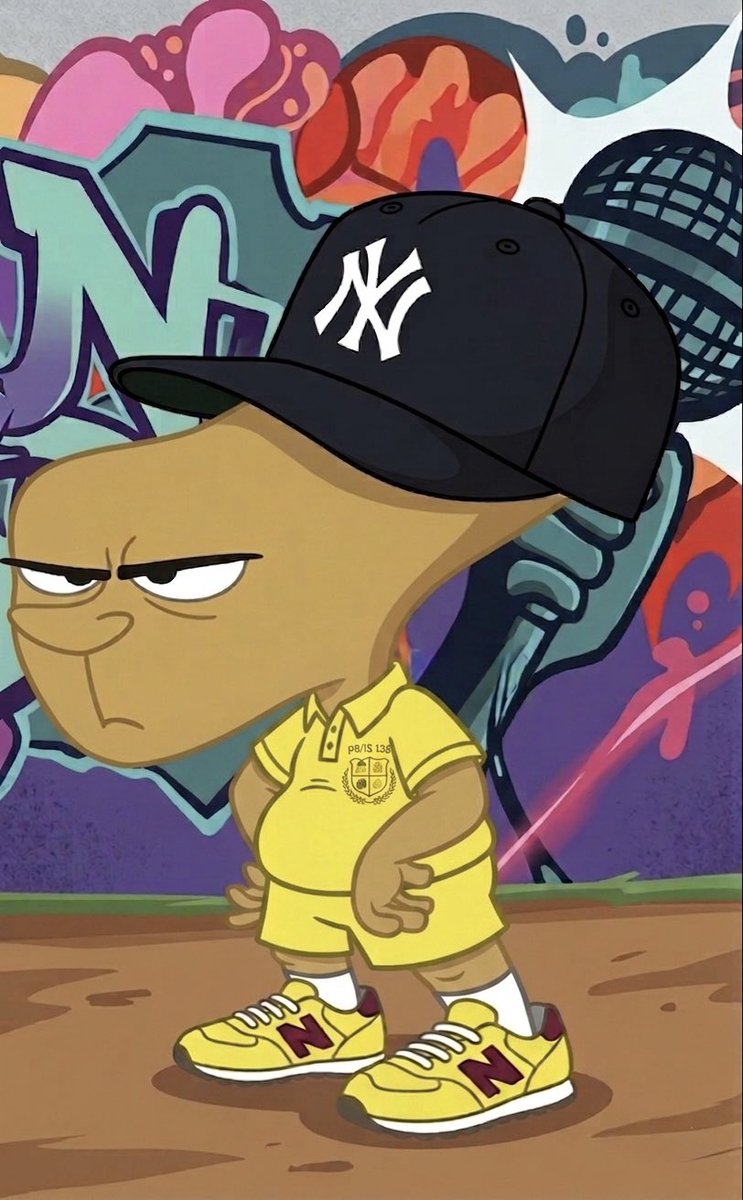

Nicki Son Big AF & Still Can’t Talk In Complete Sentences? Cardi Might’ve Been Right With That “Papa Perc” Comment 😂🤣😭
53

IM SPININ OFF THIS PERC LIKE IM A LAUNDRY MAT

4
Zordoc920 retweeted

dipping a perc 30 in bbq sauce before eating it
7
26
1,538