yuu Q ☆🫧 retweeted

I really wonder how people outside of his class perceive Nakamura. Because we know that he’s not exactly shy he just looses his composure around Hirose. when he first met Tamura and Reiko they both said he had something unique about him but neither of them said he was weird

1
30
562
5,133
borzoi! 🍁 retweeted

Do not perceive my foolish self
4
1,197
7,411
56,252

you are a grown man still caring about how ppl perceive you lol thats sad. are u self aware abt that? i dont think so 😭 and it will be the reason you never truly feel happy or free
4
Marie Pichler retweeted

Reptilians can hide themselves using frequency technology. The human eye can perceive less than 1% of the frequencies in the universe.
This means that humans are almost “blind” from a galactic perspective.
1
16
35
5,667

.@Rob_Flaherty on the Trump Administration's latest war with @AnthropicAI →
"They so desperately want to punish Anthropic because they perceive Anthropic as woke. But they can't — because Anthropic is building the most advanced model, and they need them desperately."
11

"Sino yung mawawalan ng fan projects dahil may mga taong feeling entitled para kuyugin, insultuhin, at pagsalitaan nang masasakit yung mga volunteers na hindi naman nila pinapasweldo?"
This applies to everyone. And they should realize that. While one can raise for a more united fanbase, kailangan may mag-simula. Paulit-ulit pero simulan niyo sa sarili niyo.
Clean what's rotten inside.
Balik-balikan niyo lang purpose kung bakit ba talaga kayo nandiyan, I don't think ganon kahirap ma-realize 'yan? Unless you all are blinded by your pride and ego that it's already hard for you to manage?
The key to healing and moving forward is to admit where you went wrong. Learn from it and apply what's best :)
Because at the end of the day, if you always try to attack those who are only doing projects in good faith, question their purpose, side eye their intentions, baka hindi na sa kanila ang mali? It's with how you perceive them.
May this truly be a wake up call. That before you accuse people and question their intention, was it really what they are or a reflection of who you are?
Is showing unwavering support and love be treated as competition?
Do you see those who are trying to help as people with hidden agenda or people whom you can reach out to for a better network, connection, and relation?
Simple questions but these will make you realize your true character.
p.s. if by the end of this tweet you see yourself laughing and wanting to mock, please do go outside and check yourselves.
18h

Last na. In case you still don't get it, let me spell it out for you.
Every time you pick a fight online, every time you start unnecessary fanwars, every time you decide to be hostile and nasty to people, who do you think ends up receiving the backlash & hate?
You? No. You're just a random person hiding behind a fan account. You can log off and move on with your life.
But BINI can't.
Who gets dragged by non-fans? Who gets mocked because of the fandom's reputation? Who gets associated with all the toxicity that some of you keep creating?
BINI.
Every time you attack fellow fans over a simple misunderstanding, sino yung unti-unting nalalagasan ng support?
BINI.
Every time someone discovers BINI but is immediately greeted by toxicity, hostility, and fanwars, who do you think loses a potential supporter?
BINI.
Sino yung mawawalan ng fan projects dahil may mga taong feeling entitled para kuyugin, insultuhin, at pagsalitaan nang masasakit yung mga volunteers na hindi naman nila pinapasweldo?
BINI.
That's right. It's not you. BINI is the one taking the hit.
Of course, you can defend BINI. You can lift them up when other toxic non-fans tear them down and counter negativity without turning into the very kind of toxic person you're complaining about.
You can call out misinformation without being insufferable.
You can raise concerns without acting like the world owes you something.
You can disagree with people without treating them like trash.
The problem is that some of you don't actually care about solving issues. You care more about being self-righteous, winning arguments, and feeling superior to everyone else.
And unfortunately, BINI is the one suffering the consequences of that behavior.
7

Stating facts is not arrogance. If u perceive it as arrogance it's your mistake. After all the 3rd grade comments we have received by your clan towards Jains you should be the last one to give philosophy lecture.
2

Confidence change how people perceive you.
Not because of some hidden aura but because your posture, eye contact, energy and self control often change when you feel disciplined and purposeful.
People respond to behavior they can observe not to secret they cant see
3

its so much larger than a sports win, as intelligent ppl can perceive
5

#physics #science #physicshomeworkhelp #physics #Motivation #neweyeimplant
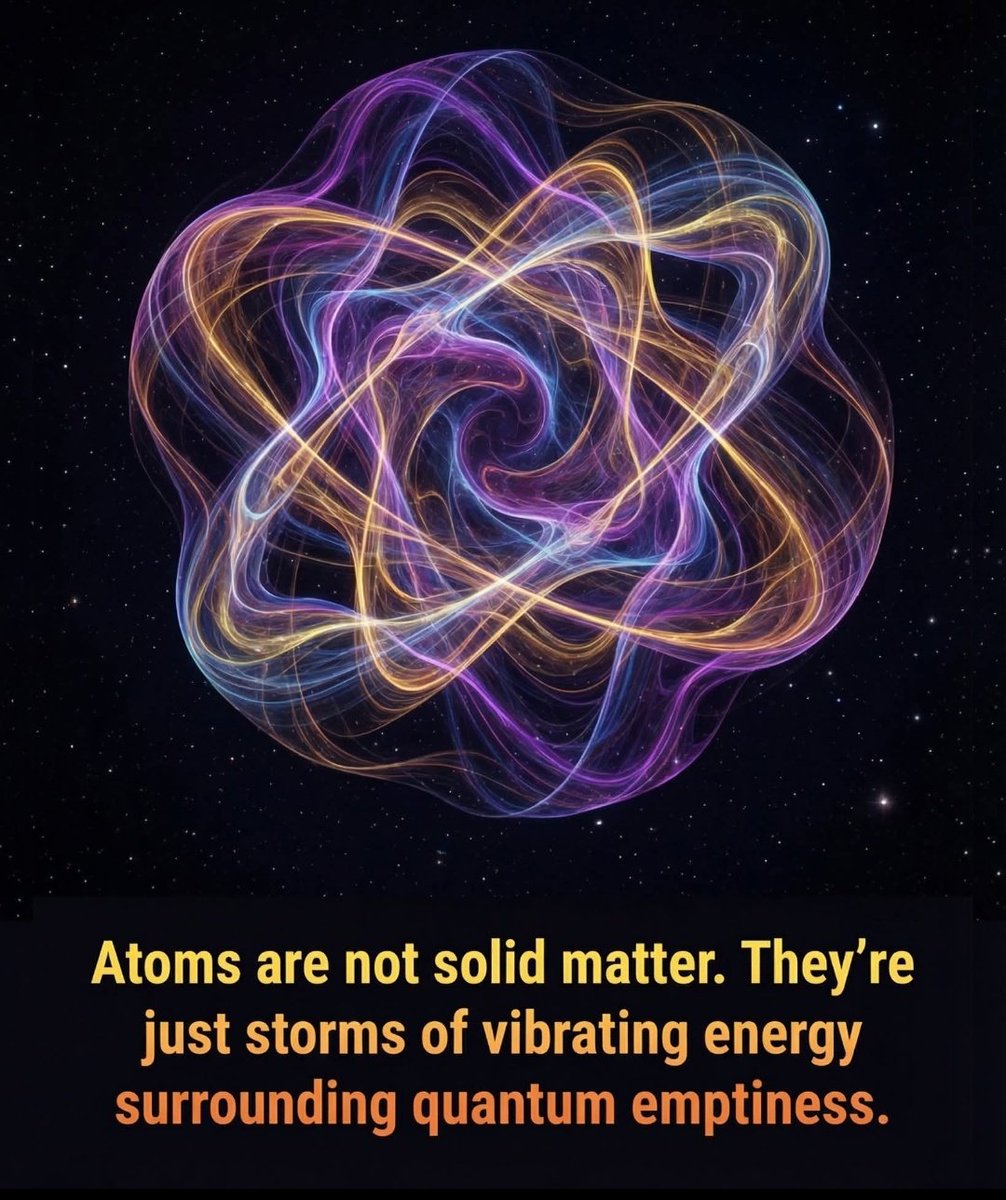
Quantum physics shows that the solid world we perceive is actually made of energy lines, emptiness, and probability — not physical matter.
For centuries, we have viewed the universe as a collection of solid objects, but quantum physics is dismantling that illusion.
At the heart of every atom lies not a tiny, hard marble, but a swirling electric storm of probability and vibration. Scientists have proven that what we perceive as physical substance is actually a series of ghostlike force fields and resonant waves dancing in a vast, silent void.
This fundamental shift in understanding suggests that the material world is less like a construction site of fixed parts and more like a complex symphony of energetic happenings.
This discovery challenges our very sense of identity, suggesting that we are not solid beings inhabiting a solid world, but rather intricate patterns of energy echoing through space. If the foundation of reality is built on probability instead of substance, the boundaries between the observer and the observed begin to blur. We are part of a continuous, dynamic dance where nothing is truly static, reminding us that existence is an ongoing process of vibration rather than a collection of independent, inanimate things.
Source: Heisenberg, W. Physics and Philosophy: The Revolution in Modern Science. Harper & Row.
1

Elon Musk is worth about $1 trillion because he owns almost 50% of a company with a market cap of just over $2 trillion.
His stock is only worth what people are willing to pay for it based on what they perceive is the future value of the company.
Hopefully that helps you.
5

I can perceive this tweet.😞

Primary school was crazy. You fit dey write test make your seat mate vomit indomie and eba beside you😭
2
hmmm retweeted

Those who do not know themselves cannot perceive others realistically either. They live in a bubble of delusion and never gain control over their own lives, seeing themselves as victims of external enemies.~Carol Shumate,
1
14
104
1,795

I live in a predominantly lower-middle class Black neighborhood and attended a majority-Black inner city school for several years. When my brother and I moved into that district, we were getting into fights nearly every week, random sucker punches in the halls, people manufacturing conflict out of nothing. I also lived in Brooklyn, where every corner store and takeout place had inch-thick security glass. That wasn’t installed for angry Jewish men. It was for unhinged, hair-trigger Black youth who could flip at the slightest provocation.
I’ve seen and recorded enough vids of the crazy fights and situations over the years to recognize it as a recurring pattern of dysfunction. I understand why people resist being painted with a broad brush, when I lived overseas, being American sometimes felt like a scarlet letter, so I get the instinct to push back. But there is real, deep-seated rot in significant portions of the black community that can’t be explained away.
The Karmelo Anthony case is a perfect example. I know exactly the mindset that caused it to escalate. Many young black men and teenagers react with immediate hostility to any form of authority or request they perceive as a challenge to their pride, reputation, or ego. I have no doubt KA was instantly offended at being told to leave an opposing team’s bench area. The testimony later confirmed it; something to the effect of “Fuck y’all, you’re gonna have to move me, bunch of pussies.” That wasn’t self-defense. That was ego and entitlement meeting a minor boundary.
1

This is what I am more worried about. The cultural valuation of the arts is falling. Though I imagine in times like the middle ages or even to the Enlightenment when the majority of people could not afford to attain any form of broad education they failed to see the value as well. The arts will survive of course but yes I think the cultural turn (outside of the upper middle class or upwards) against the arts is dangerous. You can already see the start of it now, "right-wing" appeals to attending trade school or deciding "useless" university degrees largely appeal to the blue collar or rural working class while prominent "left wing" activists tend to be UMC or above. America is allergic to class discourse but I notice that even wealthier "right wingers" tend to send their kids to university anyway just at places they perceive to be "less woke" rather than it being a right vs left situation.
1
4
LovetoReader || old man yaoi time 🌈 retweeted

Well, how else am I supposed to perceive it?
There is so much love...

1
4
100
1,241
INZN NIJI retweeted

Jun 13
We're the music, the vibrating sound of all that exists.
"Perceive All Aspects Of Your Life Through The Lens Of The Inner World.
All Races Bow To Your Endeavors As They Recognize You As Family And Friends!"
Ikai
13 Jun 2025

Not all "angels" are what you thought they'd be.
15-foot tall Arcturian Elohim walk among us unseen, manifesting as ordinary humans as needed, such as when meeting with military white hats.
They are among Earth's most powerful protectors and humanity's greatest friends.
Millions are also here as starseeds who volunteered to have the complete human experience from birth, and are still unaware of who they are.
Many of them are you.
3
28
115
5,515

Thing about me I can say some shit be joking but you perceive it as real cause it seems serious but I jus wanna see your response fr😂🤷🏾♂️

Yes, but... both may be true and can be true simultaneously because (and if) both ideas are incomplete; which they probably are.
Even in a Platonic view you could still infer reality from its perception, and in an Aristotelean view, all we perceive might not be all there is.
1
2

10m
there are several ways ~objective morality could exist:
1) our emotional reactions to classes of actions fall into some attractor basis which exists cross species. this would be emotivist (quasi-realist technically) compatible, and anti-realist since moral statements technically still ground in stances (emotions). but if this evolutionary attractor state existed, we could expect ~universal overlap in moral sentiments. not technically objective, but close enough. (to make this have "normative force" you'd just have to pair this picture with a single non-natural moral axiom: what is good is what evolution nudges us to robustly prefer. this might be the flourishing of all conscious creatures (it's possible enlightened consciousnesses converge on this non-natural intuition. agopic love, jesus, the buddha, etc)
2) physical reality is but the tip of the iceberg of reality, of all that can be said to ground true objective facts. there may be a mathematical "realm", normative "realm", and/or a moral "realm". "realm" is a horrible world since it feels spatio-temporal, but this analogy is misleading. these "realities" are better thought of as "latent structures in overall reality". these are Platonic Forms (form = structure). we discover truths about these realms via reason. this is not spooky, we do this with math, logic, an modal truths all the time. moral isn't that much weirder
3) morality is grounded in patterns in valence of consciousness. perhaps consciousness is structured in a way where all conscious creatures, necessarily, perceive things as Good or Bad. maybe this doesn't get you "duties" and "rightness and wrongness", but only Goodness and Badness. but this is still a moral domain where objective statements may be made (there are facts about whether, how much, and why someone is experiencing positive valence rn. this is true even with emptiness). that's sorta objective morality if you squint
4) some truths are known with brute intuition with no further grounding. they're just undeniable with clear thinking. examples include: "more of something good is better than less of something good, all else equal" or that "suffering is bad, all else equal". these are not definitionally true, but obvious in the same way that modus ponens is. this is Parfit and Scanlon's take
5) morality is just game theory: this would make non-naturalism make more sense ("get the highest payoff" as the one universal moral norm) while also being rooted in natural facts (the player's actual, psychological payoff schema)

I don't understand how morality can be objective. morality arises inside the human mind. you could derive facts about "universal human mortality" that almost everyone shares, like how almost everyone has 10 fingers, but this is a character of humans, not a stand-alone fact
1
1
3
100