
But those things and their class origin all stay play a role in the nature of the intelligentsia “This stratum of workers-turned-bourgeois, or the labour aristocracy, who are quite
philistine in their mode of life, in the size of their earnings and in their entire outlook,” Lenin
2


1) Grits (when cooked correctly) are delicious, you absolute Philistine
2) you’re getting your grits from a chain restaurant and generalizing the entirety of grits

My fellow Brits are so bad at slagging off American food.
Grits. Grits exists. And it's not some weird thing, it's literally on breakfast menus all over the South.
Next time they come for Beans on Toast, just start replying with a photo of Grits.

1
28

Karson Miller retweeted

“David said to the Philistine, “You come against me with sword and spear and javelin, but I come against you in the name of the Lord Almighty, the God of the armies of Israel, whom you have defied.” - 1 Samuel 17:45 NIV
2
5
76

"Then said David to the Philistine, Thou comest to me with a sword, and with a spear, and with a shield: but I come to thee in the name of the Lord of hosts, the God of the armies of Israel, whom thou hast defied."
1 Samuel 17:45
🌿🕯📖🕯🌿
3

46m
1 Samuel 17:45
Then said David to the Philistine, Thou comest to me with a sword, and with a spear, and with a shield: but I come to thee in the name of the Lord of hosts, the God of the armies of Israel, whom thou hast defied.
churchofjesuschrist.org/stud…
1
1

46m
former british mandate…. palestine. or “philistine” as it was known around 1200 bc.
2
13


Ahem. My toxic girlfriends were head and shoulders above this doltish philistine.
3
26

David exclaimed to the men of Israel, as Goliath taunted them “who is this uncircumcised Philistine, that he should defy the armies of the living God?” (1 Sam 17:26)
Deeper Significance
1. Faith vs. Fear — The Israelite army has heard Goliath’s taunts for 40 days and done nothing. David hears the same words but responds with faith and action. He sees the situation through the lens of God’s covenant and power rather than human strength or danger.
2. God’s Honor Is at Stake — David’s primary concern is not personal glory or even the reward (though he asks about it). He cares that God’s name and people are being dishonored. This is why he later tells Goliath, “You come to me with a sword… but I come to you in the name of the Lord of hosts” (verse 45).
Personal reflection: Do I care that God‘s name and people are being dishonored? Do I care that “Mormons” are slandered and accused at every turn? If I was like David, I would have faith and care deeply that the latter-day Saints are being slandered all over the place. David Alexander is a great example of standing up to the accusations of our world
3. Covenant Perspective — Calling Goliath “uncircumcised” shows David evaluating the enemy not by outward appearance (height, armor, weapons) but by spiritual reality. Goliath has no covenant relationship with God, so he is ultimately defenseless against the God who fights for Israel.
4. David’s Heart — These verses begin to reveal why God chose David as “a man after His own heart” (1 Samuel 13:14). David thinks about God’s reputation and the shame on God’s people, while others are paralyzed by fear or focused only on material rewards.
Latter-day Saints are covenant Israel and latter-day Saints are so often paralyzed with fear, that they “open not their mouths” against the spirit of accusation that is so rich in today’s world… Satan laughs that no one dares oppose him. Goliath laughs also “No one dares oppose me!”.
God will be on our right hand and on our left, his spirit will be in our hearts. The battle is His if we open our mouths…

Most of us learned the story of David and Goliath as a lesson about courage: be brave, trust God, and face your giants. But like many Old Testament characters, David also functions as a type of Christ as he fights this battle. David, the Lord’s anointed, stands before Israel as their representative champion. The army is afraid and powerless. Saul cannot save them. No one in Israel can defeat the enemy. Then David steps forward and wins the battle on behalf of the people.
Israel does not win the battle against Goliath because every soldier becomes brave enough to fight. Israel wins because one chosen representative defeats the enemy for them. Likewise, we do not overcome sin and death by our own strength. Christ conquers what we cannot conquer. King Benjamin taught that the victory of salvation comes only “through the merits, and mercy, and grace of the Holy Messiah” (2 Nephi 2:8; see also Mosiah 3:17). His victory becomes our victory.
Even the details of the battle invite a Christ-centered reading. David appears weak and unimpressive, yet God works through him to defeat a terrifying enemy. His stone strikes Goliath in the head, recalling the promise that the seed of the woman would bruise the serpent’s head (Genesis 3:15). David the shepherd delivers the flock from danger, foreshadowing the Good Shepherd who “giveth his life for the sheep” (John 10:11).
Thus, while we are often tempted to read the story and ask, “How can I be like David?” the better comparison for us is Israel, fearful, helpless, and in need of deliverance. The good news is that God has provided a Champion. The Lord’s Anointed has entered the battlefield, defeated the enemy, and invites us to share in His victory.
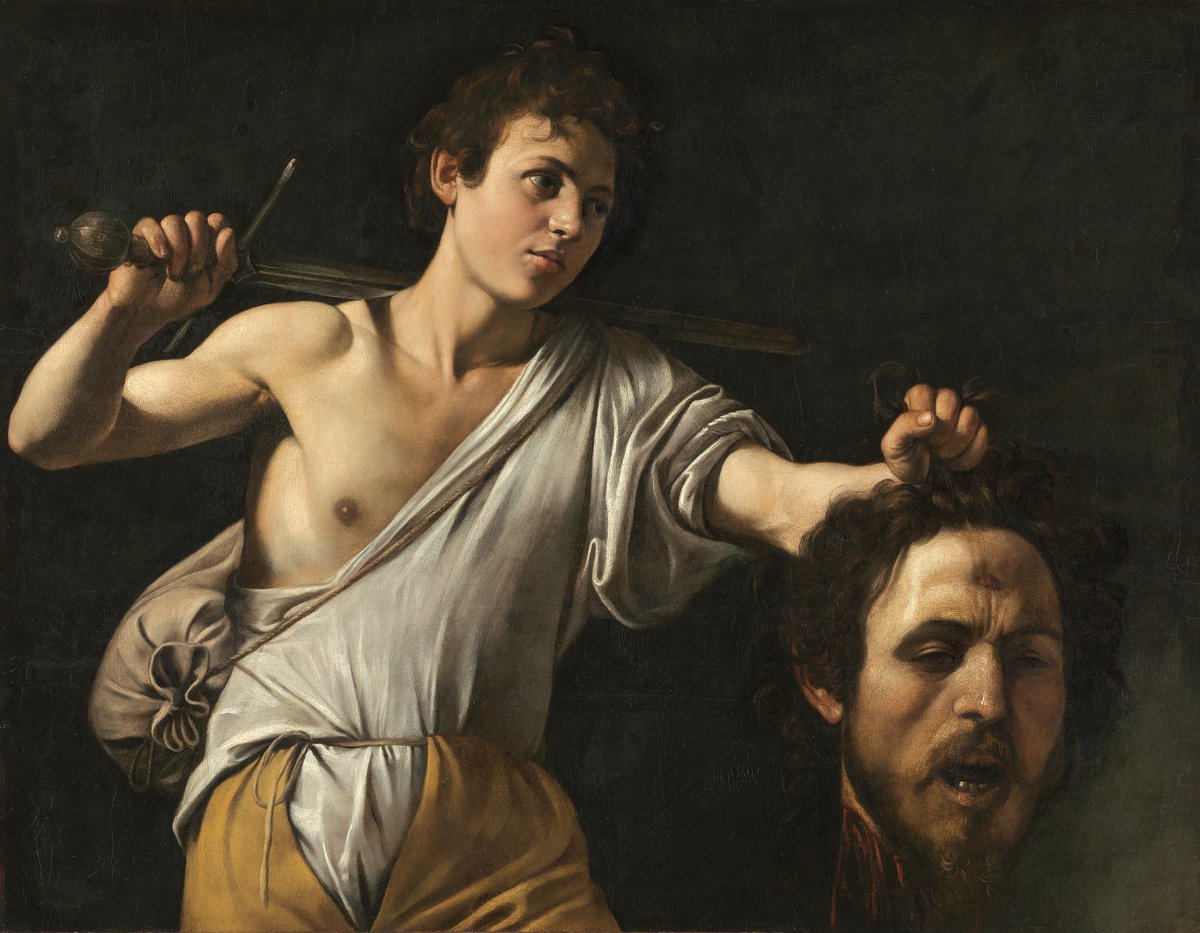
Art: Caravaggio – David with the Head of Goliath
#ComeFollowMe
#SundaySchool
17

Palestine is Roman for Philistine. It was a last fk u from the Romans after the exile. The philistines were the Jews mortal enemy.
3

1 Samuel 17:45
Then said David to the Philistine, Thou comest to me with a sword, and with a spear, and with a shield: but I come to thee in the name of the Lord of hosts, the God of the armies of Israel, whom thou hast defied.
churchofjesuschrist.org/stud…
1

Study Notes - (Smith Dictionary) David
Da'vid. (well-beloved). The son of Jesse. His life may be divided into three portions:
i. His youth before his introduction to the court of Saul;
ii. His relations with Saul;
iii. His reign.
1. The early life of David contains, in many important respects, the antecedents of his future career. It appears that David was the youngest son, probably the youngest child, of a family of ten, and was born in Bethlehem B.C. 1085.
The first time that David appears in history at once admits us to the whole family circle. The annual sacrificial feast is being held when Samuel appears, sent by God to anoint one of Jesse's sons as they pass before him, 1Sa_16:6-10, Samuel sends for the youngest, David, who was "keeping the sheep," and anoints him. 1Sa_16:11-13.
As David stood before Samuel, we are enabled to fix his appearance at once in our minds. He was of short stature, with red or auburn hair, such as is not unfrequently seen in his countrymen of the East at the present day. In later life, he wore a beard. His bright eyes are specially mentioned, 1Sa_16:12, and generally he was remarkable for the grace of his figure and countenance ("fair of eyes," "comely," "goodly"), 1Sa_16:12; 1Sa_16:18; 1Sa_17:42, well made and of immense strength and agility. His swiftness and activity made him like a wild gazelle, his feet like hart's feet, and his arms strong enough to break a bow of steel. Psa_18:33-34.
After the anointing, David resumes his accustomed duties, and the next we know of him, he is summoned to the court to chase away the king's madness by music, 1Sa_16:14-19, and in the successful effort of David's harp, we have the first glimpse into that genius for music and poetry which was afterwards consecrated in the Psalms.
After this, he returned to the old shepherd life again. One incident alone of his solitary shepherd life has come down to us — his conflict with the lion and the bear in defence of his father's flocks. 1Sa_17:34-35. It was some years after this, that David suddenly appears before his brothers in the camp of the army, and hears the defiant challenge of the Philistine giant Goliath. With his shepherd's sling and five small pebbles, he goes forth and defeats the giant. 1Sa_17:40-51.
2. Relations with Saul. — We now enter on a new aspect of David's life. The victory over Goliath had been a turning point of his career. Saul inquired his parentage, and took him finally to his court. Jonathan was inspired by the romantic friendship which bound the two youths together to the end of their lives.
Unfortunately, David's fame proved the foundation of that unhappy jealousy of Saul towards him which, mingling with the king's constitutional malady, poisoned his whole future relations to David. His position in Saul's court seems to have been first, armor-bearer, 1Sa_16:21; 1Sa_18:2, then, captain over a thousand, 1Sa_18:13, and finally, on his marriage with Michal, the king's second daughter, he was raised to the high office of captain of the king's body-guard, second only, if not equal, to Abner, the captain of the host, and Jonathan, the heir apparent.
David was not chiefly known for his successful exploits against the Philistines, by one of which he won his wife, and drove back the Philistine power with a blow from which it only rallied at the disastrous close of Saul's reign. He also still performed from time to time the office of minstrel; but the successive attempts of Saul upon his life convinced him that he was in constant danger.
He had two faithful allies, however, in the court — the son of Saul, his friend, Jonathan, and the daughter of Saul, his wife Michal. Warned by the one and assisted by the other, he escaped by night, and was, from thenceforward, a fugitive.
He at first found a home at the court of Achish, among the Philistines; but his stay was short. Discovered possibly by "the sword of Goliath," his presence revived the national enmity of the Philistines against their former conqueror, and he only escaped by feigning madness. 1Sa_21:13.
His first retreat was the cave of Adullam. In this vicinity, he was joined by his whole family, 1Sa_22:1, and by a motley crowd of debtors and discontented men, 1Sa_22:2, which formed the nucleus of his army.
David's life, for the next few years, was made up of a succession of startling incidents. He secures an important ally in Abiathar, 1Sa_23:6, his band of 400, at Adullam, soon increased to 600, 1Sa_23:13, he is hunted by Saul from place to place like a partridge. 1Sa_23:14; 1Sa_23:22; 1Sa_23:25-29; 1Sa_24:1-22; 1Sa_24:26.
He marries Abigail and Ahinoam. 1Sa_25:42-43. Finally comes the news of the battle of Gilboa and the death of Saul and Jonathan. 1 Samuel 31. The reception of the tidings of the death of his rival and of his friend, the solemn mourning, the vent of his indignation against the bearer of the message, the pathetic lamentation that followed, will close the second period of David's life. 2Sa_1:1-27.
3. David's reign. — As king of Judah at Hebron, 7 1/2 years. 2Sa_2:1; 2Sa_5:5. Here David was first formally anointed king. 2Sa_2:4. To Judah, his dominion was nominally confined. Gradually, his power increased, and during the two years which followed, the elevation of Ish-bosheth a series of skirmishes took place between the two kingdoms. Then rapidly followed the successive murders of Abner and of Ish-bosheth. 2Sa_3:30; 2Sa_4:5.
The throne, so long waiting for him, was now vacant, and the united voice of the whole people at once called him to occupy it. For the third time, David was anointed king, and a festival of three days celebrated the joyful event. 1Ch_12:39. One of David's first acts after becoming king was to secure Jerusalem, which he seized from the Jebusites and fixed the royal residence there. Fortifications were added by the king and by Joab, and it was known by the special name of the "city of David." 2Sa_5:9; 1Ch_11:7.
The Ark was now removed from its obscurity at Kirjath-Jearim with marked solemnity, and conveyed to Jerusalem. The erection of the new capital at Jerusalem introduces us to a new era in David's life and in the history of the monarchy. He became a king on the scale of the great Oriental sovereigns of Egypt and Persia, with a regular administration and organization of court and camp; and he also founded an imperial dominion which for the first time realize the prophetic description of the bounds of the chosen people. Gen_15:18-21.
During the succeeding ten years, the nations bordering on his kingdom caused David more or less trouble, but, during this time, he reduced to a state of permanent subjection, the Philistines on the west, 2Sa_8:1, the Moabites on the east, 2Sa_8:2, by the exploits of Benaiah, 2Sa_23:20, the Syrians on the northeast as far as the Euphrates, 2Sa_8:3, the Edomites, 2Sa_8:14, on the south; and finally the Ammonites, who had broken their ancient alliance, and made one grand resistance to the advance of his empire. 2Sa_10:1-19; 2Sa_12:26-31.
Three great calamities may be selected as marking the beginning, middle and close of David's otherwise prosperous reign, which appear to be intimated in the question of Gad, 2Sa_24:13, "a three-years famine, a three-months flight or a three-days pestilence."
a. Of these, the first (the three-years famine), introduces us to the last notices of David's relations with the house of Saul, already referred to.
b. The second group of incidents contains the tragedy of David's life, which grew in all its parts out of the polygamy, with its evil consequences, into which he had plunged on becoming king. Underneath the splendor of his last glorious campaign against the Ammonites was a dark story, known probably, at that time, only to a very few — the double crime of adultery with Bath-sheba and the virtual murder of Uriah.
The clouds, from this time, gathered over David's fortunes, and henceforward, "the sword never departed from his house." 2Sa_12:10. The outrage on his daughter Tamar, the murder of his eldest son Amnon, and then, the revolt of his best-beloved Absalom, brought on the crisis which once more sent him forth as wanderer, as in the days when he fled from Saul. 2Sa_15:18
The final battle of Absalom's rebellion was fought in the "forest of Ephraim," and terminated in the accident which led to the young man's death; and, though nearly heartbroken at the loss of his son, David again reigned in undisturbed peace at Jerusalem. 2Sa_20:1-22.
c. The closing period of David's life, with the exception of one great calamity, may be considered as a gradual preparation for the reign of his successor. This calamity was the three-days pestilence which visited Jerusalem at the warning of the prophet Gad. The occasion which led to this warning was the census of the people taken by Joab at the king's orders, 2Sa_24:1-9; 1Ch_21:1-7; 1Ch_27:23-24, which was for some reason sinful in God's sight. 2 Samuel 24.
A formidable conspiracy to interrupt the succession broke out in the last days of David's reign; but the plot was stifled, and Solomon's inauguration took place under his father's auspices. 1Ki_1:1-53. By this time, David's infirmities had grown upon him. His last song is preserved — a striking union of the ideal of a just ruler which he had placed before him and of the difficulties which he had felt in realizing it. 2Sa_23:1-7. His last words to his successor are general exhortations to his duty. 1Ki_2:1-9. He died, according to Josephus, at the age of 70, and "was buried in the city of David."
After the return from the captivity, "the sepulchres of David," were still pointed out "between Siloah and the house of the mighty men," or "the guard-house." Neh_3:16. His tomb, which became the general sepulchre of the kings of Judah, was pointed out in the latest times of the Jewish people. The edifice shown as such from the Crusades to the present day is on the southern hill of modern Jerusalem commonly called Mount Zion, under the so-called "Coenaculum;" but it cannot be identified with the tomb of David, which was emphatically
within the walls.
65

Sometimes I wonder why Samson did not learn from his Philistine wife.
She manipulated him into the hands of the Philistines
His father saved him and gave the woman out.
His father thought he'd have hated her by that time but he was shocked.
8

‘……So David triumphed over the Philistine with a sling and a stone; without a sword in his hand he struck down the Philistine and killed him(and the Spurs fans dreams)
 NBA
NBA
3
46

My mom is actually white thank you very much, also you are a Philistine
9

Interesting! The only confrontation I am aware of between Greeks and Jews is at the time of David, an Israeli, and Goliath, a Philistine. Philistines wer of Greek-Creetan origin, the first immigrants t Palestine when Arabs did not exist and Turks were not even born.
Think of now!
11