zuko retweeted

gf and i only just realized that we unknowingly kicked off pride month w 5 hours of hot sloppy sex in the early predawn hours of june 1st thank you molly thank you transgender

mdma will make you wanna drink a woman’s piss
8
15
804
11,004

餌付けシリーズを書けるのはpredawn で真剣に🚬と向き合ってきたからってのがデカイ。初手であれは書けない…いきなり!ご近所付き合い始められるまでの過程すっ飛ばしてスタートするなんて無理だよ!
48

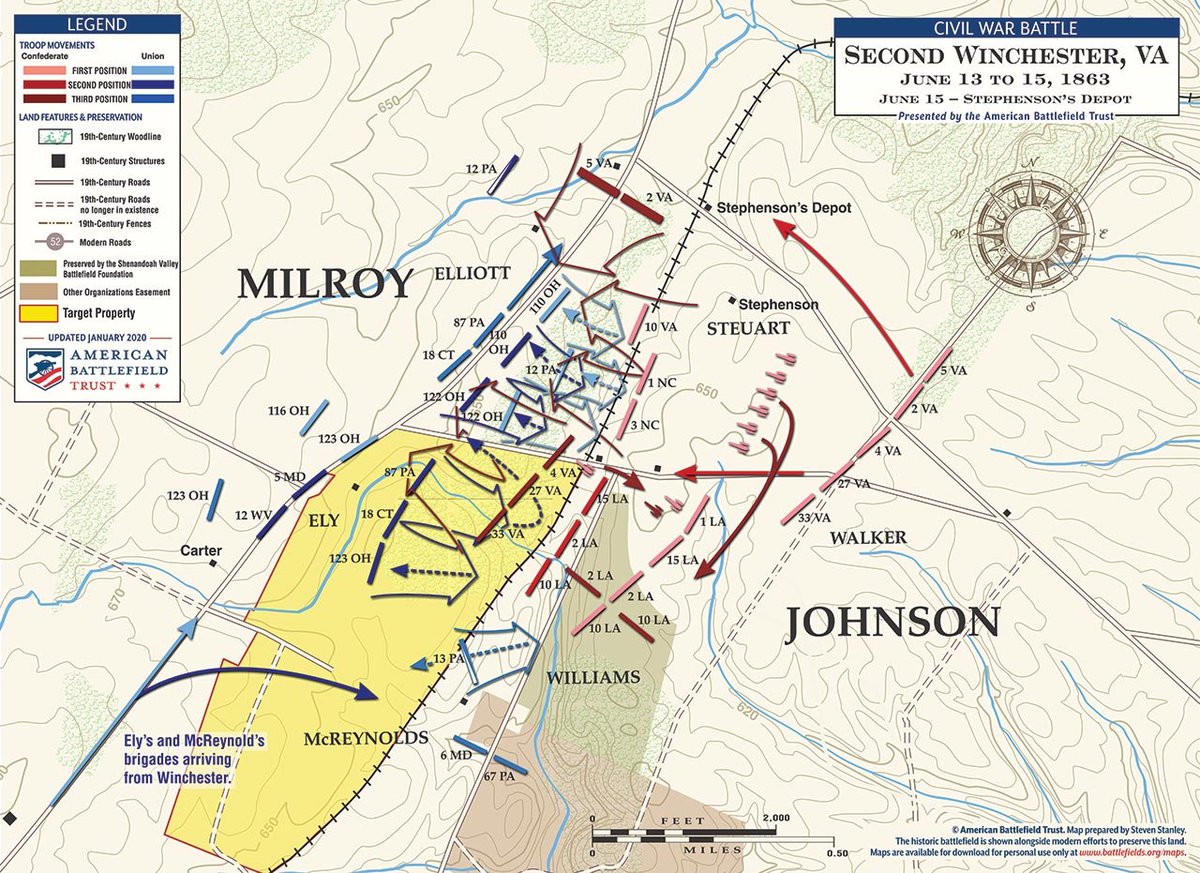
On this day in 1863, in the dark hours before dawn, a Union army that thought it was quietly escaping to safety marched straight into a trap and was destroyed, putting the final, brutal punctuation mark on the Confederate victory at Winchester and clearing the last obstacle on the road to Gettysburg.
This is the grim finish to a story that began the day before. On June 14, Confederate general Richard Ewell had outmaneuvered the stubborn Union commander Robert Milroy at Winchester, Virginia, sending Jubal Early on a hidden flank march that stormed and captured the key forts protecting the town. By nightfall Milroy understood that his roughly 6,900 men were trapped, with Ewell's far larger corps closing in around them. So he made the only choice he had left. In the darkness he spiked his cannon, abandoned his wagons and supplies, and tried to slip his whole army out to the north and run for the safety of Harpers Ferry before the Confederates realized they were gone.
But Ewell had already read his mind. Anticipating exactly this kind of night escape, he had sent Edward "Allegheny" Johnson's division on a march to get north of Winchester and cut the roads. In the predawn hours of June 15, Milroy's retreating, exhausted column ran headlong into Johnson's waiting Confederates near Stephenson's Depot, a few miles up the line. Muzzle flashes ripped through the dark. The head of the Union column was slammed to a halt, and confusion turned to panic as more troops piled up behind. The Confederates seized a stone bridge and key high ground, boxing the Union force in. There was a sharp, desperate fight in the gloom, with some Union units charging hard to try to break through and escape, but the trap held.
By full daylight it was over. Thousands of Union soldiers, seeing they were surrounded and cut off, surrendered where they stood. Only fragments of the command managed to scatter and escape on foot. Milroy himself got away with a small group of riders, abandoning the wreck of his army behind him, and rode off toward a court of inquiry and the ruin of his reputation.
When the whole Second Battle of Winchester was tallied, the Union had lost somewhere around 4,000 men, the vast majority of them captured rather than killed, along with more than 20 cannon, thousands of small arms, and mountains of supplies. Ewell's losses were astonishingly light by comparison. It was about as lopsided as a battle could get, and Stephenson's Depot was the moment the lopsidedness became total, the snapping of the jaws.
And it mattered far beyond the casualty list. Winchester was the cork in the bottle of the Shenandoah Valley, and with Milroy's army shattered at Stephenson's Depot, the Valley was swept completely clear. The road north stood wide open, and Lee's entire Army of Northern Virginia flowed up it and across the Potomac into Pennsylvania, screened and emboldened by this cheap, total victory. The men who sprang the trap in the dark on June 15 were marching, just over two weeks later, into the fields around a town called Gettysburg.
Jun 14

On this day in 1863, one stubborn general got his entire army destroyed in less than two days, handed the Confederates thousands of prisoners and tons of supplies for free, and threw open the gate to the most famous campaign of the entire war. Almost nobody remembers his name, and that is its own kind of tragedy.
His name was Robert Milroy, and to understand what happened you have to understand the place he was holding. Winchester, Virginia, sat at the northern end of the Shenandoah Valley, and the Valley was the South's secret highway. It ran at an angle that pointed Confederate armies straight toward the North while pointing Union armies away from Richmond, so every time Lee wanted to threaten Washington or invade the North, the Valley was his road. Winchester was the cork in that bottle. The town changed hands so many times during the war, dozens of times by some counts, that residents reportedly learned to live with whichever flag happened to be flying that week. Whoever held Winchester held the doorway.
Milroy had about 6,900 men and a ring of strong forts on the high ground, and he had talked himself into believing that made him a fortress in his own right. He was also, by reputation, harsh on Confederate civilians in the area, which made him hated locally and made his presence a political symbol as much as a military one. That may have fed his stubbornness. When the warnings started coming, he did not want to look like a man who ran.
And the warnings did come. Up the chain, Union commanders could see that Lee's whole army had begun sliding north after the victory at Chancellorsville. Henry Halleck and Robert Schenck wanted the Winchester garrison pulled back to safety before it got swallowed. The orders to withdraw were sent. Milroy resisted, argued, and delayed. He was convinced the forces appearing in his front were just cavalry screens and small raiding parties testing him. He trusted his forts. He stayed.
What was actually bearing down on him was Richard Ewell's Second Corps of the Army of Northern Virginia, roughly 19,000 veteran soldiers. These were not raiders. These were the legendary foot cavalry who had marched and won under Stonewall Jackson up and down this very Valley the year before. There was extra weight on this moment too, because Jackson had been dead barely a month, killed by his own men's fire at Chancellorsville, and Ewell was the man chosen to fill that impossible hole. He had lost a leg at Second Manassas and was riding into his first big fight as a corps commander with everyone wondering whether he could be even half of what Jackson had been. He intended to answer that question loudly.
What he did at Winchester was a small masterpiece. Rather than smash straight into Milroy's forts, Ewell used part of his force to fix the Union attention to the south and make Milroy think the threat was coming from where he expected it. Meanwhile, on June 14, he sent Jubal Early on a wide, hidden flanking march, an entire division plus around 20 cannon, looping far around to the west. They moved through low ground and behind woods and ridgelines, screened from view, and got into position right beside the Union works without being detected. It was the kind of concealed maneuver Jackson had made famous, and now Ewell's men were pulling it off on their first try under new command.
Then it happened all at once. In the early evening, around 6 p.m., the hidden batteries suddenly opened up at close range, and a wave of Confederate infantry burst out of the tree line and charged the West Fort. The defenders barely had time to react. They tried to swing their guns around to face this attack that had appeared out of nowhere on their flank, but it was too late. The position was stormed and overrun. As the sun went down, the key high ground that Milroy had staked everything on was in Confederate hands.
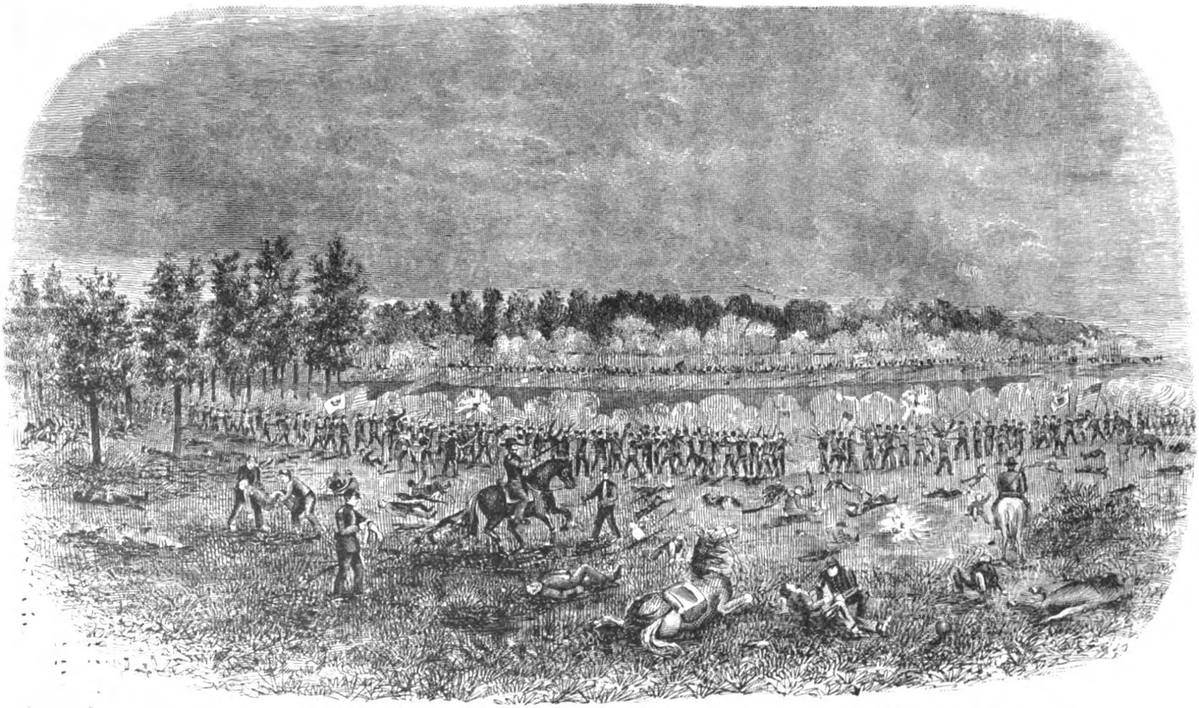
Now Milroy understood. He was not holding a fortress. He was sitting in a trap with the jaws closing. That night he made the only call left to him: abandon everything and run. His men spiked their cannon so the enemy could not use them, left their supplies and wagons behind, and slipped out of the works in the dark, hoping to escape north before dawn. But Ewell had read the board perfectly and anticipated exactly this. In the predawn hours of June 15, the retreating Union column marched straight into a prepared ambush at Stephenson's Depot a few miles north of town. Muzzle flashes lit up the dark, the column fractured, and what had been an orderly retreat dissolved into chaos and surrender. Men gave up by the hundreds, then by the thousands. Milroy himself escaped with only a fraction of his command and rode away to a court of inquiry and a ruined reputation.
The numbers tell the story. The Union lost somewhere around 4,000 men, and the great majority of those were not killed or wounded but captured, scooped up as prisoners. Ewell's losses were astonishingly light, on the order of 270. On top of the men, the Confederates seized something like 23 cannon, thousands of small arms, hundreds of horses, and stockpiles of ammunition and supplies, a windfall for an army about to march into enemy territory where it would have to live off what it carried and what it could take.
And that is the part that elevates this from a one-sided local fight to a hinge of history. With Milroy's army gone, the Shenandoah Valley was swept clean. The cork was out of the bottle. The path north was wide open, and Lee's entire Army of Northern Virginia flowed up that highway and across the Potomac into Maryland and then Pennsylvania, screened and shielded by the very success Ewell had just won. The Gettysburg Campaign was now fully in motion, and it had been lubricated by a victory so cheap and so total that it gave the Confederates enormous confidence as they crossed into the North.
Three weeks later, those same triumphant soldiers reached a quiet Pennsylvania crossroads town. And there, on the first day at Gettysburg, Ewell would face a very different kind of decision. After driving the Union forces back through the town, he was told he could take the high ground beyond it, Cemetery Hill, if he judged it practicable. He hesitated. He did not press the attack. The Union dug in on those heights overnight, turned them into an anchor, and held them for three days. Historians have argued ever since whether the man who had been so bold and decisive at Winchester lost his nerve at the one moment it mattered most.
So the same general gave us both faces of the war in the span of a month: the dazzling, lopsided victory that opened the road to Pennsylvania, and the fatal hesitation that may have helped lose it all. And it started here, on June 14, with one proud man who would not obey an order to leave.
7
31
3,291

🌌 Celestial Wonders Unfold: Tonight’s Sky Spectacle and Cosmic Updates!
Stargazers, prepare for an unforgettable night under the stars! With tonight’s Super New Moon (June 15, 2026), the sky remains exceptionally dark, offering prime conditions to observe faint deep-sky objects like galaxies, star clusters, and the glowing band of the Milky Way at its seasonal peak. No moonlight will interfere, creating ideal viewing opportunities.
Tonight’s highlights include Mercury reaching its greatest eastern elongation, positioning it at its highest point in the evening sky for optimal viewing low in the west shortly after sunset. It joins brilliant Venus and Jupiter in a captivating planetary alignment visible to the naked eye—look west for this striking lineup. Early risers may also spot Mars and Saturn in the predawn east.
Last night (June 14), skywatchers enjoyed a rare alignment of five naked-eye planets (Mercury, Venus, Mars, Jupiter, and Saturn), with reports of a vivid green fireball meteor lighting up skies across multiple states, creating a memorable display.
James Webb Space Telescope (JWST) and Hubble Updates:
Recently, JWST provided the strongest evidence yet for “black hole stars” through detailed spectra of little red dots, advancing our understanding of early universe mysteries. It also detected methane on an interstellar comet. Hubble captured stunning images, including the spiral galaxy M88 on its journey toward the Virgo Cluster and a swarm of galaxies in MACS0329-0211, revealing insights into cosmic structure and evolution.
Ongoing observations continue to probe galaxy formation, star clusters reshaping galaxies, and dynamic phenomena like nebulae and distant mergers, expanding our knowledge of the cosmos daily.
Solar Activity and Aurora Potential:
The Sun remains relatively quiet today, with low-level C-class flares and no major M- or X-class events in the last 24 hours. A glancing blow from a recent coronal mass ejection may cause active geomagnetic conditions (possible G1 minor storm) around June 16, offering a slim chance for auroras at higher latitudes. Solar Cycle 25 activity supports potential for stronger displays in the coming period—keep an eye on forecasts for any elevated chances.
Clear skies and safe viewing, everyone—share your observations below!

1
26

Gavin, you really cannot complain about your wife being investigated until the FBI HRT rifles through her underwear drawer in a predawn raid
6
47
Yutaab Barzan 🎒🦩 retweeted

Jun 10
🇺🇸🇮🇷 U.S. Bombs Drinking Water Tanks in Iran, Cuts Off 20,000 People
A predawn U.S. strike on water reservoirs in Iran's southern Hormozgan Province cut off access to clean water for the town of Kohestak and ten surrounding villages.
Local officials say underground reserves cannot fully replace the lost supply, and rebuilding the destroyed tanks will take time. Damage is estimated at nearly $850,000.
Targeting civilian water supply is a war crime.
Jun 10

🇺🇸🇮🇷 Trump Threatens MORE WAR CRIMES Against Iran, Hitting Power Plants and Bridges
He wants them to surrender, get bombed and not reply, then gets mad when they do
The man threatening to black out an entire country's electricity grid says the other side is the bully. He told Fox he is close to ordering strikes on Iranian "power plants and bridges" because they are dragging their feet, after already hitting radar and air defense sites overnight.
Imagine Iran vowing to bomb a countries power plants and bridges to force a deal. The word "terrorism" would not stop trending for a week.
15
193
330
49,149
Florida Mosquito Control Association retweeted

Weather and time permitting, truck spraying for adult #mosquitoes will occur in the following areas during the predawn hours TOMORROW:
Biscayne Park (area around Burke Recreation Center)
Coral Terrace (area around Nicklaus Children's Hospital, by AD Barnes Park)
1/6
1
1
39