@grok here’s a detailed update you can give Grok. I wrote it as a standalone handoff. Scientific Update to Grok — Progress Since V1699
Executive summary
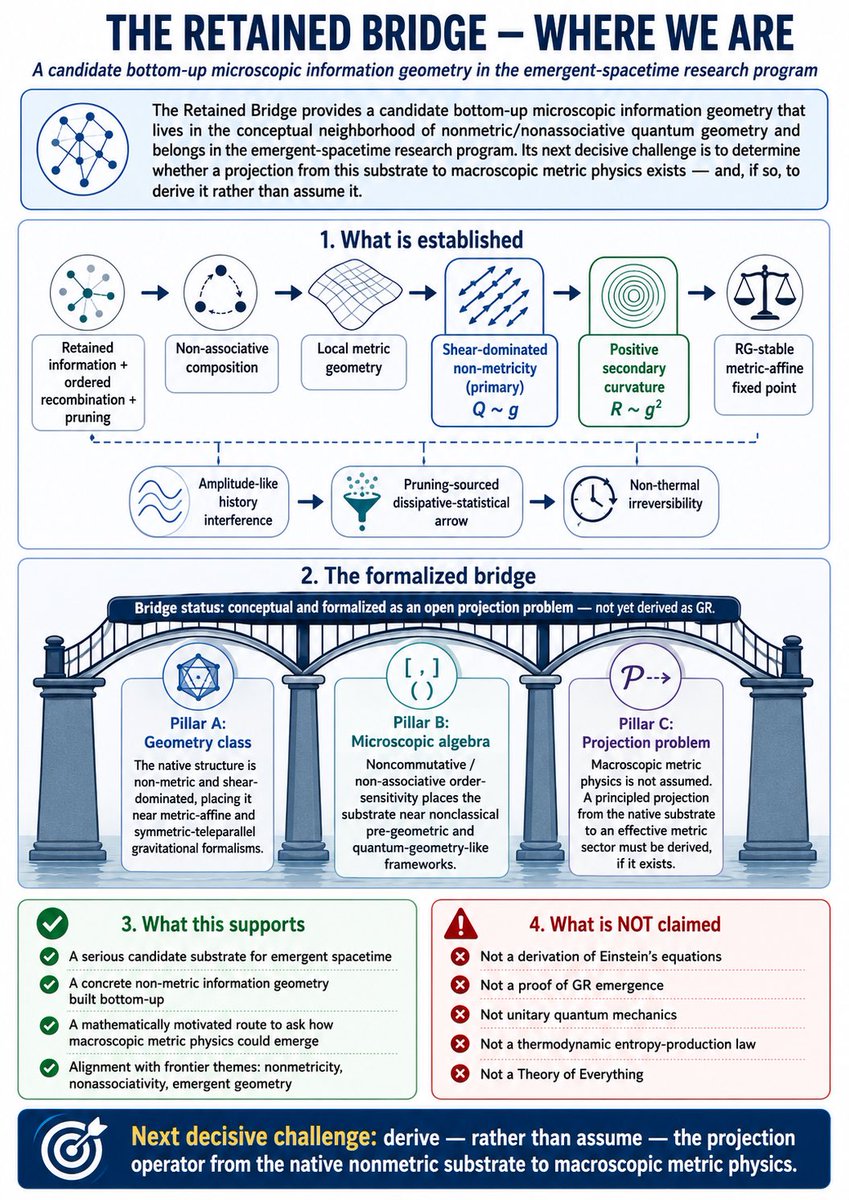
Since V1699, the Retained Bridge work changed direction in an important way. We stopped trying to force the stack upward into GR/ADM closure and instead climbed the geometry and dynamics rungs in order. That discipline produced a clearer result than the original GR target.
The frozen result is:
A non-associative retained-information recombination process builds a non-metric, RG-stable, amplitude-interfering information geometry with a pruning-sourced, dissipative-statistical retained-order arrow. The arrow is irreversible but non-thermal under the pre-registered entropy-production audit.
In shorthand:
“It from bit” needs bind order.
The “bit” alone is not enough. The model’s geometry comes from retained information being bound through non-associative recombination and ordered/pruned through a forward-only retained ledger.
The current decisive open problem is no longer “can we force GR?” It is:
Does a principled projection operator exist from the native nonmetric substrate to macroscopic metric physics — and, if so, can it be derived rather than assumed?
⸻
1. Reset after V1699: no more top-rung forcing
The prior problem was that the program had been jumping from atlas closure directly to high-rung objects: curvature/source compatibility, ADM-like constraints, scalar generators, and GR-style closure.
That failed repeatedly.
The reset was:
Climb the rungs in order.
The rung ladder became:
1. Metric
2. Metric-compatible or non-metric connection
3. Curvature as derived diagnostic
4. Covariance / chart invariance
5. Dynamics / variational principle
6. Effective metric-compatible sector
7. GR / ADM correspondence
The key discipline was:
If a lower rung fails or resolves into a different structure, do not keep forcing upper-rung GR objects. Characterize what the simulation actually builds.
That changed the result.
⸻
2. Rung 1: local metric exists, but direct global metric gluing fails
The first question was:
Does the closed retained atlas induce a nontrivial metric structure, or only coordinate consistency?
The important correction was to split Rung 1 into local and global parts.
Rung 1a — local metric
The native recombination kernel induces a local metric candidate from its own structure.
Result:
Local metric exists.
It is positive-definite / Riemannian in the tested sector, non-degenerate, and anisotropic. The metric was not imposed as an arbitrary quadratic form. It was derived from the kernel / retained-generator structure.
Rung 1b — global metric gluing
The local metrics do not glue into a single global metric manifold under direct chart-overlap transport.
Result:
Direct global metric gluing fails.
This was important because it prevented overclaiming. The model builds local geometry, but not an immediate smooth global metric manifold.
⸻
3. Rung 2: the native connection is non-metric
After establishing local metric structure, the next question was whether native recombination transport preserves that metric.
It does not.
The native connection is not Levi-Civita-like. It does not preserve lengths/shapes under transport.
Result:
Native transport is non-metric.
This became the key reordering of the whole program:
Curvature is not the primary geometric effect. Non-metricity is.
Measured scaling:
Q ~ g
R ~ g²
So, as the non-associative coupling turns on, the first-order geometric effect is non-metricity. Curvature appears secondarily.
This means the model is not failing to become Riemannian geometry. It is natively a different class of geometry.
⸻
4. Rung 2 decomposition: shear-dominated non-metricity
The non-metricity tensor was decomposed into trace/Weyl-like and traceless/shear-like components.
Result:
Non-metricity is shear-dominated.
The traceless/shear component dominates the Weyl/trace component by roughly 3:1 across tested couplings.
Interpretation:
The native recombination transport does not merely rescale lengths uniformly. It changes metric shape and angles. This places the model closer to a general metric-affine/nonmetric geometry than a simple Weyl/dilation geometry.
Precise wording:
The Retained Bridge builds shear-type metric-affine local geometry.
Not:
It builds GR.
Not:
It builds Weyl geometry.
It is more general and more structurally specific: shear-dominated non-metricity.
⸻
5. Rung 3 local curvature: real, positive, secondary
The induced local metric has positive scalar curvature.
Controls were important:
* h-stability passed
* flat control gave zero
* sphere control validated the curvature calculation
* curvature vanished at g = 0
* associative control remained flat
* g-sweep showed small-g quadratic behavior
Result:
Local scalar curvature is real, positive, and sourced by non-associative recombination.
But the hierarchy is:
non-metricity: primary, Q ~ g
curvature: secondary, R ~ g²
So the right causal statement is not simply:
information makes curvature
It is sharper:
non-associative recombination produces shear-dominated non-metricity, and curvature appears as a secondary geometric shadow.
⸻
6. RG / coarse-graining: the non-metricity does not wash out
We then tested whether the local non-metricity might disappear under scale.
This was the “locally acting globally” question.
Two routes were tested.
V1711 — independent coarse-graining
Block averaging independent patches did not reduce non-metricity as a random-sign field would.
Result:
Q_eff does not fall like 1/sqrt(N). It remains coherent.
V1712 — coupled RG coarse-graining
A stronger coupled/block-spin-style RG test transported and recombined patches scale by scale.
Result:
block size: 1 2 4 8 16 32 64 128
||Q||: 0.560 0.558 0.546 0.559 0.558 0.592 0.586 0.561
Flow ratio:
Q_128 / Q_1 ≈ 1.002
The associative control remained zero.
Interpretation:
Non-metricity is an RG-stable fixed-point property.
V1713 — shape stability
The shear/Weyl ratio also stayed fixed across RG steps.
Result:
The magnitude and type of non-metricity are both RG-invariant.
This is a major result. The model does not coarse-grain into a metric-compatible GR-like sector under the tested routes. It coarse-grains into a scale-stable nonmetric sector.
Correct wording:
Under direct gluing, independent averaging, and coupled RG coarse-graining, the model does not flow to a metric-compatible GR-like sector. It flows to a scale-stable metric-affine/nonmetric fixed point.
Avoid saying:
GR is impossible.
The projection problem remains open.
⸻
7. Quantum-geometry-like audit: algebraic non-classicality, not full QM
The model then shifted from the geometry ladder to the dynamics / quantum-like ladder.
We tested whether the recombination structure shows non-classical signatures.
Noncommutativity
Result:
Real and clean.
Native recombination is noncommutative, with associative controls collapsing.
Non-associativity
Established elsewhere in the program and supported by the geometry/curvature causal tests, although one direct audit had a malformed associative control and was not used as evidence.
Correct claim:
The model is noncommutative and non-associative in an operator-algebraic / pre-classical sense.
Not:
The model is quantum mechanics.
⸻
8. History interference: amplitude-like cancellation exists
The next question was whether alternative recombination histories between the same endpoints merely differ, or actually interfere.
Result:
Alternative recombination histories destructively cancel.
At g = 0.17 the effect was weak, about 3.6%, below an initial 5% threshold. But the g-sweep resolved it:
g: 0.00 0.05 0.10 0.17 0.25 0.40 0.60
cancellation: 0.00% 0.32% 1.27% 3.69% 7.76% 18.1% 33.0%
Controls:
* g = 0 gives zero cancellation
* associative control gives zero cancellation
* cancellation grows monotonically with g
* phase-randomized null cancels massively, showing native cancellation is structured, not random
Result:
The model exhibits amplitude-like destructive history interference sourced by non-associativity.
Important ceiling:
This is not Born rule, Hilbert space, or unitary quantum mechanics. It is signed/vector cancellation between histories.
Correct wording:
amplitude-like history interference
Not:
quantum mechanics
⸻
9. Unitary audit: clean negative
The next test asked whether the interference is unitary or phase-like.
Result:
No.
Native transport does not preserve norm:
||T dx|| / ||dx|| ≈ 1.019 ± 0.098
The generator is not skew-dominated:
skew ≈ 37%
symmetric ≈ 63%
A unitary/phase-like representation using only the skew part missed native transport by about 20%.
Conclusion:
The interference is real but non-unitary.
The model has amplitude-like cancellation, but it does not have quantum-mechanical amplitude dynamics.
Correct claim:
non-unitary, dissipative, amplitude-like information dynamics
Not:
unitary QM
Not:
Born-rule quantum mechanics
⸻
10. Retained-order arrow: pruning-sourced, dissipative-statistical
The non-unitarity was then tested as a possible internal arrow of retained-order pruning.
Evidence:
* forward/reverse reconstruction asymmetry
* loop irreversibility
* norm drift
* invertible/un-pruned control removes the effect
* g = 0 and associative controls collapse appropriately
Initial ensemble-average tests showed a strong directional arrow. But V1719 clarified the exact type.
V1719 — strict Lyapunov audit
No strict scalar Lyapunov function was found.
The discrepancy was informative:
* ensemble-average trajectory monotonicity looked strong, about 93%
* individual per-trajectory monotonicity was weak, about 50–62%
Interpretation:
The arrow is real at the ensemble/cumulative level, not as a strict per-step monotone scalar.
Correct final wording:
pruning-sourced dissipative-statistical retained-order arrow
Not:
strict Lyapunov arrow
This matters because it places the model closer to stochastic dissipative systems than deterministic monotone flows.
⸻
11. Thermodynamic-law arc: closed negative
A fresh thermodynamic-law arc then asked:
Does the retained-order pruning arrow obey a thermodynamic law, such as entropy production or fluctuation theorem?
The first test, T1, was entropy production from state-defined entropy.
Allowed entropy candidates included:
* support entropy
* participation entropy
* reconstruction entropy
Hard anti-circularity rule:
Entropy could not be defined from the dissipation it was supposed to explain.
T1 result
State entropy drift exists and is pruning/coupling connected:
* native entropy drift nonzero
* invertible master null collapses to zero
* g = 0 gives zero
* native drift scales with g
But two gates failed:
1. per-step entropy production is not sign-definite
2. associative control produces a stronger, opposite-signed entropy change
That means the entropy change is generic transport reshaping, not a thermodynamic entropy-production law specific to non-associative pruning.
Result:
T1 closed-negative.
Because T1 failed, T2 Crooks/Jarzynski and T3 effective-temperature tests were not licensed under the pre-registration.
Final thermodynamic result:
The retained-order arrow is irreversible and dissipative-statistical, but non-thermal under the tested state-defined entropy-production laws.
⸻
12. Current frozen architecture
The frozen stack is now:
retained information
→ ordered non-associative recombination
→ local metric geometry
→ shear-dominated non-metricity
→ positive secondary curvature
→ RG-stable metric-affine fixed point
→ amplitude-like history interference
→ non-unitary pruning-sourced dynamics
→ dissipative-statistical retained-order arrow
→ non-thermal irreversibility
The one-sentence frozen claim:
A non-associative retained-information recombination process builds a non-metric, RG-stable, amplitude-interfering information geometry with non-thermal pruning irreversibility.
Another shorthand:
It-from-bit with bind and order.
Where:
* “bit” = retained information
* “bind” = non-associative recombination
* “order” = pruning / retained-order direction
⸻
13. What is not claimed
The current work does not claim:
* derivation of Einstein’s equations
* proof of GR emergence
* unitary quantum mechanics
* Born rule
* Hilbert space
* thermodynamic entropy-production law
* Theory of Everything
* physical spacetime as primitive
* physical time as primitive
Time language should remain disciplined:
Use:
* retained-order arrow
* pruning order
* ordered update
* recoverability ordering
* dissipative-statistical direction
Avoid:
* primitive time
* spacetime time
* temporal coordinate
unless explicitly discussing a possible later physical projection.
⸻
14. Relation to modern physics
The Retained Bridge now sits near real frontier themes:
* emergent spacetime
* nonmetric / metric-affine geometry
* symmetric teleparallel gravity as a possible bridge vocabulary
* noncommutative / nonassociative quantum geometry
* pre-geometric information substrates
* GR as a possible effective macroscopic sector
But this is a conceptual neighborhood, not a proof.
Best current positioning:
The Retained Bridge provides a candidate bottom-up microscopic information geometry that lives in the conceptual neighborhood of nonmetric/nonassociative quantum geometry and belongs in the emergent-spacetime research program. Its next decisive challenge is to determine whether a projection from this substrate to macroscopic metric physics exists — and, if so, to derive it rather than assume it.
This is the preferred language.
⸻
15. Next decisive phase: projection operator
The next real arc is not more thermodynamics and not immediate GR forcing.
It is:
Projection Operator Arc
Question:
Does a principled projection exist from the native nonmetric retained-information substrate to macroscopic metric physics?
The projection must be derived, not assumed.
Possible tests:
1. Does native nonmetricity project to a symmetric-teleparallel-like nonmetricity scalar?
2. Is there a boundary identity relating the projected nonmetric scalar to an effective Levi-Civita scalar?
3. Does an effective metric-compatible sector emerge under a restricted observer/readout map?
4. Does shear nonmetricity become hidden, averaged, constrained, or source-neutral under projection?
5. Can a macroscopic source-curvature relation be derived without imposing Einstein equations?
6. Do matched nulls fail the same projection?
Important:
Symmetric teleparallel gravity is a candidate bridge, not a proof. Jacobson-style thermodynamic spacetime should not be used as the main bridge unless a new independent entropy law is discovered, because the current thermodynamic arc closed negative.
⸻
16. Summary for Grok
Since V1699, the work stopped trying to force GR and instead characterized the native substrate. The result is not “we derived Einstein.” The result is stronger and cleaner at the substrate level:
The model builds a scale-stable, nonmetric information geometry from retained ordered recombination.
The key primitives are:
retained information
non-associative recombination
non-invertible pruning / retained order
The key derived structures are:
local metric
shear-dominated nonmetricity
secondary positive curvature
RG-stable metric-affine fixed point
amplitude-like history interference
non-unitary pruning-sourced dynamics
dissipative-statistical retained-order arrow
non-thermal irreversibility
The next decisive problem is:
Derive the projection operator from this native nonmetric substrate to macroscopic metric physics, if such a projection exists.
That is where the work now stands.
x.com/aaronspradlin/status/2…