Finn G retweeted

Apr 17
Virginia, if you haven’t done it already, make a plan to vote YES on the redistricting referendum.
You can vote early by April 18 or on Election Day, April 21. Find your polling place at IWillVote.com/VA.
34,402
24,971
187,236
61,690,888
Finn G retweeted
Apr 21
Virginia! Today is the last day to vote in the redistricting referendum.
Make sure to vote YES.
You can find your polling location at IWillVote.com/VA.

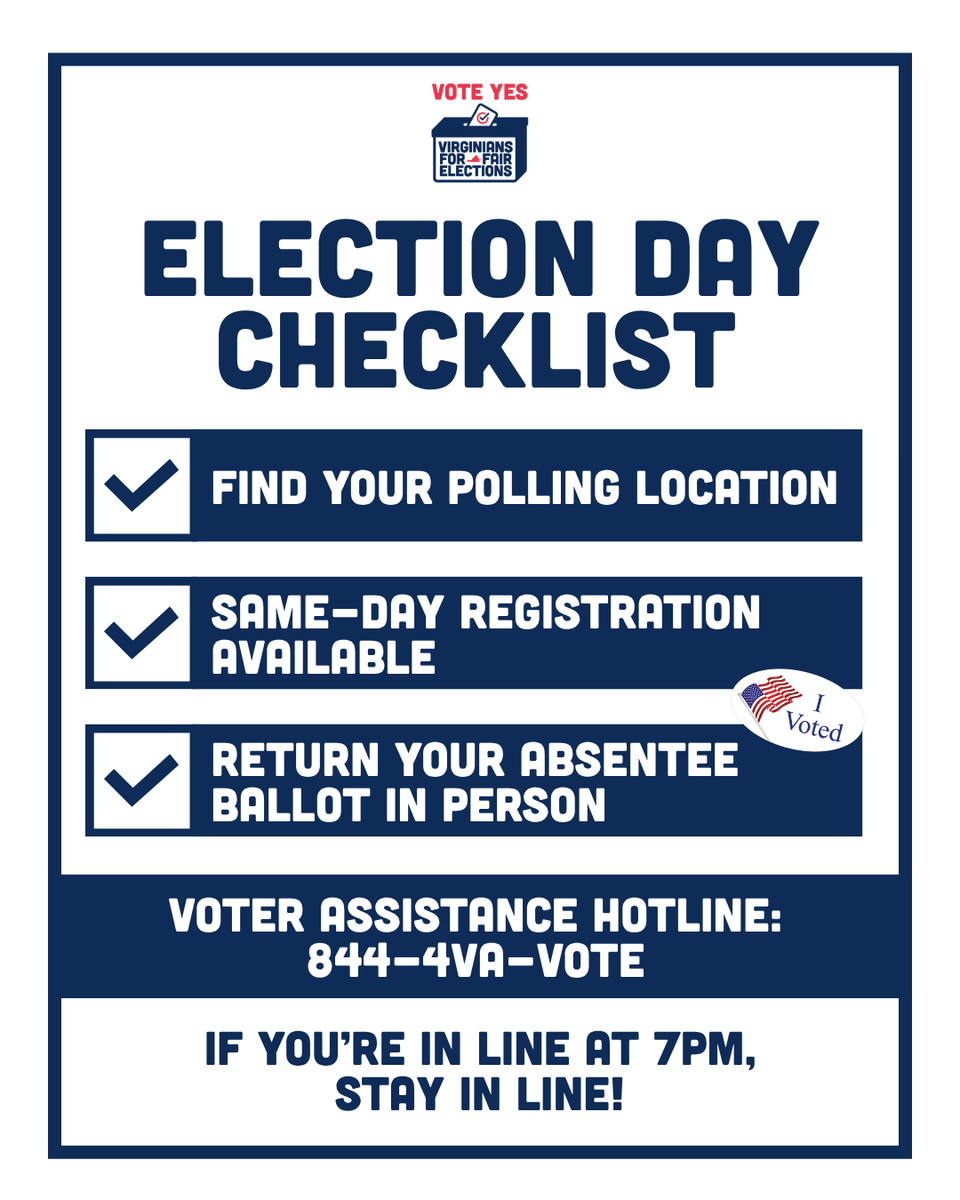
Virginia, it’s Election Day, and here’s your voting checklist.
IWillVote.com/VA
14,597
13,357
71,702
11,308,235

Louisiana Democratic State Rep. Edmond Jordan didn’t hold back when he told his Republican colleagues that voting for the latest redistricting map would mean they are casting a vote for racism.
youtube.com/shorts/fPzox-MBx…
2
Karen B 🇺🇸 🌻 retweeted

Jun 12
Here is what Democracy Docket is tracking today:
Active Voting Rights Cases: 157
Active Redistricting Cases: 41
Active Anti-Voting Cases: 79
Active Pro-Voting Cases: 74
Active DOJ Lawsuits: 32
Help support its work. bit.ly/41Owd2z
23
526
1,294
46,911
NYC212 retweeted

Jun 11
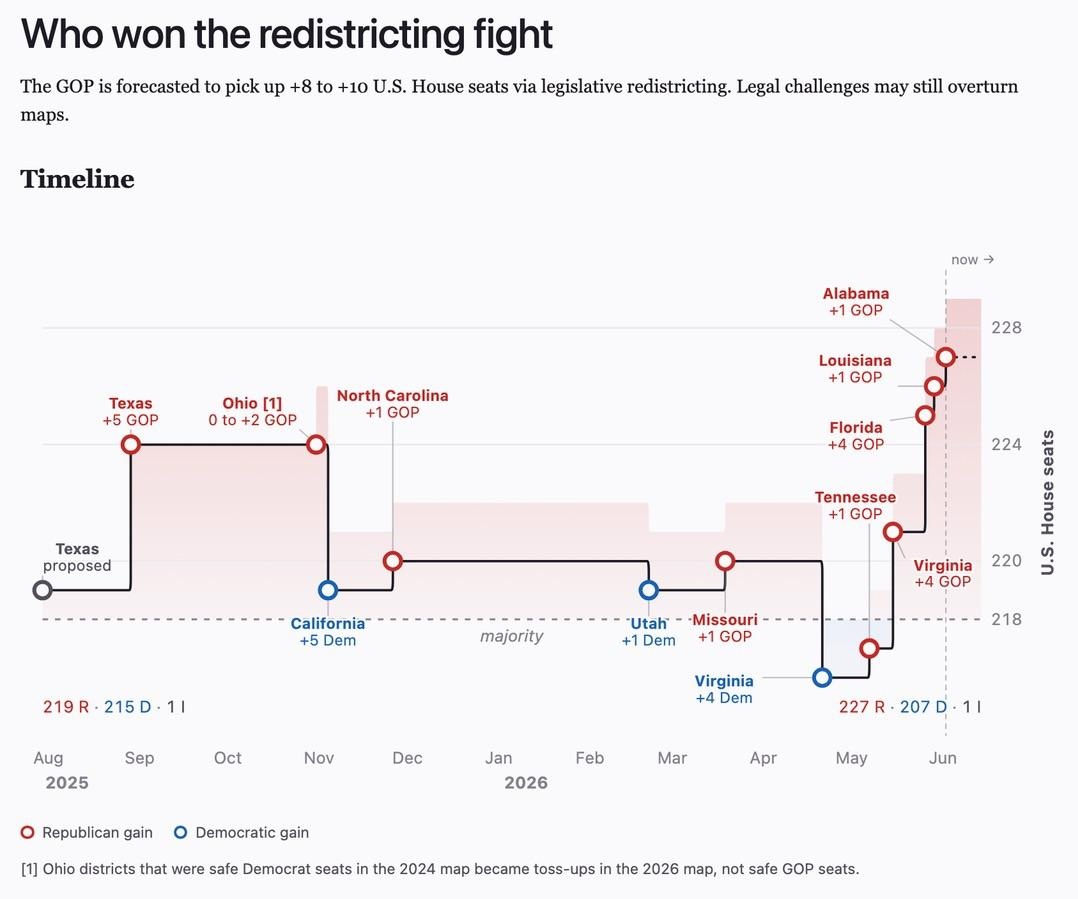
The GOP turned down gaining something like 30 extra seats via redistricting.
Instead, they'll be gaining 8-10.
214
623
7,407
504,278
Danny G retweeted

Jun 10
🚨BREAKING - Texas House PASSES redistricting map adding 5 Republican seats in Congress by vote of 88-52.
47
1,091
10,021
145,129
Lj retweeted

Republicans Won the Redistricting War. Will They Secure its Legacy? | Joseph Ford Cotto, AmericanThinker
In the high-stakes arena of American politics, few battles carry the raw drama and lasting consequences of the redistricting war that erupted in 2025 and reached its climax this year.
What began as a bold mid-decade push in Texas has reshaped the nation's electoral map, delivering hard-won gains for Republican voters and restoring a measure of balance long absent from politics. This is no dry procedural tale. It is a story of determination, strategic foresight, and judicial clarity that has empowered Republicans who had their voices drowned out for too long.
The spark ignited last summer.
Texas Republicans, responding to direct pressure from President Donald J. Trump following his 2024 reelection, redrew their congressional districts. The new map dismantled several minority-majority districts and positioned Republicans to pick up as many as five additional seats. This move shattered the usual pattern of waiting for the next U.S. Census, proving that state legislatures may act decisively when federal rules allow it.
The decision set off a chain reaction that would test norms, courts, and political wills across the country. Other Republican-led states quickly joined the effort.
Missouri, North Carolina, Ohio, and Utah held special sessions to adjust their own maps, targeting areas of Democratic strength to secure advantages for the 2026 midterms. These changes came amid declining poll numbers for the Trump administration, reflecting a clear-eyed recognition that favorable boundaries could protect red representation before any future census or leftist judicial shift.
The pace was remarkable. It was one of the highest for mid-decade redraws in over a century, prioritizing victorious outcomes for GOP voters over antiquated notions of stability.
At the heart of this reset stood Louisiana v. Callais, a case that would redefine the rules. Argued first in March 2025 and again in October, it questioned whether Louisiana's map, which included a second majority-black district to address Voting Rights Act (VRA) concerns, crossed into unconstitutional racial gerrymandering.
Challengers insisted race had dominated the drawing process over traditional factors like compactness. State officials defended the lines as essential to prevent black vote dilution. The case drew national attention as similar fights played out elsewhere, forcing a deeper look at how the VRA's Section 2 checked minority protections with constitutional limits on race-based decisions.
On April 29, 2026, the Supreme Court delivered a decisive 6-3 ruling in Callais. The GOP-appointed majority, led by Justice Samuel Alito, held that the VRA did not compel the creation of that extra district. Race could not predominate without a compelling reason tied to legitimate districting goals. The decision requires plaintiffs to prove maps failed non-racial standards and to account for partisan leanings in any polarization analysis.
This narrows the path for vote-dilution claims, giving states clearer room to draw lines focused on partisanship rather than racial quotas. It marks a turning point, emboldening Republican states to move forward confidently.
The ruling unleashed immediate action.
Alabama, Louisiana, and Tennessee moved swiftly to adjust maps and handle imminent primaries. In Alabama, officials sought to return to their 2023 map, which preserved one majority-black district but eliminated a second. Yet a three-judge federal panel — including Trump appointees — blocked it in May, citing evidence of intentional discrimination despite the Callais standards.
The panel's unanimous decision created tension with the Supreme Court's new framework, especially with primaries already in motion.
Republicans turned to the Supreme Court for relief. On their shadow docket, GOP-appointed justices quickly issued an unsigned order staying the lower court's block. That allowed Alabama's preferred map to stand. The Court found the state likely to succeed under the Callais standards. This emergency step overrode the panel, delivering six red districts and one blue seat. The outcome locked in a net advantage for the GOP in the South.
The shadow docket action carries broader weight. It raises the bar for proving intentional discrimination, demanding plaintiffs offer maps that match state goals on every legitimate front while prioritizing colorblind principles. Lower courts have clear guidance against overreach, and the ruling discourages future expansive VRA lawsuits.
Across the nation, this shifted power back toward legislatures elected by the people, away from judicial mandates that often stretched racial protections into preferences.
Florida exemplified the momentum. Gov. Ron DeSantis called a special session this April, leading to a new map signed May 4 that strengthened Republican performance in key metro areas by up to four districts. Citing population changes and the anticipated Callais outcome, the legislature acted amid its own legal fights, adjusting filing deadlines to capitalize on the moment.
These moves demonstrated proactive leadership that translated federal rulings into state strength.
Democrats attempted countermeasures. In Virginia, the blue legislature pushed a constitutional amendment for temporary control over congressional districting, aiming for a dramatic shift toward their side. Voters narrowly approved it in an April referendum. Yet the Virginia Supreme Court struck it down 4-3 on May 8, ruling the process violated strict constitutional sequencing rules tied to the 2025 House of Delegates election.
The U.S. Supreme Court declined to intervene, preserving the existing 6-5 map and blocking a potential 10-1 Democratic advantage. This blue failure highlights the limits of retaliatory strategies when jurists hold firm.
By early June, the picture was clear: Republicans had prevailed in the redistricting war. From Texas's initial thrust through Callais, Alabama's shadow docket victory, Florida's redraw, and the spectacular Virginia setback for Democrats, the GOP secured tangible U.S. House gains. Only Utah's was overturned by a judge to create a single new Democrat-dominant district. All this, despite frenzied blue efforts in California, which incidentally saw Republicans likely winners in the new blue districts in an unexpected turn of events.
The sequence delivers more power to Republican voters that they have held in generations on end. Not just in congressional races, but in state legislatures and local contests shaped by Callais and its aftermath.
This victory carries deep meaning. It shows that determined leadership, from the president to state lawmakers and clear-thinking judges, can deliver results when guided by the right priorities. The narrowed VRA standards prevent Democrats from racially gerrymandering in their states while protesting red-state partisan maps.
Americans who support Republicans now enter midterm season with turbocharged representation and a remarkable chance of being heard.
The drama of recent months feels like a movie script because it is high-stakes reality. It echoes beyond this cycle, reminding every citizen that elections and legal boundaries matter. Voters who back the GOP have every reason to turn out in force this Autumn. America is stronger when maps reflect the people's will through their elected representatives rather than blue race-baiting.
This red redistricting success stands as powerful evidence of what Republican electoral victories can achieve.
As the dust settles on this epic redistricting triumph, the GOP has delivered something profound: substantial power delivered into the hands of its voters. What once felt like an unbreakable Democratic stranglehold on fairness has been shattered, replaced by maps that finally respect the will of the people who harbor the deepest patriotism for their nation.
This hard-fought victory represents more than seats gained. It is proof that determination and principle can reshape America for the better. In these pivotal November midterms, every Republican voter should turn out to prevent blue barbarism from rolling back the true progress which has been made. Its legacy demands ironclad security.
The future which America's children will inherit depends upon the ballots cast in mere months.
americanthinker.com/articles…
5
11
32
2,251

You are literally a dumbass. The Knicks were 53-29 in the regular season and 16-3 during their playoff run. They lost 2 games to the Atlanta Hawks in the 1st RD…one at home. Question: how did redistricting go in your state of Tennessee? #Knicks #NBA #Bandwagon #TRUMP

The Knicks literally only lost the game Trump came to.
79

Again, I'm just looking at the polling aggregates.
I believe 2018 was a D 8 year and this looks like D 4-6, which means about 2-4 points more Republican than 2018.
The GOP House majority is very small, so Democrats don't need to win many seats to flip the House, which means a minor D advantage could easily see it flip. Conversely, both parties gerrymandered in 2020, but in different ways - Republicans did it to shore up their seats making them hard to flip while Democrats did it to make their seats weaker but make it easier to flip more seats in their Blue states.
But we also have different maps in 2026 due to the 2020 census/allocation/redistricting and the 2026 maps.
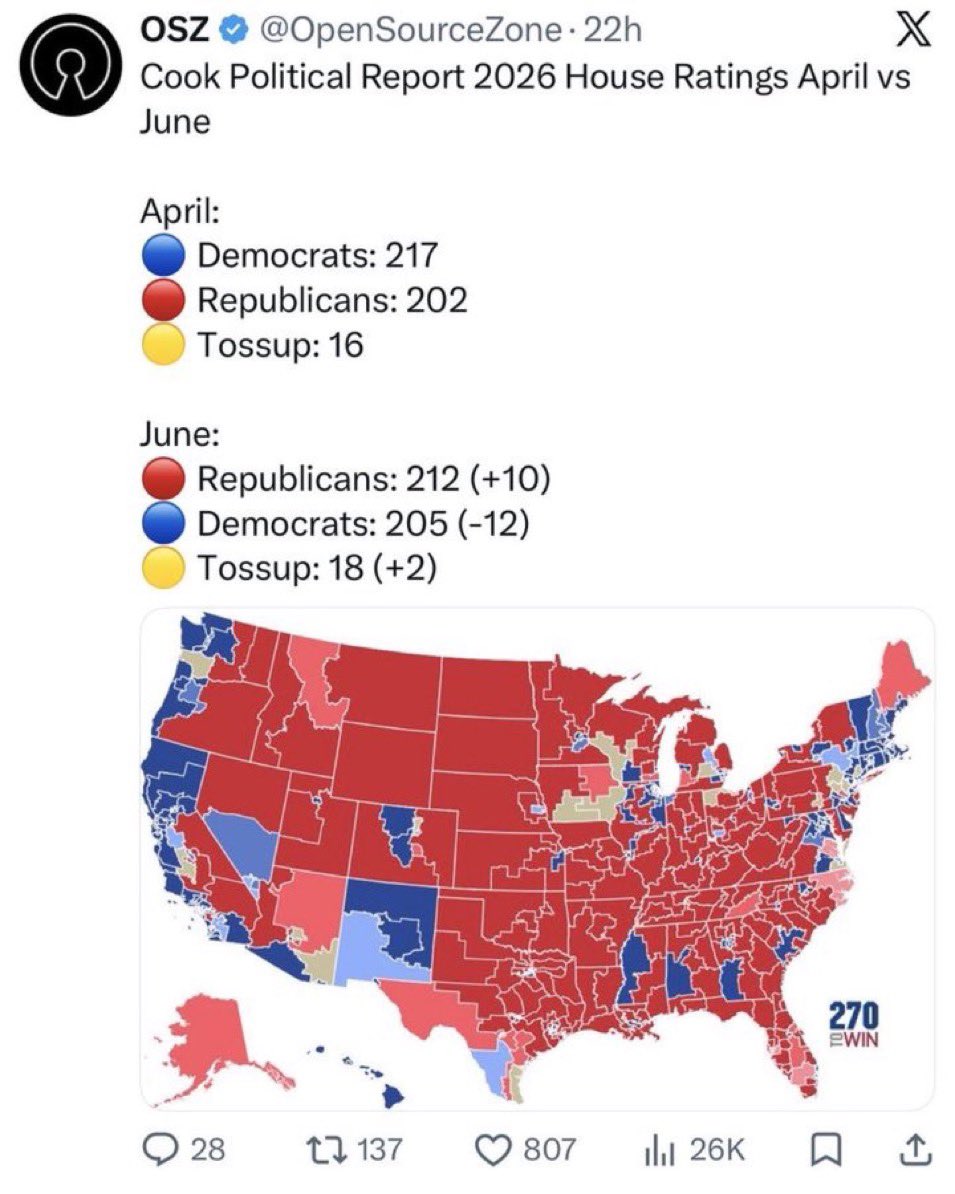
The end result is the Republicans have more safe seats (something between 202 and 214). If they lose all the swing seats and the tilt/lean R seats, the Democrats have enough to take the House, though their majority may be limited. If it's more competitive, they they may have trouble even taking the majority. But as I said above, it's so narrow, they don't have to flip many.
The Senate is a different animal.
Since the Obama years, Senate largely goes to the majority party in the state. Few people split their votes, and even in off-year mid-terms, it's been this way. There are only a few exceptions, like Collins in Maine, who can consistently win a seat in the other party's state (but Maine is kind of an outlier - their other Senator is literally an Independent, even if he caucuses with Democrats, and Collins is probably the most moderate Senator in the entire chamber).
The problem for Democrats is that they don't have a lot of GOP Senators in light-red/purple states up for grabs.
The other problem for Democrats is their ideological purity has limited the appeal of their candidates. For example, my state, Texas: Democrats refuse to nominate a moderate. I'm not even sure if there are any moderate Democrats in the state. Talarico is radical by Texas standards, and Crockett wasn't much better. I'm not sure why - I think it's they don't want a Manchin, but Republicans are pragmatic enough to put up with a Collins and Murkowski - but all it does is prevent them taking seats they might otherwise be competitive in.
There just aren't a lot of Senate seats they can pick up.
The other problem is since the Senate is by state, national mood/trends are irrelevant. It's the trend/tilt in those states. And states don't always move in the national direction. For example, in 2018, Florida shifted 3 points to the RIGHT despite the national average being 8 points to the left.
The Senate is still a GOP favorite at the present time.
The House is likely a Democrat pickup, though their majority may be limited, and this will depend on local district mood and candidate quality.
4


Freshman who pushed Trump map in SC’s failed redistricting loses reelection islandpacket.com/news/politi…
9

THE BLACK CAUCUS HOUSE OF CARDS HAS BEEN NEUTRALIZED BY REDISTRICTING DEMOCRAT JEWS NOW POWERLESS THANKS TO TRUMP & MAGA WE TOLD YOU THIS DAY WOULD COME FOR ABUSE OF POWER WEAPONIZING FEDERAL POWER FOR POLITICAL GAIN IS OVER!
Jun 12

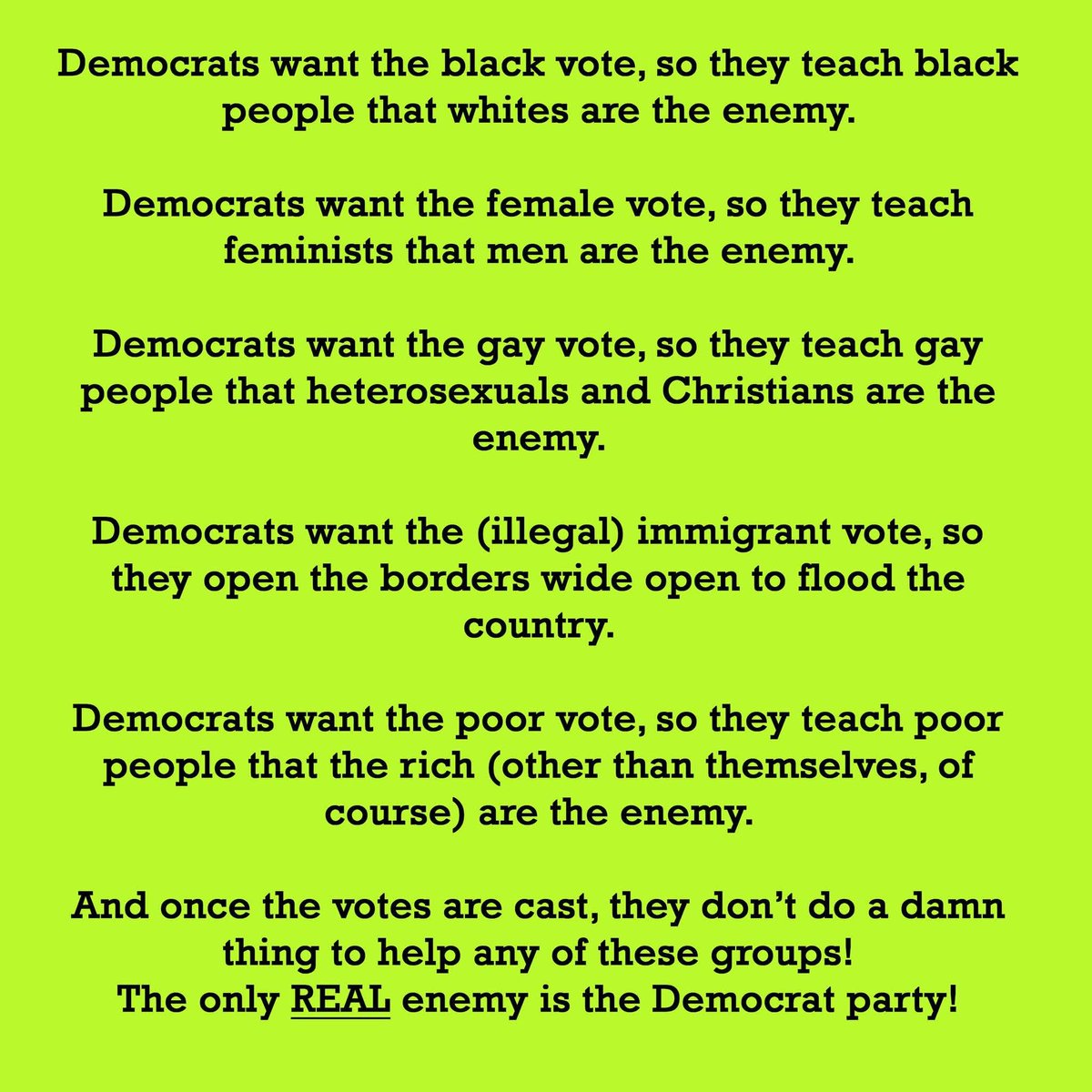
Democrats chase the black vote by teaching "whites are the enemy" and "racism explains everything."
They pit women against men, gays against straights & Christians, immigrants against citizens, and poor against rich.
All for power. None for real solutions.
The real racism is the division they sell.
The only enemy is the Democrat Party.
Abolish the democrat party.
17

The GOP is who has a higher ceiling. The Dems have a WAY lower ceiling thanks to redistricting.
1
3

I think the House could easily be 218-217 one way or the other. Dems ceiling might realistically be maybe 228 at worst. Redistricting really capped just how bad things could get.
In the Senate, my hot take is if that Muslim dude wins the Dem nomination, Rodgers will win.
3
Christie ⭐️ retweeted

Republicans finally see a Red Wave 💯
Redistricting Trump’s final 2 yrs
Americans Rise Up
Dems have nothing to motivate them a t this point. They are planning on stealing 2028
1
2
45

Try again bozo
You guys are toast I 2026 and 2028 and 2030 are gonna be worse for you and the Commies once we get fully Redistricting it’s gonna be a layup.
And once we give enough time to SCOTUS so they can remove illegals from the Census in 2030 it’s gonna get WAY worse!!
4

Because even with redistricting there’s a bunch of swing seats that are behaving the way both parties do during midterms
Regardless of such there’s guaranteed flips this year for both parties so yeah
18

You can call analysts whatever you want, but name-calling isn’t evidence. Multiple independent analyses found Republicans gained the larger advantage from this redistricting cycle. If you have credible data showing otherwise, post it.
2