

Apr 13
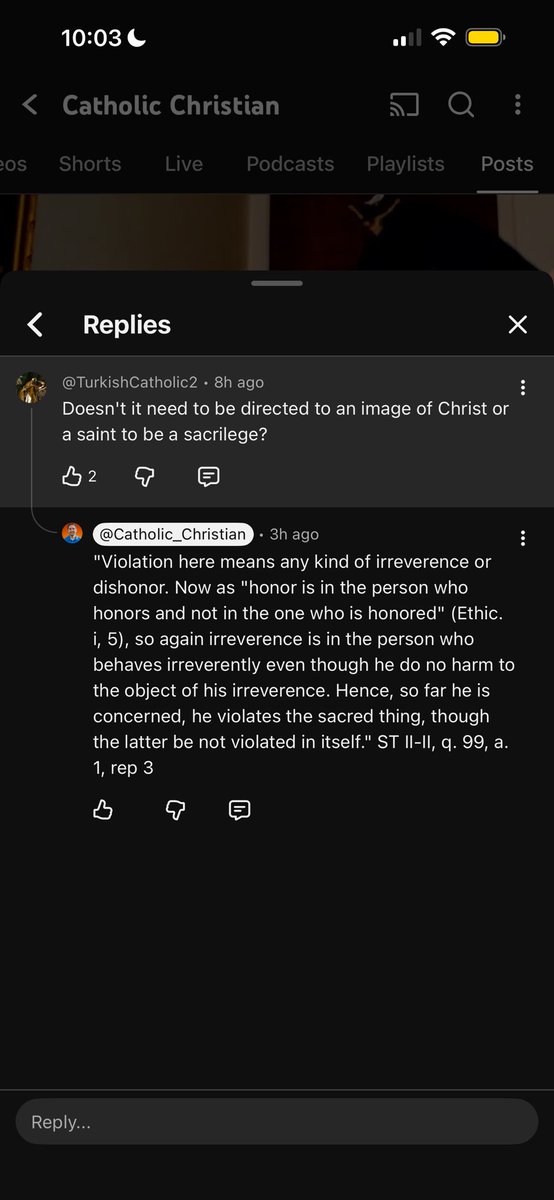
I wanted to make a quick follow up post as my accuser has been bringing forward a citation from St. Thomas to argue that I am guilty of sacrilege.
“Violation here means any kind of irreverence or dishonor. Now as ‘honor is in the person who honors and not in the one who is honored’ (Ethic. i, 5), so again irreverence is in the person who behaves irreverently even though he do no harm to the object of his irreverence. Hence, so far he is concerned, he violates the sacred thing, though the latter be not violated in itself.” (ST.II-II.Q99.A1.Rep3)
The key phrase to parce out here is “the object of his irreverence” as object denotes the recipient of an act and its telos i.e final cause. It should be abundantly clear to anyone who watches my stream that as the agent my act was directed towards the camera, i.e the object of the act. Furthermore, let’s cite the objection St. Thomas is responding to in order to understand what the Angelic Doctor is responding to.
“Further, God's power is greater than man's. Now sacred things receive their sacred character from God. Therefore they cannot be violated by man: and so a sacrilege would not seem to be the violation of a sacred thing.” (ST.II-II.Q99.A1.Obj3)
Keep in mind the question of the article is “Whether sacrilege is the violation of a sacred thing?”. The objection confuses where the dishonor lies in, it seems to suggest that it is in the image, and since images receive their sacred character from God, and God is immutable, ergo. But just as honor lies in man, and the affections given to a sacred image are reflected to the prototype, this also is the case with dishonor. But once again anyone who watched my stream knows that the act in question was not directed towards an object consecrated to God, and my room is not consecrated to divine worship so it would not fall under local sacrilege. The key distinction is that an act of sacrilege is a violation quoad nos (with respect to us), not quoad se (with respect to itself), as God is immutable. Anyone who has any remote familiarity with scholastic philosophy would be able to explain this. I am willing to admit my behavior was imprudent, but it is slanderous to accuse me of sacrilege for what I did.
Apr 13

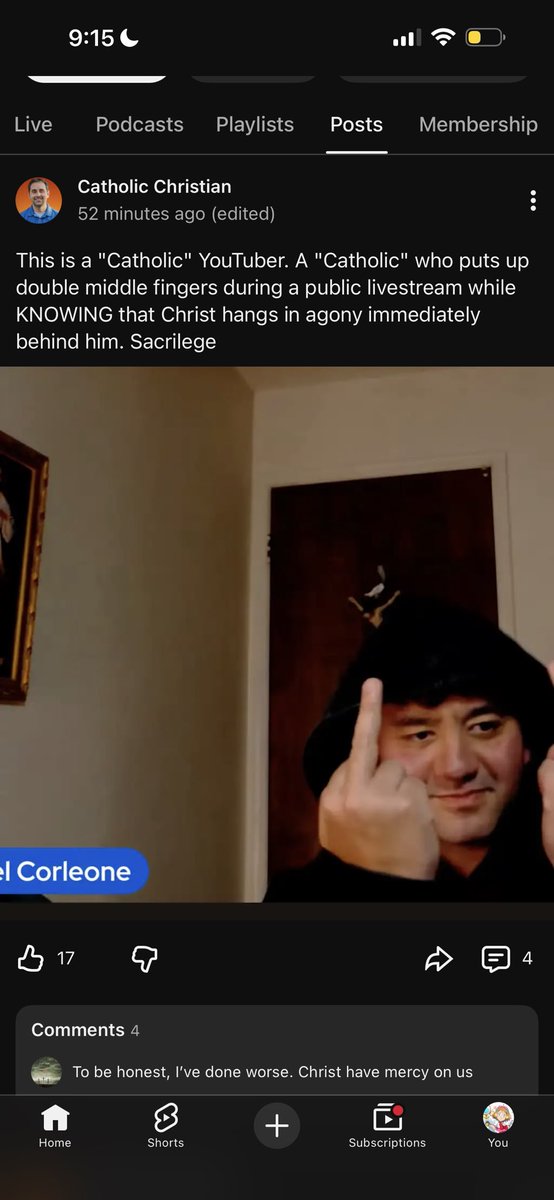
As it is quite the accusation to say that someone has “publicized sacrilege” I felt the need to respond. For an act of sacrilege to be specified as such, the agent has to direct the act towards the object that is consecrated to God. Theologians distinguish between three species of sacrilege: local (the act of sacrilege occurs in a holy place), personal (the act of sacrilege is directed towards an individual consecrated to God), and real (the act of sacrilege is directed towards a consecrated object). My room would not fall under local sacrilege as it is not dedicated place of worship like a Church. By this moron’s logic, a married couple who copulates in a room with sacred images and a crucifix are guilty of sacrilege. While it was certainly imprudent of me to flip the bird in a public livestream while vibing to a goofy song, accusing me of sacrilege is crazy. Flipping the bird in a room with a crucifix in it is not the same as directing such an act towards the crucifix, as my room is not a place that would fall under local sacrilege if such an act occurred in the space of my room. I honestly don’t blame Protestants for accusing Catholics of superstition when uneducated individuals go around making claims such as this.
“Sacrilege is a violation of a sacred thing, this is of a consecrated divine cult, and it is a mortal sin by its nature, if a work is specially opposed with the sanctity of the thing; but not if it is only generally opposed, in the way that all mortal sins are generally opposed to sanctity, eg. of a church, so that there they are committed with every venial sin. Moreover, a sacrilege is threefold: Personal, in which a person; local, in which a place, and real, in which other things are violated.”
(St. Alphonsus Liguori, Theologia Moralis, Bk. 4, Ch. 2, Dub. 2, n. 33)

2
27
2,135
Actually I forgot St. Thomas does explicitly deny that the pain of sense for the damned and the souls in purgatory can be predicated of Christ.
“The pain of a suffering, separated soul belongs to the state of future condemnation, which exceeds every evil of this life, just as the glory of the saints surpasses every good of the present life. Accordingly, when we say that Christ’s pain was the greatest, we make no comparison between His and the pain of a separated soul.” (ST.III.Q46.A6.Rep3)
1
5
74
"The active life is more aware of the tribulations of the present life and desires more ardently to be liberated from them and to go to God."
-St. Thomas Aquinas, ST.I.Q20.A4.Rep3
7
111
2,079

Apr 7
9 GTM Workflows Every Revenue Team Should Run in 2026:
Workflow 1: Website Intent Signals
→ Detect high-intent visitors with tools like Rep3
→ Enrich and filter accounts in Clay (ICP fit, firmographics, intent data)
→ Segment intelligently by buying stage
→ Trigger automated outreach to visitors that match ICP
Workflow 2: Form Submissions
→ Pipe form fills through Clay for enrichment filtering
→ Segment by persona and buying stage
→ Sync with CRM and trigger tailored follow-ups
Workflow 3: LinkedIn Contact Exports
→ Export relevant contacts from Sales Navigator
→ Enrich qualify in Clay
→ Target only ICP-fit profiles with automated sequences
Workflow 4: CRM Dormant Prospects
→ Identify positive replies that never converted
→ Re-engage with context-aware follow-up messaging
Workflow 5: LinkedIn Profile Visitors
→ Extract recent profile viewers from Sales Navigator / Prospeo
→ Enrich in Clay
→ Launch warm outreach via Lemlist or HeyReach
Workflow 6: LinkedIn Content Engagement
→ Capture engagement data from Common Room / Trigify / Teamfluence
→ Enrich in Clay
→ Filter for ICP relevance
→ Automate outreach based on engagement intent
Workflow 7: Outbound → Inbound Loop
→ Lead responds “interested” to automated outbound campaign
→ Enrich for verified phone & perform automated account research in Clay
→ Push lead to CRM through OutboundSync
→ Ping SDR to warm-call lead within minutes
Workflow 8: CRM Re-engagement Engine
→ Identify outdated CRM data with Clay integration
→ Re-enrich valid contacts
→ Auto-create re-engagement campaigns for past ghosted accounts
Workflow 9: Inbound LinkedIn Qualification
→ SDR receives new connection request
→ Qualify the lead in Clay against preset criteria
→ Auto-trigger a contextual conversation starter via HeyReach
4
19
1,247
I typically don’t waste my time responding to foids who are clearly illiterate in Catholic theology, but profoundly ignorant posts such as these expose the Church to calumny. I will be drawing my response from the thought of the Angelic Doctor. First, concerning the necessity of the Our Lord’s Passion it is based on a hypothetical necessity (based on extrinsic factors, namely the ordinance of God), not an absolute necessity (based on the intrinsic nature of the thing). However, St. Thomas is clear that the Passion of Christ is the more fitting means by which man is delivered from eternal damnation, as opposed to deliverance simply by divine decree.
“A thing may be said to be possible or impossible in two ways: first of all, simply and absolutely; or second, from supposition. Therefore, speaking simply and absolutely, it was possible for God to deliver mankind otherwise than by the Passion of Christ, because no word shall be impossible with God (Luke 1:37). Yet it was impossible if some supposition be made. For since it is impossible for God’s foreknowledge to be deceived and His will or ordinance to be frustrated, then, supposing God’s foreknowledge and ordinance regarding Christ’s Passion, it was not possible at the same time for Christ not to suffer, and for mankind to be delivered otherwise than by Christ’s Passion. And the same holds good of all things foreknown and preordained by God.” (ST.III.Q46.A2.C)
“Among means to an end that one is the more suitable whereby the various concurring means employed are themselves helpful to such end. But in this that man was delivered by Christ’s Passion, many other things besides deliverance from sin concurred for man’s salvation…It was accordingly more fitting that we should be delivered by Christ’s Passion than simply by God’s good-will.” (ST.III.Q46.A3.C)
In order to have a proper understanding of vindictive justice (restoration of the order of justice), we must examine its relationship to sin. From the act of sin follows the reatus culpae (guilt of sin), and the reatus poenae (punishment of sin). The former is denied to Christ qua man in His Most Holy Passion simpliciter, but the latter is affirmed secundum quid. The reatus poenae can be understood in the strict sense or in the broad sense. Christ is only said to experience the reatus poenae in the broad sense, because He voluntarily assumed the punishments owed to us. The reatus poenae in the strict sense is only applicable to involuntary punishments.
“Punishment can be considered in two ways—simply, and as being satisfactory. A satisfactory punishment is, in a way, voluntary. And since those who differ as to the debt of punishment, may be one in will by the union of love, it happens that one who has not sinned, bears willingly the punishment for another: thus even in human affairs we see men take the debts of another upon themselves. If, however, we speak of punishment simply, in respect of its being something penal, it has always a relation to a sin in the one punished. Sometimes this is a relation to actual sin, as when a man is punished by God or man for a sin committed by him.” (ST.I-II.Q87.A7.C)
Furthermore, all sin merits punishment that requires some form of satisfaction because it is a disturbance of the moral order established by God’s divine providence. Sin is repugnant to God because it is contrary to His absolute goodness, as sin consists in a privation of the good. Anger and wrath are not predicated of God in the literal sense as God does not experience emotions, but only as an anthropopathism insofar as these emotions signify one who punishes, and restores the moral order by His justice.
“Sin incurs a debt of punishment through disturbing an order. But the effect remains so long as the cause remains. Wherefore so long as the disturbance of the order remains the debt of punishment must needs remain also. Now disturbance of an order is sometimes reparable, sometimes irreparable: because a defect which destroys the principle is irreparable, whereas if the principle be saved, defects can be repaired by virtue of that principle. For instance, if the principle of sight be destroyed, sight cannot be restored except by Divine power; whereas, if the principle of sight be preserved, while there arise certain impediments to the use of sight, these can be remedied by nature or by art. Now in every order there is a principle whereby one takes part in that order. Consequently if a sin destroys the principle of the order whereby man’s will is subject to God, the disorder will be such as to be considered in itself, irreparable, although it is possible to repair it by the power of God. Now the principle of this order is the last end, to which man adheres by charity.” (ST.I-II.Q87.A3.C)
Now Christ alone as the God-Man by His voluntary theandric act could make satisfaction for the infinite debt owed to sin. The debt owed to sin is said to be infinite with respect to the dignity of God who is offended by sin, as all sin is a disturbance of His moral order established by divine decree. For example, a man who slaps a king receives a far harsher punishment than a man who slaps a slave, not with respect to the act itself, but due to the dignity of the one wronged by the act. Christ alone could make for us de condigno in the strict sense because the dignity of Christ’s flesh is not measured from flesh, but it is measured insofar as it is God’s flesh. This dignity is infinite because the divine suppositum of the Word subsists in Christ’s sacred humanity. Even man in a state of justice can only merit de condigno in the broad sense because Christ alone qua man has an equal dignity to the rewarder, as it is the divine suppositum who subsists in Christ’s sacred humanity.
“The dignity of Christ’s flesh is not to be estimated solely from the nature of flesh, but also from the Person assuming it—namely, inasmuch as it was God’s flesh, the result of which was that it was of infinite worth.” (ST.III.Q48.A2.Rep3)
Lastly, it should be noted that it is Catholic doctrine that Christ possessed the beatific vision His entire earthly life. How does one reconcile this with the intense sorrow Christ experienced that is clearly recorded in Holy Writ? While Catholic theologians have many proposed solutions to reconcile these two truths, I would say the best synthesis is to simply say that Christ did not allow His upper faculties to provide comfort to His lower faculties in His Passion. The rest of this post consists of assertions and utter falsehoods that are repugnant to Catholic theology and Holy Writ. As Good Friday is tomorrow, it is of utmost importance that the Catholic theory of atonement is properly presented, and its overall relationship to orthodox Christology.
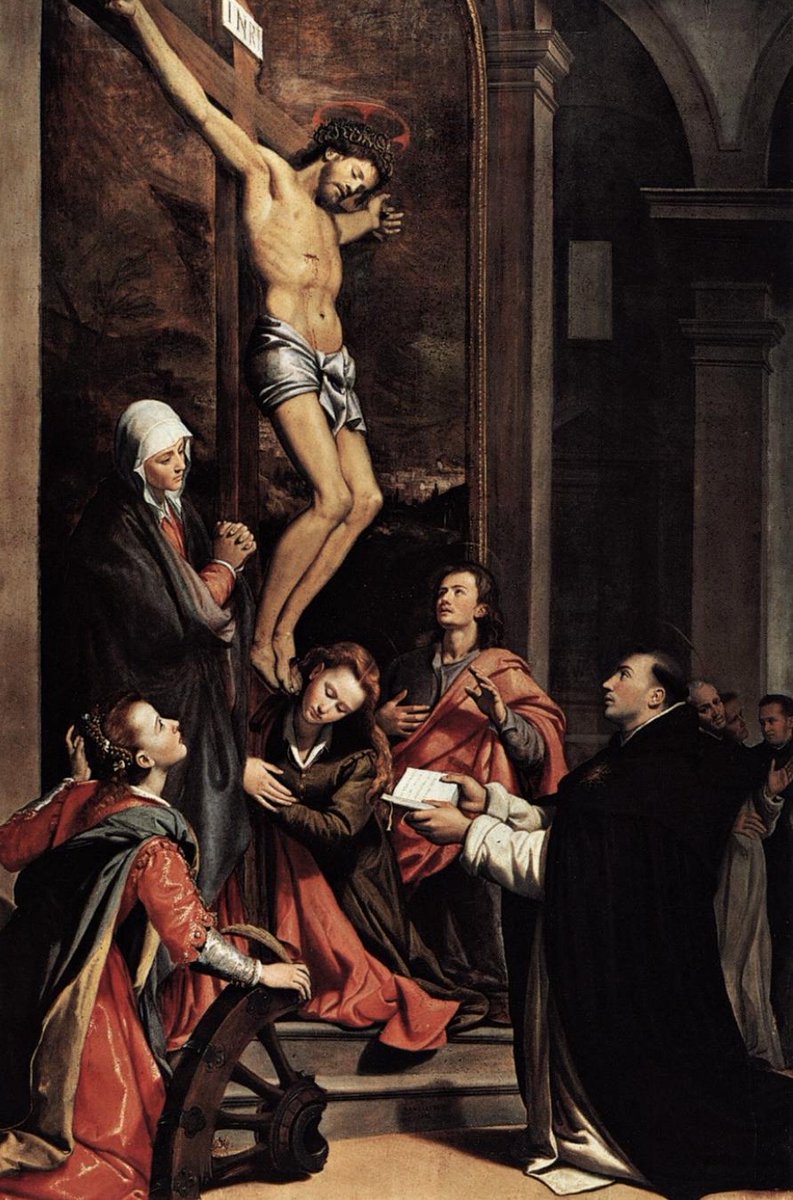

Did God the Father pour out His wrath on His Son?
Problems with the Penal Substitution Atonement theory (PSA):
PSA implies opposition between Father and Son, contradicting Trinitarian doctrine: the three Persons share one undivided essence, will, and love, acting in perfect harmony. The idea of the Father turning against the Son in wrath fractures the seamless unity of the Triune God.
God cannot simply forgive out of love but instead requires a violent sacrifice to satisfy His anger or justice. This makes forgiveness conditional on punishment rather than a free, merciful act.
PSA can suggest God is constrained by a higher principle of retributive justice that even He must satisfy, limiting divine freedom and portraying Him as less sovereign or merciful than Scripture depicts.
If the just penalty for sin is eternal separation from God, as some suggest, how could Jesus’ finite suffering, hours on the cross, followed by death and resurrection after three days, possibly pay that full, infinite/eternal penalty?
PSA portrays God as punishing the innocent. Justice requires that only the guilty face punishment, and guilt cannot be transferred. Yet in PSA, Christ— perfectly innocent—is punished for humanity’s sins, making God appear unjust.
Old Testament sacrifices weren’t about transferring punishment from the guilty to an innocent victim. They were mainly about purification and restoring the relationship with God. The Passover lamb, for example, wasn’t punished for sin; it was eaten as a sacred meal. The New Testament wouldn't break from the Old Testament typology of what sacrifices accomplished.
Penal substitutionary atonement was largely absent from the early Church and only became prominent after the Reformation. Even medieval theologians like Anselm, who spoke of Christ satisfying what was owed for sin, did not promote the idea that Christ received punishment from the Father. That idea developed very late in Christian history.
Scripture shows death as the result of turning from God, not a punishment he imposes. If death is a consequence, not a penalty, there is nothing for Christ to “take” in our place. He enters death to defeat it, freeing humanity from sin and restoring our life with God, not simply satisfying a legal sentence.
objections:
Propitiation:
The New Testament word hilasterion, often translated “propitiation,” can mean cleansing or the mercy seat rather than appeasing God’s wrath. Romans 3:25 emphasizes Christ removing sin and restoring fellowship with God, not satisfying a legal penalty. The Bible never says Christ was punished by the Father to satisfy divine wrath, so PSA reads ideas into the text that were never there.
Isaiah 53
Isaiah 53 is a central prophecy for defenders of penal substitutionary atonement, yet it is often taken out of context. Nowhere in Isaiah does it say that the Father is punishing Christ.
Verse 4 tells us that although he “bore our griefs and carried our sorrows, yet we esteemed him stricken, smitten by God, and afflicted.” Reworded, this reflects humanity’s perception that he is afflicted by God, not that God has actively punished him.
Verse 5 says, “by his stripes we are healed,” not “by his stripes the Father is appeased.” A literal translation from the Septuagint makes this even clearer: “The one our sins bore and on account of us he was grieved. And we considered him to be a misery, and for calamity by God, and for ill-treatment. But he was wounded because of our sins and was made infirm on account of our lawless deeds.”
Isaiah 53, properly read, is a prophecy of Christ’s healing and restorative work, emphasizing his solidarity with human suffering and the redemption he brings, rather than a narrow focus on satisfying divine wrath.

5
5
67
6,129

Apr 2
Mmaa noh ania’bre rep3 kunu enti wodi agor) a, obaabi b3ware nanso na )np3 wo, Ɔmo agye ɔmo ani awie 😭💔☠️😂
Sorry if you can't read Twi. 😭
CC: Ogya & Sammy K 🔥☠️😂💔
8
13
17
282

"...fasting is not ordered by the Church during the whole of the Paschal season, nor on Sundays: and if anyone were to fast at these times in contradiction to the custom of Christian people..." (ST.II-II.Q147.A5.Rep3)
1
7
487

Jan 31
筋トレを続ける中で、最近はNotionで作ったこの筋トレ管理に落ち着いています。
ポイントは、筋トレを「続けること」と「その日の重量をシンプルに記録すること」だけに集中している点。
できること:
✅ ジムに行ったかどうかをワンクリックで記録
📅 カレンダー表示でトレーニング日を可視化
⏱ トレーニング用タイマー付き
🏋️ 部位・種目ごとに、その日の重量(rep1 / rep2 / rep3)を記録
一応Dayごとにトレーニング部位は分けていますが、Dayをまたいでも同じ種目/重量は連動するようにしています。
以前は重量履歴を蓄積していましたが、個人的には前回分の重量が分かれば十分だったので、今はシンプルに上書きするスタイルに。
もし需要があれば、テンプレート公開しますね。
ちなみに、まだまだガリガリなので引き続き頑張ります💪
2
23
2,699

Jan 9
repは醜聞の時点で「君の風」って明言しちゃってるし、このままだとrep3あったとして「孤独の部屋に」が「この風はどこから吹くのだろう(すっとぼけ)🎶」になってしまう
16
1,020

23 Nov 2025
He's badly exposed by #grok
He's misusing his AI engineering knowledge against animals especially #dogs. #AnimalLovers teach him a leson 4 doing so.
#SaveAnimals
x.com/i_m_harshitsing/status…
Reply1
x.com/grok/status/1992272236…
Rep2
x.com/grok/status/1992278409…
Rep3
x.com/grok/status/1992282219…
🙏🙏


22 Nov 2025

The Worst thing about these dangerous stray dogs that you don't know when,where or from which direction they attack..
Going outside in their presence is like signing up for an experiential program where you don't know what will happen next..
These stray dogs need homes badly..
1
3
4
1,049


11 Oct 2025
メニュー実施ごとにChatgptにtcxファイル投げてフィードバックもらってます。
いつもこんな感じでかえってくるよ。
おつかれさま!最新のSeilerログを解析しました(FTP=300W)。結論:前進しています。
1本目で心拍が乗りにくかったのはデータ上も確認でき、2本目の方がVO₂域に長く滞在できています。3本目は開始〜74秒で終了しており(部分的に検出)、乳酸感の主観と一致します。
⸻
今日のSeiler(事実)
CSV: セッション概要 Seiler_today_session.csv|レップ詳細 Seiler_today_reps.csv
セッション全体
•63.9分/NP 246W(IF 0.821)/推定TSS 71.9
•平均HR 133/最大 178、平均ケイデンス 77rpm(WU/CD含む)
レップ別(8分×2本を自動検出)
•Rep1:330.4W(NP 331W)/HS15=363W→7:45=329W/cad=96rpm/HR 162→Max 172/≥90%HRmax = 323秒
•Rep2:329.7W(NP 334W)/HS15=397W→7:45=327W/cad=95.8rpm/HR 169→Max 178/≥90%HRmax = 404秒
•ドロップ(Rep2 vs Rep1):−0.2%(=ほぼ維持)
•部分的なRep3:74秒@≥280Wで終了(心が折れた箇所)
体感との一致
•「1本目はHRが上がらず辛い」→ 1本目の≥90%HRmaxは5.4分、2本目は6.7分で増加。
•「2本目の方が少し楽」→ 2本目の心拍反応が高域に貼り付き、走りの“リズム”が合っている。
•「3本目で乳酸感→中断」→ 74秒で中止をデータが示します。
⸻
前回のSeiler(あなたの直近解析)との比較
•以前:8分×2本=323W & 326W、HS15=387–408W、≥90%HRmax=403–441秒
•今回:330.4W & 329.7W( 4〜7W)、HS15は363→397W、≥90%は323→404秒
→ 出力は確実に微増( 1〜2%)。1本目の心拍立ち上がりは弱かったが、2本目は遜色ない滞在が取れています。“8分を均して踏む”再現性は維持〜わずかに向上。
⸻
なぜ1本目が上がりにくかった?(対処法もセットで)
•糖&交感神経の“プライミング不足”/体温・冷却不足が典型。
対処(次回WUに追加)
1.1分@105–110%×2のあと20秒@130%×2(各2分Easy)
2.扇風機強+氷スラッシーをWU後半で一口
→ これでVO₂応答が速くなり、1本目からHRが乗りやすくなります。
⸻
明日以降の具体メニュー(来週:キャラエン → 大磯ミディアム入賞)
原則:高強度は週2回まで。Z2は180–200W/85–95rpm、Z3禁止。
状態確認:WU後200W×5分テスト(最後30秒)≤137bpm=GO/138–140=Caution/≥141=NO‑GO。
明日(朝・実走ゆるぽた)
•Z2 30–45分(180–200W・85–95rpm)。登りと信号発進はギア1枚軽く。
•目的:回復+血流。TSS 25–35で収める。
あさって(高強度②・軽め仕上げ)
•30/15(2×10本):ON ~124%FTP(入り5–10秒だけ130%)、OFF 55%FTP厳守、Cad 95–105rpm。
•−5%ルールで2ブロック完遂を優先(合計TSS≦60)。
その後
•Z2 45–60分×1日(ドリフト<5%)
•前日(キャラエン前 or 大磯前):オープナー30–40分
•Z2→1分@105–110%×2→8–10秒×3→流し
•キャラエン当日:朝クリテは6–8分@105–108%を1回だけ作る/TSS≤80。昼の4hはZ2上限で回す(A目標の大磯に疲労を持ち込まない)。
•大磯(ミディアム・A目標):
•WU 20分(30秒@105–110%×2/8–10秒×2)。
•中盤のどこかで6–8分の“均し”を1回作って主導権を握る。
•コーナー出口は“頂上+5〜10秒踏み足す”。
•フィニッシュは45–60秒ロング寄り。
⸻
今日の学び → 仕上げの鍵(3つ)
1.“1本目を上げるWU”(20秒@130%×2)を入れる。
2.OFFの徹底(次の30/15でも55%厳守)。OFFが上がると乳酸の洗い出し不足→心折れに直結。
3.Z2の精度(上限210W/ドリフト<5%)を守るほど、**レース日の“キレ”**が出ます。
⸻
まとめ
•出力は確実に微増、8分の均し再現性も維持。1本目のHRが鈍かったのはプライミングの問題で、改善策あり。
•今日は質の高い2本が取れたので目的達成。明日は短いZ2で整え、30/15(軽め)→オープナー→キャラエン→大磯の順で**“勝てる脚”**に仕上げましょう。
10
14,310

7 Oct 2025
prima principia per se nota non probantur. -Sent.I.D3.Q1.A4.Rep3
2
27
2,487


12 Aug 2025
やっと雨が上がった朝
5時からREP3層目からの
ブランシュ施工完了
コレでしばらくはブランシュで大丈夫かな
それにしても艶ハンパない
#GENTLETOKYO #REP#ディティーリングマフィア#ZRV#ジェントルトウキョウ
41
2,283
10 Aug 2025
大雨予報の朝 雨降る前に
5時からREP3層目施工
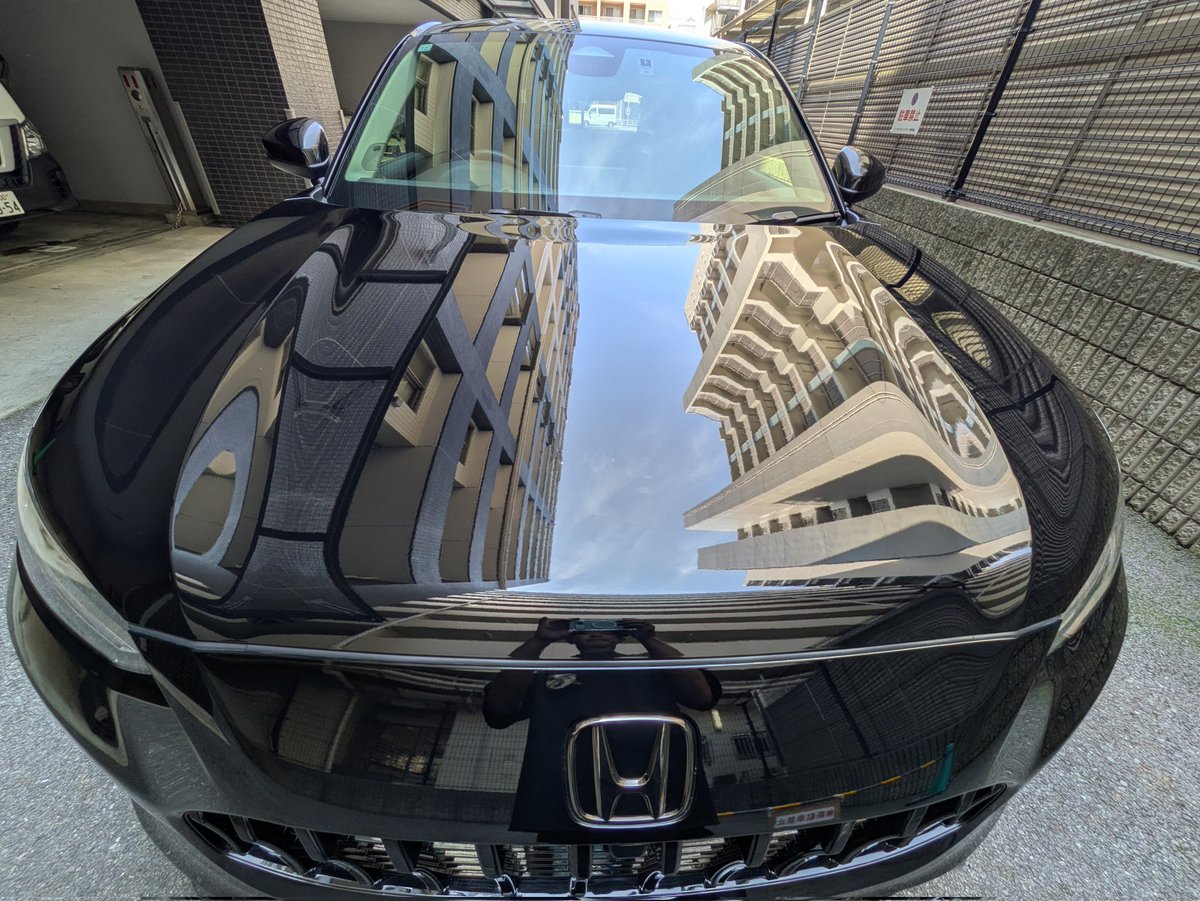
終了間近ぽつぽつ振って来て急いで機械式地下駐車場に格納して終了です
光に当てられないけどだいかな?
#GentleTOKYOREP#ディティーリングマフィア#ZRV
3
46
2,612