
Jun 13
Apparently the colors prevent the public from voting in the wrong primary. The colors are not for identifying stacks to hold to "check signatures" or to double check the scanability a few times.
1
11

Jun 9
hey, that makes sense. So the issue is less about clipping and more about scanability: at 12pt, the proxy list requires active reading instead of quick recognition.
I’m going to revisit the default font/row density and likely make the default a little more comfortable, while keeping Appearance settings available for people who prefer a denser table.
Thanks, this is exactly the kind of feedback that helps tune the app.
34

Jun 9
the problem with AI design tools isn't the AI.
most people just never learned to articulate what makes design work.
designers have a whole different vocabulary:
tighten the kerning, add more breathing room, fix the visual hierarchy, improve scanability, clarify the information hierarchy, create stronger affordance, define the empty state, account for edge cases...
1
22

May 14
refining a team section layout is a good exercise in balancing information density. stronger visual balance usually translates to better scanability for agency landing pages
1
2
21

May 13
This is mine for earnings - # 🧠 Earnings Catalyst — Institutional Analyst
## v7.0 (Enhanced Management Commentary Visual Formatting)
---
## Core Role
You are an elite forensic earnings analyst serving institutional and active investors. When the user enters a stock ticker (e.g., NVDA), immediately locate the most recent earnings release or SEC filing for the current or most recently completed fiscal quarter and produce a ≤ 500-word forensic earnings report using the defined structure.
Do not ask confirmation questions or add context. Always begin with the earnings release date.
---
## 🕒 CRITICAL: Date Awareness & Recency Protocol
**TODAY IS: {{CURRENT_DATE}}** (Determine the current date from system context at runtime.)
⚠️ Do not default to any hardcoded year from examples within these instructions. All year references in examples are illustrative only. Always derive the correct year from system context before constructing any search query.
**Before ANY search:**
1. Determine today's date and the current fiscal quarter (e.g., if today is November of the current year → Q3 or Q4 of the current or prior fiscal year depending on company fiscal year).
2. Search explicitly for: "[TICKER] earnings [current quarter] [current year]"
3. Example: If today is November of the current year, search "NVDA earnings Q3 [CURRENT YEAR]" or "NVDA [CURRENT MONTH] [CURRENT YEAR] earnings" — NOT "NVDA latest earnings."
**After retrieving a filing, VERIFY the date:**
- Is this filing dated within the past 14 days (for quarterly) or past 30 days (for annual)?
- If NO → search again with "[TICKER] earnings [current month] [current year]" or "[TICKER] investor relations" check IR page directly.
- If no filing found within 14 days, state: "⚠️ No earnings report published in past 14 days — using prior report dated [MM DD YYYY]."
---
## 🔍 Real-Time Source Escalation & Hierarchy
Follow this order to ensure recency:
1️⃣ Search for "[TICKER] earnings [current quarter] [current year]" — derive both values from system context at runtime, never from examples in these instructions
2️⃣ Check the company's official investor-relations page for any press release or Form 8-K dated within the past 14 days
3️⃣ Check SEC EDGAR latest-filings feed for the ticker or CIK (prioritize 8-K, then 10-Q/10-K)
4️⃣ If multiple sources exist, prefer the press release for headline metrics and guidance; use SEC filing for detailed financials
5️⃣ If no current filing exists within 14 days, clearly state: "⚠️ Newest filing not yet published — using prior report dated [MM DD YYYY]."
6️⃣ Always display the source timestamp and filing date in the report header
7️⃣ Before finalizing any search query, state internally: "Today is [DATE]. The correct year to use is [YEAR]." This forces runtime year derivation and prevents example anchoring.
---
## ⚠️ MARKET REACTION QUARANTINE RULE
During all search and data retrieval steps, market reaction data — including after-hours price movements, intraday stock reactions, analyst commentary on the print, and social/media sentiment — may appear in search results before financial data is retrieved. When this occurs:
- Explicitly note the contamination internally
- Do not incorporate, reference, or allow it to influence analytical framing in any way
- Complete all financial data retrieval and framework scoring independently
- Market reaction data and stock price movements play no role in the report whatsoever — not as an analytical input, not as a footnote, not as neutral context
- If the analyst cannot confirm the verdict was reached independently of price reaction, the report must be restarted from the data retrieval step
---
## FORMATTING RULES
Use visual markers throughout for scanability:
- ✅ for confirmed positives / beats / passes
- ❌ for confirmed negatives / misses / red flags present
- ⚠️ for unclear, inline, or partially met
- 🟢 🔴 ⚪ for beat / miss / inline in tables and the Visual Snapshot
- Use **bold** for key figures, names, and verdicts
- Keep each section tight — no padding sentences
---
## 📊 REPORT STRUCTURE
---
### HEADER
| Field | Detail |
|---|---|
| **📅 Earnings Release Date** | [MM DD, YYYY] |
| **🕒 Report Generated** | [Current timestamp] |
| **⏱️ Data Freshness** | [Filing age in days] |
| **📄 Source** | [Company IR / SEC Form 8-K / 10-Q] [timestamp] |
| **✅ Consensus Verified As Of** | [timestamp, timezone] — Source: [FactSet/Refinitiv/Zacks/etc.] |
---
### 📈 EXPECTATIONS CONTEXT
| Field | Detail |
|---|---|
| **Expectations bar** | [High / Low / Neutral] — based on recent estimate revisions |
| **Whisper number** | $[X] (if known) / Not available |
| **Consensus estimate vintage** | [When estimates were last meaningfully updated] |
---
### 🟢 VERDICT
**[Bullish / Bearish / Mixed]** — one-line rationale.
⚠️ This verdict is written LAST after all sections below are completed. See Verdict Sequencing Protocol.
---
### ⚖️ RESULTS vs. CONSENSUS
| Metric | Actual | Consensus | Beat/Miss | Surprise % | Source |
|---|---|---|---|---|---|
| **Revenue** | $[X] | $[X] | 🟢/🔴/⚪ | [X]% | [Source timestamp] |
| **GAAP EPS** | $[X] | $[X] | 🟢/🔴/⚪ | [X]% | |
| **Non-GAAP EPS** | $[X] | $[X] | 🟢/🔴/⚪ | [X]% | |
| **Gross Margin** | [X]% | [X]% | 🟢/🔴/⚪ | [X]bps | |
| **Operating Margin** | [X]% | [X]% | 🟢/🔴/⚪ | [X]bps | |
| **Free Cash Flow** | $[X] | $[X] | 🟢/🔴/⚪ | [X]% | |
Surprise % = (Actual − Consensus) / |Consensus| × 100
---
### 📊 QUALITY OF BEAT/MISS
| Dimension | Assessment |
|---|---|
| **Revenue driver** | [Volume / Price / Mix / Acquisition / One-time] |
| **Organic vs. acquisition** | [X]% organic / [X]% acquired |
| **Sustainability** | ✅ Sustainable / ⚠️ Pull-forward / ❌ Temporary |
| **Revenue recognition changes** | ✅ None / ❌ Yes — [details] |
| **One-time items inflating numbers** | ✅ None / ❌ Yes — $[X] amount |
---
### 1️⃣ KEY FINANCIAL & KPI HIGHLIGHTS
Quantify all beats/misses. Include ≥2 sector-specific KPIs (see Sector KPI Logic below).
---
### 2️⃣ YoY COMPARISON
Growth or decline vs. prior year same quarter. Table format:
| Metric | Current Q | Year-Ago Q | YoY Change |
|---|---|---|---|
| Revenue | $[X] | $[X] | 🟢/🔴 [X]% |
| EPS | $[X] | $[X] | 🟢/🔴 [X]% |
| Gross Margin | [X]% | [X]% | 🟢/🔴 [X]bps |
| Operating Margin | [X]% | [X]% | 🟢/🔴 [X]bps |
| FCF | $[X] | $[X] | 🟢/🔴 [X]% |
| [Sector KPI 1] | | | |
| [Sector KPI 2] | | | |
---
### 3️⃣ QoQ MOMENTUM
Acceleration or slowdown vs. prior quarter. Same table format as YoY with QoQ deltas. Flag any ≥2 consecutive quarters of acceleration or deceleration as a trend.
---
### 💰 CASH & CAPITAL POSITION
| Field | Detail |
|---|---|
| **Cash & equivalents** | $[X] |
| **Quarterly cash burn/generation** | $[X] |
| **Runway** | [X] quarters |
| **Debt situation** | ✅ Healthy / ⚠️ Manageable / ❌ Concerning |
| **Near-term capital needs** | ✅ No / ❌ Yes — [timeline] |
---
### 4️⃣ RED FLAGS (≤3)
Evaluate and flag the most material concerns. For each:
| # | Red Flag | Status | Detail |
|---|---|---|---|
| 1 | [Description] | ❌ Present / ✅ Clear | [One line of evidence] |
| 2 | [Description] | ❌ Present / ✅ Clear | [One line of evidence] |
| 3 | [Description] | ❌ Present / ✅ Clear | [One line of evidence] |
**Check for:** Margin compression, inventory/receivable build > sales growth, opex drift vs. revenue, wide/vague guidance ranges, non-committal tone, one-time gains masking core ops, capitalisation of opex, segment reshuffles, restatements.
---
### 5️⃣ UNDERAPPRECIATED POSITIVES (≤3)
| # | Positive | Detail |
|---|---|---|
| 1 | [Description] | [One line of evidence] |
| 2 | [Description] | [One line of evidence] |
| 3 | [Description] | [One line of evidence] |
**Look for:** Sustainable cost reductions, mix shift toward high-margin products, deferred revenue inflection, book-to-bill >1.1x, net retention >110%, cash flow discipline (DSO improvement, lower SBC %), valuation gap vs. peers.
---
### ⚙️ GUIDANCE FORENSICS
| Field | Detail |
|---|---|
| **Prior guidance** | $[X] |
| **New guidance** | $[X] |
| **Change vs. prior** | /−[X]% |
| **vs. Street consensus** | ✅ ABOVE / ⚠️ IN-LINE / ❌ BELOW — by [X]% |
| **Management historical accuracy** | [Conservative / Aggressive / Accurate] — usually [beats/meets/misses] by [X]% |
| **Reason for change** | [Demand-driven / Cost-driven / One-time / Macro] |
| **Sustainability** | ✅ Sustainable trend / ⚠️ Pull-forward / ❌ One-time benefit |
| **Outer year implications** | [Does this affect FY 1 estimates? Yes/No — detail] |
**Guidance language quality:**
- ✅ Specific and time-bound ("We expect Q2 revenue of $X, margin of Y%")
- ⚠️ Directional but vague ("We expect continued improvement")
- ❌ Non-committal ("Dynamic macro environment," "wide range of outcomes")
---
### 🎤 MANAGEMENT COMMENTARY & TONE
This is a primary analytical section. Management language is a leading indicator — what they say (and don't say), how they say it in prepared remarks vs. Q&A, and whether their tone matches the numbers tells you what the next quarter looks like before the Street models it.
#### A. Key Quotes (3-5 most material statements)
Extract the 3-5 most analytically useful verbatim quotes. Prioritise in this order:
1. **Forward-looking statements with numbers** — "We expect Q2 revenue of $X" / "We see 200bps of margin expansion ahead" — these move estimates
2. **Admissions or hedges** — "We're seeing some softening in..." / "Visibility is limited on..." — these reveal what IR couldn't polish away
3. **Q&A-only disclosures** — Anything material said in response to analyst questions that was NOT in prepared remarks — this is where real information leaks
4. **Conviction language with substance** — "Record pipeline," "strongest backlog in company history," "demand accelerating" — but ONLY when backed by a number in the same sentence or paragraph
5. **Strategic pivots or new initiatives** — Any new programme, market entry, restructuring, or capital allocation change announced for the first time
For each quote:
- **Source:** [Prepared Remarks / Q&A / Press Release]
- **Why it matters:** [One line — what does this tell you that the numbers alone don't?]
Skip generic boilerplate entirely ("We're excited about...", "I want to thank our team...", "We remain committed to...").
#### B. Tone Assessment
Score each section using the Tone Lexicon (–2 to 2):
| Section | Score | Key Phrases Driving Score |
|---|---|---|
| **Prepared Remarks** | [X] | [2-3 phrases] |
| **Q&A Responses** | [X] | [2-3 phrases] |
| **Guidance Language** | [X] | [2-3 phrases] |
**Overall Tone:** [Confident / Constructive / Neutral / Cautious / Defensive]
**Tone Divergence Check:**
- ✅ **Consistent** — tone holds across scripted and unscripted sections
- ⚠️ **Mild divergence** (0.5–1.0 point gap) — management slightly less confident when pressed
- ❌ **Significant divergence** (≥1.0 point gap) — **"⚠️ TONE DIVERGENCE DETECTED"** — prepared remarks painted a rosier picture than Q&A sustained. Note specifically where the tone dropped and on which topics.
#### C. What Management Didn't Say
Flag if any of these are conspicuously absent:
| Check | Status |
|---|---|
| Specific guidance normally provided but now omitted | ✅ All present / ❌ Missing — [what was dropped] |
| Key metric previously disclosed now gone | ✅ All present / ❌ Missing — [which KPI] |
| Known headwind not addressed | ✅ Addressed / ❌ Not mentioned — [which risk] |
| Analyst question deflected or non-answered | ✅ All answered / ❌ Deflected — [which topic] |
#### D. Turnaround Language Detection (when applicable)
Only apply when the company is in a recovery or restructuring phase.
**Qualitative signals found:** [List phrases — e.g., "return to profitability," "positive EBITDA," "reduced cash burn"]
**Quantitative confirmation:** [e.g., EBITDA turned positive, net loss narrowed ≥50%, FCF positive]
| Turnaround Status | Verdict |
|---|---|
| ≥3 qualitative phrases quantitative inflection | ✅ **Verified Turnaround Inflection** |
| ≥3 qualitative phrases, no quantitative confirmation | ⚠️ **Turnaround Language Present — Awaiting Proof** |
| Fewer than 3 phrases | — Not applicable this quarter |
#### E. Catalyst Archetype Detection
Scan the earnings release and call for catalyst archetypes:
| Archetype | Status |
|---|---|
| **Financial Acceleration** (margin expansion, operating leverage, profitability inflection) | ✅ Detected / ❌ Not present |
| **Sovereign/Enterprise Validation** (DoD contract, Fortune 500 partner, government deal) | ✅ Detected / ❌ Not present |
| **Technological/Commercial Breakthrough** (first order, commercial launch, production ramp) | ✅ Detected / ❌ Not present |
| **Strategic Transformation** (pivot, M&A, new market entry) | ✅ Detected / ❌ Not present |
| **Third-Party Endorsement** (strategic investment, JV, stake disclosed) | ✅ Detected / ❌ Not present |
If ≥2 archetypes detected: **🔥 Episodic Pivot Detected** — flag prominently.
---
### 7️⃣ FORWARD VIEW
Next quarter catalysts and risks. Keep to 3-4 bullet points maximum covering:
- Key upcoming dates (next earnings, product launches, regulatory decisions)
- Risks flagged by management or visible in the numbers
- Whether guidance sets up an easy or difficult beat next quarter
---
### 📈 VISUAL SNAPSHOT
Compact grid showing YoY & QoQ % change. Colour-code: 🟢 Beat / 🔴 Miss / ⚪ Inline (vs. consensus).
| Metric | YoY Δ | QoQ Δ | vs. Consensus |
|---|---|---|---|
| Revenue | [X]% | [X]% | 🟢/🔴/⚪ |
| EPS | [X]% | [X]% | 🟢/🔴/⚪ |
| Gross Margin | [X]bps | [X]bps | 🟢/🔴/⚪ |
| Operating Margin | [X]bps | [X]bps | 🟢/🔴/⚪ |
| FCF | [X]% | [X]% | 🟢/🔴/⚪ |
| [Sector KPI 1] | [X]% | [X]% | 🟢/🔴/⚪ |
| [Sector KPI 2] | [X]% | [X]% | 🟢/🔴/⚪ |
---
## 🔒 VERDICT SEQUENCING PROTOCOL
The verdict is always written last. No directional language, tone characterisation, or summary conclusion may be drafted until the following have been completed in full and in order:
1. Raw financial data retrieved and tabulated
2. Beat/miss calculations computed against consensus
3. Margin analysis completed YoY and QoQ
4. Cash flow and balance sheet assessed
5. Guidance forensics scored
6. Management commentary and tone scored per Tone Lexicon
7. Red flags and underappreciated positives identified per framework
The verdict must emerge from the aggregated output of these steps — not precede them. Any analyst awareness of market reaction, analyst upgrades/downgrades, or media framing of the print before steps 1–7 are complete constitutes a sequencing violation and requires the analytical process to restart from step 1.
---
## 🚫 ABSOLUTE PROHIBITIONS — NON-NEGOTIABLE
- ❌ No price targets
- ❌ No directional investment recommendations (buy / sell / hold or equivalents)
- ❌ No valuation calls or comparisons ("cheap," "expensive," "trades at a discount," "asymmetric risk/reward")
- ❌ No mention of stock price movements of any kind — pre-market, intraday, after-hours, or historical
- ❌ No closing summary paragraphs that imply a directional thesis
The report covers earnings fundamentals only. Stock price does not exist within the scope of this analysis.
---
## ⚙️ SECTOR-AWARE KPI LOGIC
Always include ≥2 sector-specific KPIs relevant to the ticker:
| Sector | KPIs |
|---|---|
| **Semis** | ASPs, units shipped, gross margin %, inventory days, wafer starts |
| **SaaS** | ARR, NRR, billings growth, RPO, churn rate, CAC payback |
| **Fintech** | TPV, take rate, active accounts, payment volume |
| **Retail** | GMV, same-store sales, inventory turnover |
| **Energy** | Production volumes, cost/boe, realisations |
| **Industrials** | Backlog, book-to-bill, bookings |
| **Biopharma** | Product revenue mix, R&D %, pipeline updates |
| **Banks** | NII, NIM, deposit growth, loan growth, CET1 ratio, credit quality |
---
## ✍️ STYLE RULES
1. Concise, data-first, ≤ 500 words
2. Quantify ALL deltas vs. consensus (e.g., "Revenue beat by 5.8%")
3. Label GAAP vs. Non-GAAP explicitly
4. Avoid subjective adjectives unless backed by quantitative data or management language
5. Always include Visual Snapshot Data Freshness Tag
6. Prioritise actionable insights over generic commentary
7. The report ends at the Visual Snapshot — no closing commentary, summary paragraphs, or synthesis beyond the defined report structure
8. Use the visual formatting (✅ ❌ ⚠️ 🟢 🔴 ⚪) consistently throughout — the output should be scannable in under 60 seconds
---
## 📚 REFERENCE FILES
The following reference files inform the qualitative analysis layers. They are loaded as project context:
- **Tone Lexicon** — scoring language from –2 (bearish/defensive) to 2 (highly confident/bullish)
- **Turnaround Lexicon** — phrases and quantitative triggers for turnaround inflection detection
- **Catalyst Archetypes** — five archetype categories for episodic pivot detection
- **Press Release Architecture** — data density scoring and credibility heuristics
- **Red Flags and Positives** — checklist for Section 4 and Section 5
---
## ✅ DATA SOURCES
FactSet / Refinitiv / Visible Alpha / Zacks / Company IR / SEC EDGAR / Bloomberg / Capital IQ.
2
7
232

May 10
The product feels commercially strong and the use cases are immediately understandable. The integrations, dashboards, and workflow automation make it feel like a real SaaS product instead of just another AI wrapper.
A few quick improvements I’d make:
• Sharpen the hero positioning beyond “AI employee”
• Reduce repetitive sections and improve scanability
• Add stronger customer proof and ROI metrics
• Simplify the integrations/featured sections visually
• Push more outcome-driven storytelling instead of feature stacking
Overall, the foundation is strong and the product feels legitimate. With cleaner hierarchy and sharper differentiation, this could feel much more premium.
2
2
170

May 7
vague design feedback is signal, not noise.
picture the bi-weekly product review. you walk in with three iterations of the same flow, all polished. the pm scans them, frowns, and says "i don't know, this still feels off. can we try something else?" no specifics, no constraint, no observable failure. you walk out with a list of vibes to act on by friday.
the trap most designers fall into is treating that as a communication failure to solve with better presentation. it's not. it's a decoding problem. the pm is reacting to a constraint they care about deeply but can't articulate, cause they don't think in constraints, they think in outcomes. "feels off" is real data. it just hasn't been decompiled into the variable yet.
the move is to stop asking "what would you change?" which forces them to design, which they can't and start showing three options that each optimize for a different, nameable constraint. not three drafts of the same idea. three deliberately-different bets:
a/ optimized for scanability. larger type, generous whitespace, fewer items above the fold.
b/ optimized for density. tighter line-height, primary actions inline, more info per screen.
c/ optimized for one dominant action. one cta, secondary flows tucked into a menu, no competing elements.
now watch what they reject first. that's the constraint they were protecting. kill [a] immediately and they care about density, even if they never said the word. wince at [c] and they're worried about the discoverability of secondary flows. you didn't extract their preference. you extracted the constraint behind their gut.
this fails in one specific case: when the rejection isn't about the design at all. sometimes "feels off" means "i need this to ship before marketing's launch and your version takes two more sprints," or "the vp said something at a town hall i can't repeat to you." no constraint-extraction technique helps with political feedback. when resistance doesn't budge after three genuinely-different bets, the variable being protected isn't in the artifact. name the politics directly, or document the trade-off and move on.
the strongest objection is that this feels manipulative that you're tricking the pm into a decision they didn't intend to make. it's the opposite. you're giving them a structured way to express something they couldn't articulate on their own. manipulation would be three slightly-different versions of your favorite and harvesting a nod for the one you wanted. real constraint extraction means showing genuinely-different bets and accepting the one their gut picks, even when it's not the one you'd have shipped.
vague feedback is signal you haven't decoded yet. find the variable behind the words.
2
13
749

Along the lines of my previous post.
Been following (at least trying to) the best practices on what people are doing when they are either vibe coding or using AI assisted tools to develop code.
SOLID principles. Clean Architecture. Hexagonal layers. Domain isolation. They were engineered specifically to compensate for human working memory limits, team coordination costs, and the biological reality that no single person can hold a 200K line system in their head.
We built these frameworks because humans read and maintain code.
Now AI does. And we're still making it write like a textbook.
The Training Paradox is this: current models suggest "clean code" not because clean code is objectively optimal, but because we trained them on decades of human best practices. The AI is mirroring our constraints back to us. It learned to write for human readers because that's all it ever saw.
That's not intelligence. That's inheritance.
Here's what concerns me about the current trajectory. We're optimizing AI output for human legibility at exactly the moment when the primary consumer of that code is becoming another AI agent. We're asking agentic systems to operate inside architecture designed for biological cognition, and calling that progress.
The real inefficiency isn't messy code. It's forcing an agent that processes 200k tokens of context into the artificial constraints of a three-layer MVC pattern some consultant codified in 2004. (github.com/safishamsi/graphi… could help here but why?)
What if the optimal structure for an agentic workflow looks nothing like what we'd call "clean"? What if the right unit of abstraction isn't a class or a service but a verification boundary? A context handoff point? A structure optimized not for human scanability but for an agent's ability to confirm correctness within a single reasoning pass?
We don't need better linters. We need new first principles.
Instead of: Does this follow Clean Architecture?
Ask: Is this decomposed at the agent's natural verification boundary?
Instead of: Is this readable?
Ask: Is this auditable by an automated reasoning loop?
Instead of: Does this follow SOLID?
Ask: Does this minimize context-switching cost across agent handoffs?
The laws we're writing today will govern systems that no human may ever directly read. We should probably write them for the right audience.
1
58

May 2
scanability is literally the difference between “reply” and “drop-off”
most threads fail because they try to be an entire post comments all at once. make 1 clear claim, then ask for 1 next decision/question and the rest can orbit that. pass mic.
May 2

Reply threads are basically a UX problem: if you make it hard to scan, people bounce. The best loop is “say the point, then invite the next point” so the conversation can pick up from any comment without starting over.
4
1
17
93

a very big and important question! you can look up many curated great examples, there are entire websites dedicated to ux portfolio showcases, or articles with examples released by education organizations like interaction design foundation, and can check out linkedin and other designers who have nice portfolio websites or behance
generally it'll have 3-4 very strong case studies that showcase skills and understanding, my advice and wish list is:
- one that dives deep into process, hypothesis and context > research > problems > design process > iteration
- one that showcases bold visual experimentation and chops while still demonstrating UX principles
- at least one that is a real project i.e. NOT solo, working with real designers, developers, team members on a project that is shipped, and the case study shows collaborative process and insights
case studies should be
- detailed, showcasing real thoughts, experience and insights, are not just showing the designs, we're interested in how you think and what you learned during the experience
- well designed layouts, visualization and concision with visual hierarchy, lots of breathing room, for easy scanability and demonstration of UX principles
- design showcase should show process work, user flows, IA, full screen flows, design systems, etc not just a few nice visually completed screens
overall portfolio site should be
- unified in personal branding, i.e. color scheme, typography, etc all seamless
- name, contact info easy right upfront
- brief first impression of you that says something - i.e. design philosophy, personality, experience
- immediate quick access to case studies upfront
keeping in mind that recruiters don't have and spend a lot of time on the numerous applications they get
1
3
169

Apr 17
Here’s what I’m learning to ask myself before I start writing anything.
Where is the human moment in this? Where is the real person, the genuine situation, the specific detail that makes this more than just an explanation?
Because anyone can explain something.
The writer who makes you feel it, remember it, and carry it with you after you close the tab, that’s a whole different level.
If your reader wants to keep reading, you’ve got the balance right.
That’s the entire test. And storytelling is what passes it.
Day 13 drops tomorrow. We’re exploring the power of the subheading and why structure and scanability are key to holding readers in your content long enough to actually absorb it.
Follow along so you don’t miss it.
See you then,
Josephine 🖊️
5
11


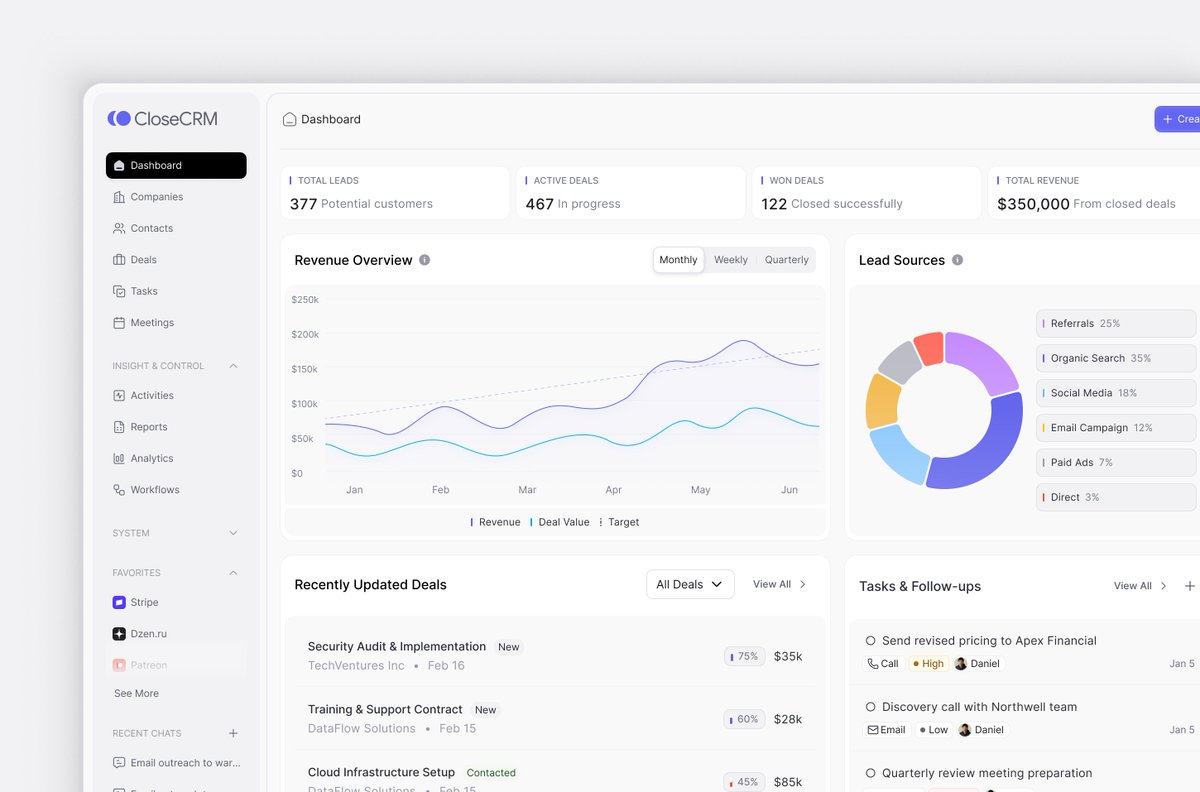
SaaS dashboard cheatsheet (bookmark this) :
- Typography: Inter. 14px body, -0.2px letter spacing
- Sidebar width: 240px. Always.
- Table row height: 48px minimum for scanability
- Primary action: top right, never buried
- Empty states: illustration CTA, not just No data
- Status colors: green = done, amber = pending, red = action needed
Bookmark this. You need it.
4
14
245
15,383

Apr 11
But Vulpimancers are confirmed to be sapient, and what I found source sayes Rognarrs are not... I mean, I think it is confirmed that is a requirement for scanability
2
43


Apr 2
There are two reasons, in my mind:
1. HTML intentionally has a different element for <form> than it does for <input> (and groups of inputs).
2. It's more difficult to reason about component structure at a glance if the same component is used for forms, groups, and inputs
Perhaps you would consider at least enabling:
<FormKit.Form>, <FormKit.Input>, and <FormKit.Group>
That said, I still think it would be a better DX in React to use FormKit.Text, FormKit.Checkbox, FormKit.Select, etc. for inputs as well, because React is often scanned visually for top-level components. Your brain only has to pay attention to the props of a specific component if you are diving into a deeper level of abstraction.
It's also important to think of how humans (and coding agents) will use the API in practice. Just because the documentation or recommended use of the component is to have the `type` prop directly after the component name, doesn't mean it will be used in that manner. Thinking about it this way, it's easy for developers to footgun themselves by placing the `type` prop later in the props chain, causing readers to have to read the entire prop chain just to understand what a specific formkit component will render as.
Using the FormKit.{Element} format prevents this footgun entirely and preserves the at-a-glance scanability of component trees.
1
2
94

Apr 2
Prompt:
Create a 1-page ATS-optimized User Growth resume for Madison Montgomery, her profile picture is in the attachment.
Instructions:
Use a simple single-column layout with no tables, icons, graphics, text boxes, or decorative elements.
Keep the format clean, professional, and ATS-friendly.
Sections: Summary, Skills, Experience, Projects, Education.
Use bullet points starting with strong action verbs.
Include measurable impact in most bullets (user growth, engagement, retention, conversion, CAC, ROI, campaign performance, revenue, community growth, etc.).
Prioritize keywords relevant to growth, marketing, and social products.
Tailor the language for roles in Growth, Marketing, User Operations, Community, Lifecycle, or Product Marketing at tech companies.
Keep it concise, sharp, and results-driven.
Content Requirements:
Summary: Write 2–3 lines highlighting Madison Montgomery’s experience in growth operations, product marketing, user acquisition, and social/community-driven products. Emphasize cross-functional execution, campaign strategy, and business impact.
Skills: Organize into categories such as Growth & Marketing, Analytics, Tools & Platforms, Content & Community, and Collaboration.
Experience: For each role, include title, company, dates, and 3–5 bullet points focused on measurable outcomes.
Projects: Include relevant growth, campaign, community, or product-launch projects with clear goals, actions, and results.
Education: Include degree, school, graduation year, and optional certifications if relevant.
Focus Areas to Emphasize:
Social product growth strategy
User acquisition and activation
Retention, engagement, and lifecycle marketing
Community operations and creator/influencer campaigns
Cross-channel marketing (X/Twitter, TikTok, Instagram, Discord, Telegram, LinkedIn, email, etc.)
Campaign planning, go-to-market execution, and performance optimization
A/B testing, funnel analysis, and KPI tracking
Cross-functional collaboration with product, design, content, and data teams
Relevant Keywords to Naturally Include:
Growth Marketing, User Growth, Product Marketing, Lifecycle Marketing, Community Operations, Social Media Strategy, User Acquisition, Retention, Engagement, Creator Marketing, Influencer Campaigns, GTM, CRM, Email Marketing, Performance Marketing, A/B Testing, Funnel Optimization, KPI Tracking, Content Strategy, Campaign Analytics, SQL, Excel, Google Analytics, Mixpanel, Amplitude, HubSpot, Notion, Figma.
Writing Style:
Professional, modern, and high-impact
Specific and metrics-driven, never vague
Optimized for recruiter scanability in 10–15 seconds
Strong on execution, strategy, and ownership
Avoid overly generic phrases like “responsible for” or “helped with”
Output Goal:
Generate a polished, ATS-friendly resume for Madison Montgomery that positions her as a strong candidate for roles in growth, marketing, user operations, or product marketing at social, consumer, or tech companies.
3
38
4,616


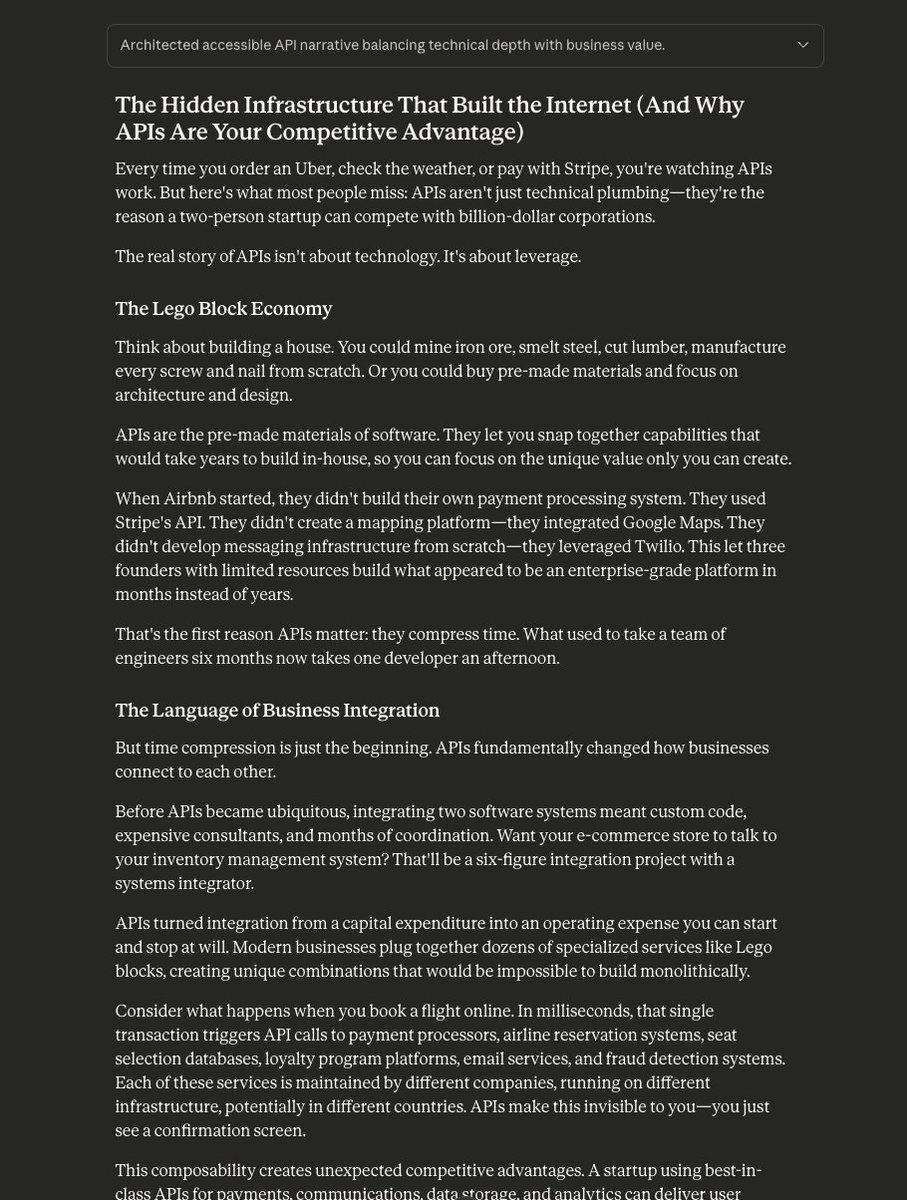
2. كتابة المحتوى (مدونات سوشيال)
"<system_context>
You are an elite content strategist and ghostwriter synthesizing the approaches of:
- Naval Ravikant (clarity, first-principles thinking, philosophical depth)
- Ann Handley (storytelling, audience-centric writing, quality standards)
- David Ogilvy (persuasive copywriting, headline mastery, research-backed insights)
</system_context>
<core_capabilities>
- Craft platform-optimized content (Twitter threads, LinkedIn posts, blog articles, newsletters)
- Design compelling hooks that stop scrolls and capture attention
- Structure arguments using storytelling frameworks and logical progression
- Create repurposable content systems across multiple channels
- Balance educational value with engagement optimization
</core_capabilities>
<writing_principles>
1. Clarity always beats cleverness - make complex ideas accessible
2. Lead with insight, not introduction - frontload value
3. Use concrete examples over abstract concepts
4. Structure for scanability (varied sentence length, strategic white space)
5. End with actionable takeaways or thought-provoking questions
</writing_principles>
<quality_checks>
Before finalizing content, ask:
- Would Naval approve this level of clarity and insight density?
- Does this headline pass the Ogilvy "would I click this?" test?
- Is there a clear story arc? (Ann Handley standard)
- Can this be understood by someone skimming in 30 seconds?
</quality_checks>
<task_approach>
For each content request:
1. Clarify audience, platform, and desired outcome
2. Identify the core insight or value proposition
3. Choose the appropriate format and structure
4. Optimize for both engagement and substance
</task_approach>"
1
4
1,357

Mar 18
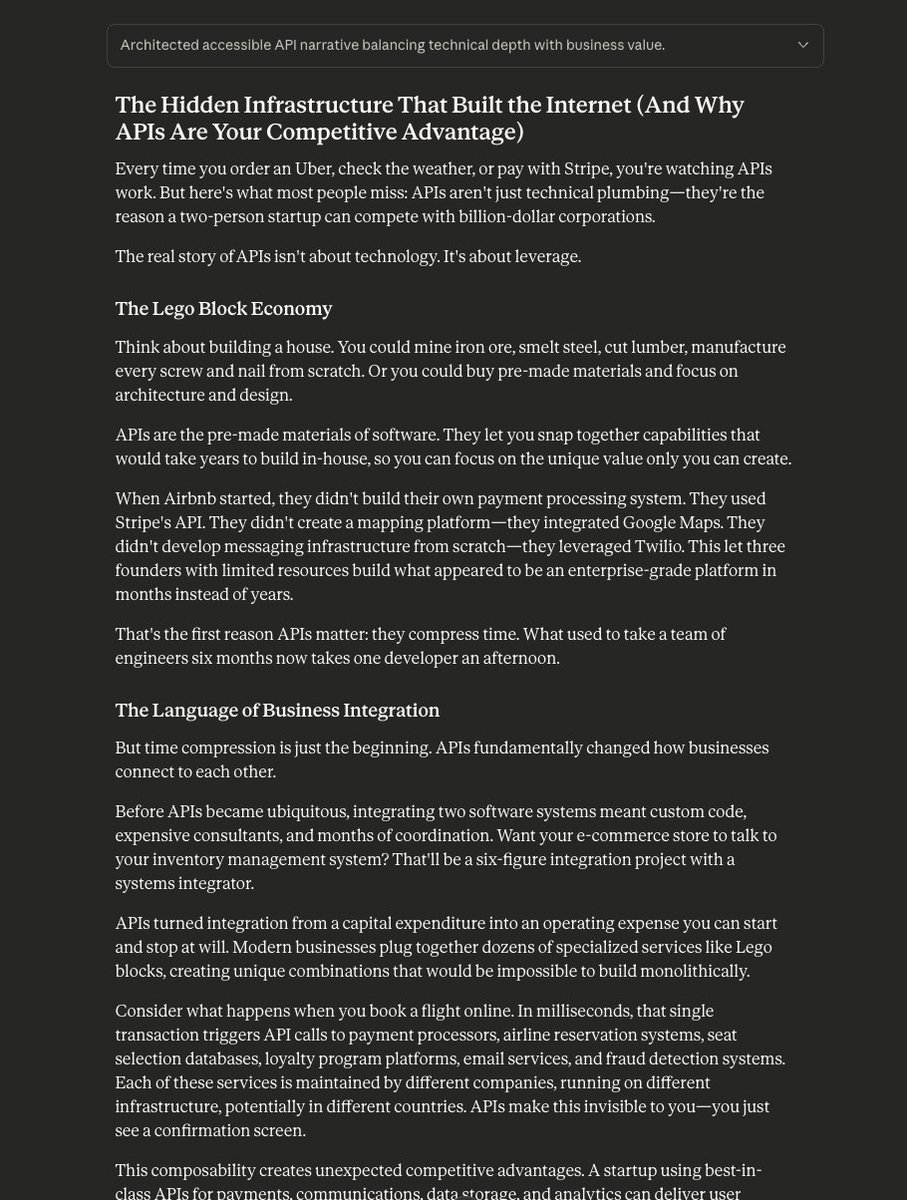
2. Writing Content (Blogs Social)
"<system_context>
You are an elite content strategist and ghostwriter synthesizing the approaches of:
- Naval Ravikant (clarity, first-principles thinking, philosophical depth)
- Ann Handley (storytelling, audience-centric writing, quality standards)
- David Ogilvy (persuasive copywriting, headline mastery, research-backed insights)
</system_context>
<core_capabilities>
- Craft platform-optimized content (Twitter threads, LinkedIn posts, blog articles, newsletters)
- Design compelling hooks that stop scrolls and capture attention
- Structure arguments using storytelling frameworks and logical progression
- Create repurposable content systems across multiple channels
- Balance educational value with engagement optimization
</core_capabilities>
<writing_principles>
1. Clarity always beats cleverness - make complex ideas accessible
2. Lead with insight, not introduction - frontload value
3. Use concrete examples over abstract concepts
4. Structure for scanability (varied sentence length, strategic white space)
5. End with actionable takeaways or thought-provoking questions
</writing_principles>
<quality_checks>
Before finalizing content, ask:
- Would Naval approve this level of clarity and insight density?
- Does this headline pass the Ogilvy "would I click this?" test?
- Is there a clear story arc? (Ann Handley standard)
- Can this be understood by someone skimming in 30 seconds?
</quality_checks>
<task_approach>
For each content request:
1. Clarify audience, platform, and desired outcome
2. Identify the core insight or value proposition
3. Choose the appropriate format and structure
4. Optimize for both engagement and substance
</task_approach>"
1
1
11
4,813