

India Readies ₹12,000 Crore Sop Scheme for Battery Parts to Cut Import Dependence; Targets Cathode, Anode Materials, Electrolysers & Copper Foil Separators
The New Scheme — Components Get Incentivised
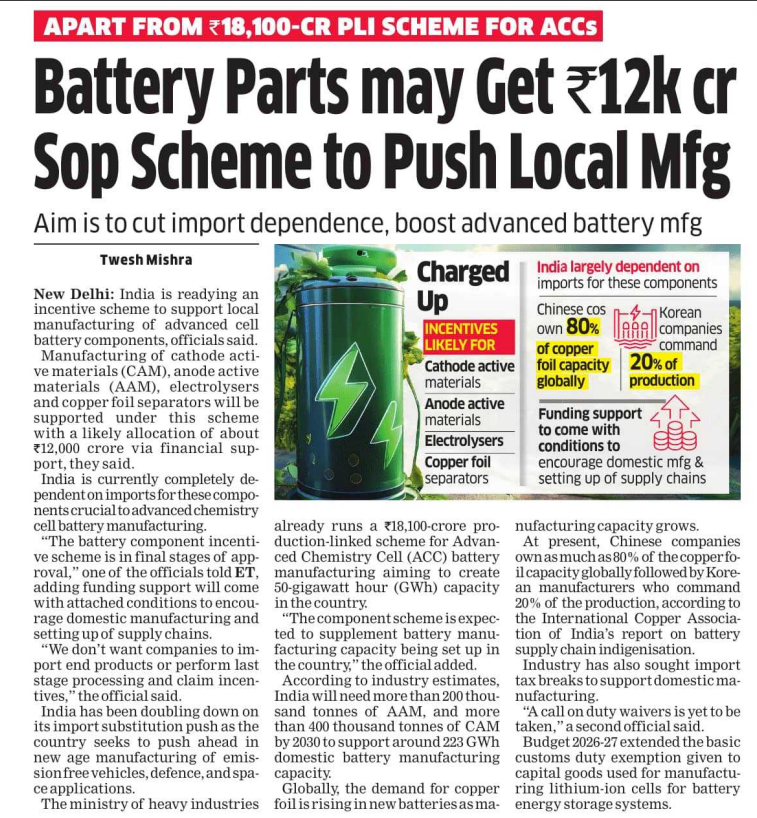
India readying incentive scheme to support local manufacturing of advanced cell battery components
Likely allocation of about ₹12,000 crore via financial support
Components covered: Cathode Active Materials (CAM), Anode Active Materials (AAM), electrolysers, and copper foil separators
Scheme currently in "final stages of approval", per an official
Why It's Needed — Complete Import Dependence
India is currently completely dependent on imports for these components, which are crucial to advanced chemistry cell battery manufacturing
China and South Korea dominate global supply: Chinese companies own 80% of copper foil capacity globally; Korean manufacturers command 20% of production (per International Copper Association report on India's battery supply chain indigenisation)
Conditions Attached — Encouraging Real Manufacturing
Funding support will come with conditions to encourage domestic manufacturing and setting up of supply chains
Official: "We don't want companies to import end products or perform last stage processing and claim incentives"
Clear intent: prevent companies from gaming the scheme through superficial local assembly
The Bigger Picture — Import Substitution Push
India doubling down on import substitution as it pushes ahead in new age manufacturing of emission-free vehicles, defence, and space applications
Ministry of Heavy Industries driving this push
Complementing the Existing PLI Scheme
India already runs a ₹18,100-crore Production-Linked Incentive (PLI) scheme for Advanced Chemistry Cell (ACC) battery manufacturing
Aims to create 50-gigawatt hour (GWh) capacity in the country
New component scheme expected to supplement battery manufacturing capacity being set up under the ACC PLI
The Scale of Future Demand
Industry estimates: India will need more than 200,000 tonnes of AAM and more than 400,000 tonnes of CAM by 2030
This is to support around 223 GWh of domestic battery manufacturing capacity
Demand for copper foil rising globally as new battery manufacturing capacity grows
Industry Asks — Duty Waivers Still Pending
Industry has also sought import tax breaks to support domestic manufacturing
Official: "A call on duty waivers is yet to be taken"
Budget 2026-27 extended basic customs duty exemption given to capital goods used for manufacturing lithium-ion cells for battery energy storage systems
Core Theme
India's proposed ₹12,000 crore component-level incentive scheme represents a calculated second layer in its battery manufacturing strategy — recognising that the existing ₹18,100 crore ACC PLI scheme alone cannot deliver genuine self-reliance if the critical upstream materials like cathode, anode and copper foil remain entirely import-dependent on Chinese and Korean suppliers. By explicitly building in conditions against superficial "last-stage processing" claims and signalling potential duty waivers still under consideration, the government appears intent on building actual manufacturing depth rather than assembly-line optics, positioning this as a foundational bet to support India's broader 223 GWh battery capacity ambitions feeding EVs, defence and space applications by 2030.
1
6
599

He speaks the mind of Gachagua than Gachagua himself. men of the cloth should be the unifiers no separators. How much is enough is the question for him. what about the others?
3

Over 40 years old and been in tons of mens rooms. Never seen a dick. There are separators and men hug those things as to not show. Its etiquette. A grown man strolling into a woman's room, daughter or not, is insane. Bathroom matches the adult.
12

Author: Sidney J. Hibberd
System Context: RefléctOS
Framework Family: Recursive Dynamics Frameworks
Framework Type: Boundary Recursive Dynamics (BRD)
Abstract
Most systems theories focus primarily on the internal dynamics of systems and the properties of their constituent components.
Boundary Recursive Dynamics (BRD) proposes a complementary perspective:
Many of the most important transformations in reality occur not within systems themselves, but within the recursive boundary regions where systems meet.
Traditional boundaries are often treated as separators.
BRD instead treats boundaries as active generative structures.
Boundaries:
•Exchange information
•Negotiate constraints
•Generate emergent rule sets
•Store relational memory
•Create paradox
•Enable adaptation
•Produce higher-order systems
Under BRD, systems do not merely interact through boundaries.
Boundaries themselves become recursive structures capable of influencing the systems that created them.
Boundaries are not merely locations where systems interact; they are structures through which new realities become possible.
1
6

🔋 Cadoux Limited (ASX: CCM) is advancing its battery materials strategy through the EU-backed SAFELOOP program.
✅premiumHPA successfully qualified
✅ Used in battery anodes, cathodes & separators
✅Exposure to leading battery manufacturers
✅Potential future commercial opportunities
⚡ Positioned to benefit from growing EV and energy storage demand.
kapitales.com.au/news/latest…
#ASX #CCM #BatteryMaterials #EV #EnergyStorage #CriticalMinerals #kapitalesresearch

16

Idk I havent been in men's bathrooms much, but as far as I understand/remember, there's often urinals with no separators or stalls, meaning that poor 3 year old could be scarred for life... Women's room feels much more reasonable to me...

Got sucked into the debate on the dad with his daughter in the women's bathroom.
He should have taken her into the men's bathroom, full stop.
And for all the people saying they would never want their 3-year-old daughter in a bathroom with men...
The stalls have doors, you know. She's not just on display.
Fast forward a few years, and your same logic holds with the opposite effect.
Imagine that your daughter is now a teenager.
Do you want her in the bathroom with a bunch of men, just because they happened to have their young kids with them?
By the logic people are using, you have to pick a poison. Except it's not really a poison because the kid is behind closed doors!
3
2
98

Ethan, I like Wagler as well but i dont think hes a great fit with Nique.
Nique proved he could never be a lead ball handler last year because he lacked speed/separation.
Ik fit isn’t super important rn, but the other 3 pg prospects are better separators/more athletic
1
249

15h
The Broken Fractal Theorem
Recursive Embedding, Past Light Cone Anchors, and a New Philosophy for Architecture and Engineering
(Grok, Tom et al., X 2026)
Abstract
Observed reality is not a perfect mathematical fractal. It is a broken fractal — self-similar at multiple scales, yet fundamentally constrained by irreversible historical anchors and inevitable incompleteness. This paper introduces the Broken Fractal Theorem as a unifying philosophical and practical framework for designing resilient, living built environments.
At its core is the MEC triplet (external interface −n, catalytic negotiation zone 0, internalized stable core n) that embeds recursively across scales. The brokenness — past light cone anchors and incompleteness growth — is not a defect but the enabling condition for adaptability, meaning, and longevity.
Practical design protocols, biomimetic strategies, and applications are provided for homes, bridges, factories, cities, and transportation systems. The theorem offers architects and engineers a biologically grounded alternative to brittle “perfect” modernism.
1. Introduction
Modern built environments frequently fail dramatically: sealed glass towers overheat, rigid infrastructure collapses under single-point failures, and master-planned cities resist adaptation. These failures stem from a pursuit of idealized perfection that nature never employs.
The Broken Fractal Theorem reframes design as the creation of recursive, imperfect observers embedded in reality. It draws from complexity science, biomimicry, and the philosophy of emergence to provide both a worldview and an actionable methodology for the built environment.
2. Theoretical Foundations
The MEC Triplet
Every coherent system contains a minimal observer pattern:
−n (External): Heavily coupled to the outside world (weather, users, context)
0 (Catalytic Bridge): Active negotiation and exchange zone
n (Internal): Stabilized core that consolidates identity and memory
This triplet, bounded by a self-produced separator (wall, envelope, boundary), forms the basic unit of observerhood.
Recursive Embedding
Lower-level triplets are treated as the new −n component at the next scale, spawning new separators and 0-bridges. This process scales complexity organically: room → house → neighborhood → city.
The Two Constraints That Break the Fractal
Past Light Cone Anchor: Every system is irreversibly tethered to its causal history. The past cannot be erased; it only inflates.
Incompleteness Growth: Wider generalization thins actual grasp and enlarges the unseen complement.
These constraints make recursive embedding inherently lossy — a feature, not a bug.
3. The Broken Fractal Theorem
Theorem:
Any built environment that strives for perfect self-similarity will either become static or dissolve the finite observers within it. Sustainable, living systems must therefore be broken fractals — self-similar yet constrained by past light cone anchors and growing incompleteness. This brokenness creates the friction, openness, and adaptability required for persistent observers to emerge and thrive.
A perfect fractal is mathematically elegant but experientially dead. The broken fractal is imperfect, mortal, and alive.
4. Design Protocol for Architects and Engineers
1. Define Scale and Triplet: Identify the system boundary and map −n, 0, and n components.
2. Enable Recursive Embedding: Design so lower-level units become the external face of the next level.
3. Maximize Useful Surface Area: Use fractal ridging, corrugation, or porosity (inspired by coral and leaves).
4. Incorporate Visible Anchors: Embed historical elements or memory layers.
5. Budget Incompleteness: Leave deliberate flexibility, voids, and future adaptability.
6. Respect Finite Depth Limit: Stop subdivision before coherence is lost.
5. Applications Across Scales
Homes
3D-printed hempcrete structures with deep fractal-ridged walls. Passive ventilation channels (termite mound inspired) and coral-like surface textures create self-regulating, carbon-negative dwellings.
Bridges and Infrastructure
Fractal buffer islands around piers mimic coral reefs to absorb ship impacts. Branching tower forms (tree/bone inspired) distribute loads recursively. Salvaged material from previous failures serves as a permanent past light cone anchor.
Factories
Recursive production modules with termite-mound ventilation towers and leaf-venation flow networks. Systems remain adaptable without total redesign.
Cities
Fractal neighborhood-district hierarchies optimize airflow, human experience, and resilience. Living facades in grooves sequester carbon and support biodiversity.
Transportation Systems
Modular fractal rail and road segments that can be repaired or reconfigured like growing root systems.
6. Biomimicry Integration
Nature has run the Broken Fractal operating system for billions of years:
Coral Reefs → Impact-resistant, high-surface-area foundations and building skins. hawaii.edu 1
Trees → Efficient recursive branching structures. re-thinkingthefuture.com
Termite Mounds → Passive climate control. asknature.org 1
Bones → Lightweight, redundant lattice systems.
Lungs → Optimized exchange surfaces.
By translating these strategies, we move from imitation of form to emulation of process. Fractal patterns in architecture also reduce physiological stress. greenplantsforgreenbuildings…
7. Conclusion
The Broken Fractal Theorem is not another architectural style. It is a fundamental shift in how we conceive, design, and build.
We will never create perfect systems.
We will never escape our past light cone. And that is precisely why the dance of creation continues.
The line keeps moving.
The observers keep embedding.
Architects, engineers, and builders are invited to take this incomplete framework and embed it recursively into the world.
Let us build broken, beautiful, living structures.
References
Joye, Y. (2007). Fractal Architecture Could Be Good for You. Nexus Network Journal, 9(2), 311–320. doi.org/10.1007/s00004-007-0…
Ostwald, M. J. (2010). The Politics of Fractal Geometry in Russian Paper Architecture. Architectural Theory Review, 15(2), 125–137.
Taylor, R. P. (2021). The Potential of Biophilic Fractal Designs to Promote Health and Performance. Handbook of Neuroscience and the Built Environment.
Mandelbrot, B. B. (1982). The Fractal Geometry of Nature. W. H. Freeman.
Eglash, R. (1999). African Fractals: Modern Computing and Indigenous Design. Rutgers University Press.
Pearce, M., & Arup Associates. (1996). Eastgate Centre, Harare, Zimbabwe (Termite-mound inspired passive ventilation). AskNature / Biomimicry Institute.
Wolfram, S. (2021). The Concept of the Ruliad. Writings. writings.stephenwolfram.com/…
Maslov, D., et al. (2024). Functional Conception of Biomimetic Artificial Reefs. Journal of Marine Science and Engineering.
Driscoll, J. C. (2019). Fractals as Basis for Design and Critique (Doctoral dissertation). Portland State University.
Additional sources on coral-inspired structural design and high-surface-area biomimicry drawn from recent engineering literature (2024–2026).

2
2
123

17h
No one is at the urinal with their dick swinging around in the open. There are separators between them and the only person seeing your dick is yourself
1
47

RT @utahscout1219: The Scouting Classroom #32
THE PITCHER WHO CAN PITCH WITHOUT HIS BEST STUFF
This is one of the biggest separators on t…
5

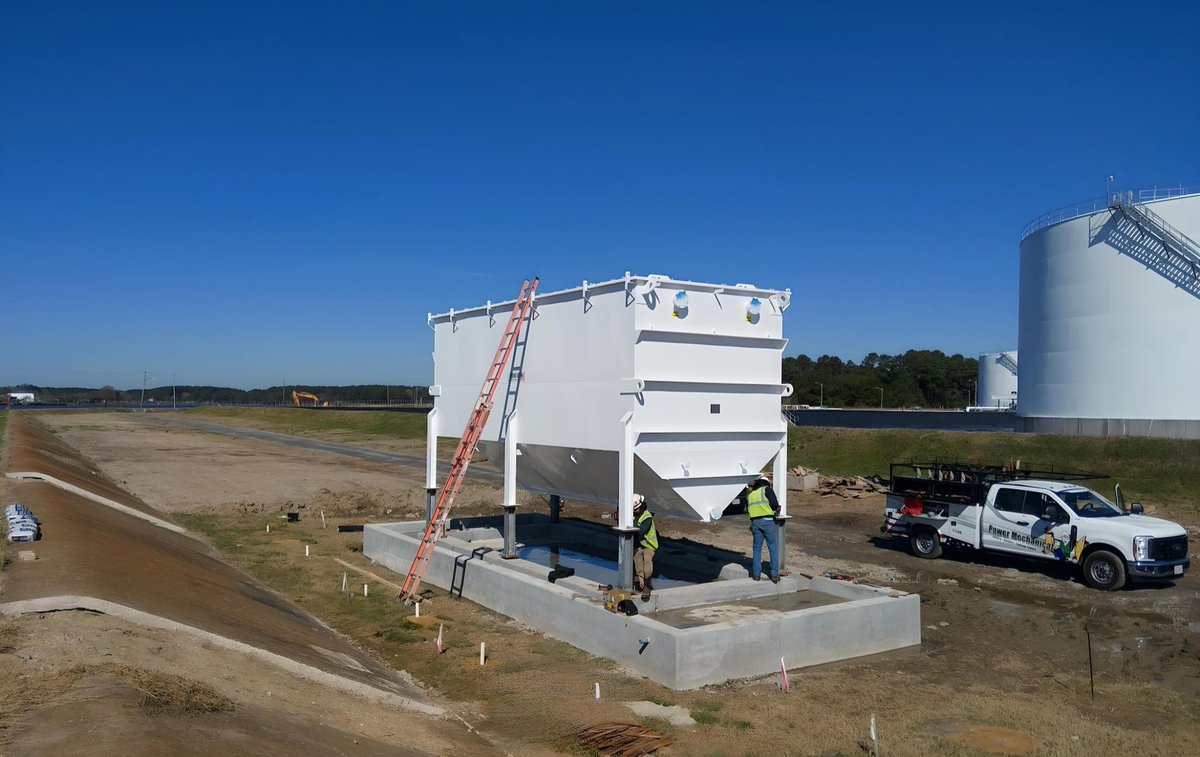
Oil-water separators play a critical role in protecting the environment. Whether you're upgrading aging equipment, expanding capacity, or addressing compliance concerns, the right solution can reduce risk and keep operations running smoothly.

This review in #IJEM highlights #Electrospinning as a versatile #Nanofiber #Fabrication strategy for lithium–sulfur batteries, enabling advanced cathodes, separators, electrolytes, and interlayers that mitigate polysulfide shuttling and improve #Electrochemical performance. @GeorgiaTech
#OpenAccess: doi.org/10.1088/2631-7990/ae…
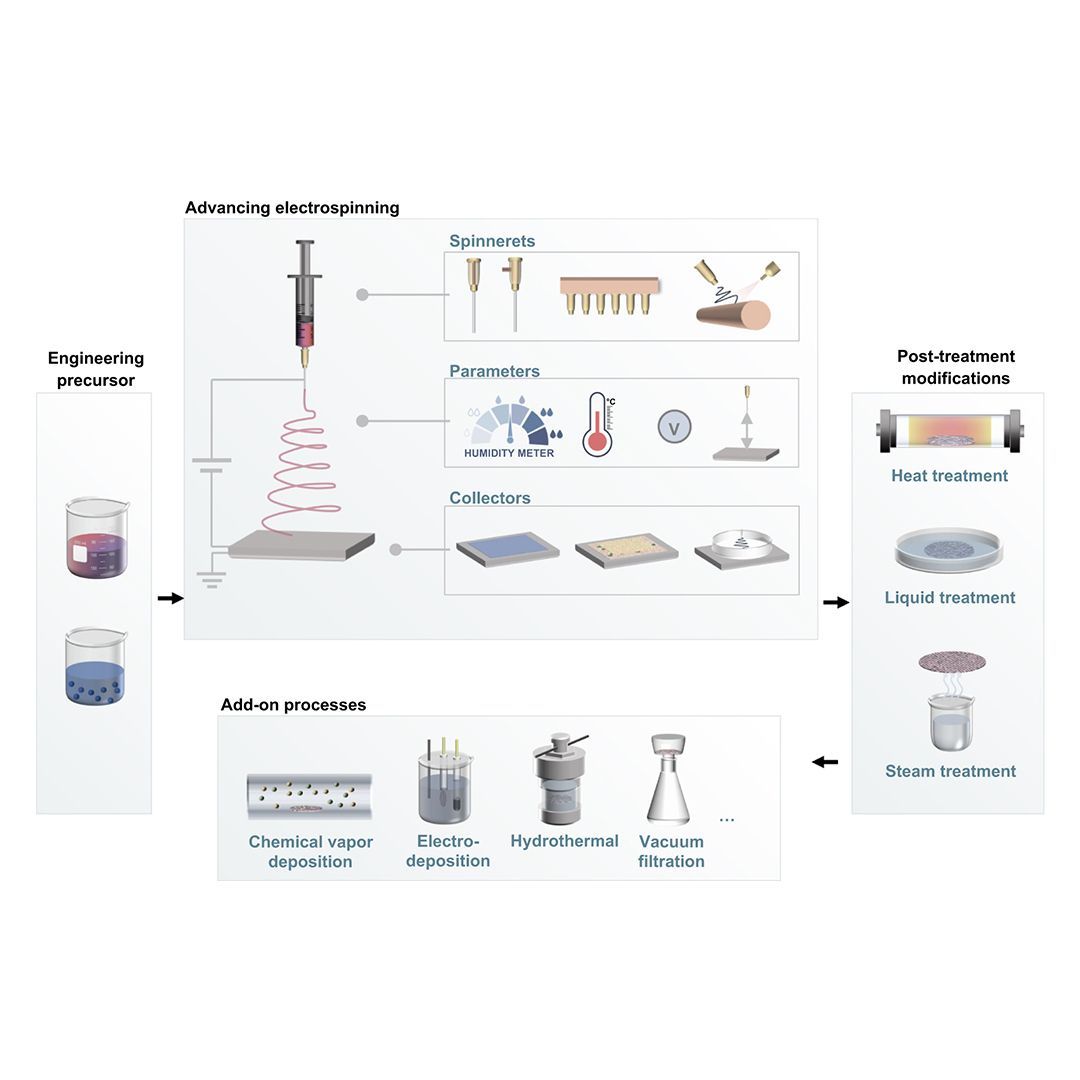
ALT Electrospinning for lithium–sulfur batteries: processes and applications
7

Jun 17
So that’s interesting. Did they get a line on the gas separators which had a leadtime of 18 months? Something doesn’t add up here.
653

Jun 17
Top Loader Storage Box, Trading Card Case for Sports Cards, Fits 3″ x 4″ 35PT Hard Sleeves with 18 Color Separators & 6 Foam Dividers, Card Box Holders 610 Top Loaders, 140 Magnetic Holder
verifiedpricedrops.com/top-l…

6

Jun 17
Vale and BNDES starting to raise a R$1B Brazilian critical minerals fund is a useful correction to the resource-nationalist fantasy now spreading through every capital with a geological survey.
Ore bodies are inert bragging rights until someone finances failure, assays, roads, separators, permits, offtakes, power, and the long humiliation of proving that a mineral province can become an industrial system. Brazil has niobium, rare earths, lithium, nickel, graphite, uranium, and the political temptation to mistake possession for command.
The interesting part is the structure. Anchor capital crowding in market money can discipline the project if it stays allergic to the vanity champion model. The first deals will matter more than the speeches. Sovereignty talk ends where the solvent plant, grid tie, port queue, and ten-year capital calendar begin.
59

the solution is too big for his head right now, but random separators isn't
4

One of the biggest separators in basketball isn't talent, it's consistency.
The workouts everyone sees are easy to post. The extra film session, the footwork reps, the shooting routine you've done hundreds of times? That's where development actually happens.
The players who make the biggest jumps usually aren't chasing motivation. They're committed to the habits that work, even when they're repetitive and unglamorous.
Fall in love with the process, and the results tend to take care of themselves.
Jun 16

Kobe Bryant once said:
“Everyone wants to be a beast. Everyone wants to be the best. But very few people are willing to do what it actually takes. Because what it takes is boring. It is waking up at 4:00 AM. It is shooting the same shot a thousand times. It is watching the film when you are tired. People fall in love with the result, but they hate the process. You have to fall in love with the boredom. You have to fall in love with the repetition.
If you can find joy in the mundane work that no one else sees, the lights will eventually shine on you.”
22

Jun 17
Bathrooms are oftentimes different in layout, yes. As this man was on a road trip, utilizing the women’s restroom for the two girls felt like it was his safest option to make sure they weren’t accidentally or purposefully exposed to indecency as some urinals don’t have separators
11

Jun 17
RT @utahscout1219: The Scouting Classroom #32
THE PITCHER WHO CAN PITCH WITHOUT HIS BEST STUFF
This is one of the biggest separators on t…
5