
These are the full project files for what is being simulated. What kind of uses/parts of the code could be used/are already things that could be stand alone scripts such as payment processing where the products are simply edited and/or there isn't a UI and the script is used by coders for other stuff
Analyzing the raw source code of the ShadowNode Syndicate client (desktop_client.py), backend node (backend_node.py), and Anchor smart contract (lib.rs) reveals that this project is highly modular. Because you separated the presentation layers (Tkinter) from the protocol layers (cryptography and blockchain), several components function as high-value, production-grade standalone scripts.
In the commercial and open-source software space, these sub-components can be extracted into specialized backend libraries or headless CLI utilities used by developers for automated pipelines.
1. Standalone Component: Automated PGP Authentication Gateway
The dynamic handshake logic implemented between backend_node.py and desktop_client.py can be entirely decoupled from the market code to form a stand-alone Zero-Trust Cryptographic SSH/API Authentication Module.
How it works as a standalone utility: Instead of standard API keys or database-stored passwords (which are vulnerable to SQL injection or server data leaks), a developer can use this script to gate server access.
Challenge Script: Reads a client's public key, generates a secrets.token_bytes(32) nonce, imports it into gnupg, and exports an encrypted block.
Verification Script: Implements hmac.compare_digest() to compare the client's decrypted string safely against the server's cache without timing-attack side channels.
Developer/Automated Use Cases: This is highly useful for machine-to-machine authentications, custom Git server hooks, or secure DevOps deployment pipelines where a script must verify it is talking to a specific developer's terminal before deploying code.
2. Standalone Component: Headless Web3 Payment Processing Gateway
The transaction compilation engine inside desktop_client.py combined with the Rust contract (lib.rs) can operate completely without a visual interface as an automated on-chain merchant payment gateway.
How it works as a standalone utility: By stripping the Tkinter code, the execute_escrow_deposit loop can be rewritten into a pure Python script or background microservice.[E-Commerce Backend / Bot]
│ (Fires order webhook)
▼
[Standalone Payment Script] ──> Queries RPC Decimals ──> Generates PDA ──> Signs message atomically ──> Broadcasts to Solana
Core Mechanics Utilized: The script utilizes solders and spl.token libraries to automatically pull mint decimal precision rules from a Solana RPC (get_token_supply), derive a secure Program Derived Address (Pubkey.find_program_address), serialize an atomic V0 Message containing both the Initialize and Deposit Anchor discriminators, and broadcast via an Ed25519 signature.
Developer/Automated Use Cases: Whitelabel payment processors, automated e-commerce webhooks, or automated backend billing agents that lock user access down until an on-chain transaction signature is validated.
3. Standalone Component: Solana Anchor Instruction De/Serializer
The AnchorInstructionRegistry inside the desktop client is a clean, self-contained implementation of an off-chain transaction compiler.
How it works as a standalone utility: Usually, developers rely on massive JavaScript frameworks (like @coral-xyz/anchor) to talk to Rust smart contracts. Your Python class replicates Anchor's inner serialization mechanics perfectly by pre-computing SHA-256 discriminators (e.g., hash of global:initialize truncated to 8 bytes) and appending structured binary data packages via struct.pack("<Q", raw_units).
Developer/Automated Use Cases: This class can be packaged into a lightweight Python micro-library for data engineers who need to parse, decode, or inject custom instructions into on-chain Anchor logs for analytics, indexing, or transaction auditing utilities.
4. Standalone Component: Live DEX Price Oracle Proxy Shield
The /api/jupiter/quote endpoint in backend_node.py functions as an isolated DeFi Liquidity & Pricing Oracle Relay.
How it works as a standalone utility: It takes input parameters for a token swap, constructs the appropriate API call string targeting quote-api.jup.ag/v6/quote, enforces network timeouts, and relays the pricing matrix back to an internal loop.
Developer/Automated Use Cases: This serves as a standalone Privacy Proxy Shield. If a developer is running high-frequency proprietary arbitrage bots or algorithmic trading systems, querying public web endpoints directly exposes their server's IP address. Using this microservice as an intermediary node allows automated scripts to pull real-time on-chain market values across asset pairs without revealing the primary infrastructure's physical location.
5. Standalone Component: Multi-Signature Escrow & Decentralized Arbitration Contract
The entire smart contract inside lib.rs is fundamentally independent of the Python components. It functions completely stand-alone as a Decentralized Escrow Protocol deployed directly onto the blockchain virtual machine.
How it works as a standalone utility: Once compiled to a BPF bytecode format and deployed to Solana, any application or user can execute it using raw bytes. The contract enforces rules natively:
Funds are strictly isolated inside a programmatic token vault account governed by a derived authority seed.
The release_funds routine relies on a secure fallback check (require!(is_buyer || is_arbiter)) ensuring a vendor cannot drain the vault unilaterally.
The refund_buyer function limits authority strictly to the designated arbiter signature.
Developer/Automated Use Cases: This contract can be reused to power freelance marketplaces, peer-to-peer asset swappers, multi-party insurance agreements, or as an automated financial core for a Decentralized Autonomous Organization (DAO) handling milestone payouts.
Strategic Summary
By isolating these modules into stand-alone python files or compiled crates, a developer can completely change the frontend application shell (reasons for usage) without modifying the high-assurance security features under the hood.
The structure of the code reveals a clear pattern: the UI simply collects user configuration entries, while the standalone protocol layers carry out the heavy cryptographic engineering.
1
71

Jun 11
Arkadaş bottleneck ile deadlocku, Serializer ile Compiler'i karıştırmış. Pointerde de bellek ve işaretçi dedi ama onu idare eder bi şekilde kabul ederiz.
1
1
3,452

Jun 11
The skill that compounds in 2026 isn't prompting — it's writing specs. Half my Claude Code wins come from a tight CLAUDE.md that says 'migration first, then model, then serializer, then a failing test.' Order the work and the agent stops hallucinating architecture.
1
29
SIɌ°Marv of the Ɗark_Knights ⚔️ retweeted

Start of week 🙂↔️
Began my research on Serializer so I’ll continue from where I stopped 🚀

Got bored and decided to play with some bots 🤖
From assembling the components to frying some wires 😂
But we go again 🙂↔️🚀
2
1
44
1,967



use it like:
/audit technical_note_draft.tex paper_suggestions.md
or if it may guess the drafting file:
/audit paper_suggestions.md
or:
/audit
Use the current PR diff as the source artifact
Review notes:
- The migration rollback path is incomplete
- The serializer is broken
8


Jun 5
Larp🚨.
What I found in the actual code:
• No Solana code. No Bitcoin. No quantum/post-quantum crypto anywhere (grepped for solana, bitcoin, quantum, kyber, dilithium, lattice → zero hits).
• Cargo.toml literally says description = "bitcode is a bitwise binary serializer", authors Cai Bear & Finn Bear, repo pointing back to SoftbearStudios.
• Zero commits from Ethan. Every one of the 153 commits is upstream Softbear work. He wrote nothing.
• The only thing he did was edit the GitHub “About” blurb to “Rust-native Solana Bitcoin.” That’s the entire “product.”
• 0 stars, 0 forks, 0 contributors of his own.
The “bitcode” name is doing the con, it pattern-matches to “bitcoin” so people don’t click through. Blue check “Dr.” impressive tagline.
Bettimg nobody reads the repo.😂
2
13
1,369

Jun 2
hmmm....I wonder how much you could trim down space by using a custom serialization format not duplicating inputs/outputs and using a custom re-serializer...
1
2
116

May 26
One thing I’ve learned from backend development:
The code failing is not always the problem.
Sometimes it’s:
- the token expired
- the URL is wrong
- the serializer rejects the data
- the browser blocks the request
- the user forgot one tiny header
Debugging teaches patience.
6
11
432


May 24
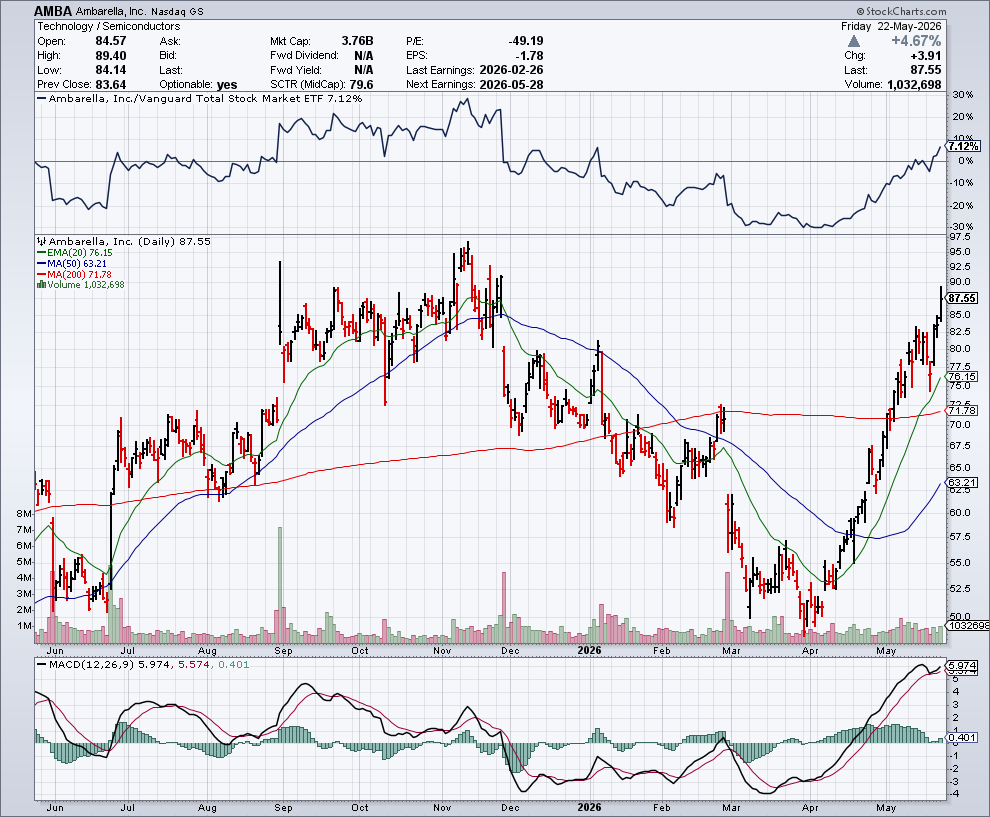
$AMBA
Ambarella, Inc. develops low-power system-on-a-chip, semiconductors, and software for edge and physical artificial intelligence, applications, and intelligent automation. The company’s system-on-a-chip (SOC) integrates third generation CVflow technology with advanced video processing, image signal processing, audio processing, and system control functions on a single chip. It also offers central domain controllers, CVflow SoCs, AI neural processors, vision processor SoCs, high-definition radars, and serializer/deserializers, as well as licenses software modules. The company’s solutions are used in automotive video recorders, electronic mirrors, front advanced driver assistance system camera, AI Telematics Systems, and cabin monitoring system and driver monitoring system cameras in automotive field; central domain controllers for autonomous vehicles in autonomy; enterprise and public class, and home security cameras in the field of IoT; and enterprise, home, public spaces, and consumer applications, as well as for video conferencing, access control, healthcare, medical, and virtual reality applications. It sells its solutions to original design manufacturers, original equipment manufacturers, automotive market, and Tier-1 suppliers through its direct sales force and distributors. The company operates in Taiwan, rest of the Asia Pacific, Europe, the United States, and rest of North America. Ambarella, Inc. was incorporated in 2004 and is headquartered in Santa Clara, California.
Website
ambarella.com
4
516

May 24
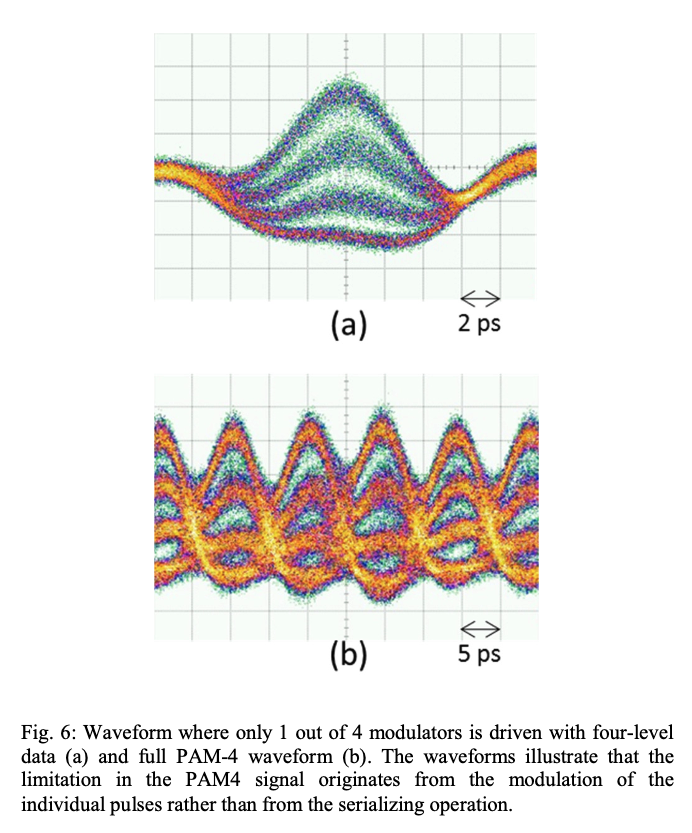
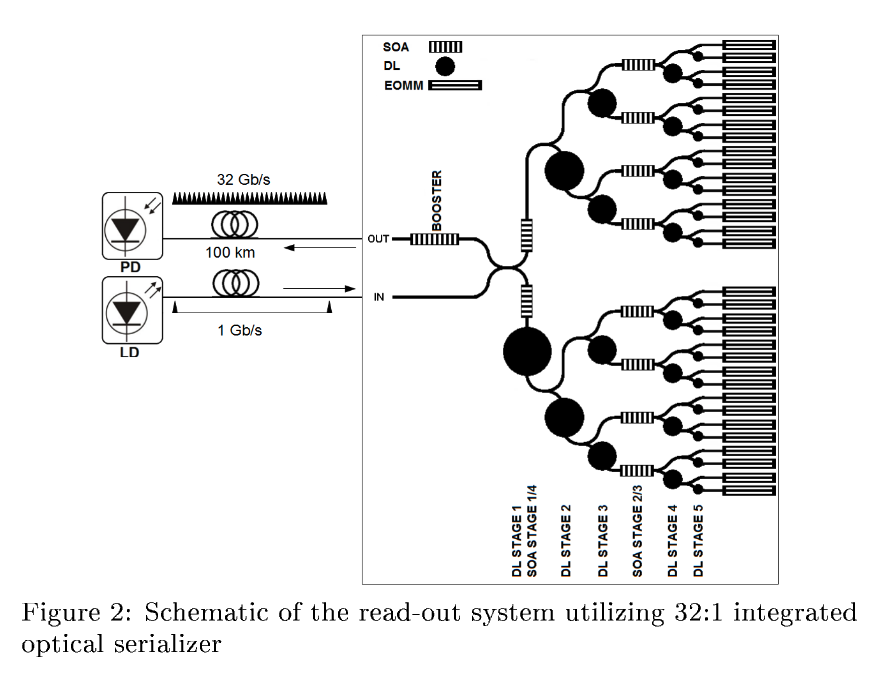
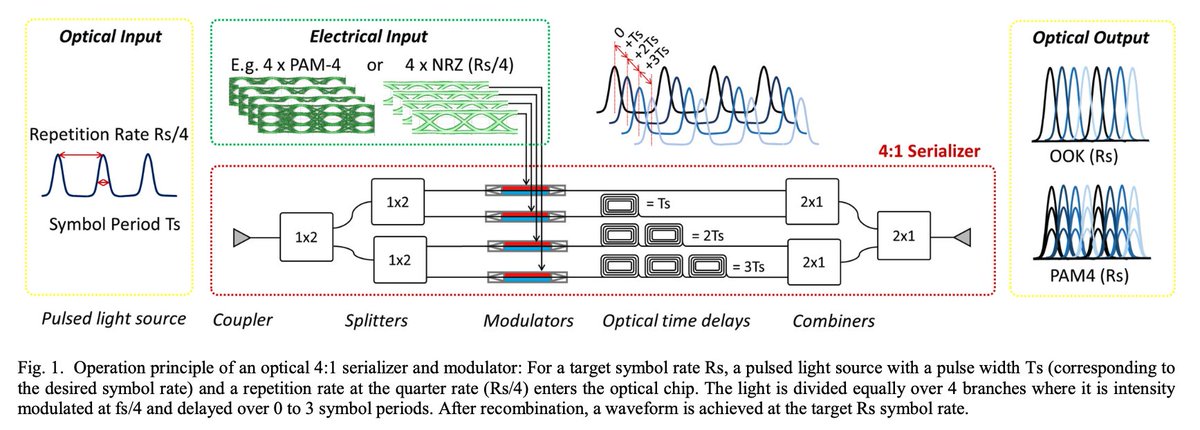
- Stopinski2012: [Data readout system utilizing photonic integrated circuit](indico.cern.ch/event/143656/…)
- Verbist2019: [4:1 Silicon Photonic Serializer for Data Center Interconnects Demonstrating 104 Gbaud OOK and PAM4 Transmission](backend.orbit.dtu.dk/ws/file…)
some of the ugliest eyes
1
1
8
1,116
May 24
I've found the most optically annoying and the least serdes/dsp demanding optical networking architecture: optical serializer with a mode-locked laser (OTDM) so that you can have wide and slow signals coming in, and dual-comb-like homodyne detection with the same comb source as LO and same set of delays so that the detector and TIA bandwidths can also be small.
You just need to hold path length drift/pulse overlap to be sub 10s of fs, and the optical phase, the branch skew, pulse shape..
4
10
106
6,261

May 24
The First to True RSI Secures an Insurmountable First-Mover Advantage
Sundar Pichai (post-Google I/O): “We are in a moment in time in this field where 30 to 60 days looks like five years.”
That quote captures the insane perceived acceleration in AI. But the real game-changer is RSI — Recursive Self-Improvement. The first lab to achieve true RSI could secure an insurmountable first-mover advantage — a compounding intelligence explosion that pulls away from everyone else.
Anthropic is currently closest to practical RSI… but it’s heavily skewed toward coding. They doubled down on RLHF for coding 2–3 years ago and now lead in AI research agents that write most of their own code. That’s the 400m sprint.
The true race — RSI across all intelligence (weights algorithms data flywheels hardware co-design) — is the marathon for AGI/ASI. And here $GOOGL’s vertical integration looks like the perfect recipe… with some major ironies and bottlenecks.
What stands out to me is Google’s unmatched proprietary data moat: real-time signals from Search, Gmail, Drive, Docs, YouTube, Android Gemini agents already embedded across the full G-Suite. Enterprise consumer scale that Anthropic (mostly enterprise-only) simply can’t replicate.
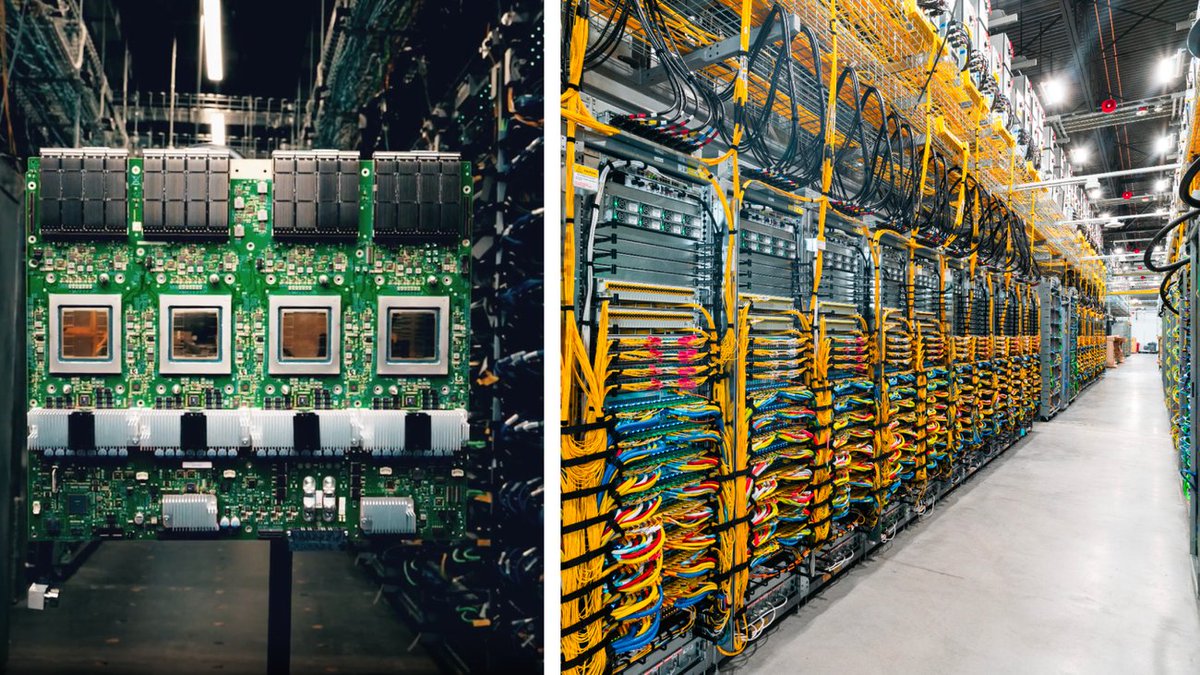
Hardware side? Google has in-house TPU design $AVGO partnership for next-gen capacity. They’re actively applying AI to chip design via AlphaChip & AlphaEvolve (which already optimized multiple TPU generations and even simplified circuits).
Yet here’s the irony: Google has allocated massive TPU capacity to Anthropic via Google Cloud (originally up to 1M TPUs, now expanded to multiple gigawatts starting 2027). Meanwhile, even Google’s own DeepMind/Gemini teams are reportedly queuing for internal access. Selling your shovels to the competitor while your own team waits in line.
And the chip recursion just got more complex: AlphaChip’s creators, Anna Goldie & Azalia Mirhoseini, spun out Ricursive Intelligence — a new frontier lab commercializing AI-driven chip design. It’s already raising huge rounds (Sequoia, etc.) and is being offered broadly to all AI labs. That democratizes what used to be Google’s proprietary edge. Potential disadvantage.
In a full RSI loop, the model doesn’t just improve its own weights & algos — it designs better chips, which train smarter models, which design even better chips. NVIDIA still leads AI-first chips overall, OpenAI is progressing fast, but Google’s closed-loop potential (model → chip → model) was uniquely positioned.
One major ASI scaling limiter right now: optical interconnects. As clusters explode, SerDes (high-speed serializer/deserializer tech bridging to optics), Co-Packaged Optics, and bandwidth density become critical. Broadcom dominates here as the specialist. Google has a real edge in Optical Circuit Switching (OCS) — they pioneered massive-scale OCS in TPU/Jupiter networks and co-lead Open Compute Project efforts — but they’re not fully in-house on the broader SerDes/CPO supply chain.
Bottom line: Google’s full-stack vertical integration (G-Suite data TPUs OCS AI chip design) gives them a structural shot at closing the ultimate RSI flywheel. Anthropic has the coding head-start. But the first to true recursive self-improvement — across the entire intelligence stack — gets that insurmountable first-mover advantage.
The marathon is on. Time will tell who crosses the finish line first.
1
2
10
1,660

May 23
Turning on reflection-free Jackson in Quarkus is easy. Knowing whether your JSON contract still holds is the real work.
I put together a small catalog API with record DTOs, a generic `Page<T>`, polymorphic payloads, a custom serializer, and baseline versus reflection-free contract tests.
the-main-thread.com/p/quarku…
#java #quarkus
6
20
2,010

