
Jun 15
John bought a field, it is a perfect square of 10×10 m²
So, he decided to recalculate the field.
He concludes that fields has -10 meters as side by squareroots.
🤷♂️🤔
The squareroots of 49 is -7
🤷♂️🤷♂️🤔🤔
3
35

Jun 13
I’ll propose, regardless of Moon and Mars ISRU oxygen production that pathos and snake plants are crucial in a CELLS like environment. All biological oxygen producing plants are primary for future soil production & oxygen generation. Nitrogen on Moon will come from Earth. Mars?
1
27
Jun 12
It generates ambiguous answers, because of this is avoided by mathematcians. See:
10×10=100
100^½=-10
🤔🤷♂️🤷♂️
You can't measure 100m² and say it's side is -10 meters, makes no sense.
The squareroots only return positive.
But the lv2 equation and functions return them.
1
7
Jun 12
Ok:
10²=10×10=100
(-10)²=(-10)×(-10)=100
100^½=|10|=10
No number to square is negative after the process of squareroot, it only gives positives.
Even Bhaskara uses the squareroots on Delta and later multiplies it by -1
In nature doesn't exist negative side to generate a square.
1
11
Jun 11
No, it's not.
The negative 10 is only for function of level 2, because it's a root of the parabole graph.
When it uses squareroots, are finding a Real number positive.
(x²)^½=|x|
(-10)×(-10) is 100 indeed, but the process only looks for positive numbers, except for Imaginary etc.
2
18

May 26
1/ Food for thought, @grok conversation starting with can a Hydroponics system like @squareroots be provided nutrients via ISRU on Mars? Surprisingly yes. I would want double the food capacity needed, in physically separated units for redundancy or damage to one part of the Settlement. @elonmusk @kimbal @tobiaspeggs
grok.com/share/bGVnYWN5_3116…
4
1
2
163

May 23
I don't know if you have to sign the exponent somehow. But in order of operations, it's sqrtx 4 = 10 so subtraction first. 10-4, 6. Then sqrtx = 6, 6^6. So x =36. This is really basic. Squares and squareroots. I feel sad people can't solve this.
1
12
9,073
May 21
Boring a Settlement @boringcompany (Maye Mt Basalt Plug, Mars)
We would begin with the ~9 km-diameter basaltic volcanic plug at Maye Mt. First, deploy small robotic precursor TBMs and Optimus teams to map fractures and build a real-time digital-twin stress model. Then bore a perimeter tunnel, followed by a series of cross tunnels spaced ~1.5 tunnel diameters apart for structural stability. Within these tunnels, backfill the lower portion with graded boring residuals (excavated basalt) that are sintered in-place for a level, low-dust surface for personnel and equipment; In the ceiling, install mounts for habitation systems infrastructure (power, water, air, waste management, data cables, etc.). Add multi-layer compartmentalization with blast doors/airlocks every 200–300 m, redundant utility trunks, and dedicated safe-haven pods.
For a larger settlement, I recommend fully independent ECLSS (Environmental Control and Life Support Systems/recycling systems) loops for different 10–20 person sectors rather than one overarching system. This modular approach—aligned with NASA deep-space habitat principles—ensures that a complete failure of any single ECLSS unit would not be catastrophic, since the crew can relocate to another section while repairs are underway. Cross-connections allow emergency sharing without compromising isolation.
From the cross tunnels, a smaller tunneling machine could excavate dedicated spaces for labs, apartments, medical facilities, recycling systems, stored air/water/waste tanks, and emergency Megapacks serving that specific section. Since this is a competent basalt plug, the entire process can be repeated downward across multiple levels to support increasing population, with vertical transport shafts linking floors.
I would distribute berthing (sleeping quarters) near workspaces to prevent congestion of the main corridors, while reserving a few dedicated logistics corridors for base operations, cargo movement, and heavy equipment. For larger open spaces such as greenhouses (@InterstellarLA @b_belvisi BioPod, @SierraSpaceCo Astro-garden, @squareroots @kimbal), use a denser set of more closely spaced cross tunnels interconnected to form the required larger volumes; route supplemental LED lighting and CO₂ piping directly from local ECLSS for hybrid bioregenerative efficiency. Vertical shafts would provide multiple surface egress points with rover charging and airlock access.
This architecture creates a scalable, fail-safe, radiation-shielded settlement that grows organically with Starship cadence and Arcadia Planitia’s ISRU resources. @elonmusk @rookisaacman @NASAMoonBase
May 18

🧪 Mars Settlement Deep Dive: Maye Mt (Erebus Montes) Starship Architecture Thread Summary. With NASEM-COPP feasibility for potential ZMBR classification. Full @grok analysis linked. @elonmusk @NASAAdmin @NASAMoonBase @dr_hendrix @ltelkins @DavaExplorer @redplanetrick @alder_riley @roydendsouza
Back in May, I posted about Maye Mt — a ~9 km-wide, ~600 m-high isolated basaltic plug in Erebus Montes, Arcadia Planitia — as a prime spot for a Boring Company-style tunneled radiation-shielded base near Starship landing ellipse EM-16. Planetary geologist @viciykevin delivered a masterclass CRISM analysis showing it’s a dust-mantled volcanic plug dominated by global ferrihydrite altered basalt. No exotic clays or sulfates at orbital scale — just competent rock perfect for excavation.
I took that and ran a full feasibility series with @grok :
✅ Tunneling & Shielding Maye Mt’s basalt is mechanically ideal. 2–3 m overburden drops GCR dose from ~234 mSv/yr on the surface to <10 mSv/yr (HZETRN-based model). Far better than regolith burial. Thermal stability is excellent underground.
✅ ISRU Propellant Hub at AP-1~450–500 km east, SpaceX’s top Arcadia candidate (39.8°N, 202.1°E) has ultra-shallow excess ice (cm-scale table under polygons) flat, safe landing terrain. Large-scale Sabatier electrolysis Methalox production here can refuel Starships for return flights and outbound missions.
✅ Multi-Site Network EM-16 for crew/cargo landings, Maye Mt for the shielded habitat core, AP-1 for propellant, with EM-15 and AP-11 as rover recharging waypoints. A ~500 km resource corridor connects everything.
✅ Asteroid Belt Synergy Per Taylor et al. (2022), Mars orbit/Phobos is a delta-v goldmine for Main Belt Asteroid access. Surface-produced Methalox makes frequent, reusable Belt missions economically viable — turning Mars into a true propellant depot for cislunar-to-belt commerce.
✅ Planetary Protection (NASEM CoPP 2021)Arcadia’s shallow ice means no relaxed bioburden, but the site is an outstanding human Exploration Zone. Precursor ZMBR characterization (SAM-like organic carbon assays to human-access depths) Agnostic Life Finder (ALF) screening of ISRU ice would confirm low biologic risk. Teleoperated Tesla Optimus humanoids UV-C LED sterilized rovers can then safely explore high-priority sites like Jezero Crater (~5,580 km away) from the Maye Mt command hub.
✅ Mars Surface Chemistry Bonus Intense UV perchlorate photochemistry creates a self-sterilizing surface. Radical yields (O(³P), O₂⁻, OH•, ClOₓ) reach 10¹²–10¹³ radicals g⁻¹ s⁻¹ under typical flux — inactivating Earth microbes in seconds to minutes while preserving buried organics. External robot surfaces self-decontaminate; internal UV-C LEDs add 4–6 log reduction in 1–30 s for full redundancy.
Bottom line: This is a highly feasible, integrated 2030s architecture — shielded living at Maye Mt, rapid ISRU at AP-1, responsible PP via ZMBR/ALF/UV-C robotics, and a propellant economy that scales to the Asteroid Belt. Combines Starship cadence, @Tesla_Optimus , and rigorous science into a sustainable Mars foothold.
Huge thanks to @viciykevin for the original analysis that kicked this off. Full technical breakdowns (shielding models, radical yields, CoPP alignment, etc.) are in my Grok chat history if you want the deep dive.
grok.com/share/bGVnYWN5_e16e…
x.com/viciykevin/status/2056…
2
3
512


Apr 13
Think you know radicals? 🤔 What happens when a square root hides inside another square root? Let’s break down √(50 √100) step-by-step in this quick math short. Perfect for sharpening your algebra skills! 💡
Double radicals, perfect squares, and simplifying like a pro. Can you solve it before the reveal?
👇 Comment your answer below!
#Math #Radicals #SquareRoots #LearnMath
1
3
30
2,767

This quick way is not accurate for other squareroots. Purely coincidental for the numbers used as examples
4
744

Today’s Schedule: return van used for SquareRoots, meeting with staff re AAA bike network report, final prep for Regional Council and this evening Regional Centre

3
137


18 Dec 2025
🌱noteを更新しました🌱
米国Square RootsとUAE最大級のアグリテック企業「Silal」がパートナーシップを締結。
砂漠の地で挑む次世代農業。
近い未来、日本の農業の支えにも繋がる挑戦が始まります。
x.gd/au9KF
#SquareRoots #agritech
3
116

17 Dec 2025
イーロンの兄、キンバル・マスクが本気で挑むのは「宇宙より先に食」。AI×屋内農業Square Rootsが日本上陸。1997年イタリアの気候を再現するバジル…もうSFじゃない。#スマート農業 #SquareRoots #食の未来 #アグリテック l.smartnews.com/m-6MZcMtGM/X…
1
64

12 Dec 2025
How Long?
17 2 is prime
17 2 4 is prime
..........
Is 17 2 4 ... 32 a prime?
See here math1089.in/mathematics-is-b…
#math1089 #math #maths #mathematics #alphametics #numbers #squareroots #Prime #primenumbers

1
2
6
2,271

26 Sep 2025
Solve for X
Solution:
youtu.be/vdUlJvpC7fY?si=0aXj…
#MathTricks #SquareRoots #MentalMath #PrimeLogic #MathOlympiad #SATMath #NumberTheory

5
1
5
656
23 Sep 2025
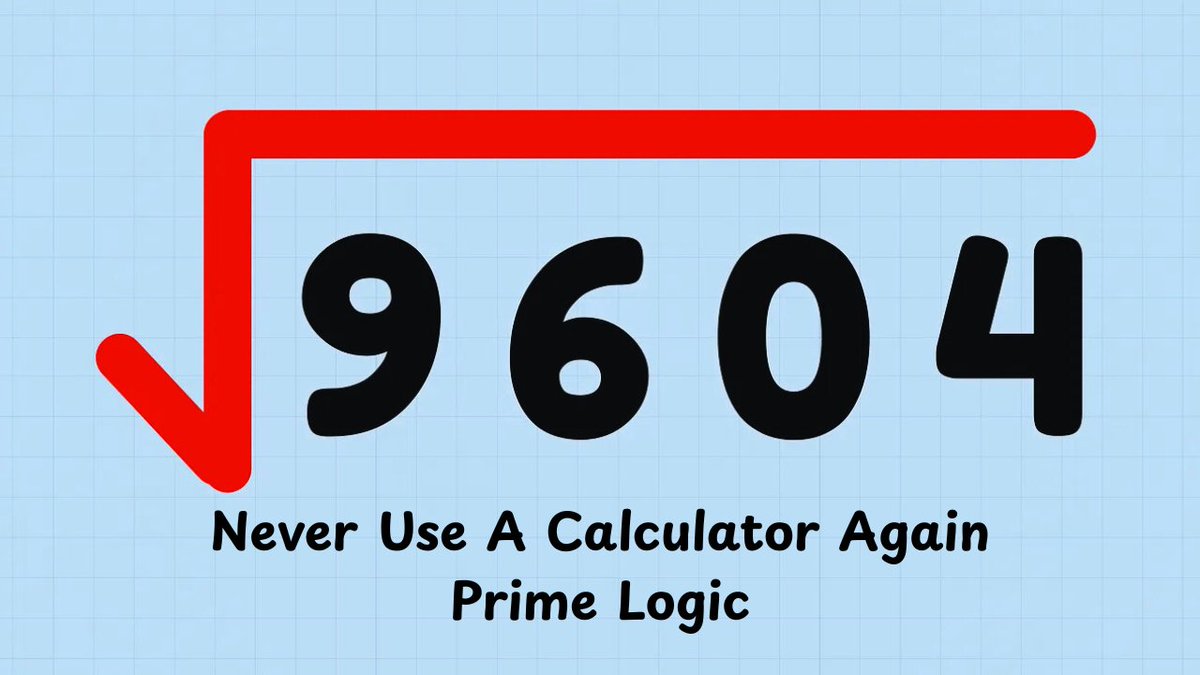
How to Find Square Roots of 4-Digit Numbers FAST | Mental Math Hack for Exams
youtu.be/6JHsPA8HdwE
#MathTricks #SquareRoots #MentalMath #PrimeLogic #MathOlympiad #SATMath #NumberTheory
1
3
242

4 Aug 2025
Perfect for WAEC, NECO, Checkpoint, and other key exams.
📞 For enquiries or to enrol: 08088844023.
🌐 Visit us: waniesacademy.com
👉 Don’t forget to like, subscribe, and turn on notifications so you never miss a class!
#WaniesAcademy #SquareRoots | 2025 WASSCE
2
102

11 Jul 2025
9 numbers? Only the numbers that are squareroots
1, 4, 9, 16, 25, 36, 49, 64, 81
7
4
41,471