
economictimes.indiatimes.com…
The article argues that the sudden U.S. decision to restrict access to Anthropic's most advanced AI models for non-Americans is more than a commercial dispute—it is a geopolitical warning. Even close partners of the United States discovered that access to frontier AI can be switched off overnight if Washington decides national security requires it. The event exposed how dependent much of the world has become on a handful of American technology companies and U.S.-controlled infrastructure.
The deeper message is that technological globalization has limits. Countries may be partners, customers, or allies, but when strategic technologies become involved, national interests come first. The Anthropic episode demonstrated that access to critical AI capabilities is conditional, not guaranteed.
For India, the shock is not merely about losing access to one AI model.
It is a reminder that a nation of 1.4 billion people cannot permanently build its digital future on technologies it does not control. If the most advanced AI systems powering research, education, healthcare, finance, governance, and defense remain externally owned, India remains vulnerable to decisions made in foreign capitals.
The immediate effects may include:
Increased urgency for sovereign AI infrastructure.
Greater investment in domestic computing capacity and data centers.
More support for Indian foundation models and research ecosystems.
Reduced complacency about dependence on foreign AI providers.
India has historically experienced technology denial regimes in areas such as nuclear technology, supercomputing, semiconductors, and defense systems. The article argues that AI has now joined that list. The difference is that AI is not just another industry—it is becoming a foundational layer for economic productivity, scientific discovery, military capability, and governance.
The key lesson is that technological sovereignty does not mean isolation. India will continue collaborating with the U.S., Europe, Japan, and others. But partnership is strongest when dependence is lowest. A country that can build, train, and deploy critical AI systems domestically negotiates from a position of strength rather than vulnerability.
India's AI Sputnik Moment?
This episode may eventually be remembered as India's AI Sputnik moment—a shock that exposed a strategic weakness and forced a national response.
The danger is not that America protected its own interests. Every major power does that. The danger is if India learns the lesson but fails to act on it. Nations that consume technology remain markets. Nations that create technology shape the future.
The health of India's long-term economic and strategic future will depend less on whether it can access the next American AI model and more on whether it can build world-class AI capabilities of its own. The Anthropic shock is therefore not merely a technology story. It is a sovereignty story, a development story, and a warning that in the AI age, dependence itself has become a strategic risk.
8


This week's PAI Spotlight covers two Texas organizations that couldn't look more different — and are working on the same problem from opposite ends.
The Houston Data and AI Meetup gathers a small, technically sharp group of data scientists and AI practitioners at the Ion in Houston's Midtown. No sales pitches. No slides. Just engineers working through the problems that come up when you're deploying AI agents in regulated energy industry environments.
Texas Tech just made headlines by becoming the first R1 public university in the country to acquire NVIDIA's newest Blackwell Ultra supercomputing system — a $25 million investment designed to make Lubbock a national hub for industrial-scale AI and to give Texas businesses access to frontier computing without going to a coastal cloud provider.
One is 17 people in a room. The other is a supercomputer built for a state. PAI explains why they belong in the same column — and what the gap between them says about where Texas AI actually stands.
Available online at 5:30 AM. Link below.
open.substack.com/pub/paisan…

13

Half of the people polled in Utah are strongly objecting to data centers. Needs to be a national moratorium on any more data centers. Do we really need more supercomputing to burn up our planet’s water supply?
54

Seymour Cray, father of supercomputing, founded Cray Research in 1972. Cray produced the Cray-1 supercomputer. A masterpiece of engineering, the Cray-1 rewrote compute technology from processing to cooling to packaging. hpe.to/6014BD8Qmm
1

SpaceX uses custom DGX Spark systems at Starbase. This isn't just about rockets. It’s about leveraging cutting-edge AI and supercomputing to advance space missions.
1
12

Philip Emeagwali - The creator of the INTERNET AND SUPERCOMPUTING
The greatest lie ever told “your spirituality is just for the pulpit, and Sunday morning preaching”
Anambra Nigeria 🇳🇬 is blessed
5
56

Mistral investi dans ses propres datacenters, à un moment il faut bien comprendre qu'à partir de 0 on n'a pas les infrastructures.
"OpenAI systems have run on an Azure-based supercomputing platform."
1
4
158
Defining the future of supercomputing El Capitan is #1 in the TOP500. No one runs faster than HPE. HPE powers the three fastest verified supercomputers on the planet. The next leap forward starts where AI, quantum and simulation converge. hpe.to/6017BD8b55
13

1. Indian companies are structurally disincentivized from building large foundational models due to a service‑first business model, limited long‑term R&D funding
2. Lack of domestic supercomputing scale
3. The gap is fixable with coordinated funding, infra & data program.

Why are Indian IT companies incompetent to build AI models?
Everyone is questioning Modi Govt instead of questioning our IT cos.
4

One of the coolest things about the Isambard-AI supercomputer is actually the cooling.💦
Go inside the UK’s fastest supercomputer. Prof. Simon McIntosh-Smith, director of the Bristol Centre for Supercomputing, leads the tour on HPE’s Technology Now.

You've got to see this. 👀 We toured the UK's fastest supercomputer, Isambard-AI, helping accelerate life-changing research.
Here's our up-close look with Bristol Centre for Supercomputing's Prof. Simon McIntosh-Smith, on HPE's Technology Now.
4
144

One of the coolest things about the Isambard-AI supercomputer is actually the cooling.💦
Go inside the UK’s fastest supercomputer. Prof. Simon McIntosh-Smith, director of the Bristol Centre for Supercomputing, leads the tour on HPE’s Technology Now.
You've got to see this. 👀 We toured the UK's fastest supercomputer, Isambard-AI, helping accelerate life-changing research.
Here's our up-close look with Bristol Centre for Supercomputing's Prof. Simon McIntosh-Smith, on HPE's Technology Now.
4
510

12h
From a "rest of the world" perspective, the Anthropic Fable restrictions matter even if they ultimately prove temporary. Whether these bans will sustain is secondary in my opinion; the bigger signal here is that frontier AI can now be selectively restricted for strategic/geopolitical/commercial reasons. This aspect alone changes how countries should think about technological dependence. Critics may argue that this could create a new digital hierarchy where a few western labs control the highest-end AI capabilities while countries like India remain downstream users of intelligence designed elsewhere. History too offers reasons for such concern, from cold war-era supercomputing restrictions to today's semiconductor export controls. If access to the best AI systems can be interrupted at critical/arbitrary moments, India could face vulnerabilities in defence, scientific research, advanced manufacturing, and core AI innovation itself.
At first glance, the counterargument, that India can still thrive by adapting and scaling global technologies, seems to accept India remaining primarily a "power-user" or deployer rather than a creator/innovator. But that conclusion may not be entirely correct. In the past, India has entered various industries through scale, operational efficiency, and market adaptation first, and and then gradually moving upward in capability. Reliance Jio did not invent telecom technology, but transformed internet access at population scale and reshaped digital economics. The UPI similarly did not invent digital payments; yet it created one of the world's most advanced real-time public payment infrastructures through deployment scale and policy innovation. China followed a comparable path, first integrating into global supply chains, then becoming competitive in several domains, such as EVs, batteries, fintech, and even AI.
Therefore, deployment scale itself can become a source of innovation power. For countries like India to achieve "AI sovereignty", the efforts can still focus on generating valuable data at scale (from diverse domains, such as healthcare, education, agriculture, languages, governance, and commerce), along with talent, operational expertise, and think of ways to channel all of these with economic leverage to eventually build frontier systems of its own. In that sense, being a "deployer" is not necessarily the final destination; it can also be the pathway to becoming a creator. The real danger is not temporary exclusion from cutting-edge models, but failing to use that period to build indigenous capability before the technological gap becomes permanent.
Jun 13

PM @narendramodi Sir we need an India AI Mission under you with @NandanNilekani as vice chair and others from the private sector and govt. to Help India tackle the AI Revolution. We are way behind and need a national mission to get going quickly. Existing govt programs are too slow, way too small to make any large impact. We need an annual 50000 cr fund for deep tech and AI, a 200,000 cr ELGS Guarantee Fund to build Hyper cloud, hardware and chips. @AshwiniVaishnaw @nsitharaman @PiyushGoyal @FinMinIndia @RBI We need a Very Large National Mission. @AmitShah @amitmalviya
2
8
156

@Gartner_inc's infrastructure and security trends for 2026 include AI supercomputing, confidential computing, pre-emptive cybersecurity, and the AI infrastructure reckoning around inference costs.
gartner.com/en/articles/top-…
5

India's #DataCentre & #AI Infrastructure Boom 🚀
#NETWEBTECHNOLOGIES CMP ₹4590
This stock already moved almost 150% last one year, valuation also high present price.
🔴Promoter & FIIs recently reduced holding.
✅India's Leading AI Server Company
✅HPC & Supercomputing Solutions
✅AI Infrastructure Beneficiary
✅ Direct Play on India's AI Revolution
❗️Support & Resistance..
🔽Downside expecting 3220 then 1980 levels
🔼Upside seeing 4750 then 5110..
📍Potential multibagger if India becomes a significant AI infrastructure market.
2
178

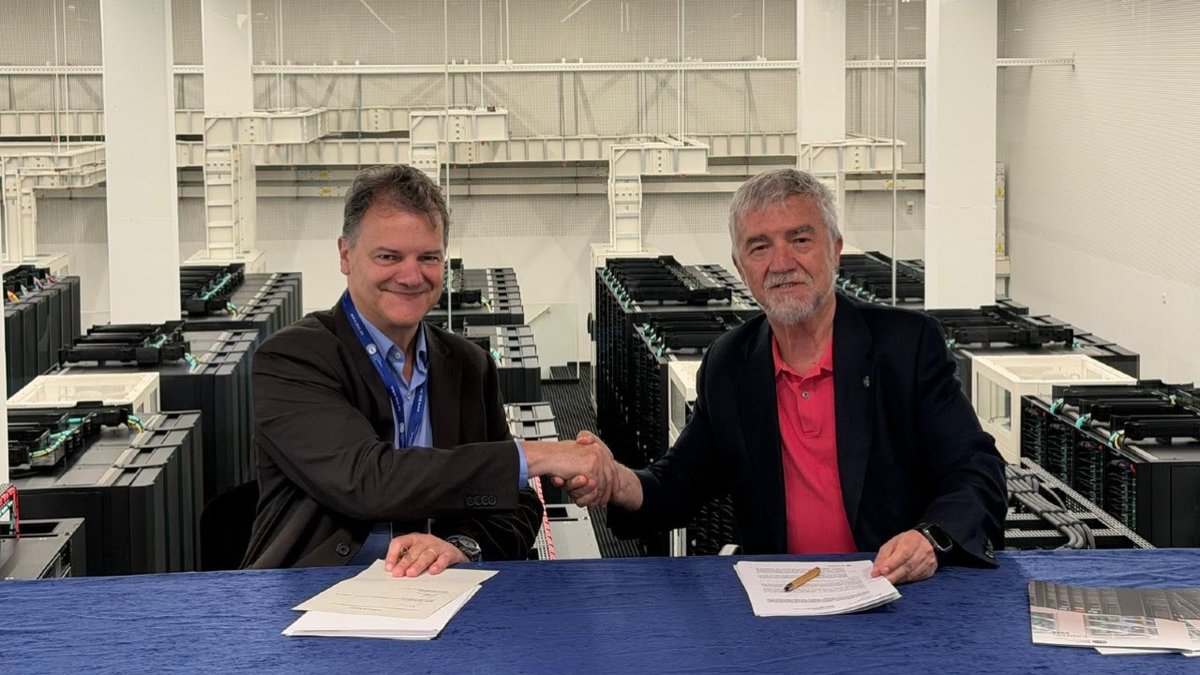
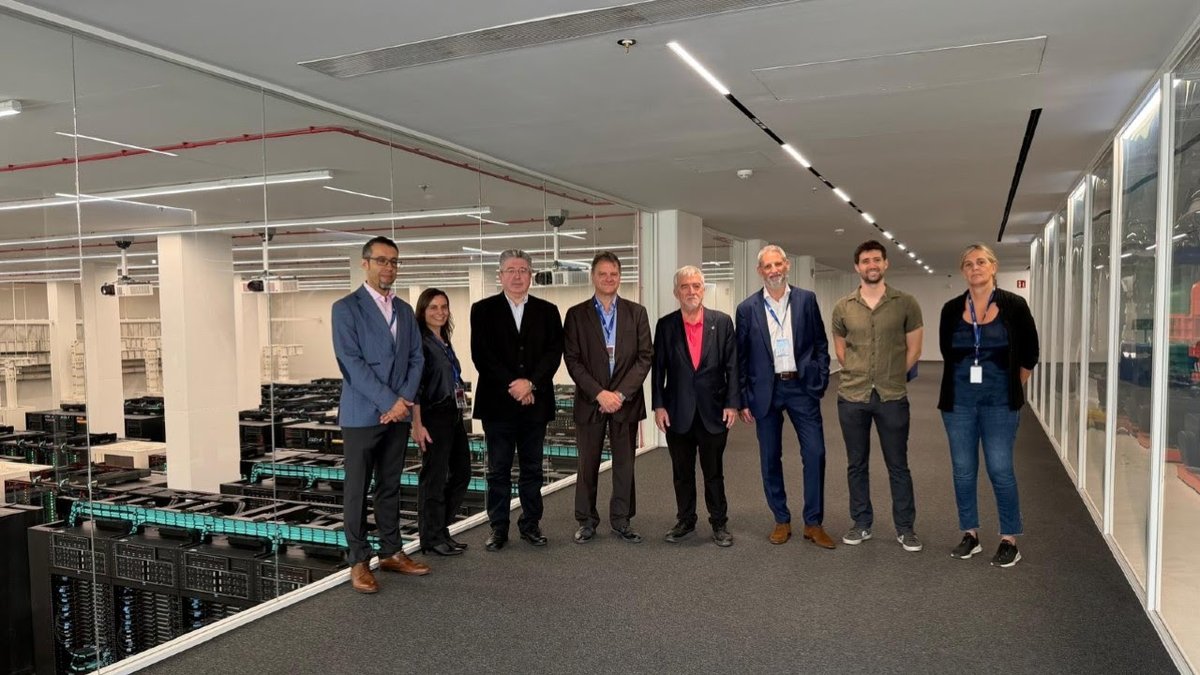
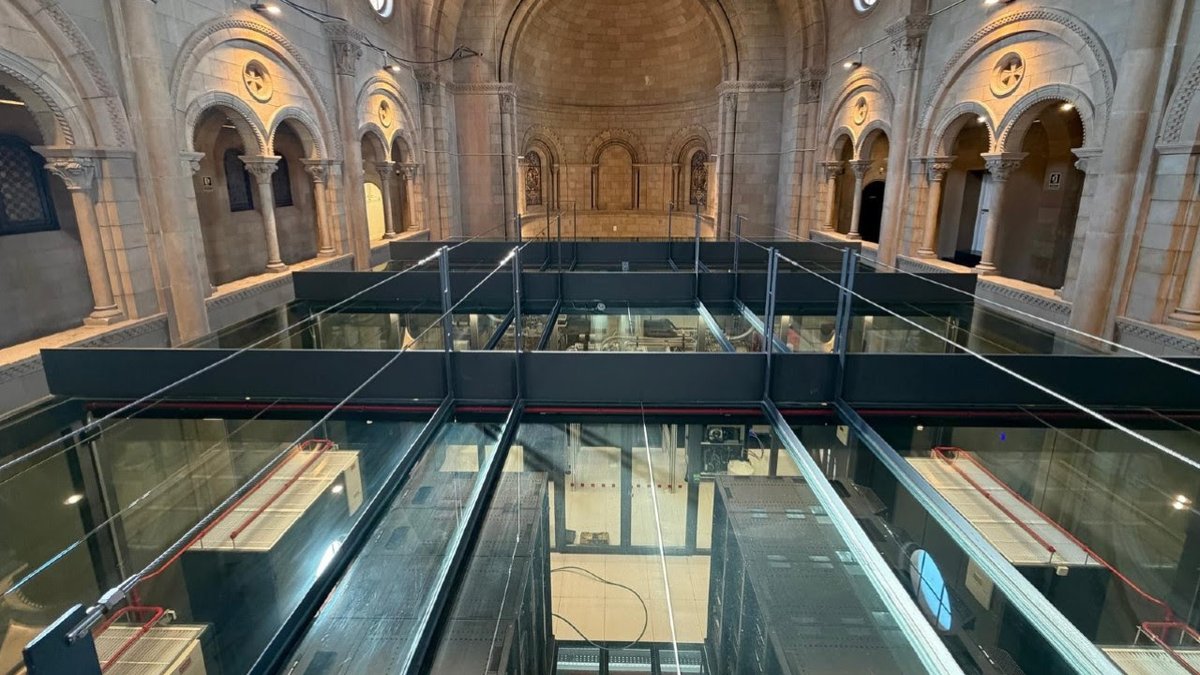
L’ACA i el Barcelona Supercomputing Center, inicien un projecte conjunt orientat a millorar la predicció de les inundacions
@aigua_cat @BSC_CNS #prediccioinundacions
monsostenible.net/noticies/l…
16
Cray-1, the first commercially successful supercomputer, spurred a new era of modern supercomputing that continues to thrive 50 years later. Cray-1 a catalyst for modern supercomputing driving breakthroughs & engineering possibilities, like AI and quantum hpe.to/6019BDB0Fl
2
Join HPE in celebrating the 50th anniversary of the Cray-1 supercomputer, a groundbreaking achievement that significantly advanced supercomputing-driven discovery and innovation. hpe.to/6019BDBLxT
10

(5/6)
youtube.com/watch?v=avkO4iSP…
* Gershom Martin — Electron Correlation: Nature’s Chemical Glue
* Tarak Karmakar — From the Schrödinger Equation to Machine Learning Interatomic Potentials
* Rahul Maitra — Generative AI/ML-Driven Approaches to Quantum-Centric Supercomputing
1
113

🚨 $CRWV JUST HIT A MAJOR AI INFRASTRUCTURE MILESTONE WITH NVIDIA’S NEXT-GENERATION RUBIN PLATFORM 🤖⚡☁️🏭
CoreWeave $CRWV announced it has completed the industry-first bring-up and validation of NVIDIA’s Vera Rubin NVL72 system, making it one of the earliest real-world deployments of NVIDIA’s next-generation AI factory architecture. (X (formerly Twitter))
This is a much bigger deal than it may initially appear.
🤖 WHY THIS MATTERS
The Vera Rubin NVL72 is NVIDIA’s next major AI supercomputing platform:
🧠 72 Rubin GPUs
⚡ 36 Vera CPUs
💾 Massive HBM4 memory architecture
🔗 260 TB/s NVLink bandwidth
🏭 Built specifically for agentic AI, reasoning models, and next-generation AI factories. (NVIDIA)
CoreWeave being first to successfully bring up and validate the system gives it an important strategic advantage.
🟢 THE SIGNAL TO THE MARKET
This announcement reinforces something investors are increasingly realizing:
👉 CoreWeave is not just renting GPUs.
It's becoming one of NVIDIA's closest AI infrastructure deployment partners.
NVIDIA previously confirmed CoreWeave would be among the first cloud providers deploying Rubin-based infrastructure. (NVIDIA Newsroom)
Now we're seeing that roadmap become reality.
⚡ WHY VALIDATION IS IMPORTANT
Anyone can announce future hardware plans.
Very few companies actually become:
✅ First deployment partners
✅ First validation partners
✅ First production-scale operators
Bringing up Rubin NVL72 requires:
🏭 Power infrastructure
❄️ Advanced cooling
📡 Networking
⚡ Rack-level orchestration
🤖 AI cloud software integration
This is one reason NVIDIA increasingly talks about:
🏭 AI factories
instead of simply:
🖥️ servers.
🌍 THE BIGGER AI INFRASTRUCTURE WAR
The AI race is increasingly shifting from:
🧠 AI models
➡️
🏭 AI infrastructure ownership.
The winners may not only be:
🟢 OpenAI
🟢 Anthropic
🟢 Google
🟢 Meta
They may also include companies controlling:
☁️ Compute
⚡ Power
📡 Networking
🏭 AI factory deployment
🔥 THE BULL CASE FOR $CRWV
Bulls increasingly believe CoreWeave is evolving into:
☁️ A next-generation AI hyperscaler
rather than a niche GPU cloud provider.
Key drivers:
✅ Early NVIDIA access
✅ Massive AI backlog
✅ Enterprise AI demand
✅ AI factory deployment expertise
✅ Deep alignment with NVIDIA's roadmap. (Yahoo Finance)
⚠️ RISKS
Important to stay balanced:
🔴 Capital intensity remains enormous
🔴 Debt and infrastructure spending are massive
🔴 Competition from AWS, Azure, Google Cloud and Oracle
🔴 Execution risk at hyperscale deployment levels
🔴 AI demand expectations remain extremely high
The market is pricing in substantial future growth.
💭 BOTTOM LINE
CoreWeave completing the first industry validation of NVIDIA's Vera Rubin NVL72 is another sign that the company sits very close to the center of the AI infrastructure buildout. (X (formerly Twitter))
The key takeaway isn't just the hardware.
It's that CoreWeave continues to establish itself as one of the earliest deployment platforms for NVIDIA's most advanced AI systems.
As AI factories scale from:
🏭 Hundreds of megawatts
➡️
⚡ Gigawatt-scale infrastructure
the companies capable of deploying and operating these systems may become some of the most strategically important players in the AI ecosystem.
👀 Key Question:
Could CoreWeave eventually evolve into a true AI hyperscaler alongside AWS, Azure, and Google Cloud — or will Big Tech ultimately dominate the AI factory era? 🚀🤖☁️📈
2
2
337