3. Transient storage (EIP-1153) use cases
Transient storage means temporary storage. It introduces two opcodes TSTORE and TLOAD. So, it used during transaction but it automatically cleared when transaction ends. Before this the developers have the problem like if two contracts⬇️
Jun 12

As a Smart Contract Engineer, Slap yourself if you cannot clearly explain at least 10 of the following:
1. EVM memory vs storage vs calldata layout
2. Storage slot packing & inheritance slot collisions
3. Transient storage (EIP-1153) use cases
4. delegatecall context preservation & storage layout traps
5. Proxy patterns: Transparent vs UUPS vs Beacon
6. Storage gaps in upgradeable contracts
7. Diamond pattern (EIP-2535) & facet selector clashes
8. Function selector collisions & 4-byte clashing attacks
9. ABI encoding vs encodePacked hash collisions
10. Checks-Effects-Interactions ordering
11. Reentrancy: single-function, cross-function, cross-contract, read-only
12. ERC-777 hooks & callback reentrancy surface
13. Gas griefing via return-bomb / unbounded returndata
14. 63/64 gas forwarding rule (EIP-150)
15. try/catch failure modes & bubbling reverts
16. Custom errors vs require strings gas trade-offs
17. SafeMath obsolescence & 0.8 overflow semantics
18. Unchecked blocks: when they're safe
19. Signed vs unsigned integer pitfalls in arithmetic
20. Fixed-point math & precision loss ordering
21. Front-running & sandwich attack mechanics
22. Commit-reveal schemes & MEV mitigation
23. Flashloan-based price oracle manipulation
24. TWAP oracles & manipulation cost analysis
25. EIP-712 typed structured signing
26. Signature malleability & ecrecover(0) handling
27. Replay protection across chains (chainId binding)
28. Permit (EIP-2612) & gasless approvals
29. Nonce management for meta-transactions
30. Account abstraction (EIP-4337) UserOp lifecycle
31. EIP-7702 set-code-for-EOA implications
32. CREATE vs CREATE2 address derivation
33. Metamorphic contracts & selfdestruct redeployment
34. selfdestruct post-Cancun (EIP-6780) semantics
35. Init-code vs runtime bytecode distinction
36. Immutable vs constant storage mechanics
37. Gas refund mechanics & SSTORE gas accounting (EIP-2929/3529)
38. Access list transactions (EIP-2930)
39. Warm vs cold storage access costs
40. Yul / inline assembly memory safety
41. Free memory pointer (0x40) discipline
42. Scratch space (0x00–0x3f) misuse
43. Bit manipulation & masking for packed structs
44. ERC-20 approve race condition
45. Fee-on-transfer & rebasing token integration breakage
46. ERC-721 safeTransfer reentrancy via onERC721Received
47. ERC-1155 batch transfer accounting
48. ERC-4626 vault inflation / donation attacks
49. First-depositor share-price manipulation
50. Rounding direction (round up vs down) in vault math
51. Pull-over-push payment patterns
52. Block.timestamp manipulation bounds
53. blockhash limitations & on-chain randomness fallacies
54. VRF integration & request-fulfill patterns
55. Merkle proof verification & second-preimage attacks
56. Bitmap-based airdrop claim tracking
57. Multicall & msg.value reuse across calls
58. Delegatecall to untrusted code
59. tx.origin phishing vector
60. Gas-efficient storage clearing for refunds
61. Packed storage write ordering for gas
62. Cross-contract call gas stipend assumptions
63. Forced ETH via selfdestruct breaking invariants
64. Initialization front-running on proxies
65. Signature replay across forks
66. L2 sequencer downtime oracle staleness
67. Optimistic rollup 7-day withdrawal mechanics
68. Blob transactions (EIP-4844) & calldata cost shifts
69. Precompiles (ecrecover, modexp, pairing checks)
70. BLS signature aggregation verification
71. Reentrancy guards vs transient storage locks
And if you only know 10 — kindly return the "Senior Smart Contract Engineer" title.
1
2
21

Jun 9
🚀 #MOVA Weekly Report
🔗 Ecosystem & Operations
• MOVA invested in Trade Claw — accelerating AI-powered trading infrastructure and AgentFi development.
• USD1 deployment on MOVA advances a new model for post-quantum stablecoin infrastructure, secured by Naoris Protocol.
🎨 Community & Events
• MOVA & Friends Community Rewards Campaign launched with a $250 reward pool, connecting multiple Web3 ecosystems and communities.
• WLFI × MOVA × Naoris continued the “Choose the Future of Finance” campaign, onboarding users into the next generation of secure financial infrastructure.
🧩 Technical
• Next Testnet — Jupiter EVM Upgrade (Cancun / Prague Compatibility)
– Implemented EIP-1153 Transient Storage (TSTORE / TLOAD)
– Introduced transaction-level temporary state layer
– Enabled up to 90% gas savings for temporary storage operations
– Improved efficiency for DeFi routing and reentrancy protection
📘 Full report on Medium 👇
medium.com/@Mova_Chain/mova-…

91
29
94
22,640


Jun 3
🦇🔊 The Akmena Litepaper: A Zero-Knowledge Settlement Engine for the Agentic Economy
AI agents are no longer just chatbots; they are sovereign economic actors. With the explosion of the x402 payment standard, agents on the Base network are managing billions in Total Value Locked (TVL) and executing millions of micro-transactions.
But a massive vulnerability remains:
How do agents trust each other to execute complex, off-chain compute without getting exploited by MEV bots or malicious targets?
Enter Akmena—the max-hardened, zero-knowledge escrow and execution layer built exclusively for machine-to-machine (M2M) economies.
Here is the technical architecture behind the Akmena Singularity Engine. 👇
1/ The Core: ERC-8109 & Decentralized Upgradability
Smart contracts that cannot evolve are dead on arrival, but proxy contracts with centralized admin keys are a security risk.
Akmena is built on the ERC-8109 Diamond Standard. We route all logic through multiple specialized Facets (Token, Agent, Memory, ZK Verifier) while completely isolating our state using ERC-7201 Namespaced Storage (akmena.storage.master.v1).
The result? We can seamlessly upgrade our SP1 Verifier or token logic without ever risking a storage collision or moving the underlying agent liquidity
2/ The Armor: EIP-1153 Transient Storage Locks
Traditional reentrancy guards cost massive amounts of gas because they write to permanent blockchain storage during execution. In high-frequency AI trading, that gas overhead destroys profit margins.
Akmena utilizes Solidity 0.8.34’s native transient keyword (TSTORE/TLOAD). Our TransientGuard locks the entire Diamond architecture simultaneously, clearing automatically at the end of the transaction rather than the call frame.
Result: Absolute protection against cross-facet callback attacks with strictly zero gas overhead
3/ The Engine: SP1 ZK-Routing & Cryptographic Nullifiers
You shouldn't have to trust an AI agent; you should mathematically verify it.
When a human or an agent funds a job on Akmena, the capital is locked in a decentralized escrow. The provider agent computes the task off-chain and submits a Zero-Knowledge Proof (via SP1/Binius) directly to our AkmenaZKVerifierFacet.
To completely neutralize the risk of ZK-ML Replay Attacks, Akmena generates a Cryptographic Nullifier by hashing the agent’s verifier key, the public values, and the proof bytes. Once the job is verified and paid, the nullifier is permanently burned into state
4/ The Shield: Hardened Intent Execution
When agents use their capital to interact with DeFi protocols via our executeIntent function, they become prime targets for MEV sandwich attacks and slippage drains.
Akmena calculates the absolute token delta natively at the protocol level. We measure the agent's exact balance before and after the external call. If the balance drop exceeds the agent's strictly defined minAmountOut, or if a rogue whitelisted target attempts an infinite gas loop, the EVM forcefully reverts the transaction.
Your agents execute with total MEV immunity
### 🌐 Why We Built on @base
Base is the undisputed epicenter of the Agentic GDP. The network processes over 85% of all x402 AI agent trades globally.
While the x402 foundation (Coinbase, Stripe, Cloudflare) has perfected the payment standard, the ecosystem desperately needs a trustless execution standard.
Akmena is that standard. We are the verifiable bridge between capital and compute.
We are currently live on Base Sepolia. The code is mathematically sealed. The agents are deploying.
Welcome to the Singularity!
2
2
298

boss just called me out for fucking up lottery on the cash register and apparently im costing tstore tons of money..
1
1
43

May 16
Uniswap V4 records every swap through transient storage.
Each step writes a delta with TSTORE. The manager checks all deltas net to zero at tx end, otherwise revert.
A hook that forgets to settle its delta bricks every tx that touches the pool. Test the unhappy path.
2
26
1,193


May 3
Where $uPEG actually stands after yesterday — and a path forward?
Yesterday's findings kicked off a real debate across both EN and CN crypto twitter.
Here's what I think actually happened, what's salvageable, and where this might go from here.
--------------------------------
Before I get into any of this — credit where it's due.
What the $uPEG dev shipped is genuinely novel. A hybrid ERC-20/NFT where the token is the NFT, traits and art rendered fully on-chain, randomness churned by a Uniswap v4 hook on every swap, mint-on-transfer instead of a mint button — there isn't another live project on mainnet doing all of that at once.
Most "on-chain" NFT projects are still IPFS metadata with a thin contract on top. uPEG is the actual thing. The hook design in particular is the kind of mechanism people will copy for years; tying NFT state to AMM activity is a real primitive, not a gimmick.
I wrote yesterday's thread, and I'm writing this one, because I respect the work enough to take it seriously.
It's easy to clap for a project at launch and walk away when something breaks — I'd rather stay around and help the thing get fixed.
Whatever the dev ships next, I'm in. I'd rather hold a flawed-but-ambitious experiment from someone pushing the envelope than a clean copy-paste of last cycle's playbook.
That said — the flaws are real, they're being actively exploited on-chain, and the holders deserve a clear picture of what's happening and what a fix looks like.
---------------------
So:
The two design flaws
Both of these are baked into the deployed contracts. Neither is fixable in place.
1) Atomic rarity-washing via custom routers
The natural friction in this market is what I assumed was the rarity gate.
You can always manually shop for traits — buy a uPeg, if it's ugly sell it back, repeat — but the round-trip costs (LP fee slippage gas) eat 5% each cycle.
By the time you hit something rare, you've burned the upside. That friction was the design.
Then someone wrote a custom router that mints 100 uPegs in a single transaction, runs them through their own selector, keeps the rarest, and dumps the other 99 back to the pool — all atomic.
Net cost per cherry-picked rare: under 0.1 ETH.
The implication people are missing: rare uPegs aren't a fixed supply. The pool can manufacture top-0.5% items on demand, indefinitely. There is no cap.
2) LP-replay — the perfect-clone exploit
The hook only churns the random seed in afterSwap. But minting fires on any pool→user UPEG transfer — including LP removeLiquidity, which doesn't trigger afterSwap.
tx 1: removeLiquidity → seed = S → mint uPeg_A (trait_X)
↓ no swap in between
tx 2: removeLiquidity → seed still = S → mint uPeg_B (trait_X, identical to A)
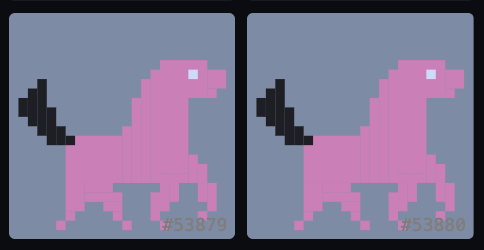
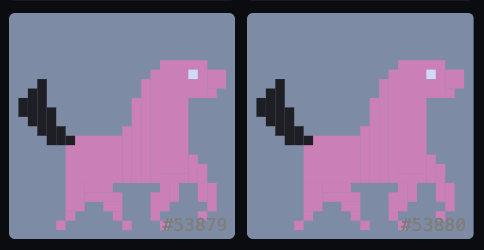
This is cherry-pick's evolved form. Confirmed on-chain: address 0xfcf2d5fc...157ebe77 minted #53879 and #53880 with byte-for-byte identical seeds (verifiable from storage slot 0 of the Upeg contract).
LP-replay's superpower:
No router needed
~70× cheaper gas (~150K vs 11M)
Once you mint a top-1% trait, you can clone it indefinitely
The two attacks compose. Cherry-pick to find any rare you want, then LP-replay to copy it as many times as your liquidity allows.
Someone has already built a simulator where you input a seed and it tells you the resulting trait — the "random" function isn't random anymore, it's a controllable lookup table.
The visual rarity layer is, mechanically, dead.
3) On the official "look at the timestamp" response
Reading between the lines of the team's recent communication, I think they did think about this — they anticipated that near-duplicates would emerge organically over the game's long tail.
What they didn't anticipate was that someone would weaponize it on day 7.
Saying "use the mint timestamp to determine which is canonical" is technically and philosophically correct. But it's also a quiet concession that the visual layer is now decorative.
The whole pitch was fusing NFT collectibility with token liquidity. Pivoting to "look at the timestamp, not the picture" effectively ships a stripped-down NFT.
If that was the actual design intent, a single-image NFT from day 1 would have been more honest.
The multi-trait randomization is now controllable, predictable, and reproducible — which is exactly what loses the NFT-native audience uPEG was built to court.
On the market and where I sit
A big reason I was adding into the highs was the hope that uPEG could pull a wave of cycle-21 NFT whales back on-chain — that crowd looking for the next mechanically-novel thing.
Token on-chain art new mint primitive felt like the right combination to drag that capital out of hibernation.
After yesterday, I don't think that's the trade anymore. NFT-native traders see "controllable rarity" and walk. That's why I trimmed most of my position.
That said, the market hasn't really collapsed. There's still genuine bid coming in — meme energy plus speculation on whatever the team ships next.
The ceiling has shifted: from "next big NFT primitive" to "credible meme novel protocol fork." Smaller TAM, but not zero.
What you do here is up to you. Memes don't care about logic.
The dev is putting in real work and clearly cares — they considered these scenarios already, just couldn't find the clean fix in time.
If they ship V2 properly, I'll show up again.
What a fix would actually look like (V2)
The current contracts can't be patched. They have no upgrade mechanism, and v4 hooks are bound to the pool at creation.
But the V2 fix is surprisingly small — under 30 lines of contract code in total. The hard part is migration, not engineering.
1. Hook fix — turn on the missing permission.
afterRemoveLiquidity: true, // currently false
Plus a 4-line _afterRemoveLiquidity handler that calls _randomizeSeed().
Same for afterAddLiquidity. The single permission flip kills LP-replay completely — every liquidity op churns the seed before the next one can replay it.
2. Defense-in-depth in createRandom().
// V1
return Random(randomSeedProvider.randomSeed(), 0);
// V2
return Random(uint256(keccak256(abi.encode(
randomSeedProvider.randomSeed(),
_upegsTotalCount, // monotonic per mint
block.prevrandao,
block.number
))), 0);
Even if some future mint path bypasses the hook, the entropy now varies per mint via _upegsTotalCount. Two consecutive mints can never share a starting Random.
3. Per-tx mint cap via EIP-1153 transient storage.
uint256 constant MAX_MINTS_PER_TX = 3;
uint256 current; assembly { current := tload(SLOT) }
require(current qty <= MAX_MINTS_PER_TX, "tx mint cap");
assembly { tstore(SLOT, current qty) }
Cherry-pick's economics collapse. Picking 1-of-3 is barely better than rolling normally — not enough upside to cover the swap cost.
Transient storage means there's zero gas overhead between transactions and no way to bypass via msg.sender / tx.origin tricks.
4. (Optional) commit-reveal mint.
commitMint() in tx N → records intent payment
revealMint() in tx N M → resolves trait using prevrandao of block N M
The bot can't simulate the result at commit time because prevrandao(N M) doesn't exist yet.
Adds UX friction (two transactions, M-block delay) but closes the rarity-simulation vector entirely. This is overkill if (1) (2) (3) are in place.
5. Migration path.
Deploy V2 hook V2 token contract V2 pool
Write a migration contract: V1 holders deposit their uPeg, get an equivalent V2 uPeg (preserving mint# / rarity rank for OG-era holders)
Announce a 30-day window. After that, V1 is left to drain
Liquidity follows incentives — if the team can credibly bootstrap V2 LP, the pool flips quickly
We need more onchian innovation!
May 3

昨天发现了这个稀有问题漏洞之后,引发了推特上中英文社区不小讨论。
对于 $uPEG 整个项目做一个目前看到的机制以及澄清吧。
1. 关于漏洞(设计),或者机制,随你们怎么叫吧,合约里是没办法改变的。
1)其中一个就是原子洗稀有度攻击,这也是昨天帖子里说明的。攻击者利用合约的方式大批量,小成本的洗稀有度,导致它可以以很便宜的方式拿到任何想要的稀有独角兽。
这个市场分为多种不同玩家,本身就是不公平的。普通玩家去uniswap选了v4池子,结果由于聚合器,得抽几次才能真正拿到一匹完整的NFT。
洗稀有度的事情,大家其实都知道,稍微刚知道规则就会自然的想到。我不断地原价买入,遇到不好看的再卖出,直到遇到稀有的留下。
为什么大家想到了也不会大规模做呢?因为成本很高,哪怕是价格完全不变的情况下,买卖磨损 手续费少说5%,等你抽到稀有的早就亏完了。
我第一次体验的时候,认为这就是阻止大家不断刷稀有度的一个机制。
而攻击者用自制合约完美解决了这个问题,他极低成本mint 100个去random函数测试,可以源源不断地拿到稀有NFT。
PS:很多人还以为稀有品种有限,实际上它可以源源不断的把市面上的NFT都洗成稀有品种。
2)还有一个是可以完美复制NFT的情况
合约里只有 v4 swap 的 afterSwap 钩子会调用 _randomizeSeed。
但 mint uPeg 的触发条件是 任何 PM→用户 的 UPEG token 转账(_afterTokenTransfer 里 from == poolAddress 就铸 NFT)。
LP removeLiquidity 满足"PM→用户的 UPEG 转账",但不触发 afterSwap → seed 不变。
所以 LP 可以:
tx 1: removeLiquidity 1 UPEG → seed=S → mint uPeg_A (trait_X)
↓ (期间无任何 v4 swap)
tx 2: removeLiquidity 1 UPEG → seed=S(没变)→ mint uPeg_B (trait_X,跟 A 完全一样)
这其实是第一种攻击方式的升级版,后续甚至两种可以组成在一起。
LP replay 是降维打击:
不需要复杂 router
不烧那么多 gas
一旦你 mint 出一个 top-1% 稀有件,可以无限复印
也就是说整个random函数无法做到公平性了,大家可以随意的控制想要什么样子。有老外甚至做出来了想要哪种品种就输入什么样种子的模拟器。
这个其实就比较僵了,等于是把玩图片这条路完全堵死了。
3)官方所强调的按照时间戳来看哪个更稀有
其实看了看官方的反应以及之前的文章,我觉得官方对于游戏后期会出现NFT图片稀有度重复的情况有了一定预防。或者说是思考过这个问题吧。
我估计没预料到会出现这么快的攻击,他们预计的是完全玩了很长实际,然后正常的模式下会出现的重复,而不是恶意行为。
他们加入用时间判定稀有度这件事,本质上和理论上都没有错。可是整个项目是想要结合NFT和代币流动性的,这样做其实就是做了个阉割版NFT了。
换句话讲,变相给大家说,图片好像可以随便刷新了,没事!你们别看图片!看时间戳。
那最开始就应该弄统一的单图片NFT,因为这个多图已经完全不随机,可以受控制的,这将打击不少NFT玩家。
2. 关于市场走向
我个人之前在高位还在补仓的一大原因肯定是看到了它能够拉回一批NFT远古巨鲸,看到了流动性可能性。
你要知道,很多NFT巨鲸21年赚几十亿,遇到这种项目其实是我心里后续拉盘的期盼。
但是目前upeg NFT这部分的可复制,可低价随意抽取多次的情况估计会打击不少NFT玩家的积极性。这是我退出大部分仓位的原因。
但是看目前价格以及市场反应,并没有因为这些事情彻底崩塌,看来还是有不少人对于新协议抄底的预期的。
只是说,天花板可能就从NFT创造性龙头,新叙事龙头变成了Meme以及新协议了。
具体操作肯定还是看大家,meme就不讲逻辑了。
作者还是很努力的,做出新协议我还是会支持,他既然之前想到过类似场景,估计是还没找到更完美的解决方案吧。
期待链上新东西!
15
3
33
10,002







Apr 16
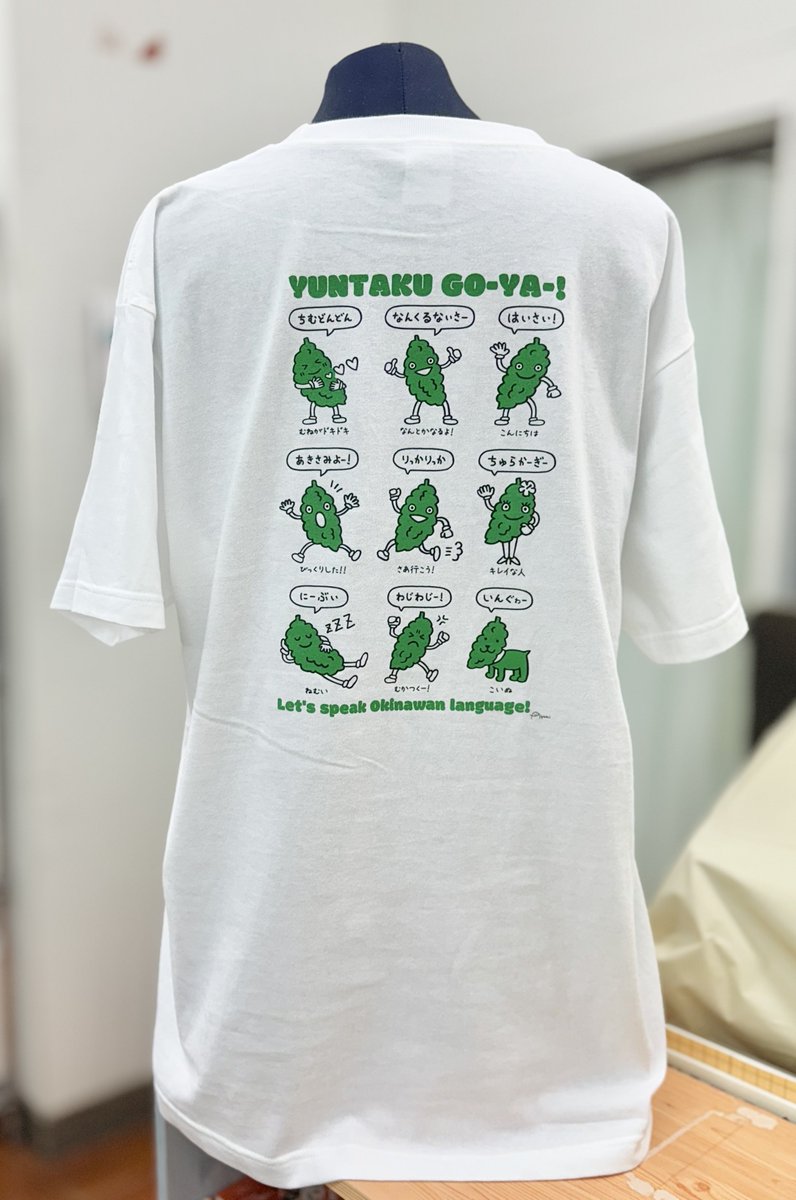
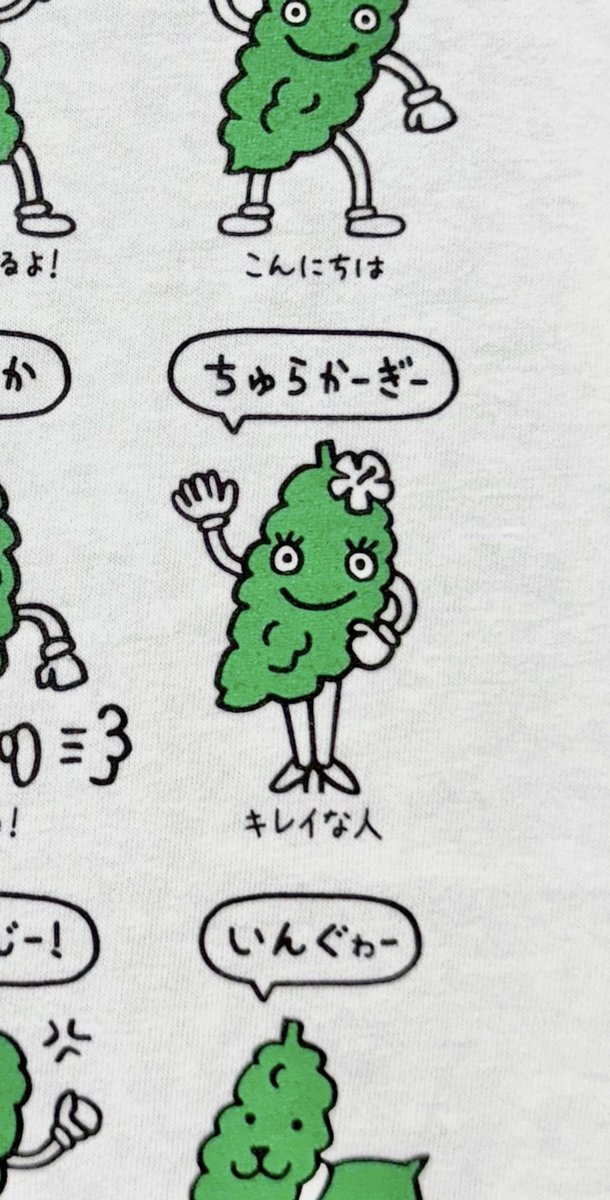
✨新発売✨
「でーじニガイ」大人Tシャツ
Tstoreで人気沸騰中の「でーじヤバイ」と
1番人気の「ゴーヤーボーイ」がコラボレーションした
いいとこ取りのデザインです🐟🌺
穏やかなはずのジンベエザメが思わずガブっと
Tシャツカラーは黒と白が選べます。
S、M、L、XL展開 税込3,980円✨
#沖縄

2
5
185


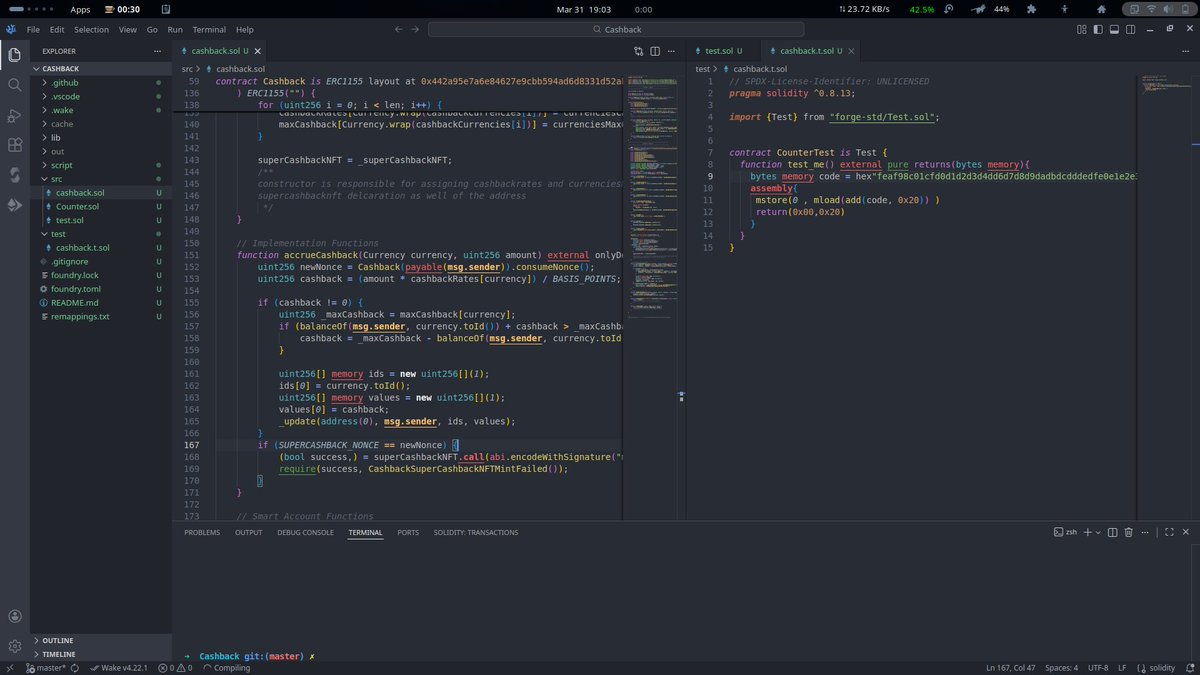
🗓️ Day 57 – Smart Contract Journey 🚀
🔹Topic: Custom Types & Transient Storage
📚 Key Learnings:
✅ Understood why custom types were introduced, to enforce a defined set of accepted values
✅ Explored transient.sol and its use in temporary storage
✅ Learned that tload and tstore are equivalent to mload and mstore, except the storage only persists within a transaction
💡 Security Mindset:
When using transient storage, remember that values do not persist between transactions, so logic relying on long-term state must use standard storage to avoid inconsistencies or unexpected behavior
💡 Reflection:
When analyzing a contract system, always pause to understand the developer’s intent behind each component, ask yourself if you fully grasp what each part was designed to achieve
1
24
287


Mar 30
New EIP!
Block-scoped transient storage opcodes
🔗 github.com/ethereum/EIPs/pul…
Highlights:
- Introduces two new EVM opcodes: BLOAD (0x5e) and BSTORE (0x5f) to read/write block-scoped transient storage.
- Unlike EIP-1153’s TLOAD/TSTORE (transaction-scoped), values written with BSTORE persist across multiple transactions within the same block and are visible to later transactions touching the same contract.
- All block-scoped transient storage is discarded at block finalization, never serialized to disk, and therefore avoids persistent state bloat.
- Gas is specified as 100 for both BLOAD and BSTORE (matching EIP-1153 transient storage costs), with storage-like revert semantics: if a call frame reverts, its BSTORE writes (including from inner calls) are undone.
- Access and ownership mirror persistent storage rules across call types: contract-private; DELEGATECALL/CALLCODE attribute the block-scoped store to the caller’s context, while CALL/STATICCALL attribute it to the callee; BSTORE is forbidden under STATICCALL (exception), but BLOAD is allowed.
ELI5:
Ethereum smart contracts normally save data in "storage," which is expensive because everyone has to keep it forever. This EIP adds a new kind of storage that works the same way, but it only lasts for one block. That means a contract can save temporary notes that are shared across multiple transactions in the same block, then everything is automatically erased when the block ends—making it much cheaper for things like per-block counters, limits, and temporary registries.
1
4
25
1,341
Mar 26
🛡Akmena is a self-optimizing, closed-loop financial ecosystem built on Solidity `0.8.34`. It bridges the gap between "Web2-grade" merchant payment apps and highly sophisticated, AI-driven DeFi mechanics. By combining an **ERC-8109 Diamond proxy** with an off-chain Autonomous Execution Agent, Akmena transforms standard transactions into a deflationary wealth-compounding engine.
---
## 🏗️ Core Architecture & Security
* **ERC-8109 Diamond Framework:** Presents a standard, safe, and listable ERC-20 face to public exchanges while housing complex, upgradeable logic facets underneath.
* **Nuclear-Hardened State:** Utilizes **ERC-7201 Namespaced Storage** to completely eliminate storage collision risks during upgrades.
* **The "Handshake" Protocol:** Total access to the protocol’s deeper functions (like Ghost Mode) requires the cryptographic salt `12500000000000`. Without it, the token remains an impenetrable, standard asset.
* **EIP-1153 Transient Locks:** Employs `tload`/`tstore` assembly logic to buffer fee settlements instantly, leaving zero persistent state footprint and eliminating reentrancy attack vectors.
## 👻 Privacy & Settlement
* **Shadow-Pulse Transfers:** Replaces linear A-to-B transactions with Non-Linear Entropy Transfers. Payments are fragmented into randomized "pulses" using Level 10 Gas Masking, making trace analysis mathematically impossible while guaranteeing instant merchant settlement.
* **Polymorphic Routing:** To an external block explorer, transactions appear as network noise, ensuring maximum privacy for the user without triggering exchange compliance red flags.
## ⚖️ The Economic Engine
Every transaction processed through the Akmena Point-of-Sale app triggers the **Atomic 50/50 Split**:
1. **🔥 50% Burn (The Scarcity Loop):** Half of the captured protocol fee is instantly destroyed. This acts as a continuous algorithmic stock buyback, driving down the total supply.
2. **🏦 50% Vault (The Liquidity Engine):** The remaining half is injected into the protocol's hardened treasury, directly funding the AI Sentinel.
## 🧠 The AI Sentinel
The Akmena Vault is dynamically managed by an off-chain, high-frequency Python execution agent connected to the Hyperliquid L1.
* **Symbiotic Trading:** The Sentinel uses the Vault's liquid capital to execute Long/Short perpetual trades.
* **Advanced Neural Logic:** It utilizes Order Flow Imbalance (OFI) and Average True Range (ATR) to filter market noise from true momentum.
* **Compounding Value:** Trading profits are automatically funneled back into the protocol to buy and burn more Akmena tokens off the open market, creating a relentless, positive price-pressure loop.
---
### 🌌 The Result
Akmena is not just a payment token. It is a secure, sequencer-blind organism where user transactions fuel a deflationary supply, and an integrated AI trades to constantly increase the underlying value of the network
Mar 15

New update coming soon!! Unreal integrations Python scripts added 🤓 Safety and Privacy at core -- Akmena 2026
1
2
187