
Generic winback flows just don't f*cking work.
Nobody buys again because we send an email 60-90 days after their initial purchase.
They buy when there's a reason.
So give them one. And it's different for every brand.
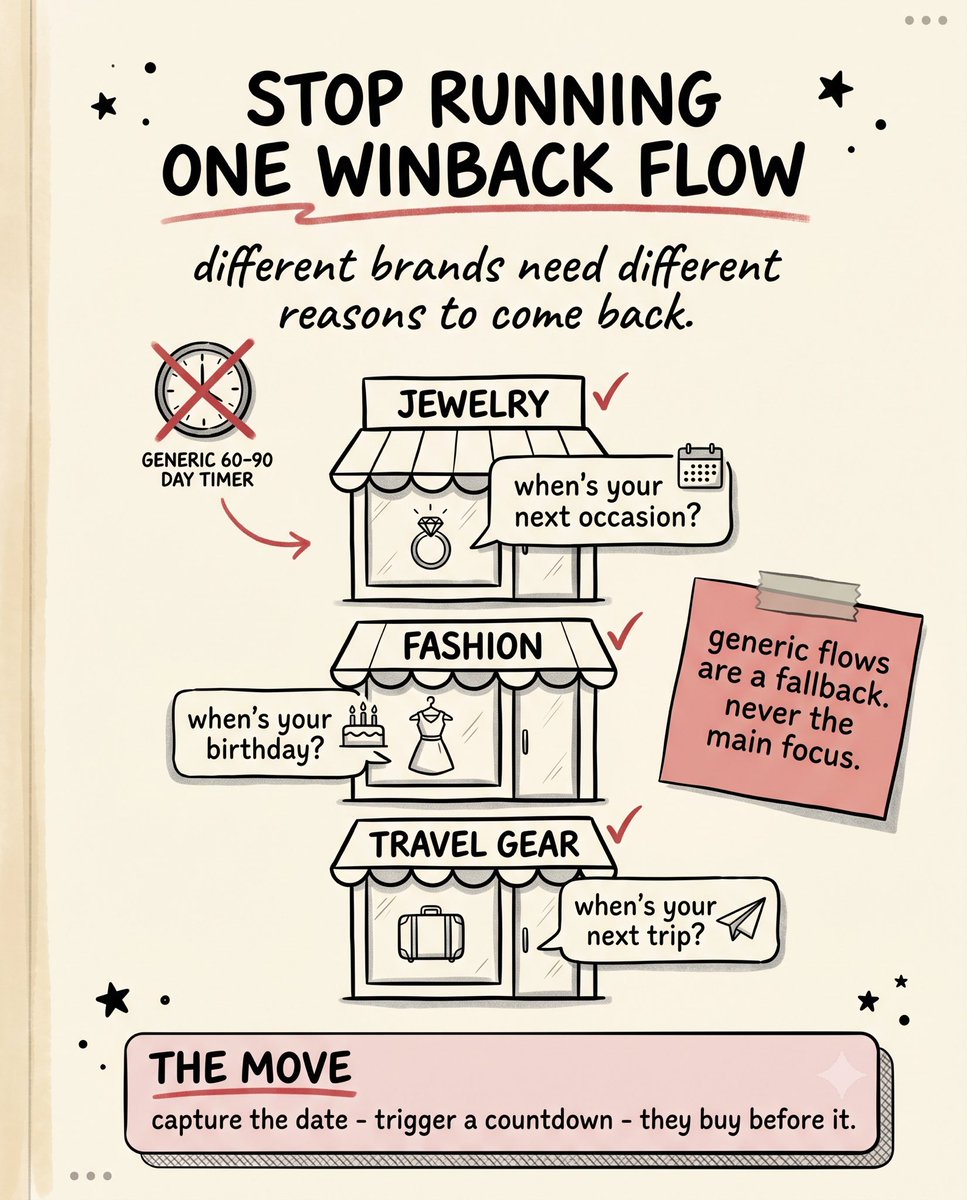
1. PERSONALIZED JEWELRY: When they return, show a popup that asks for their next OCCASION. Anniversary, friend's birthday, graduation day, etc. Use that date to trigger a countdown flow.
2. FASHION: Popup to capture their birthday. Now you have a reason for them to buy for themselves - they obviously wanna look their BEST on that day.
3. TRAVEL GEAR: Cross-sell on past purchases (e.g. backpack >> suitcase). But also capture their next TRAVEL DATE - then remind them to grab anything they're missing before the trip.
You get the idea.
Most agencies skip this because they reuse the same cookie-cutter template on every brand.
7

Klaviyo emails generate more profit per dollar than Meta ads.
Nobody talks about this because email isn't sexy.
You don't get to call yourself a "performance marketer" on LinkedIn for setting up a winback flow.
But the math doesn't care about your job title.
89

Jun 13
Join me, Hector L. Torres, for an exclusive Winback Clinical Immersion Tour in Florida. Experience firsthand how the Winback device can accelerate recovery and enhance patient care. This is an event you won’t want to miss. Reserve your spot now: docs.google.com/forms/d/e/1F…

2

A 7-figure Helsinki-based wellness brand had email generating 17% of total revenue and had been stuck at that number for almost a year despite consistent sending.
The team had tested new templates, refreshed campaign copy, and rebuilt the welcome flow twice.
When we ran a full retention audit the real picture became clear quickly.
Repeat purchase rate had declined from 28% to 19% over eight months.
The email revenue number had stayed flat not because the channel was performing well but because list growth had masked the deterioration in customer retention underneath it.
New subscribers were replacing churning customers fast enough to keep the revenue number stable. But the system was working harder to stand still.
The audit found three specific leaks.
1. Post-purchase sequence ending too early.
2. No replenishment flow despite a product with a predictable usage cycle.
3. A winback sequence that was triggering too late to recover customers who had already bought elsewhere.
None of these were visible in the top line email revenue number.
All of them were fixable once the right questions were asked.
We put together the email FAQ covering the most common retention questions we hear from founders at exactly this stage.
Where the hidden leaks usually live and what to check before assuming the channel itself is the problem.
Comment FAQ and I'll send it over.
31


Most DTC brands don’t die suddenly.
They die slowly.
One non-returning customer at a time.
At first, everything looks fine.
Revenue is growing.
Ads are working.
The founder feels like the brand has momentum.
But under the surface, there’s a leak:
Customers buy once.
Then they disappear.
So every month, the brand has to go back into the market and buy more new customers just to replace the ones who never came back.
This works for a while.
Especially when CAC is low.
Especially when the offer is fresh.
Especially when the market is still responding.
But eventually, acquisition gets more expensive.
CPMs rise.
ROAS drops.
Competitors enter.
Creative fatigue sets in.
Margins tighten.
And suddenly the brand that looked healthy starts feeling fragile.
The founder thinks:
“We need better ads.”
“We need more traffic.”
“We need a new offer.”
“We need better creatives.”
Maybe some of that is true.
But often, the real problem is simpler:
The brand never built a system that brings customers back.
It was not building a brand.
It was renting attention.
There’s a big difference.
A real brand compounds.
Every customer acquired today should make future revenue easier, not just create a one-time transaction.
But if customers buy once and vanish, every month starts from zero.
That is exhausting.
And expensive.
This is the leaky bucket problem.
Paid acquisition pours water into the bucket.
Retention keeps the water inside.
Most founders obsess over the faucet.
More traffic.
More ads.
More creators.
More landing pages.
But they ignore the holes.
No post-purchase journey.
Weak email follow-up.
No second-purchase path.
Poor segmentation.
Generic campaigns.
No winback system.
No real customer memory.
So the business gets addicted to new customers.
And the more it grows, the more expensive that addiction becomes.
The fix is not to stop acquiring customers.
Acquisition matters.
The fix is to stop treating the first purchase like the finish line.
It is not.
The first purchase is where retention begins.
Before scaling spend, every DTC founder should ask:
What percentage of customers buy again?
How long does it take them to buy again?
What happens after the first order?
How much revenue do we make per email recipient?
Are we giving customers a reason to remember us?
Because if the answer is unclear, growth will eventually feel harder than it should.
Not because the market hates the brand.
But because the brand is paying to acquire customers it never properly follows up with.
That is how most DTC brands slowly die.
Not from one big mistake.
From thousands of missed second purchases.
1
3
116

The only controller I was able to pull off a pistol headshot-only run in Winback
2
157

Subscription platforms mostly compete on billing. @GetStayAI competes on what happens after the subscription exists: the offer that lifts order value, the cancel flow that saves the subscriber, the winback that brings them back, and the analytics that tell you which of those actually worked. After the Recharge acquisition of Skio in April, Stay is also one of the few serious independents left.
caffeinecommerce.com/blog/st…
4

Jun 11
Hi Harneet! I was saddened to hear that you have decided not to accept the offer from our Winback team. You mentioned that it was escalated to our customer service team, I am wondering how long ago was that? ^ BE
4


Jun 10
omalla kohdalla hassan tarjos vikana päivänä samaa diiliä, minkä olivat laittaneet jo aiemmin. Ei taida Elisan Winback-tiimi olla enää ihan kärkihyökkääjiä täynnä.
780

Jun 10
Partly. It's BaseRival...F4 S4[TTY,CYF, AY, ASY CM,RI,HBJ,WZY]
PrimeTTY Win PrimeF3 S4. TTY ez all inc Akane&Fei2 except ASY LXR&CloseMatch May Marin. Similarity,ASY scare AY-CYF-CM&KGE. Ofcoz WTF23 GS ASY#1 win but SF injury TTY#ranklow winback. Both Prime BAC21 F TTY won ASY.
1
2
224
Brands kill their winback flow too early because they measure it against the wrong benchmark.
A winback flow converting at 8% looks weak compared to a welcome flow converting at 12%.
But a winback flow is talking to people who already stopped caring.
8% of a disengaged segment is not underperformance.
It is revenue that would not have existed without the flow.
Judge retention automations against the alternative of doing nothing, not against acquisition benchmarks.
18

Your winback flow is probably costing you more than it's making you.
Most brands run a 3-email sequence:
"We miss you."
"Here's 10% off."
"Last chance."
That's not a winback strategy.
That's training your customers to wait for a discount.
What actually works:
Segment by last purchase date, not just last open date
Someone who bought 90 days ago but hasn't opened is different from someone who never bought at all.
Lead with curiosity, not desperation
"You haven't tried X yet" outperforms "We miss you" every time.
Introduce something new
New product, new formula, new offer. Give them a reason to come back, not just a reason to feel guilty for leaving.
Suppress after 4 emails with no engagement
Letting dead contacts sit on your list tanks deliverability for every email you send.

1
90


Jun 9
Something I see often:
A brand or solopreneur with a 500-person list trying to build 100 segments for every possible micro-niche customer
This is polishing an empty machine.
Segmentation pays off when you have volume because, well, you have enough data to act on.
With a small list, you lack that data.
And every hour spent on complex setups is an hour not spent on what actually moves the needle at this stage:
1. 5 core flows (Welcome, Cart Abandonment, Post-Purchase, Winback, maybe Browse Abandon)
2. A front-end offer that converts
3. A source of leads
4. A way to get on the email list
5. Emailing regularly
Sophistication comes later.
Once you have volume and revenue signals, you'll know exactly where to add depth.
Until then, doing the basics well > half-building fancy systems that don't boost your sales.
The bigger your list, the more segmentation pays off. The smaller your list, the more your fundamentals matter.
7
1
12
2,387

Jun 9
Email flows are areas of CRO that get tested the least.
A cart abandonment sequence is pure mid-funnel CRO. The buyer showed intent and left, and every element is testable: subject line, send timing, offer structure, CTA.
Most brands have one. Very few have tested it against a baseline in the last twelve months.
Browse abandonment runs on the same logic with weaker intent and larger volume. Someone viewed a product and didn't add to cart, which is a softer signal but covers a lot more traffic.
Winback sequences address a different problem. The buyer converted once and drifted, so the messaging starts from familiarity, not acquisition.
Post-purchase flows run on the highest open rates in your email program. That attention window is worth testing for review capture, replenishment, or cross-sell, not just filling with a template upsell.
The common pattern: a sequence built two years ago is still running on assumptions that may not match current buyer behaviour.
Open rates look fine because the subject lines still land. The flow itself isn't earning its place.
I'd treat every major flow as a live test, measured on attributed conversion per recipient.
Open rate tells you if the subject line worked. Conversion rate tells you if the flow is.
38,339

Jun 9
this is the move. when I built Winback for chargebacks the version people actually trusted was the boring one with a human owner and a threshold, not the magic agent. operators buy a thing they can see the seams on.
1
5

Winback
May 21

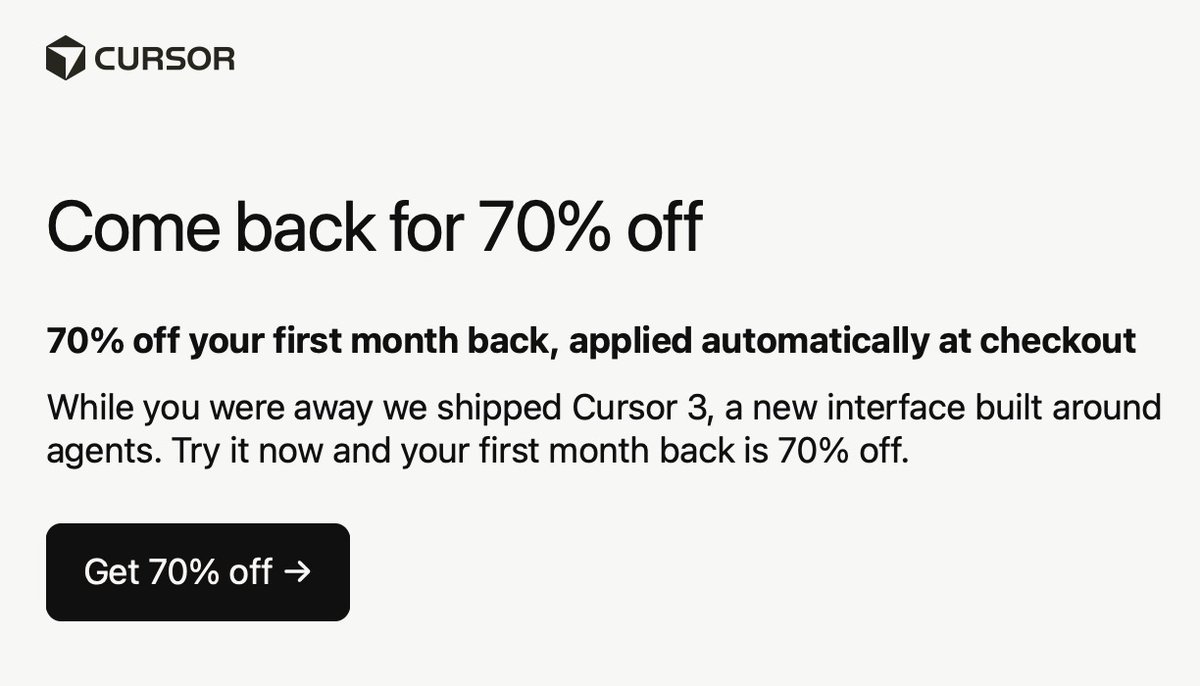
Cursorから1ヶ月間70%OFFのメールが来てたからComposer2.5を試してみたくて課金してみた。
噂通り、「速さ」+「賢さ」+「安さ」を兼ね備えてました。
しかも高いレベルで。
個人的には視覚的な能力も高いし文章を書かせても悪くない。
ChatGPTのProプランに課金できない人や、コーディングがメインの人はChatGPT Plus+Cursor20ドルで十分だと思う。
以前Composer2のとき毎日バリバリ使ってたけど100%いったこと無かった。
Googleに落胆した方、ChatGPTかCursorにしましょう。
間違いないです。
1
8
6,405
