
Good night family 🥃
Everyone’s launching “L1s” that are just smart contracts with extra branding
@CNPYNetwork is the only framework where you actually own the chain.
Not a slot. Not a rollup. Not a layer on someone else’s rules.
The whole chain blockspace, fees, token, governance yours permanently.
What’s the point of web3 sovereignty if your chain still answers to someone else?

Jun 12

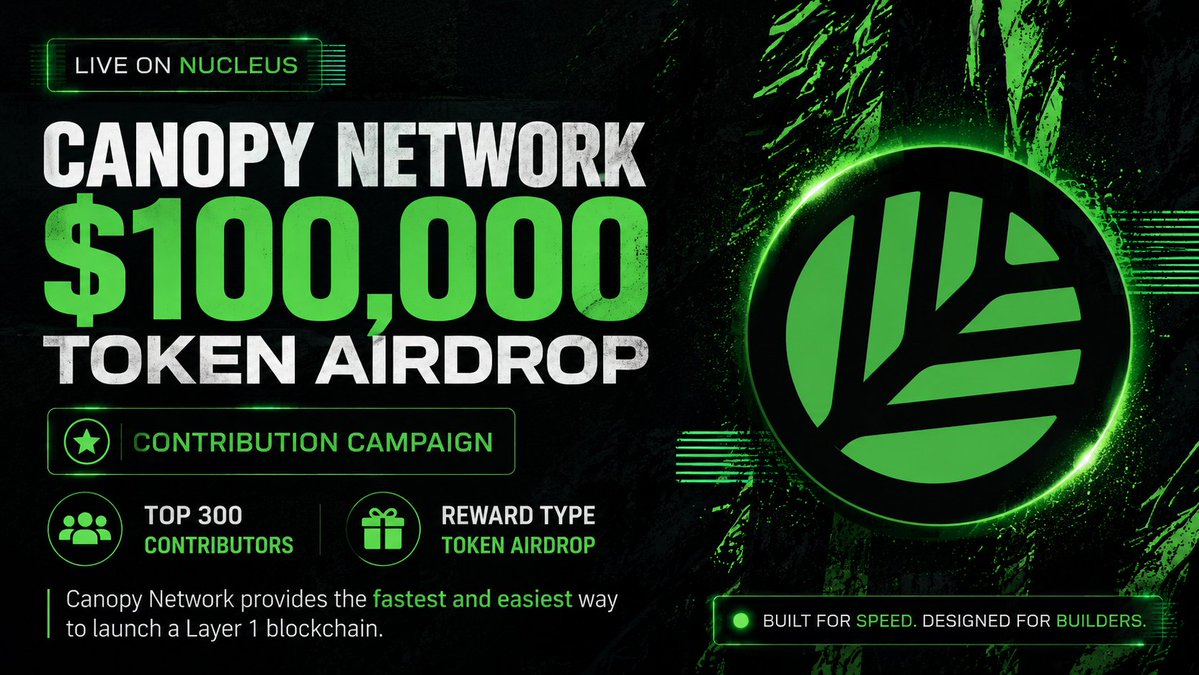
Canopy Network is coming to Nucleus
Starting June 16, the Top 300 contributors will compete for a share of $100,000 worth of tokens
Support @CNPYNetwork, the fastest and easiest way to launch a Layer 1 blockchain 👇
nucleus.codes/
6
1
10
48

GN X
Most people look at crypto and see tokens. I look at projects like @quipnetwork and see infrastructure.
Because at the end of the day, AI models, scientific research, financial simulations, and future applications all need one thing: Compute.
The demand for compute keeps rising, but access to it is still limited and expensive for many people.
A network where compute isn't wasted, but shared, utilized, and turned into something valuable.
The future may belong to AI. But AI will belong to whoever can provide the compute.
Check out @CNPYNetwork as is building for builders. Instead of sharing blockspace, projects can launch their own sovereign L1s while inheriting security through Canopy's Recursive Security model.
The future may not be one chain ruling all, but thousands of chains growing together.
$CNPY @CNPYNetwork

65
2
62
273

CNPYNetwork focuses on sovereign L1 infrastructure with shared security and simplified deployment, reducing reliance on bridges and fragmented blockspace.
6

3h
I stopped building on legacy networks when my application crashed just because a meme coin launched on the same chain
Processing every transaction in a single file line is the biggest bottleneck in decentralized infrastructure today
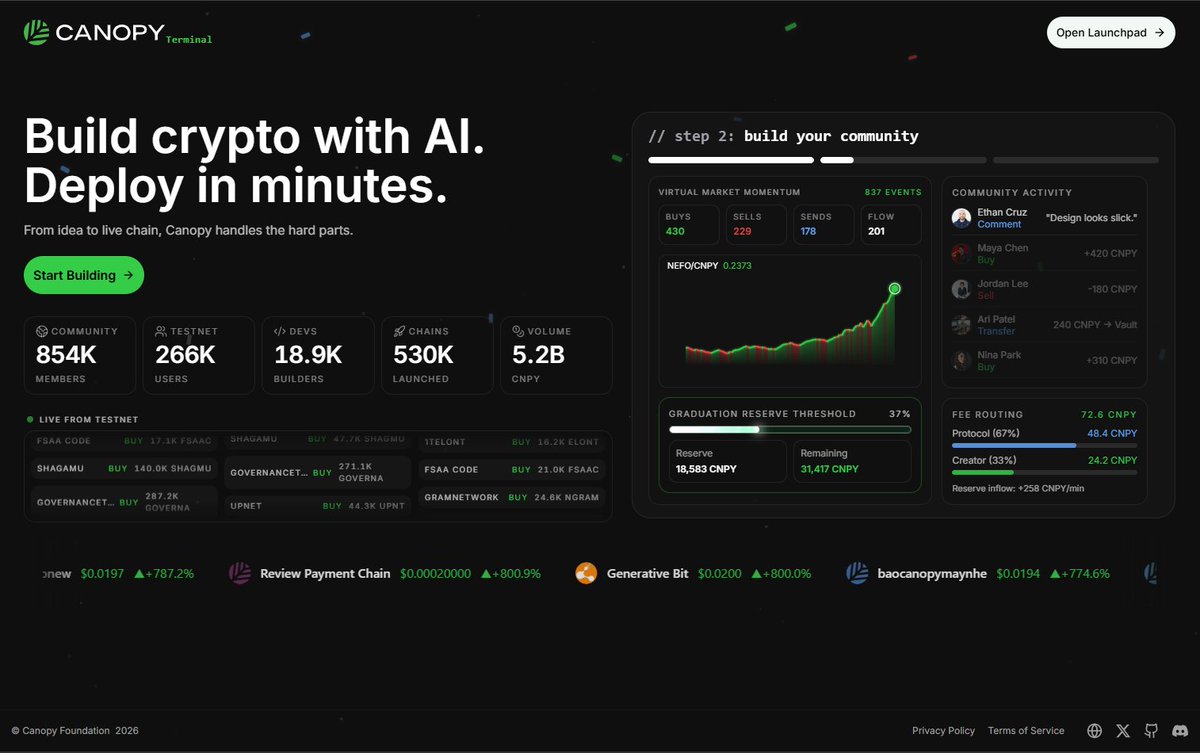
@CNPYNetwork operates as a high-performance Layer 1 blockchain built to replace congested monolithic systems
It utilizes a Parallel Execution Engine to process thousands of smart contracts simultaneously across different lanes
By separating transaction data into distinct State Channels it prevents one viral application from clogging the network
True scalability requires a foundation that never forces applications to compete for the exact same blockspace
We are moving past the era of single-lane processing into massive concurrent computational expansion
Deploying projects on this architecture means you stop bleeding user capital to random network gas spikes
Early adopters who build on these independent fast lanes will capture the absolute most trading volume
The next generation of decentralized applications demands infrastructure that actually scales with user adoption
Why continue paying rent on a crowded dirt road when the multi-lane highway is already built natively
26
32
255
Fredriko.Bandiko retweeted

Jun 10
One year ago, $KEEL CEO Ben Gagnon spoke about the bottleneck he aims to solve:
“What you don’t hear much about is all the power and infrastructure that’s necessary to operate Nvidia GPUs and make them run”
Yesterday, KEEL closed a $458 million convertible senior notes offering to continue Ben’s mission of bringing compute online
6
14
125
13,051

$187B in USDT briefly topped Ethereum’s market cap today, and too many people will read that as a meme instead of a warning.
My read is that this says more about demand for dollars onchain than demand for “crypto” in the abstract. Traders, payroll desks, market makers, people moving size across borders, they keep choosing the asset that does the job, not the one with the best narrative. That’s not glamorous, but markets rarely are.
There’s also an uncomfortable message for ETH holders in this. If the biggest non-sovereign dollar on the internet can outweigh the asset that powers most of DeFi, then value is clustering around settlement and distribution, not just around blockspace. I don’t think that kills Ethereum, but it does force a harder question about where the monetary premium actually lives.
The part I’d watch next is who captures the yield, the issuer, the chain, or the interface. Fidelity already pushed its dollar stablecoin into Curve and Uniswap in one block, which tells me the next phase is not “DeFi versus institutions.” It’s institutions using DeFi rails better than most crypto teams do.
That’s why I spend more time modeling flows than debating tribal identities. When a market starts rewarding utility over ideology, price usually lags the shift before reflecting it. If USDT passing ETH is a glimpse of that repricing, what else are we still valuing like it’s 2021?

1
1
21
Alexis Johnson retweeted

Jun 11
the top crypto funds by aum are gonna have to stop investing in and building more blockchains with more blockspace and more governance and more nodes and more tokens and more marketing funds - and fund some apps - or we're going to have a whole bunch of chinese ghost cities
77
20
405
43,351


DEEP DIVE: Jito ($JTO) — The Toll Booth of Solana 🧵👇
Most investors think Solana runs on validators, traders, and memecoin degenerates.
They're only half right.
Behind the scenes sits a protocol that quietly controls the majority of transaction ordering on the network, processes billions in staked capital, and profits every time bots fight for execution priority.
That protocol is Jito.
While everyone argues about which memecoin will do 100x next week, Jito is busy collecting the tolls from the entire highway.
The question is simple:
Is $JTO one of the strongest infrastructure assets in crypto?
Or is the market underestimating the risks of putting so much power into a single piece of software?
Let's apply the Blockchain Forensics framework and find out.
🧠 1️⃣ The Hidden Monopoly
Solana's greatest strength is speed.
But speed creates a new problem: transaction wars.
Thousands of bots constantly compete to buy first, sell first, and capture arbitrage opportunities before everyone else.
Jito turned this chaos into a business.
Through the Jito-Solana validator client, transactions are bundled, auctioned, and prioritized before reaching the chain. Traders and MEV bots pay tips to gain execution priority, effectively creating a private marketplace for blockspace.
The result?
More than 92% of Solana validators currently run Jito software.
That's not influence.
That's infrastructure dominance.
📊 2️⃣ Follow The Money
Unlike many governance tokens, Jito sits next to real economic activity.
TVL: Over $3.1B locked in the Jito liquid staking ecosystem.
MEV Tips: Between 5,000 and 12,000 SOL paid daily for priority execution, with spikes during periods of intense memecoin speculation.
Every market mania creates more competition.
More competition creates more MEV.
More MEV creates more value flowing through Jito's ecosystem.
The protocol doesn't need a narrative.
It benefits from everyone else's.
💰 3️⃣ Why JTO Is Different
Every investment thesis eventually comes down to one question:
Who is forced to pay?
For Raydium, success depends heavily on trading volume.
For many DeFi projects, value depends on attracting new users.
For Jito, the customers are often professional traders and MEV operators competing against each other.
As long as money is being made on Solana, someone will pay for priority.
That makes the revenue engine unusually resilient.
⚠️ 4️⃣ The Risk Nobody Talks About
Jito's biggest strength may also be its biggest weakness.
When more than 92% of validators rely on the same software stack, infrastructure concentration becomes a real concern.
A critical bug, exploit, or operational failure wouldn't just affect Jito.
It could impact a large portion of Solana's validator ecosystem simultaneously.
The market loves monopolies.
Until it remembers why monopolies are dangerous.
📊 5️⃣ The Forensic Verdict
Jito isn't betting on a single narrative.
It doesn't care whether the next cycle is powered by DeFi, AI agents, RWAs, or memecoins.
It simply monetizes activity.
The more people compete for blockspace, the more valuable its position becomes.
In many ways, Jito is not a bet on a specific sector of Solana.
It's a bet on Solana remaining relevant.
And that's what makes it one of the most interesting infrastructure plays in the entire ecosystem.
Are you holding $JTO as a long-term infrastructure asset, or do you prefer higher-beta plays elsewhere in the Solana ecosystem? 👇
#Solana #Jito #JTO #MEV

2
3
71
Can Toraman retweeted
NEW @gwartygwart w/ @ethannmarcus: Solving the liquidity silo problem
"Bitcoin markets trade upwards of $30 trillion a year basically entirely through trusted custodial intermediaries."
also:
- solana & stables
- why @flashnet moved on from Lightning
3
3
9
1,960

People said the same thing about the early internet protocols before the apps arrived. Polkadot built the ultimate decentralized supercomputer first. With inflation dead and Coretime burning supply dynamically, the market is about to realize how cheap this blockspace actually
100

"Mind blown! Having full control over blockspace, fees, and rules is a game change
4

From idea to your own sovereign L1 in minutes? @CNPYNetwork is changing the game. Start nested with shared security, evolve into full independence with your own rules, fees & blockspace. AI-powered templates native interoperability = no more compromises.🌿 $CNPY"
6

Jamie Coutts CMT retweeted

Once agent activity scales, each one is a source of round-the-clock organic demand for blockspace. Up to now, utility has been based primarily on speculation. AI is the productive use case. Blockchains are the economic substrate.
Everyone talks stablecoins and tokenisation (incl me). But these are known knowns. Probably priced in in the short term (while severely underpriced in the long term).
Permissionless AI on permissionless money rails? That gets discussed, but I don't think that use case is priced in at all, and it's moving faster than the humans who can't pass a basic innovation bill because of a dying banking industry's vested interests.
And we should see strong evidence in the next 6 months with the proliferation of locally-run open-source models, whether these agents get funded by humans and become meaningful economic agents.
21
13
166
14,453


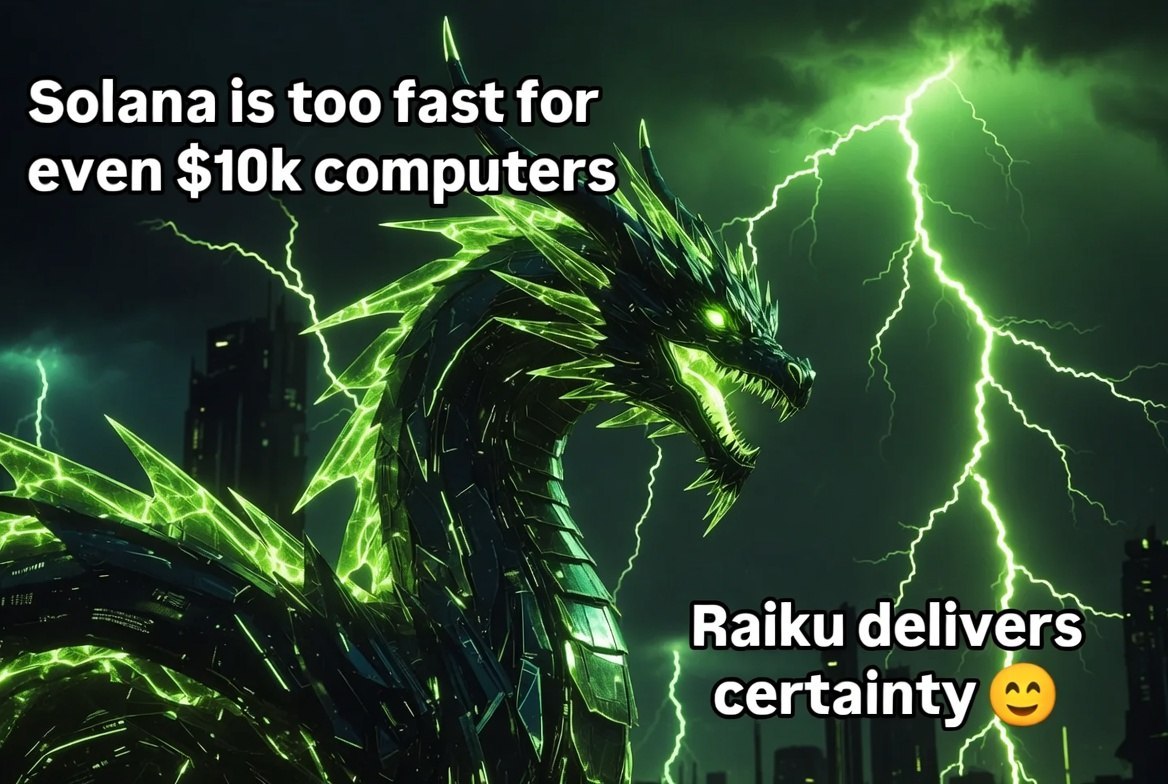
Not even $10,000 computers can keep up with Solana! 🔥
But with Raiku, you don’t need to chase speed — you reserve certainty.
Guaranteed inclusion. Pre-confirmations. Blockspace on your terms.
Welcome to the calm in the storm.
#Raiku #Solana #GuaranteedTxs
3
46

youre absolutely right that blockspace is the main issue here we need scalable solutions ASAP
1
9
