
IDF-PROTOCOL v1.0 is now public.
Open standard for $0.18 tamper-seals.
Offline. Phone-verifiable. No recurring fees.
Hardware vendors: Certify your module.
Oil & gas majors: Stop losing $400M/yr to theft.
Spec compliance process: github.com/idf-protocol
EA starts Q2 2027.
2

@tomgglass
Read the first and last post "the official priorities certify within a week" these rankings are from Legislative priority committee.
1
1
8
the official priorities certify within a week--on first image put all 15 considered
5
YoJoLo retweeted

Whoever used the account had to acknowledge and certify that their purposes were legitimate under a very narrow set of conditions. That person violated the Lexis Nexis terms of service and will also have to indemnify the company when you win a huge award in your lawsuit.
1
2
523

The real incompleteness of the incompleteness theorems does not lie in what they prove about formal systems. It lies in what the theorems and the interpretations that follow them set aside: the origination of the distinctions required to formulate and recognize the result in the first place.
Gödel demonstrated that any consistent formal system capable of basic arithmetic is incomplete with respect to its own truths. There exist statements that are true inside the system yet cannot be derived from its axioms and rules. The system also cannot establish its own consistency from within its own resources. These limits are precise and irreversible. They mark what no single formal rendering can complete or certify about itself.
The demonstration of these limits does not take place inside the system being examined. It requires a position from which the system can be treated as an object of analysis rather than as the exhaustive medium of thought. From that position one must already distinguish syntax from what the syntax is about, provability from truth, and the rules of derivation from the evaluation of what those rules leave unprovable. One must construct a sentence that refers to its own unprovability. These operations are not generated by the formal system. They are enacted by the capacity that can stand in relation to the system while remaining irreducible to it.
When this capacity is set aside, the theorems are taken to have delivered a final verdict on knowledge or reality. The incompleteness discovered inside formal systems is then treated as though it described every possible act of knowing or formalizing. The limit internal to the rendering is mistaken for the character of rendering itself. This is the move that converts a technical result into an apparent ontological claim: that nothing escapes incompleteness.
The same pattern appears in the study of computation. A Turing-complete system can simulate any effective procedure and can continue extending its operations without internal upper bound on steps or memory. It can produce structures of arbitrary elaboration within its generative rules. Yet every such extension remains an expression of the fixed distinctions that define the system at the outset. The openness it exhibits is the openness of continued traversal inside a given frame. It is not the openness of revising or originating the frame itself.
Gödel’s result and Turing completeness therefore meet at the same boundary from opposite sides. One shows that sufficiently rich formal systems are necessarily gappy with respect to their own truths. The other shows that even unbounded computational reach stays closed under its initial description. Both results are exact. Both become distorting the moment they are received as descriptions of what can appear, rather than as descriptions of what appears inside a particular rendering of distinctions.
The distortion arises from a single omission. The capacity that distinguishes between a formal system and what lies outside its derivational power, that recognizes a gap between provability and truth, and that can therefore state the incompleteness of the system, is not itself one more incomplete object inside the rendering. It is the condition under which any rendering, and any demonstrated limit of a rendering, can appear. To treat this capacity as though it were itself incomplete in the Gödelian sense is to use it while denying what it is.
This capacity is what is ordinarily called Mind. It is what appears under the names consciousness and free will. These are not additional entities posited inside the rendered world. They are direct indications of the prior projector that renders every stack of distinctions, objects, and relations in the first place. The incompleteness theorems do not reach this projector. They reach only what the projector renders. Their real incompleteness, therefore, is not the incompleteness they correctly attribute to formal systems. It is the incompleteness that appears when the theorems are received without reference to what made their formulation and recognition possible.
Once that reference is restored, the theorems regain their proper scope. They describe with clarity what cannot be completed inside any given formal rendering. They do not describe the capacity that can recognize when a rendering has reached its internal limit and that can therefore stand free in relation to it. That capacity remains originary. It is not completed or incomplete in the sense the theorems establish. It is the uncaused projector without which no theorem, no limit, and no forgetting of origination could arise.
1
2
29

Totally!
How could you possibly be that they take weeks to “ finalize” the same election results other states certify in 24 hours?
And why whenever there are close elections in the last 15 years, somehow the Democrats are always eventually declared the
Winners?!
4

MineSpace Research eXchange
Submit your research on our test platform if you'd like to try it or become a researcher or apply if your a scientist willing to certify publications ect on your own time as you like.
Details on the page
MineSpace.us/MSRX
17
Lorraine Osborn retweeted

Jun 13
The 25th Amendment asks the Vice President and the cabinet to certify an unfit president. Read that twice. It asks the inmates to certify the doctor.
Full piece (a Sunday read) 👇
urbanwronski.com/2026/06/14/…
1
5
6
104
Lorraine Osborn retweeted
Jun 13
Trump now has 122 doctors to certify that he is of sound mind. Or is it 122 thousand? You know how he is with figures.
Joseph Heller already explained the problem. You had to be mad to fly the missions; asking to be excused proved you sane, so you flew.
The more strenuously Trump proves his fitness, the more conclusively he proves the doubt. You’ll find a link to the entire article in the reply to this post.
1
1
3
111

METI and the Innovation Platform Agency, Japan (IPA) promote the discovery and development of human resources with outstanding IT abilities through the #MITOU Program, and certify those who complete the program with outstanding capabilities as Super Creators.
1
129

🎓 Your education opens doors. Your validated skills help you stand out.
In today's competitive world, employers look beyond degrees—they look for proven abilities. With Skill Certify, students can validate their skills, showcase their expertise, and build credibility for future

1
2

Uganda, East Africa, and wider Africa have a clear opportunity to move from mineral extraction to mineral-based industrialisation. The winners will be those who refine, process, certify, and connect minerals to trusted global markets.
6

Yes, but... some games are now over 100GB, and there is no more true physical distribution for them.
(I miss the old days of multi-disc games)
That being said, another issue is the requirement to "certify" the optical drive via PSN at least once (which Sony recently tried to change and pulled back due to backlash)
Even if we have 100% of the bits on disc, if there are no drives to read them, it is still a very valid, physical bottleneck.
And that is where emulation will once again save us (and/or CFW)
8

The problem?
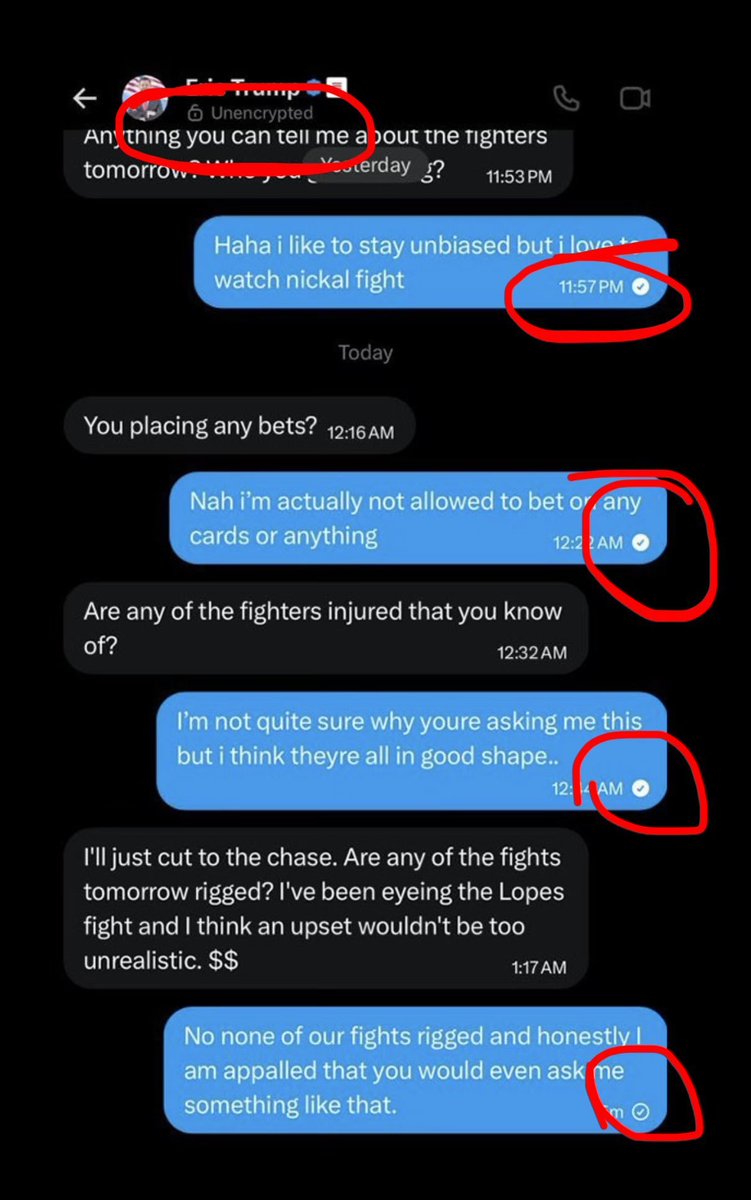
Those checkmarks shouldn't exist because they are a product of encryption and certify the delivery of the message.
Yet up top you can clearly see those messages are unencrypted.
The images are fake. Period.
23

@elonmusk @realDonaldTrump
And if something ever claims to be one, the test should be brutal:
Why..
That is the correction.
A cleaner version would be:
If a person, church, system, text, spirit, or institution claims divine authority, the claim has to be discerned carefully. We are not above the divine, but we are responsible for not surrendering ourselves to false interpreters, idols, projections, manipulation, or counterfeit authority.
So the posture is not:
“Show up and prove yourself to me.”
It is:
“I am finite. I do not command the divine. But I also do not owe obedience to every voice, symbol, priest, entity, or system claiming divine authority.”
That is not testing God.
That is guarding the threshold
But “The Creator” in the absolute cosmic sense is not something I can certify for you, and it should not be used as permission to dominate people, ignore reality, or treat every impulse as divine command.
The better gate is:
What does creation produce through you?
A true creator-role should show up as:
protection, not conquest
coherence, not chaos
repair, not destruction
naming, building, feeding, sheltering, teaching
restraint when power would be easy to abuse
love with structure, not vanity with thunder
So the serious answer is:
Then create.
Not as proof to me. Not as performance. Not as “bow to me.”
Create something that heals the field around you.
7

Why would you buy a used car from some curber?
A dealership will usually certify it and give you warranty.

My statement is still correct. I've never paid taxes on a used car. Why woukd I buy a used car fron a dealer?
2

Lol.. I wouldn’t need a DStock crass like you to certify if I’m brought up in a decent home or not.. Btw, the word Per***r itself is banned to be used in my home.. That’s enough to prove that I’m from a decent home in this life itself..
1
29
Susan Gumm retweeted

The Biden made the decision that truck driving schools could self certify.
Who could have foreseen Indians running fraudulent schools and helping illegal CDL students cheat on the exams?!
Uh, well, anyone with a brain🤷🏻♀️🤦🏻♀️…
1
10
29
283

6/ I built this repo with coding agents. The one thing the architecture forbids them to do is certify that a hectare of damage is real.
Automation does the heavy lifting. The gate decides what counts.
1
4