

28 Jul 2025
Cysic and the Future of “ZK Verification as a Service” (ZK-VaaS) An Underrated Revolution
Everyone’s focused on ZK proving.
But here’s a forgotten piece of the puzzle:
🔘Who verifies all these proofs?
🔘 How do you trust the verification process in a decentralized world?
@cysic_xyz is quietly pioneering ZK Verification as a Service (ZK-VaaS).
Let me tell you what i mean
ZK proofs are only valuable if someone can efficiently verify them ideally:
🔹 Quickly
🔹 Trustlessly
🔹 On any chain
🔹 Without bottlenecks
Verification sounds easy.
It’s not especially when you scale ZK to AI, oracles, rollups, and real world apps.
Here’s the problem:
Most ZK platforms treat verification as “someone else’s problem.”
But in reality:
– Verification gas costs pile up
– Cross chain verification adds latency
– Poor validator designs introduce trust assumptions
Cysic’s answer? ZK-VaaS
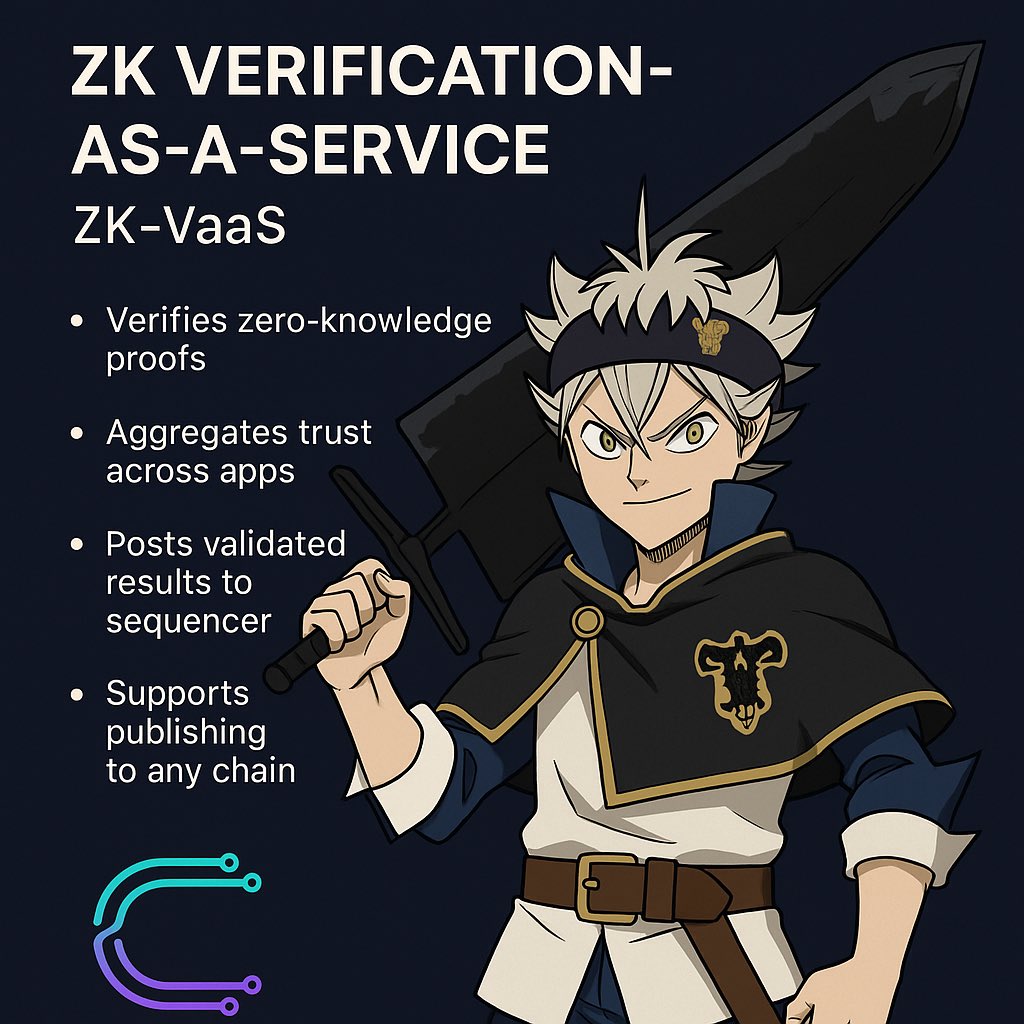
Cysic introduces a Validator Committee Layer that:
✅ Verifies incoming proofs across apps
✅ Aggregates trust using multiple VCMs (Validator Committee Members)
✅ Posts validated results to a sequencer
✅ Publishes to any chain via ChainAPI
Imagine a future where:
– dApps just “plug in” to a validator network
– zkML inferences are verified in real-time
– Rollup proofs are validated before reaching L1
– Oracles push verified data without revealing inputs
All of that? Powered by Cysic ZK-VaaS
But wait, there’s more:
Cysic’s design allows these validators to earn.
Verification becomes an incentive market.
No longer a thankless job. Now, it’s an economy.
It’s ComputeFi, but for proof checkers.
This unlocks a brand new ZK primitive:
🔘Composable Verification
Apps no longer need to roll their own verifier logic.
They simply submit to a network like Cysic
and get real time, validated trust as a service.
ZK-VaaS becomes the trust fabric.
And here’s the kicker:
The more complex zkML gets…
The more you need modular, performant, and trustless verification.
Cysic isn’t just scaling proving.
They’re making verifiability itself composable and decentralized.
So if you’re watching Cysic only for proving speed or hardware acceleration…
Look again.
They’re also building the ZK verification layer one that every AI agent, oracle, L2, and privacy app will need to plug into.
GMsor
35
2
29
401

11 Jul 2025
Hey @DaneBulat, let me help you answer @Joseptec's questions.
Imagine if your apps are using a library (or a third-party service API), usually how does the library author communicate with you about breaking changes in the new version of their library? I think there are 2 things: bump the major version of the library and have a clear release note of the new version describing what changes are breaking, so you would know how to migrate to the new version without breaking your apps.
In that case, do you need to use another different API or service to help check if you can use a certain API of that library? No, I don’t think so, right? It’s simply the communication about what the breaking changes in the new version are and how to deal with them that is enough, right? At least for me as a dapp developer.
In the blockchain world, especially in Polkadot, it’s not really as simple as the case I described above, where we don’t control when the new version of the runtime (we can treat it like an API service if you’d like) is upgraded, and the new version might contain some breaking changes that we’re using for our dapps, so we’re forced to deal with this situation.
But we know a few things:
- What the current runtime version is
- When the runtime upgrade happens (by subscribing to runtime events)
- What the new version (spec_version) of the runtime is, because we know the metadata of the runtime (we can get it in the runtime WASM file or if the runtime developer provides it somewhere)
- What the breaking changes are.
- If you don’t know this, then the runtime developer—in this case the library author—did not do a good job in providing their service.
- Or we can easily check this by generating the ChainApi interface (.d.ts files) of the new version from the metadata file or WASM runtime file using dedot cli, and compare the diff of the two interfaces to see what the changes are.
Given all the things we know, what do you think we should do to prepare our dapp for the foreseeable breaking changes?
My simple mind would say we do a simple if/else check:
1. Constantly listen for the runtime upgrade event to detect when the new version is upgraded
2. When making on-chain interactions:
- If we’re on the new version → interact using the new API of the new version
- Else if we’re on the current version → interact using the API of the current version
That’s it!
That’s my approach to solving that problem and also the approach I recommend dapp developers take to deal with breaking changes!
---
Another thing I’d like to clarify: as we stated in the acknowledgment section of the Dedot README file, Dedot is inspired by @polkadot/api, and Dedot CLI was also inspired by @polkadot/api CLI as well, to generate types and APIs for any chain given the metadata. Yes! @polkadot/api has a CLI! :)
1
1
3
334
11 Jul 2025
For dapp builders looking for the answers:
There’s no library or automatic magic that can prevent your dapp from breaking due to runtime upgrades without mindful awareness of the potential changes. Don’t fall for the illusion that something will “just work” — you need to take control and handle it in your dapp logic.
When a runtime upgrade happens:
- The runtime is upgraded to a new version.
- The chain interactions used in your dapp may change and become incompatible with your existing code.
With Dedot:
- You can easily check the current runtime version and subscribe to events that notify when a new runtime is upgraded.
- You can generate the ChainApi interface for the new runtime version given the metadata.
- You can then handle your logic accordingly, depending on which runtime version is active.
If you don’t handle these changes consciously, your dapp will break. Dedot gives you the tools — it’s your responsibility to use them right.

I wonder what you do when a runtime upgrade breaks a Dedot dApp: showing wrong info or crafting a tx with the wrong call-data because Dedot can’t detect if the runtime matches your code? 🤔
This won't ever happen with PAPI. Also, since descriptors are lazy-loaded in the background, it's done without any perf hit 😎
Want to shoot yourself in the foot? Just call getUnsafeApi: that’s Dedot-mode for you.
2
10
1,638

7 Jul 2025
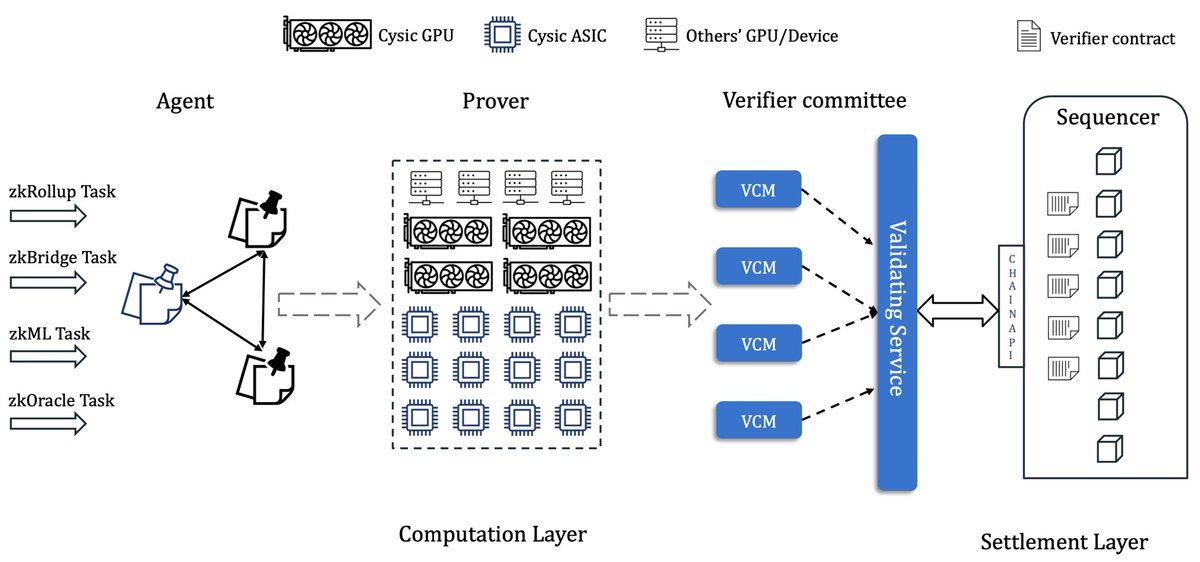
Modular ZK (Zero-Knowledge) Processing Architecture
This diagram illustrates how different zk tasks (zkRollup, zkBridge, zkML, zkOracle) are processed and verified before being finalized on-chain. 👇
1.Agent Layer: zk tasks are received and dispatched to the Prover layer for computation.
2.Computation Layer (Prover): Proofs are generated using specialized hardware including Cysic GPUs, Cysic ASICs, and other devices.
3.Verifier Committee: Generated proofs are checked for correctness by multiple VCM (Verifier Committee Members).
4.Validating Service: A centralized service coordinates verification results.
5.Settlement Layer (Sequencer): Verified proofs are submitted on-chain via the sequencer, using ChainAPI for communication.
This architecture enables efficient, scalable, and secure zk computation and settlement. 🌐⚙️
@cysic_xyz @KaitoAI
11
8
18
172

Is the future of blockchain in jeopardy?
AI's growing capabilities might just shake up the smart contract world as we know it.
Let's dive into why @bbenligiray is pivoting away from his own concept, 'Commercial Building Blocks'. 🧵
A quick recap: 'Commercial Building Blocks' were born from his work on Airnode, ChainAPI, and Omnimarket. They were meant to be the bridge between low-level oracle services and dApps. But the future isn't looking so rosy.
The problem? Modularity. It's a design principle that has dominated software development for ages. Think LEGO bricks - flexible, standardized, and easy to fit together. But this might be its downfall.
Enter deep learning. It challenges the modular approach by stacking non-linear functions, creating complex models that can learn from data. A single deep model can outperform an expert’s modular solution, challenging the status quo.
The shift from modularity to end-to-end solutions will take a decade, but it's coming. APIs will become less standardized, making it harder to build deterministic oracle integrations and smart contracts.
EVM and its competitors, designed for deterministic computation, will fall behind in this new stochastic era. We might see smart contracts stripped down to their core functions: minting, trading, and lending tokens.
For @API3DAO, the path is clear. We must excel at serving these core use cases, rather than trying to solve the fundamental limitations of smart contracts, which might be intractable.
So, what's the future of blockchain?
The allure of self-enforcing contracts is tempting, but we need to balance ideological purity with practicality.
The 'perfect' oracle doesn't exist. It's time to embrace pragmatism.
The future of blockchain and smart contracts is uncertain.
AI's rise challenges the core principles of modularity.
It's a revolution that will redefine how we approach the blockchain world.
Let's embrace the change. 🔄
3
2
13
372

29 Oct 2024
07 />
Oracles: Services that provide real-world data to blockchain smart contracts.
@Chainlink, @Tellor, @BandProtocol, @Witnet, @UmbrellaNetwork, @PythNetwork, @DIAdata_org, @API3DAO, @ChainAPI, @Oraclize, and more

1
4
192

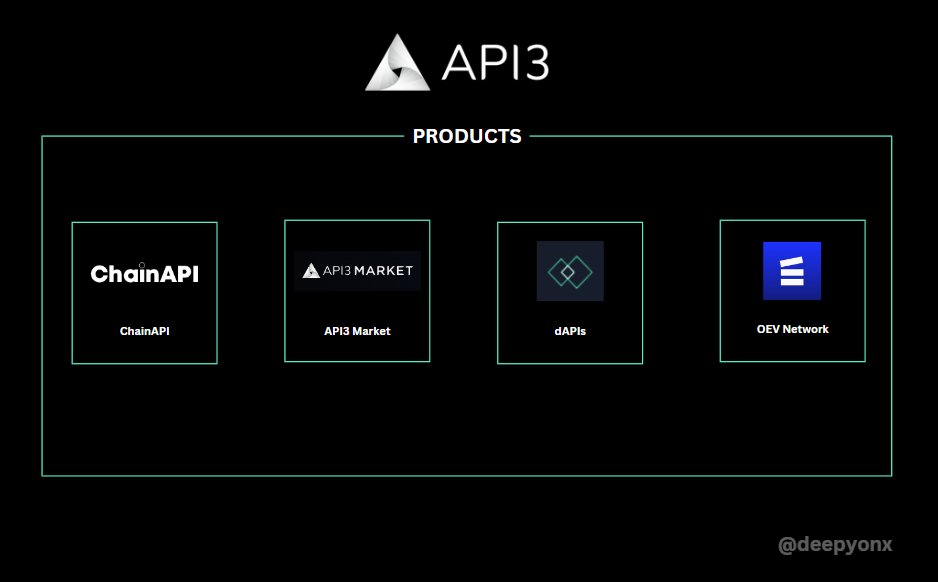
#API3 is gearing up for a breakout in the next bull run. API3 Market offers seamless access to first-party data feeds across 37 networks. Airnode-powered ChainAPI connects everybodys APIs to blockchain, while the newest product, OEV Network, reclaims protocol MEV. DAO governed.
7
24
866

16 Jun 2024
4/ Team, Investors and Partners
🟢 Team: Burak Benligiray is presently the CTO at ChainAPI. He co-founded Honeycomb and the API3 project.
🟢 Investors: API3 was funded by 13 investors, with Digital Currency Group and Raystone Capital being the most recent ones to invest.
1
1
121

🚨Important Security Announcement for the API3 Ecosystem🚨
API3 is committed to maintaining the highest standards of security and transparency. We have identified a potential risk that requires action from our users’ end. Once ample time has been given to all potentially endangered parties to respond, we will publish a detailed report.
This is not related to the API3 token contract, the API3 DAO and staking pool contracts, or the Airnode request-response protocol contracts included in the api3/airnode-protocol (used by Airnode, ChainAPI, and QRNG).
It is important to note that no funds were lost and no harm occurred.
The relevant components have been redeployed with a guided fix for the issue. In the past days, all known affected users have been contacted and they have taken steps to switch over to the new deployments, successfully eliminating any known potential risk.
API3 dAPIs are permissionless to read, which is why we have no reasonable way to determine everyone who might be using our data feeds.
If you have not been contacted by API3 in recent days or did not have a preexisting communications line with us, please make sure to follow these steps to utilise the newly deployed data feeds immediately:
Instructions for dAPI users:
🔗 link.medium.com/kPSjYG79pFb
The data feeds referred to by the old proxies will continue being updated until Friday, December 15, 2023, after which time they will be abandoned. To reiterate, our users should not wait until then, and are strongly recommended to update their proxies as soon as possible.
Security is Our Number One Priority
The security and trust of our ecosystem partners is paramount.
We want to thank @Quantstamp for their support and swift action. We also want to thank our users for acting quickly to mitigate any risk. We will continue to update the community with more details once all at risk parties have had ample time to address this concern.
For more information, please reach out to our support team in Discord or contact us at security@api3.org.
7
18
82
9,825

17 Nov 2023
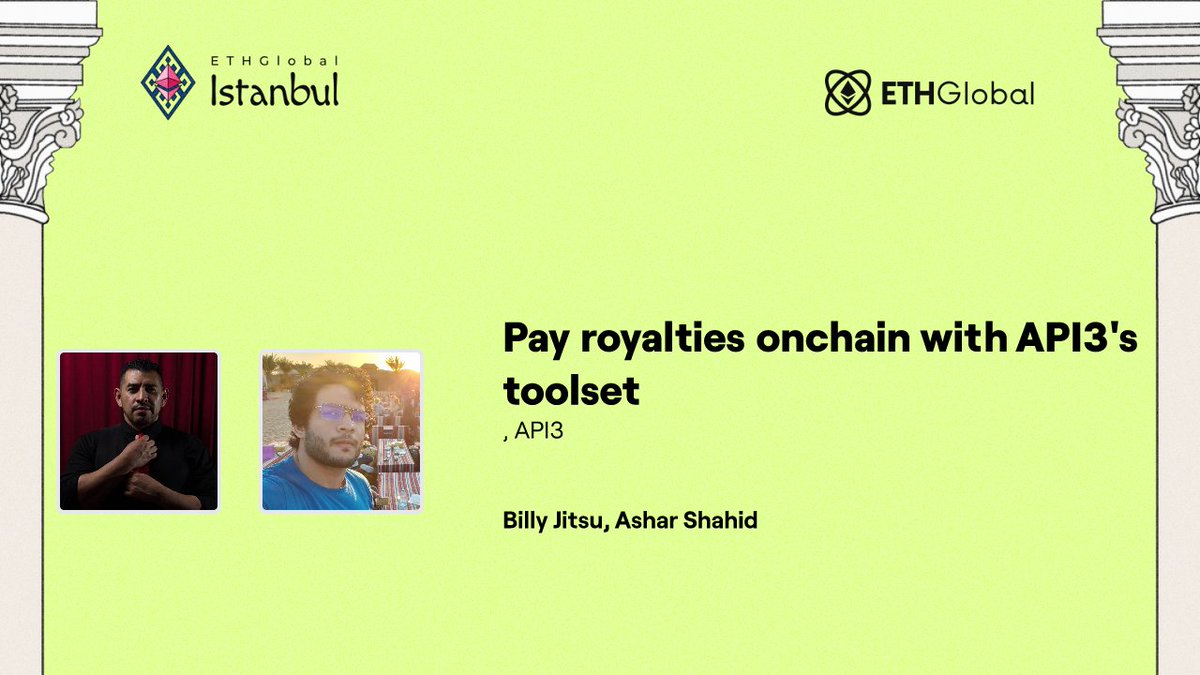
🫰Pay Royalties Onchain with API3's Toolset
Intro into API3's tools: overview of API3's ChainAPI tool that lets you bring off-chain api data on-chain, whilst leveraging dAPI price feeds to ensure royalty payments are the correct value.
🚪 Workshop Room 3 @ 4pm
📺 ethglobal.tv/istanbul-worksh…
2
1
8
1,570
Check out our Friday @EthGlobal workshop with @Ashar2shahid & @wc49358 on how to pay royalties onchain.
They'll show you how ChainAPI lets you bring off-chain data onchain while leveraging dAPI data feeds to ensure royalty payments are the correct value.
ethglobal.com/events/istanbu…
1
4
8
509

13 Nov 2023
Join us on Friday @EthGlobal for a workshop with @Ashar2shahid @wc49358 on how to use API3's toolset to pay royalties onchain.
They'll show you how ChainAPI lets you bring off-chain data onchain while leveraging dAPI data feeds to ensure royalty payments are the correct value.
1
1
5
214
23 Oct 2023
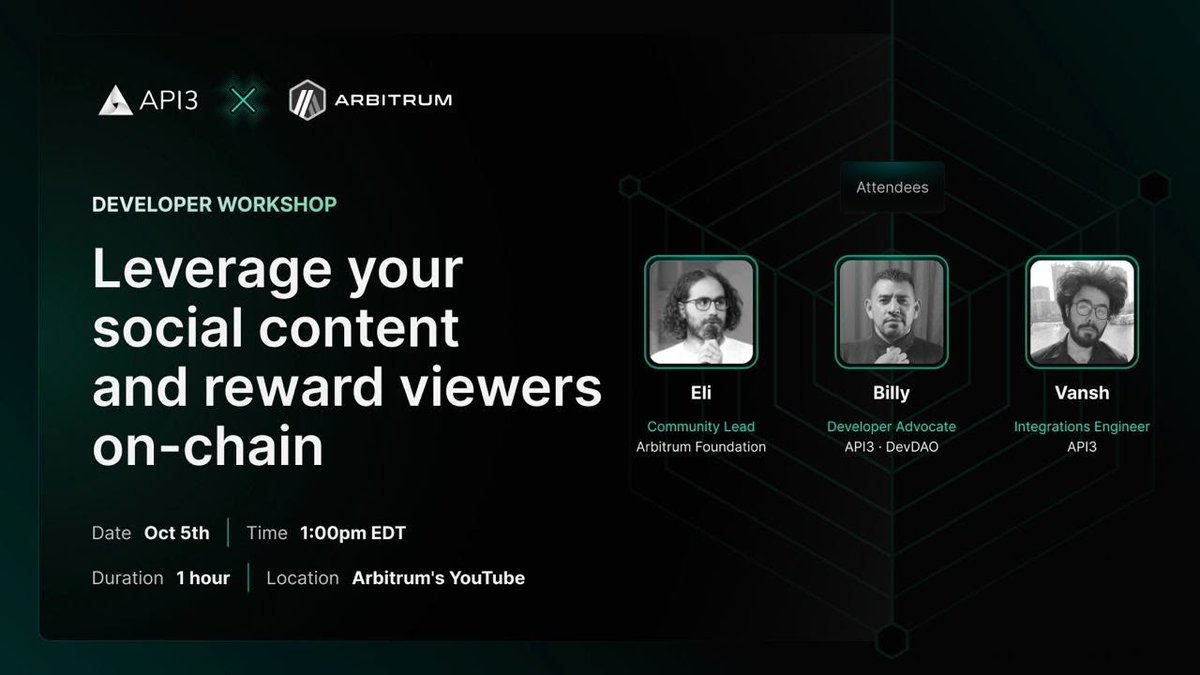
Unlock new use cases for your smart contracts by integrating off-chain APIs with ChainAPI and dAPI data feeds.
Watch our Developer Workshop with the @arbitrum team to learn how to leverage social content and engage with viewers on-chain.
📺 Watch now:
youtube.com/watch?v=p5vuYOcZ…
1
10
360
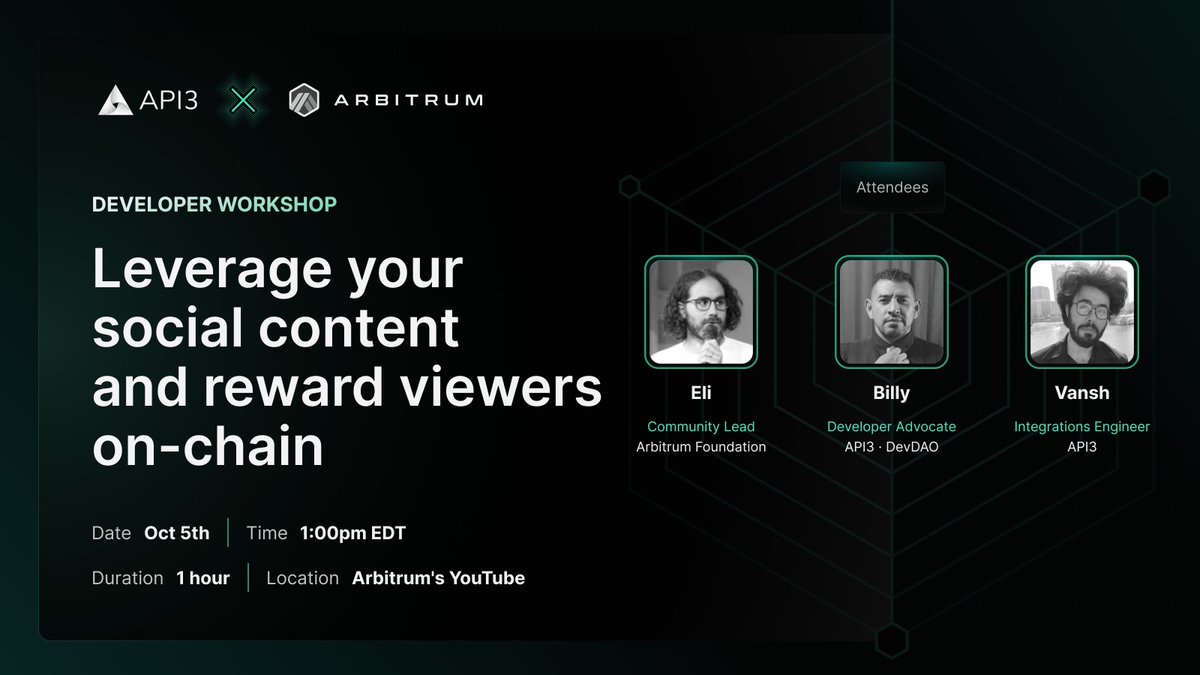
Join us on October 5 for an online workshop featuring @eli_defi Community Lead @arbitrum, along with developers @wc49358 & @WassanVansh from @API3DAO.
We will be exploring how to bring your off-chain APIs on-chain using ChainAPI and dAPI price feeds from API3.
5
14
55
35,154

12 Jun 2023
#ElixirJobs 📣
@chainapi is hiring for an Elixir developer position. Check it out: buff.ly/3t4mjHW
More Elixir jobs at buff.ly/3sHDOfo
#MyElixirStatus
1
4
1,574

24 May 2023
Senior backend developer @ ChainAPI / Remote #job #myelixirstatus #elixirlang elixirjobs.net/offers/chaina…
2
616
4/
ChainAPI has been designed to simplify the technical process of serving off-chain data to smart contracts.
Getting started is easy. Check out the introduction and user guides available in the ChainAPI docs.
chainapi.com/
4
150