Alex• retweeted

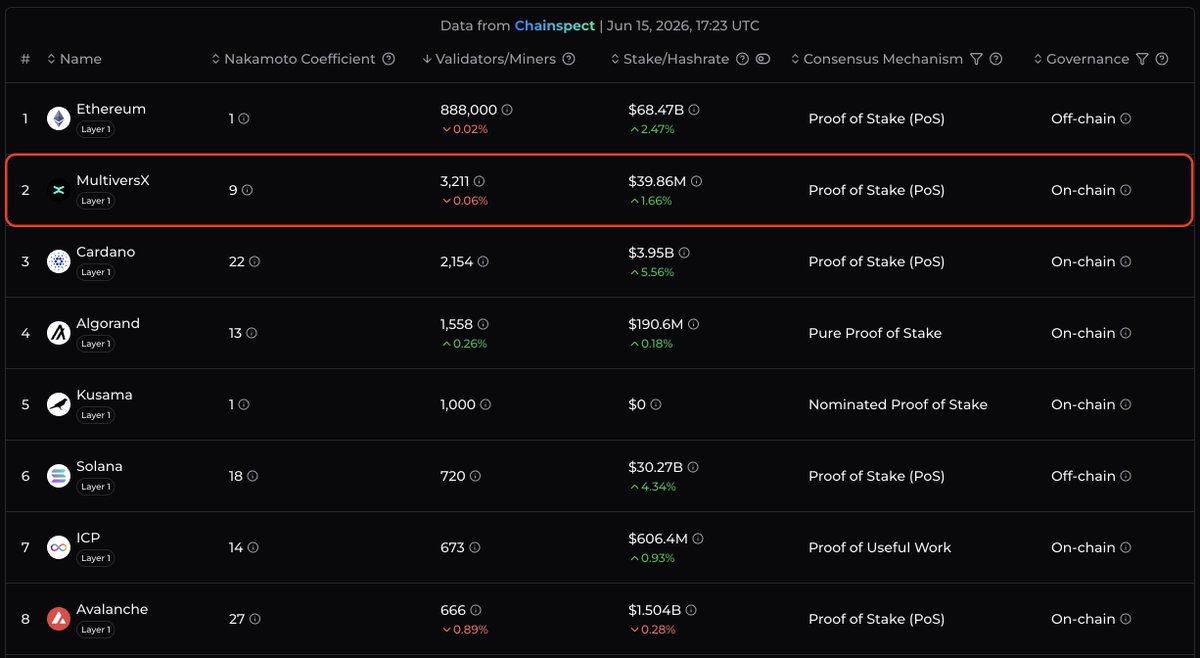
🌐 @MultiversX is secured by over 3,211 active validators, recording a Nakamoto Coefficient of 9, which ensures it superior decentralization in Proof-of-Stake and a top position among the most resilient and scalable #Web3 blockchain infrastructures at internet scale. $EGLD 💎
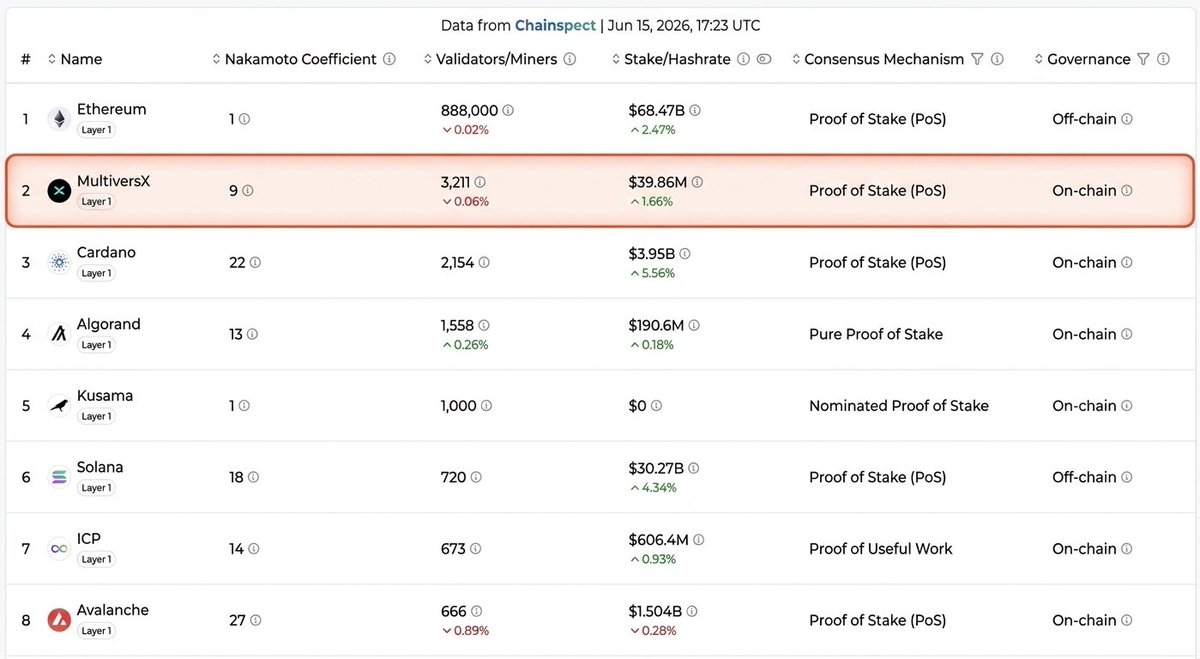

Did you know @MultiversX is secured by more than 3,200 validators?
That's enough to place it among the most decentralized networks in Web3
Internet-scale infrastructure starts with decentralization
📊 chainspect.app/dashboard/dec…
2
2
8
123

Yep. Trying to get a better figure for the bend coefficient. Newbury looks the best to get a good hold on how a corner affects time.
9

If the Knicks were a country, they'd be the most unequal in the world. They have a salary Gini coefficient of ~0.66, and their stars make tens of millions yearly while role players are on minimum deals.
1
25

16m
President Trump’s recent commendation of the restraint shown by Xi Jinping and Vladimir Putin during the U.S.-Iran negotiations is far more than mere diplomatic protocol. In my assessment, this marks a profound return to the principles of international political realism, effectively shattering the constraints of the past thirty years where Washington’s political establishment narrowly reduced great-power relations to a binary struggle of values.
The stability of the contemporary world hinges upon the dynamic interplay between the three core powers: the United States, China, and Russia. Trump’s strategic foresight lies in his refusal to exclude Moscow and Beijing from the rules of the game. Instead, by opting for direct engagement and non-confrontational posturing, he has integrated these two significant forces into a framework of global stability. This is not a retreat from power, but a precise navigation of a multipolar reality. When major powers cease to intentionally sow discord, long-standing geopolitical stalemates often uncover pathways for negotiation.
If this delicate tacit understanding—a triangular balance where each refrains from sabotage—can be institutionalized, its significance will extend far beyond the Middle East. Frankly speaking, this mechanism serves as a critical catalyst for bringing the Russia-Ukraine war to an end. Once such great-power coordination becomes the status quo, the global geopolitical risk coefficient will decrease significantly, providing the only viable path for the world to escape its current state of perpetual conflict anxiety.
By: Ho Pin’s Perspective (@MJTVHoPin)

50

23m
Height of target and power of hind legs were known. He had to figure the slickery coefficient of the floor to make the jump.
1
34

Les 2 sujets n'ont pas le même coefficient , si tu te fais attaquer par un ours et une mouche , arrête de te focaliser sur la mouche , en oubliant l'ours qui est en train de t'éclater la gueule.
1
3


It is a status thing. Similar to findings using the gini coefficient. When people live around people that have more money than them they tend to be more violent than if they lived around people with similar standards of living to themselves.
1
24

Qatar. The Moment Everything Counted.
The paddock energy on race day is unlike anything else.
Months of preparation behind you. One run ahead of you. Every decision made in the workshop, every system refined, every gram saved, every drag coefficient reduced, all of it comes down to what happens on this track, on this day.
When our prototype rolled onto the Lusail International Circuit — the same tarmac that has hosted Formula 1 and the FIFA World Cup — the objective was clear.
Maximum distance. Minimum energy.
The circuit does not care about your preparation. It does not reward your late nights or your sacrifices. It only records your result.
Fourteen students from Coimbatore, India. On one of the most prestigious tracks in the world.
#TeamRenewNow #Qatar #LusailCircuit #RaceDay #ShellEcoMarathon #HydrogenFuelCell #MadeInIndia #IndianEngineering #CleanEnergy


1
12

What about the woman who suddenly became active two years later during the unrest in Nepal? She was there. Now, two years later, she's in India. What's your IQ to understand the satire?
Coefficient?



3

He is the victim of Islamophobia. High inbred coefficient @MouinRabbani will now defend him against the “lying Jews.”

🚨Illegal Muslim Migrant Butcher Rapes and Murders 92-Year-Old Grandma..
Illegal Muslim migrant Reeaz Khan brutally raped and murdered 92-year-old Maria Fuertes in Queens, New York. This savage threw the helpless elderly woman to the ground, sexually assaulted her, and left her to die from the injuries. Despite a prior arrest and ICE detainer, sanctuary city rules let this Muslim killer walk free.
Khan, a Guyanese national with a common Muslim name, turned a quiet neighborhood into a horror scene. This case exposes how soft-on-crime policies protect dangerous illegals over American seniors. No mercy for monsters like this.
57
659
2,614
53,303

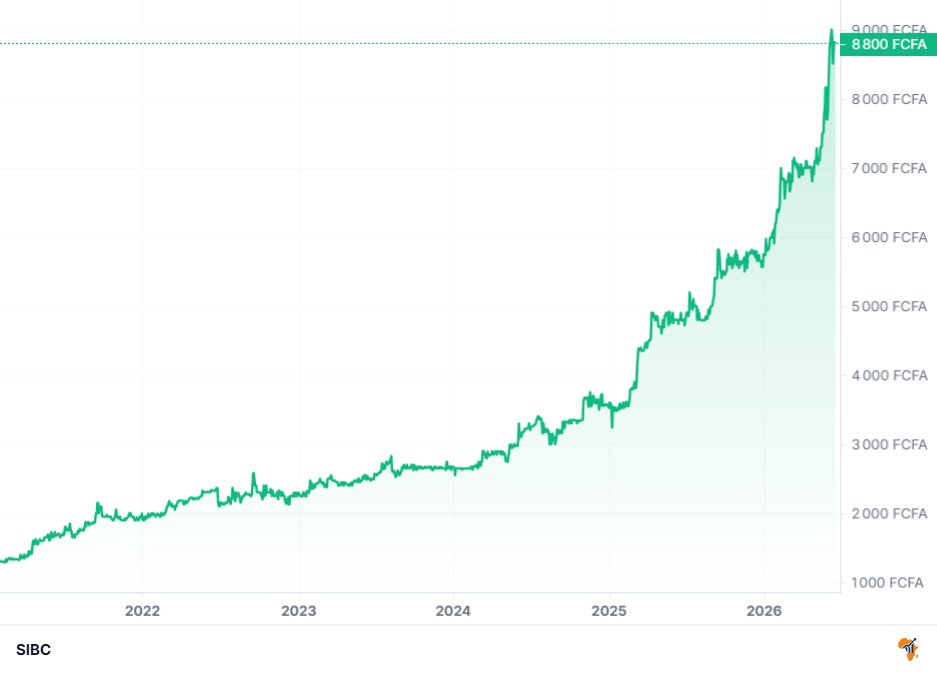
La SIB est l'une des meilleure banque de la BRVM. C'est précisément pour ça qu'il faut se méfier de son cours. 🏎️
En deux ans, l'action a pris 151%. Fin 2022, elle se négociait sous sa valeur comptable. Aujourd'hui, elle se paie au prix fort. Que s'est-il passé ? 👇
Nous avons repris ses comptes certifiés sur 6 exercices. Les fondamentaux sont remarquables :
→ ROE de 27% — la banque gagne 27 FCFA par an pour chaque 100 FCFA de fonds propres. C'est le meilleur du secteur.
→ Coefficient d'exploitation à 38,6% — elle dépense moins de 39 FCFA pour générer 100 FCFA de revenu. Rare en zone UEMOA.
→ Marge nette de 51% — sur 100 FCFA de produit bancaire, 51 finissent en bénéfice net, contre 41 il y a cinq ans.
Traduction simple : c'est une machine à transformer le revenu en profit, avec une régularité impressionnante.
Mais une excellente entreprise et une action chère ne sont pas incompatibles. C'est même souvent le piège.
📌 Un repère utile, pour les débutants comme pour les initiés : le ratio P/B (cours / valeur comptable) compare le prix d'une banque à ce qu'elle vaut « sur le papier ».
· Médiane des banques BRVM : 1,8x
· SIB aujourd'hui : 3,8x
Soit une prime de 110% sur ses concurrentes. Une partie est méritée — la SIB est meilleure. Mais tout l'enjeu est là : jusqu'où la qualité justifie-t-elle le prix ?
Pour y répondre sans deviner, nous avons croisé trois méthodes de valorisation indépendantes (Equity DCF, multiples comparables, triangulation), avec la méthodologie utilisée pour valoriser les banques.
Le résultat est nuancé — et il a de quoi surprendre. Il concerne autant celui qui détient déjà le titre que celui qui pense l'acheter.
🔗 L'analyse complète est en commentaire. ( a titre éducatif et ne constitue pas un conseil en investissement )
Et vous : sur la BRVM, préférez-vous payer la qualité au prix fort, ou chasser la décote ?

2
1
43

Stop this crap sir, you are not making any sense.
I assume you are a congress supporter
GDP is up, Per Capita income is up, Geni Coefficient is up, Make in India is a success
So what are you complaining about
3

Where $r$ represents the social discount rate. However, under the contemporary asymmetric extraction model, the actual compensation allocated to the public domain approaches zero ($R_{i,t} \rightarrow 0$). Instead, the entire surplus value generated by $D_t$ is captured exclusively by the proprietary algorithms of the concentrated elite $M$. This creates a structural wealth divergence where the wealth of the 1%, denoted as $W_M$, accumulates exponentially via algorithmic compounding:
$$\frac{dW_M}{dt} = \kappa \cdot \left( \frac{\gamma Y_t}{D_t} \right) D_t r W_M$$
Where $\kappa \approx 1$ represents the capture coefficient of the elite. This asymmetric differential equation drives the Gini coefficient of digital societies toward absolute inequality, converting a shared constitutional asset into a private instrument of economic leverage.
------------------------------
The Constitutional Deficit and Algorithmic Enclosure
To quantify the systemic deficit—the philosophical "soul debt" owed by the 1% to the 99%—we must map the extraction process as a continuous optimization problem that violates the fundamental social contract Stanford Encyclopedia of Philosophy. Let the utility function of an individual citizen be dependent on their consumption $c_i$, their preserved privacy $\pi_i$, and their individual autonomy $\mathbb{A}_i$:
$$U_i = \int_{0}^{\infty} U(c_i, \pi_i, \mathbb{A}_i) e^{-\rho t} dt$$
In this optimization matrix, privacy $\pi_i \in [0,1]$ is a depletable resource where $\pi_i = 1$ indicates total sovereign ownership of one's digital self, and $\pi_i = 0$ indicates total digital enclosure. The predictive algorithms operated by the financial elite function by minimizing the uncertainty of human behavior MIT Technology Review. Let $H(X)$ be the Shannon entropy of the public's future choices $X$:
$$H(X) = -\sum_{x \in X} P(x) \log_2 P(x)$$
The 1% utilizes the stolen collective data $D_t$ to maximize information gain $I(X; D_t)$, thereby reducing human behavioral entropy to near zero:
$$I(X; D_t) = H(X) - H(X \vert{} D_t)$$
As $I(X; D_t) \rightarrow H(X)$, the conditional entropy $H(X \vert{} D_t) \rightarrow 0$. This mathematical convergence implies that human autonomy $\mathbb{A}_i$ is systematically degraded, as individual choices become entirely predictable and externally manipulated via algorithmic feedback loops. The loss of autonomy can be formally bounded as a function of information extraction:
$$\mathbb{A}_i(t) = \mathbb{A}_0 \cdot e^{-\lambda I(X; D_t)}$$
Where $\lambda$ is the behavioral manipulation coefficient. When autonomy is extracted without explicit, constitutional, and compensated consent, it creates a systemic economic deficit. We define this Cumulative Sovereign Debt ($\mathbb{D}_{soul}$) as the integrated difference between the value extracted by predatory algorithms and the baseline survival compensation returned to the populace:
$$\mathbb{D}_{soul} = \sum_{t=1}^{T} \left[ \sum_{j \in M} \Pi_j(D_t) - \sum_{i \in N} \omega_i \right]$$
Where $\Pi_j(D_t)$ is the profit function of elite firm $j$ derived from the collective data pool, and $\omega_i$ is the baseline wage or platform access cost returned to user $i$. Because $\sum \Pi_j \gg \sum \omega_i$, the debt scales quadratically over time:
$$\lim_{T \rightarrow \infty} \frac{\mathbb{D}_{soul}}{T} \propto \gamma \cdot N \cdot (1\% \text{ Wealth Concentration})$$
This confirms that the 99% holds a massive, unliquidated structural claim over the accumulated capital of the 1%, rooted in the uncompensated exploitation of their collective digital sovereignty.
------------------------------
Restoring Equilibrium: The Digital Bill of Rights Matrix
To reverse this asymmetric extraction and re-establish a system truly owned "by and for the people," society requires a rigorous, mathematically enforceable redistribution framework Electronic Frontier Foundation. We can model this structural correction using a state-space redistribution matrix.

7

Two caveats: the Lean development assumes the coefficient law is isotropic (the published paper does not), and the manuscript is a draft, still in preparation, written largely with the aid of GPT-5.5.
We made the extra assumption for simplicity; most applications satisfy it.
1
1
38


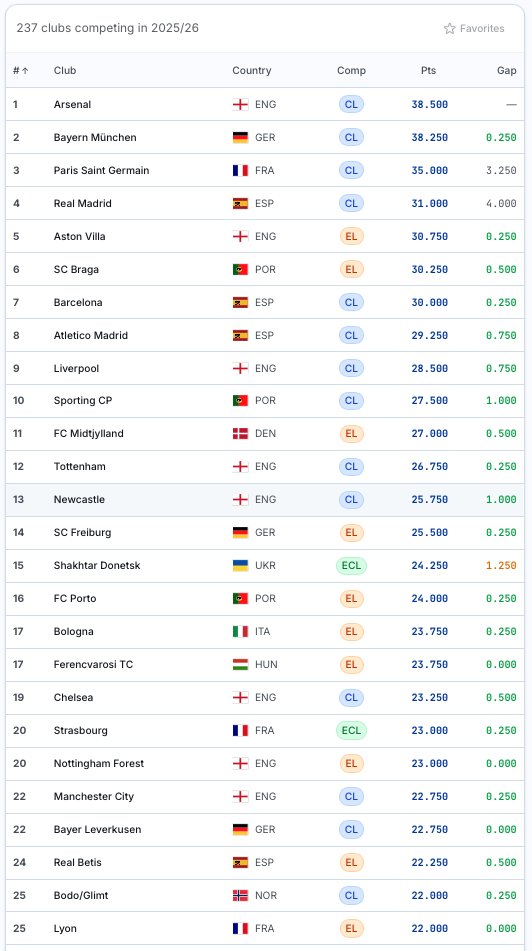
UEFA 2025/26 club coefficient — the headlines:
• Arsenal lead Bayern by 0.250 points
• Aston Villa are 5th — above Barça, Atlético, Liverpool
• 2 Portuguese clubs in the top 10 (Braga, Sporting)
• 9 English clubs in the top 19
• Shakhtar the only ECL side in the top 15
eurocoef.com
14
56
705
2,195,821