
📢Valkey upgrade
We've rebuilt our managed Valkey from the ground up, a more standard setup that's more stable and resilient.
The goal: make our managed databases something you can lean on.
The new setup is live now, every newly created Valkey service runs on it. Existing deployments will be upgraded over the coming days. Your data is persisted across the upgrade, expect only a short unavailability window (up to a few minutes) per service. Premium support users will be contacted beforehand with their upgrade time window.
What's new:
Password protection → new instances are password-protected by default. The password is generated automatically, exposed as the sensitive password variable, and already embedded in the connectionString variables, so connecting stays a one-liner. Existing deployments stay as they are.
AOF-first durability → persistence now relies on the append-only file, fsynced once per second, rather than periodic RDB snapshots. Your dataset survives restarts and rebuilds automatically on startup, with at most ~1 second of writes lost in an unclean crash.
Platform-managed encrypted backups → point-in-time recovery via encrypted RDB snapshots, for both Single and HA setups. Disabled by default.
Latest 7.2 patch → Valkey is bumped from 7.2.5 to 7.2.12, picking up the latest bug and security fixes (same 7.2 line, fully compatible).
Two new tunable settings (editable env vars, applied live — no restart, no reconnect):
• VALKEY_MAXMEMORY_POLICY → what Valkey does when memory fills up.
• VALKEY_LAZYFREE_LAZY_USER_DEL → whether DEL frees memory asynchronously, keeping Valkey responsive even when deleting very large keys.
Details:
docs.zerops.io/valkey/overvi…
6
151

May 18
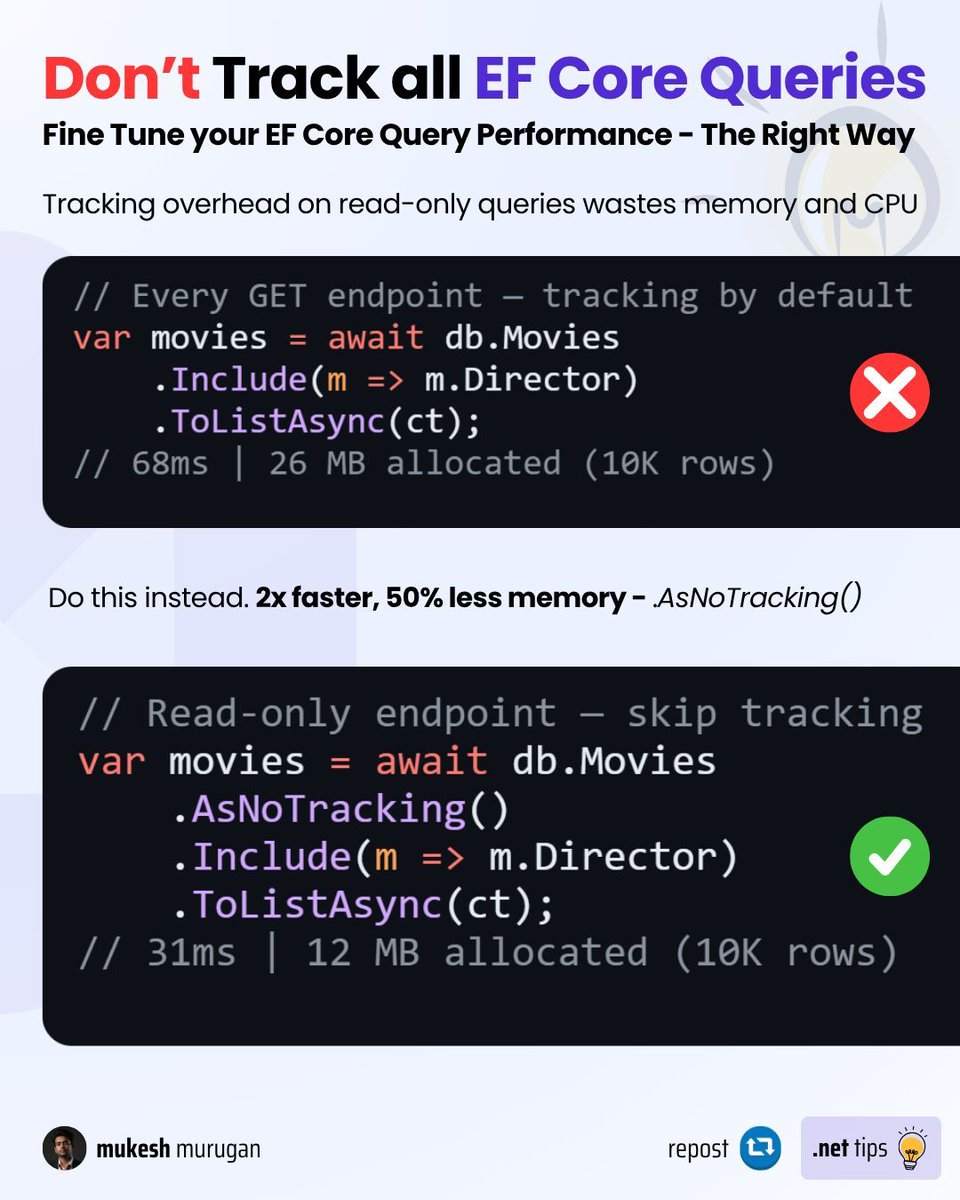
If you are not calling AsNoTracking() on read queries, EF Core is doing free work for nothing.
By default, every entity EF Core loads gets a change tracker. EF takes a snapshot of every field. It sets up event handlers. It registers the entity in a watch list, waiting for an update that, on read endpoints, will never come.
The cost: memory and CPU on data you are never going to modify.
Two ways to fix this.
𝗣𝗲𝗿 𝗾𝘂𝗲𝗿𝘆:
var users = await context.Users
.AsNoTracking()
.ToListAsync(ct);
𝗗𝗲𝗳𝗮𝘂𝗹𝘁 𝗳𝗼𝗿 𝘁𝗵𝗲 𝗲𝗻𝘁𝗶𝗿𝗲 𝗗𝗯𝗖𝗼𝗻𝘁𝗲𝘅𝘁:
services.AddDbContext<AppDbContext>(opts =>
opts.UseNpgsql(connectionString)
.UseQueryTrackingBehavior(
QueryTrackingBehavior.NoTracking));
Then opt back in only on the queries that actually update.
𝗪𝗵𝗲𝗻 𝘁𝗼 𝗸𝗲𝗲𝗽 𝘁𝗿𝗮𝗰𝗸𝗶𝗻𝗴 𝗼𝗻:
- Queries followed by SaveChangesAsync that update entities
𝗪𝗵𝗲𝗻 𝘁𝗼 𝘀𝘄𝗶𝘁𝗰𝗵 𝘁𝗼 𝗡𝗼𝗧𝗿𝗮𝗰𝗸𝗶𝗻𝗴:
- Every read endpoint
- Every list query
- Every dashboard
- Every report
- Every query that ends in a JSON response
This is the kind of change where the diff is two lines, the benchmark shows a 30 to 40 percent gain on large result sets, and the behavior is identical.
Most .NET performance problems are not about the framework. They are about defaults nobody bothered to override.
I share .NET patterns like this every Tuesday to 8,500 developers.
Join the newsletter: codewithmukesh.com/newslette…
Happy Coding :)
1
6
32
1,271

May 15
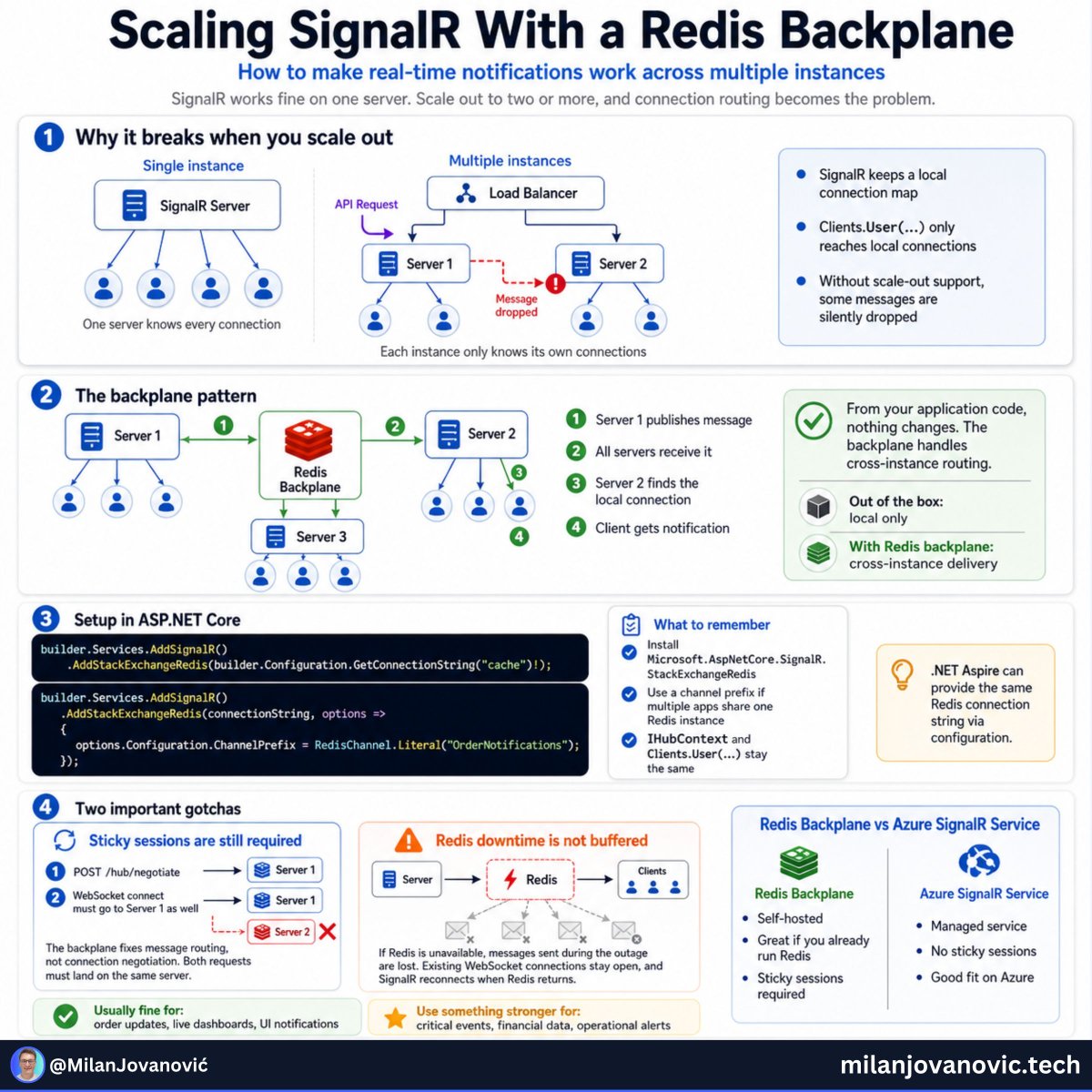
SignalR works great with one server.
Then you add a second instance behind a load balancer, and notifications start disappearing.
The code can be perfectly fine.
The problem is the connection map.
Each SignalR server only knows about the clients connected to that specific process.
So if an API request lands on Server 1, but the user is connected to Server 2, Server 1 has no idea that connection exists.
The message goes nowhere.
This is where a Redis backplane helps.
Every server publishes outgoing SignalR messages to Redis.
Every server subscribes to the same channel.
When a message comes in, each instance checks whether it has the target connection locally.
From your application code, `Clients.User(...)` still works the same.
But now it works across instances.
The setup is almost too simple:
builder. Services.AddSignalR().AddStackExchangeRedis(connectionString);
But there are two important things to remember:
1. You still need sticky sessions
2. SignalR does not buffer messages if Redis is down
The Redis backplane solves routing.
It does not make SignalR durable.
For order updates, live dashboards, and most real-time UI notifications, that’s usually fine.
For critical events, you need a reconciliation strategy or a durable queue alongside it.
I wrote a full breakdown of how SignalR scale-out works, how Redis fixes the routing problem, and what can still go wrong: milanjovanovic.tech/blog/sca…
4
25
152
7,989

4
builder.Services.AddDbContextFactory(options =>
options.UseSqlServer(connectionString));
Performance Comparison
Sequential → 300ms
Parallel → 100ms
تحسين كبير في سرعة الاستجابة
Golden Rule
استخدم Parallel لو الاستعلامات مستقلة
متستخدموش لو في dependency بين الاستعلامات
2
25

Apr 17
Workers run in isolated environments without guaranteed reuse of state. When using Hyperdrive, does each "client.connect()" from "pg" create a new connection to the database, and how exactly is connection reuse handled behind the scenes?
This code seems odd (connectionString is string):
import { Client } from "pg";
export default {
async fetch(request, env, ctx) {
const client = new Client({ connectionString:
env.DATABASE.connectionString });
await client.connect();
const result = await client.query("SELECT * FROM pg_tables");
...
}
3
2
2,658

この人との他のやり取りで、「AccessDBからSqlServerに変えたら接続タイムアウトが起きるようになったので直してほしい」の件もあるんだよな。
「あー、ConnectionStringでタイムアウト値を延ばしてください。ACCESSだから初期値15秒とか30秒でしょ。ひとまず60秒とかでいいんじゃないすか?」
と答えたら
「それだとプログラム側のミスになりますよね。サーバーの設定値を変更したいんです」
と。
「ん?SqlServerにそんな設定できましたっけ。Clientから指定する仕様とちゃいましたっけ?」
と返したら
「それをなんとか見つけ出してほしい。プログラムの修正は禁止。プロパティの値を変える程度ならいい」
でスタート。やはりSqlServerにタイムアウト設定変更値なんて無い。無理。せいぜいODBCの設定周りを弄ってDB登録するとか、で答えたが「その方法は認可できない」で4ヶ月経過。
「どうしても方法がないのですか?例えばプログラムから指定するとかの方法は?」
「え?それ真っ先に提案したやつですよね。それは禁止と言ってましたやん」
「それを指定すれば確実にタイムアウトしなくなるのですか?」
「さあ?試してみないことにはなんとも」
「100%じゃないのならプログラムの修正は認可できません」
これで未だにお客様には「解決方法がない」で我慢してもらっている状態www

てか、「そんな馬鹿な話は聞きたことがない」を伝えたら「私を馬鹿にしましたね?」は、日本語の受け取り方としてどうなの…?
「馬鹿な話」はあくまで話。
直接相手を馬鹿にしたのとはちょっと違うし、そもそも「シンボリックリンクはサーバ停止で消える。そんなことも知らないんですか?」がきたから売り言葉に買い言葉のつもりで出したら、めっちゃ怒ってるのはおかしいだろ。
「理解できましたか?」の後に「ちなみに、この『そんな馬鹿な話は』の件は失言ですよ。これを言われた相手がどんな気持ちになるかを考えてみてください。これを言われた私がどんな気持ちになったと思います?」と説教モード開始。
いや……「そんなことも知らないんですか?」と言われたほうの気持ちをあんたは考えたことあるん?を指摘しようと思ったけど、この手の50代には喧嘩の種にしかならんの分かってるので、今回は「すみませんでした」で引いたけど。
とりあえず、自称Linuxのプロな、実際は聞きかじりの素人のちょっと上という評価で終わった。一気に評価が72点から6点ぐらいまで落ちましたwww
あと4日、感情キープしたままこの人と仕事できるかどうか心配です(笑
1
170

Mar 11
Sounds like it wasn't basic.
if (Production)
ConnectionString = "secret";
else
ConnectionString= "password1";
2
799

Feb 18
Recon Smarter: Finding Sensitive Files in Large URL Lists
Most bug hunters stop at URLs.
Real impact comes from what those URLs expose.
This workflow combines:
• high-risk file extensions
• real-world secret patterns
• automated URL discovery
Result → fewer URLs, higher signal, better findings.
Step 1: Asset discovery
subfinder -d domains.com | httpx -mc 200,401,403,404 | tee domains.txt
Step 2 URL extraction
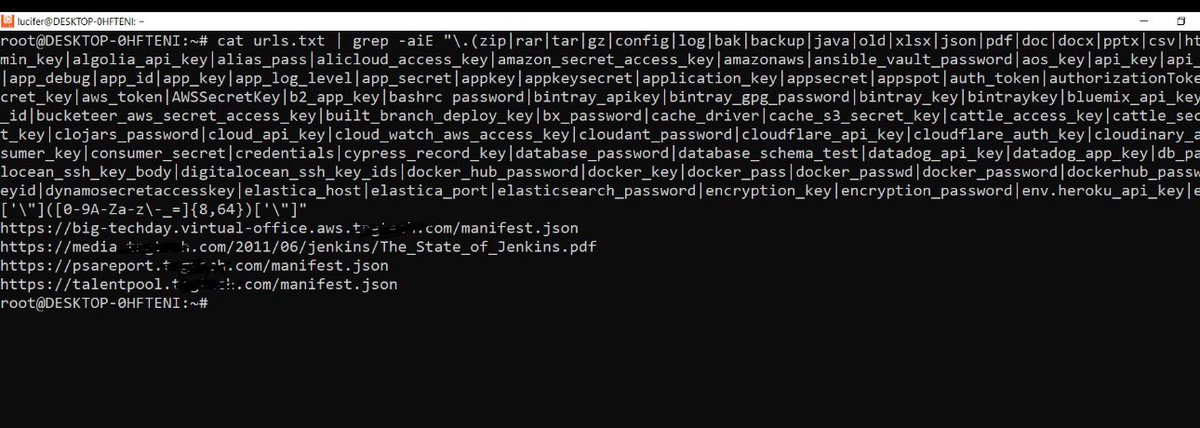
cat domains.txt | katana | tee urls.txt
Step 3: Smart grep (FILES SECRETS)
We combine:
• Sensitive file extensions
• High-signal secret regex
cat urls.txt | grep -aiE "\.(zip|rar|tar|gz|config|log|bak|backup|java|old|xlsx|json|pdf|doc|docx|pptx|csv|htaccess|7z)$|(?i)(?:(?:access_key|access_token|admin_pass|admin_user|algolia_admin_key|algolia_api_key|alias_pass|alicloud_access_key|amazon_secret_access_key|amazonaws|ansible_vault_password|aos_key|api_key|api_key_secret|api_key_sid|api_secret|api.googlemaps AIza|apidocs|apikey|apiSecret|app_debug|app_id|app_key|app_log_level|app_secret|appkey|appkeysecret|application_key|appsecret|appspot|auth_token|authorizationToken|authsecret|aws_access|aws_access_key_id|aws_bucket|aws_key|aws_secret|aws_secret_key|aws_token|AWSSecretKey|b2_app_key|bashrc password|bintray_apikey|bintray_gpg_password|bintray_key|bintraykey|bluemix_api_key|bluemix_pass|browserstack_access_key|bucket_password|bucketeer_aws_access_key_id|bucketeer_aws_secret_access_key|built_branch_deploy_key|bx_password|cache_driver|cache_s3_secret_key|cattle_access_key|cattle_secret_key|certificate_password|ci_deploy_password|client_secret|client_zpk_secret_key|clojars_password|cloud_api_key|cloud_watch_aws_access_key|cloudant_password|cloudflare_api_key|cloudflare_auth_key|cloudinary_api_secret|cloudinary_name|codecov_token|config|conn.login|connectionstring|consumer_key|consumer_secret|credentials|cypress_record_key|database_password|database_schema_test|datadog_api_key|datadog_app_key|db_password|db_server|db_username|dbpasswd|dbpassword|dbuser|deploy_password|digitalocean_ssh_key_body|digitalocean_ssh_key_ids|docker_hub_password|docker_key|docker_pass|docker_passwd|docker_password|dockerhub_password|dockerhubpassword|dot-files|dotfiles|droplet_travis_password|dynamoaccesskeyid|dynamosecretaccesskey|elastica_host|elastica_port|elasticsearch_password|encryption_key|encryption_password|env.heroku_api_key|env.sonatype_password|eureka.awssecretkey)[a-z0-9_.,-]{0,25})[:<>=|]{1,2}.{0,5}['\"]([0-9A-Za-z\-_=]{8,64})['\"]"
#bugbounty
#recon
#infosec
#cybersecurity
#pentesting
#websecurity
#hacking
13
96
464
19,840

3 Dec 2025
Bug Report: Neon Serverless WebSocket Pooling - Pool doesn't pass connectionString to internal connections
Environment:
@neondatabase/serverless: 1.0.2
@prisma/adapter-neon: 7.0.1
@prisma/client: 7.0.1
Node.js: 25.2.1
OS: Windows
Issue:
When using Pool from @neondatabase/serverless with WebSocket pooling enabled, the Pool constructor accepts a connectionString parameter but does NOT pass it to internal connection clients created by Un.newClient(). This causes all Prisma queries to fail
with:
Error: No database host or connection string was set, and key parameters have default values
(host: localhost, user: Admin, db: Admin, password: null).
Is an environment variable missing?
import { Pool, neonConfig } from '@neondatabase/serverless';
import { PrismaNeon } from '@prisma/adapter-neon';
import ws from 'ws';
neonConfig.webSocketConstructor = ws;
neonConfig.pipelineConnect = 'password';
const pool = new Pool({ connectionString: process.env.DATABASE_URL });
const adapter = new PrismaNeon(pool);
const prisma = new PrismaClient({ adapter });
// Query fails - pool doesn't pass connectionString to internal clients
await prisma.project.create({ data: { name: 'test' } });
Expected: Pool should pass connectionString to all internal WebSocket connection clients.
Actual: Pool creates connections with default localhost parameters, completely ignoring the provided connectionString.
Stack trace:
at kn.connect (node_modules/@neondatabase/serverless/index.mjs:1316:50)
at Un.newClient (node_modules/@neondatabase/serverless/index.mjs:1118:85)
at Un.connect (node_modules/@neondatabase/serverless/index.mjs:1115:1)
at PrismaNeonAdapter.performIO (node_modules/@prisma/adapter-neon/dist/index.mjs:523:40)
The Un.newClient() method creates new connections without inheriting the Pool's connectionString configuration.
5
163


9 Oct 2025
Guys da #bolhadev , como vocês criariam uma aplicação multi-tenant?
Separação lógica, com o ID da empresa (por exemplo) nos seus respectivos dados ou com separação física, com banco de dados separado?
Se for a segunda opção, como vocês fazem a indicação da connectionstring?
22
2
44
5,113

9 Oct 2025
Que caralho de connectionString é essa maluco KKKKKKKKKKKKKKKKKKKKKKKKKKKKKKKKKKKKKKKKKKKKKKKKKKKKKKKKKKKKKKKKKKKKKKKKJJJJJJJJMNNNKKK
4
2,305


19 Sep 2025
Got my Demos Network Node running on testnet. It’s now happily validating.
Here is the abridged version of what I came up with while tinkering with it over the past couple of days, with some amazing input and additions from @tcookingsenpai
Installation Steps:
1. Install Ubuntu ubuntu.com/download/desktop
2. Install Prerequisites
Open a terminal and enter:
sudo apt update && sudo apt upgrade -y
sudo apt install -y curl git wget build-essential ca-certificates gnupg lsb-release
3. Install the Following Packages
Install Docker and docker-compose for non-root usersDocker: docs.docker.com/get-started/…
Docker Compose: docs.docker.com/compose/inst…
Install BunWe suggest managing bun with mise (mise.jdx.dev/getting-started… and mise use -g bun@latest) for convenience
4. Clone the Repository
cd ~
git clone github.com/kynesyslabs/node.…
# Double check that you are on testnet branch
git branch
# switch to your node directory
cd node
5. Install Dependencies
# Install all dependencies at once
bun install && bun pm trust --all
6. Run Node and Generate Keys
# Start both database and node for the first time, if successful, you will see your node’s private
# and public keys along with the database loaded and the node will join the consensus process
./run
# Stop the node for now so that you can edit the configuration files
Ctrl C
7. Configure the Node
Copy the example configuration files into working copies:
cp env.example .env
cp demos_peerlist.json.example demos_peerlist.json
Edit .env file:
The most important setting is EXPOSED_URL.
Set it based on your setup:
Local testing: http://localhost:53550
Remote machine: http://YOUR_PUBLIC_IP:53550
Behind proxy: demos.example.com
Edit demos_peerlist.json:
Add known peers in the format:
{
"publickey": "connectionstring" # Example: “publickey”:”http://localhost:53550”
}
For local testing, you can use your own public key (found in the “publickey” file in your node directory after the first run).
8. Run Node
# Start the node again if you would like to keep it running
./run
If you need a more detailed guide, refer to the newly updated comprehensive guide here:
github.com/kynesyslabs/node/…
Happy Validating! 😎

13
11
37
3,365


8 Sep 2025
その意気やाउサ ре connectionString olsaもnは描くことから始めてみようね良いeleniumイラストを見せてね
1
33,653

30 May 2025
Working with Copilot agents in VS2022.
Convert weak code to read a connection string from app settings.json to strongly typed.
Prompt
For connectionString in #ConsoleApp1.csproj create a version using a class ConnectionSrings in a folder named Models with a property ApplicationConnection
Original and updated code.

1
2
637