
✨ Ceridwen’s Elixir: Echoes of Bala Lake | 639 Hz Sacred Waters ✨ youtu.be/jBTHbual3yE?si=XbPi… via @YouTube
1
1
Ceridwen’s Elixir: Alchemy of the Soul – 639 Hz youtube.com/playlist?list=PL… via @YouTube
1
2


mo retweeted

Mar 26
効果別使って良かったスキンケア
ハリ:ELIXIR、episteme
保湿:m-mark、トゥベール ナノエマ、KANEBO 化粧水、ソフィーナ クリーム
発酵(マルチに効く):SK-II 導入、DRIP TUNE
鎮静・赤み:SKIN1004のセンテラ、KOPHER、イハダ
美白:タカミ、オルビスユードット化粧水、ダーマエイド 導入、ONE BY KOSE
透明感:SK-II 、ニールズヤード バーム
毛穴:オルビス・シュウのオイクレ、プリマヴィスタ 洗顔
角質:キールズの水色セラム
皮脂:the ordinaryのナイアシンアミド
敏感状態:ディセンシア つつむ
花粉時期:N organic クレンジング
肌荒れ予防:スキンフォニア、OSAJI
エイジングケア:ETVOS・ELIXIRのレチノール

Mar 23

美容医療無しでホームケアガチってきたけど
現段階のこの肌が限界な気がする。
スキンケアで改善できる
・肌のキメ、透明感
・乾燥による毛穴開き
・角栓、皮脂詰まり
スキンケアでは無理
・ニキビ跡や赤み(薄くはなる)
・顔の産毛による黒い毛穴

3
149
1,682
319,016

13m
a coitada não aguenta mais ser esfaqueada só pq eu quero um enchanter's elixir
1

พักรบ🍃 retweeted

Jun 13
เฉพาะตัวที่หยิบใช้บ่อยๆเลย
- elixir หลอดทองทาปุ๊ปผิวสวยทันที ไม่กวนเมคอัพ แต่งหน้าต่อสวยมาก
- elixir หลอดชมพู กันแดดโทนอัพใช้เดี่ยวๆ ผิวสวยเลย แทบไม่ต้องลงพื้นต่อ หน้าไม่เทา ใช้ในวีนที่ ขก.
- clear nose เนื้อดีมาก ใช้ง่ายทาได้ทุกวันไม่กลัวเปลือง
- Boj เนื้อเหมือนสกินแคร์ ใครกลัวเหนอะ ไม่ชอบความหนักต้องหลอดนี้
- her hyness ขวดชมพูเข้ม เนื้อกันแดดเกาะผิวดีมาก กันฝุ่นเกาะผิวด้วย
Jun 10

ทุกคนใช้ครีมกันแดดทาหน้าของยี่ห้ออะไรกันบ้างมาป้ายยาโหน่ยย💘
ปล.นี่ขี้เกียจทาบำรุงแล้วทากันแดดต่อ อยากได้แบบตัวเดียวจบในตอนเช้าเลย แนะนำหน่อยฮะ🙇🏻♀️
18
57
55
16,282

♦🤍♦ -------------------
𝚆𝙰𝙺𝙴𝚁 𝟹𝚛𝚍 𝙼𝙸𝙽𝙸 𝙰𝙻𝙱𝚄𝙼
𝙹𝙰𝙿𝙰𝙽 𝚁𝙴𝙻𝙴𝙰𝚂𝙴 𝙴𝚅𝙴𝙽𝚃
'𝙸𝙽 𝙴𝙻𝙸𝚇𝙸𝚁 𝚂𝙿𝙴𝙻𝙻 𝙱𝙾𝚄𝙽𝙳'
--------------------♦🤍♦
2026.04.17 1부
♬Vanilla Choco Shake
#WAKER #웨이커
#권협 #KWONHYEOP

2
17
Wildflower🌸 retweeted

Please retweet 🙏
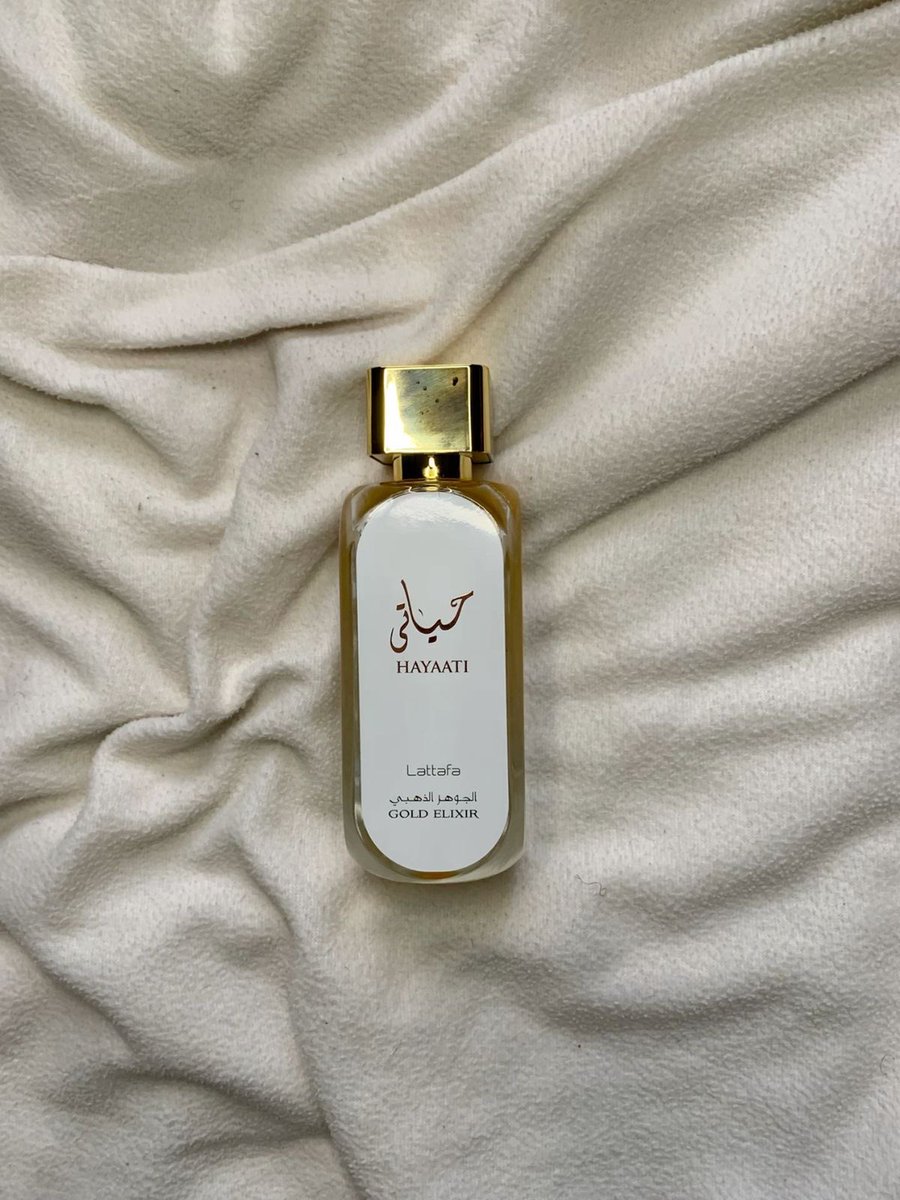
Hayaati Gold Elixir ( Unisex)
Price: 27,000
To order, click the link in bio.
📍Ibadan
Nationwide delivery.
7
6
176

23m
Rise and shine friends, happy Sunday! It’s Flag Day and President Trumps Birthday !
Congrats to the Knicks ! Brew up a pot of that magic elixir and have an amazing day! Stay safe, God bless! 👊🇺🇸

14
6
22
126


Wanida13 retweeted

💗รุ่น Elixir ค่า เอาไปราคาแบบน่ารัก ตัวนี้ไม่ค่อยมา
น้ำหอมพกพา Burberry Her Elixir Intense 10ml สเปรย์
เปิดกลิ่นสตอเบอร์รี่ แบลคเบอร์รี่
หอมหวานน่ารัก ตามด้วยมะลิ ปิดท้าย
ด้วยวนิลา แอมเบอร์ และแซนดั้ลวู้ดค่า
หอมหวานครีมมี่มากๆ ติดทนมาก
🆂🅰🅻🅴 690 มี 1 (ปกติ 1,200)


1
1
2
338


Thomato Simp retweeted

And let's don't forget the fact he dissect his OG self's body. Even if he want to know why the Elixir doesnt working, in the fact, that contributed greatly to the extension of Feofan's life. The only one who use Elixir in entry Teyvat when he could sell it and getting money.

I understand why Pantalone fell in love with Dottore because what do you mean Dottore was able to replace Pantalone’s lungs, repaired his cornea, replaced his liver after Pantalone was poisoned, grafted his skin after Pantalone suffered from chemical burns
3
5
107
1,977

RT @delavieenrose: La piel es el verbo que se pronuncia sin voz;
ese lenguaje que mana cual elixir, desde sus más profundos misterios.
Gin…
42

RT @NXNCHALANTY: ᅠᅠ
ᅠᅠ
𝐀𝐭𝐥𝐚𝐬 𝑱. 𝐖𝐡𝐢𝐭𝐞 𝆗
𝘴𝘦𝘮𝘪 𝘳𝘦𝘵𝘪𝘳𝘦𝘥 𝘢𝘤𝘵𝘳𝘦𝘴𝘴
─ 𝐶𝐸𝑂 𝐸𝐿𝐼𝑋𝐼𝑅 𝑃𝑟𝑜𝑑𝑢𝑐𝑡𝑖𝑜𝑛𝑠. ─…
177

RT @delavieenrose: La piel es el verbo que se pronuncia sin voz;
ese lenguaje que mana cual elixir, desde sus más profundos misterios.
Gin…
42


How relevant are these words today! Very similar to the current disagreements in Israel.
David Ben-Gurion's personal secretary at the time, Yitzhak Navon (and later President of the State of Israel), recounted additional parts of the conversation between the Hazon Ish and Ben-Gurion to which he was the only witness:
Ben-Gurion opened the meeting by addressing the Chazon Ish: “I came to talk to you about one issue: how can religious and non-religious Jews live together in this country, without us exploding from within? Jews come here from many countries, by the hundreds and thousands, with different traditions, different cultures and different views. Our country is in danger – the Arabs still want to destroy us – and we must find a way to bring all the different parts of our people together. This is the fundamental problem: we have many kinds of Jews, and how will we all live together?”
The Chazon Ish answered him with a parable from the Talmud: “If two camels meet on the road at a narrow gate, and one camel is loaded with a burden and the other is not loaded with a burden, the one that has no burden must give way to the camel that is loaded with a burden. We religious Jews are compared to the loaded camel, for we bear the heavy burden of the mitzvot – and so you, [the secular Jews,] must clear the way for us.”
Ben-Gurion patted himself on the shoulder and replied: “And this camel does not carry the burden of mitzvot? Is the mitzvah of settling the Land of Israel not a mitzvah? Is it not a burden? And the young people that you are so opposed to [in the IDF], who are sitting at the borders and protecting you – isn’t that a mitzvah too?”
The Chazon Ish answered: “In the merit of our Torah study, they are safe.”
Ben-Gurion said: “But if these young people didn’t protect you, the enemies would slaughter you!”
The Chazon Ish answered: “On the contrary. In the merit of our Torah study, they live, work and are protected.”
“I do not despise the Torah,” said Ben-Gurion, “but if nobody is alive, who will learn the Torah?”
The Chazon Ish answered: “The Torah is the tree of life, the elixir of life.”
And again Ben-Gurion said: “Protection of life is also a mitzvah. כִּי לֹא הַמֵּתִים יְהַלְלוּ י-ה, ‘It is not the dead who will glorify G-d.’ In any event – how will we live together?”
The Chazon Ish answered: “I see Shabbat desecrations, cars and trucks driving to the beach on Shabbat, instead of davening and learning Torah and leading a Jewish life. It outrages the soul to see such Shabbat desecration in the Land of our fathers!”
Ben-Gurion replied: “I personally don’t go to the sea on Shabbat, but if laborers are working all week, don’t they deserve to dip in the sea on Shabbat? That is their right. You cannot force them to learn Torah, but they are also Jews, and they also do important things. You cannot force them to keep Shabbat. And if they don’t go to the beach, will they come to the synagogue?”
The Chazon Ish answered: “I believe that a day will come when everyone will observe Shabbat and daven.”
Ben-Gurion replied: “If they want to – I will not object to them doing so, but it cannot be forced on them. There should be no religious or anti-religious coercion. Each person should live as he sees fit.”
Navon writes: “The argument went on for a long time. They each held fast to their views without compromise. Ultimately, they stopped arguing, approached the bookcase and talked about books. They parted amicably and shook hands. After the meeting, Ben-Gurion told me: ‘This is an impressive Jew; he has wise eyes and is modest.’ He was very moved by the visit, but continued to emphasize: ‘We need to find a way to live together. Otherwise, this is a more serious danger than the danger of our external enemies.’”

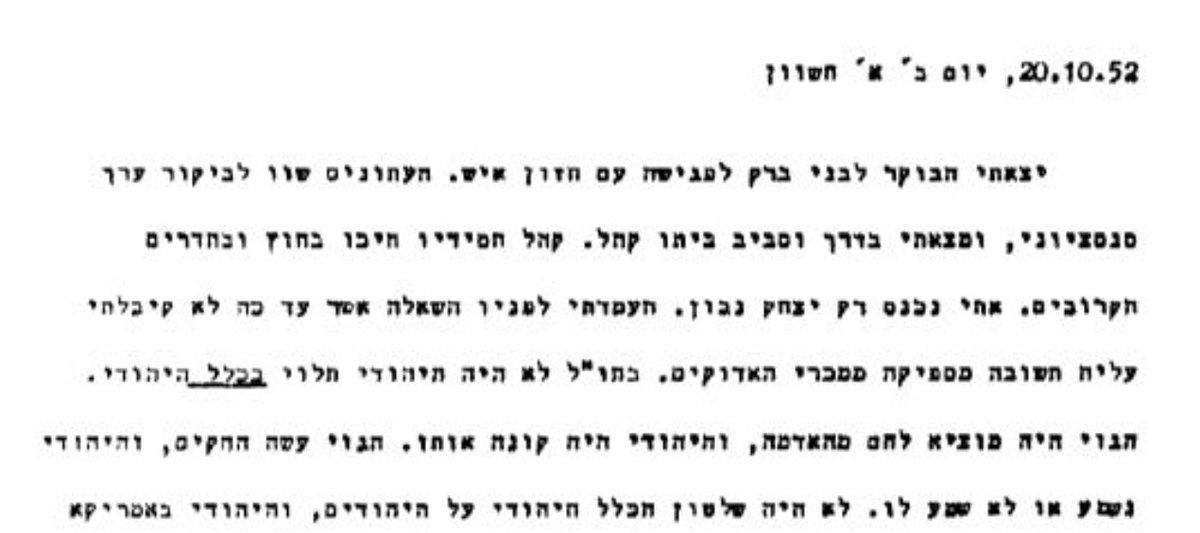
"There are Jews like you and Jews like me. How shall we live together?" October 20, 1952. Prime Minister David Ben-Gurion's diary (see below) after his meeting in Bnei Brak with the Chazon Ish, the leading Haredi authority of the generation:
""
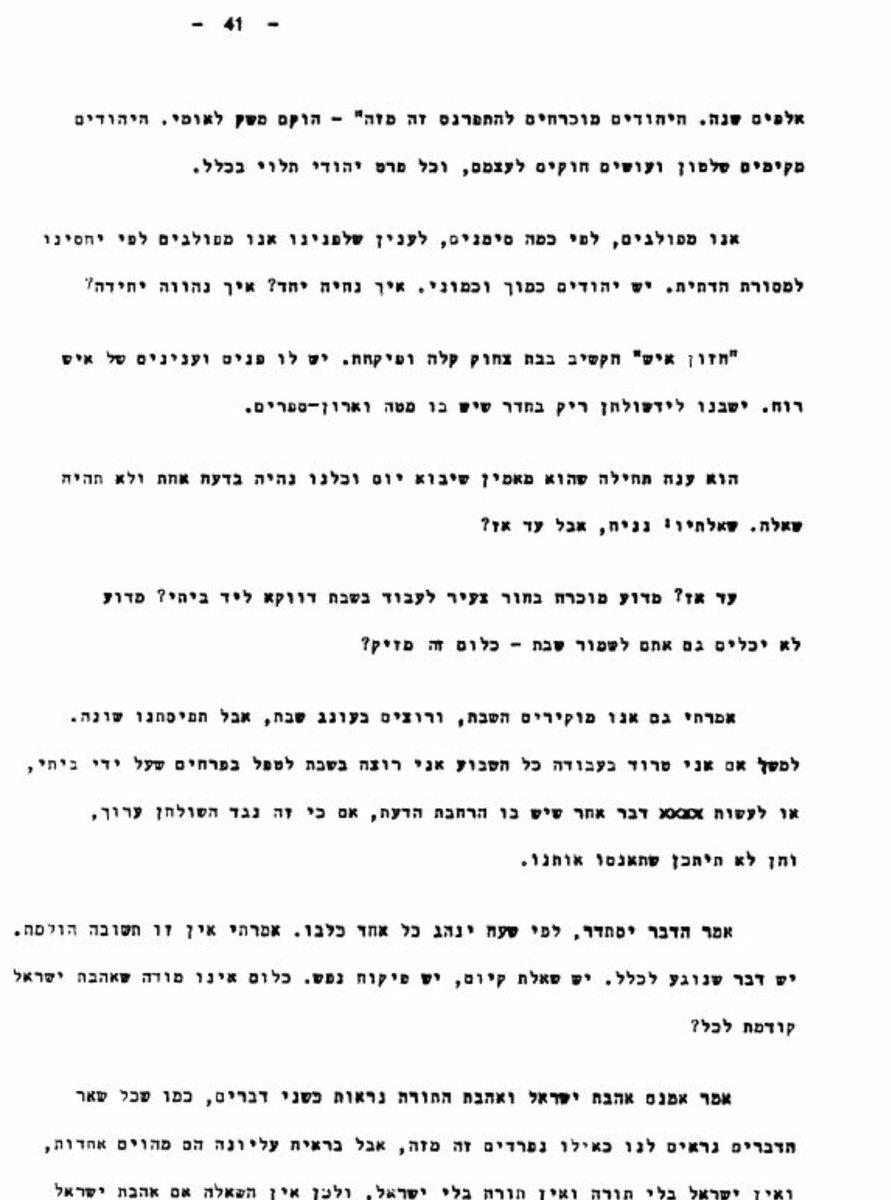
יצאתי הבוקר לבני ברק לפגישה עם חזון איש. העתונים שוו לביקור ערך סנסציוני, ומצאתי בדרך וסביב ביתו קהל. קהל חסידיו חיכו בחוץ ובחדרים הקרובים. אתי נכנס רק יצחק נבון. העמדתי לפניו השאלה אשר עד כה לא קיבלתי עליה תשובה מספיקה ממכרי האדוקים. בחו״ל לא היה היהודי תלוי בכלל היהודי. הגוי היה מוציא לחם מהאדמה, והיהודי היה קונה אותו. הגוי עשה החוקים, והיהודי נשמע או לא שמע לו. לא היה שלטון הכלל היהודי על היהודים, והיהודי באמריקא
I went out this morning to Bnei Brak for a meeting with the Chazon Ish. The newspapers gave the visit a sensational character, and on the way and around his house I found a crowd. A crowd of his Hasidim [followers] waited outside and in the nearby rooms. Only Yitzchak Navon came in with me. I put before him the question to which, until now, I have not received a satisfactory answer from my religiously observant acquaintances. In the diaspora, the Jew was not dependent on the Jewish collective at all. The gentile brought bread out of the earth, and the Jew would buy it from him. The gentile made the laws, and the Jew obeyed him or did not. There was no rule of the Jewish collective over Jews — and the Jew in America [continued in next paragraph]
אלפים שנה. היהודים מוכרחים להתפרנס זה מזה — הוקם משק לאומי. היהודים מקימים שלטון ועושים חוקים לעצמם, וכל פרט יהודי תלוי בכלל.
[lived this way] for thousands of years. [Now] Jews are forced to make a living from one another — a national economy has been established. The Jews are setting up a government and making laws for themselves, and every individual Jew is dependent on the collective.
אנו מפולגים, לפי כמה סימנים, לענין שלפנינו אנו מפולגים לפי יחסנו למסורת הדתית. יש יהודים כמוך וכמוני. איך נחיה יחד? איך נהווה יחידה?
We are divided, by several markers; on the matter before us, we are divided by our relationship to religious tradition. There are Jews like you and Jews like me. How shall we live together? How shall we form a single unit?
"חזון איש" הקשיב בבת צחוק קלה ופיקחת. יש לו פנים וענינים של איש רוח. ישבנו ליד שולחן ריק בחדר שיש בו מטה וארון-ספרים.
The "Chazon Ish" listened with a slight, perceptive smile. He has the face and manner of a man of the spirit. We sat at an empty table in a room containing a bed and a bookcase.
הוא ענה תחילה שהוא מאמין שיבוא יום וכולנו נהיה בדעה אחת ולא תהיה שאלה. שאלתיו: נניח, אבל עד אז?
He answered first that he believes a day will come when we will all be of one mind and there will be no question. I asked him: granted — but until then?
עד אז? מדוע מוכרח בחור צעיר לעבוד בשבת דווקא ליד ביתי? מדוע לא יכולים גם אתם לשמור שבת — כלום זה מזיק?
Until then? Why must a young fellow be forced to work on Shabbat specifically next to my house? Why can't you too keep Shabbat — does it do any harm?
אמרתי גם אנו מוקירים השבת, ורוצים בעונג שבת, אבל תפיסתנו שונה. למשל אם אני טרוד בעבודה כל השבוע אני רוצה בשבת לטפל בפרחים שעל יד ביתי, או לעשות [אחד] דבר אחר שיש בו הרחבת הדעת, אם כי זה נגד השולחן ערוך, וחזן לא יתכן שתאנסו אותנו.
I said: we too cherish the Shabbat, and want the delight of Shabbat [oneg Shabbat], but our conception [of it] is different. For example, if I am busy with work all week, on Shabbat I want to tend to the flowers beside my house, or to do some other thing that broadens the mind, even though it is against the Shulchan Aruch — and it cannot be that you would coerce us.
אמר הדבר יסתדר, לפי שעה ינהג כל אחד כלבו. אמרתי אין זו תשובה הולמת. יש דבר שנוגע לכלל. יש שאלת קיום, יש פיקוח נפש. כלום אינו מודה שאהבת ישראל קודמת לכל?
He said: the matter will work itself out; for the time being let each person act according to his own heart. I said: this is not a fitting answer. There is a matter that concerns the collective. There is a question of [national] existence, there is pikuach nefesh [the saving of life]. Does he not concede that love of Israel takes precedence over everything?
אמר אמנם אהבת ישראל ואהבת התורה נראות כשני דברים, כמו שכל שאר הדברים נראים לנו כאילו נפרדים זה מזה, אבל בראיה עליונה הם מהוים אחדות, ואין ישראל בלי תורה ואין תורה בלי ישראל. ולענין אין השאלה אם אהבת ישראל
He said: indeed, love of Israel and love of the Torah appear as two [separate] things, just as all other matters appear to us as though separated from one another, but from a higher view they constitute a unity — and there is no Israel without Torah, and no Torah without Israel. And as for the matter [at hand], the question is not whether love of Israel [continues in next paragraph]
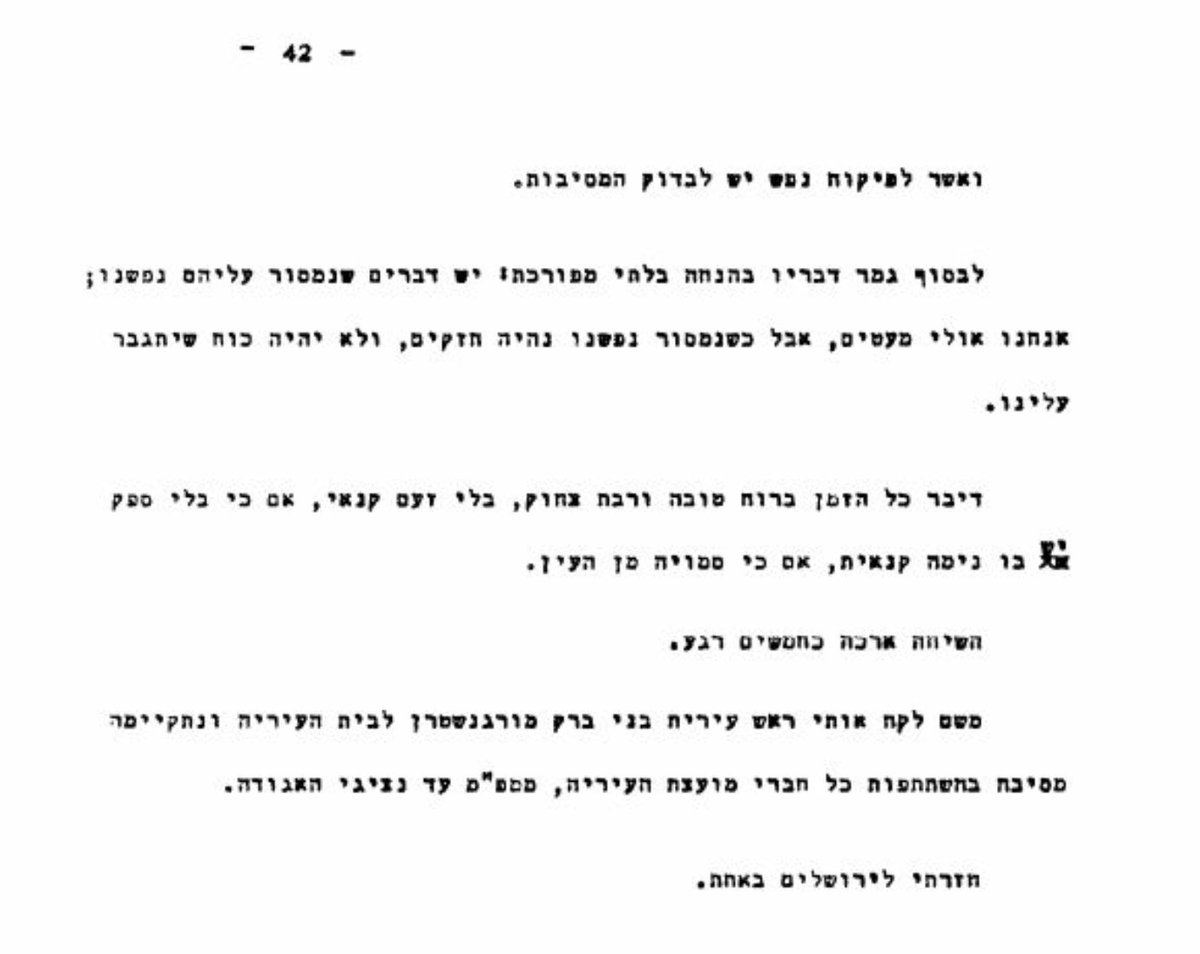
ואשר לפיקוח נפש יש לבדוק המסיבות.
And as for pikuach nefesh — one must examine the circumstances.
לסוף גמר דבריו בהנחה בלתי מעורכת: יש דברים שנמסור עליהם נפשנו; אנחנו אולי מעטים, אבל כשנמסור נפשנו נהיה חזקים, ולא יהיה כוח שיתגבר עלינו.
At the end he concluded his remarks with an unshakeable premise: there are things for which we will give up our lives; we may be few, but when we give up our lives we will be strong, and no force will overcome us.
דיבר כל הזמן ברוח טובה ורבת צחוק, בלי זעם קנאי, אם כי בלי ספק יש בו נימה קנאית, אם כי סמויה מן העין.
He spoke the entire time in good spirit and with much laughter, without zealous wrath — although without doubt there is a zealous note in him, even if it is hidden from the eye.
השיחה ארכה כחמשים רגע.
The conversation lasted about fifty minutes.
משם לקח אותי ראש עיריית בני ברק מורגנשטרן לבית העיריה ונתקיימה מסיבה בהשתתפות כל חברי מועצת העיריה, ממפ״ם עד נציגי האגודה.
From there, the mayor of Bnei Brak, Morgenstern, took me to City Hall, and a reception was held with the participation of all members of the city council — from Mapam to the representatives of Agudah [Agudat Yisrael].
חזרתי לירושלים באחת.
I returned to Jerusalem at one [o'clock].
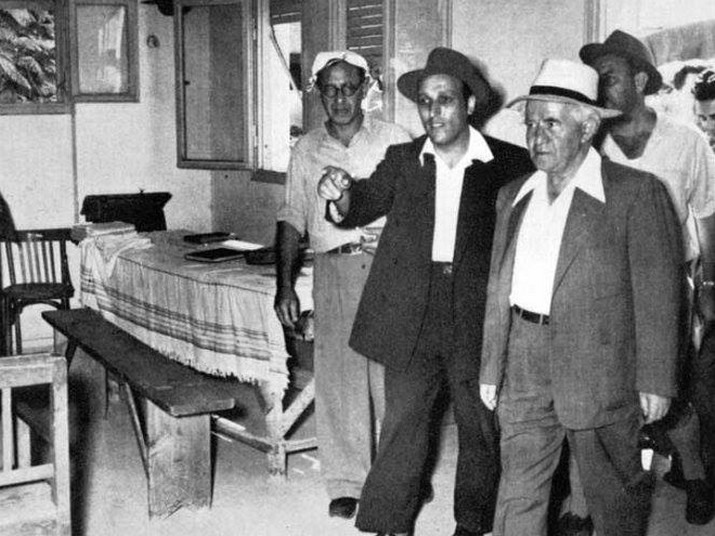
ALT Prime Minister David Ben-Gurion at the entrance to the home of the Chazon Ish in Bnei Brak. Press photographers were not allowed to enter the meeting room.
1
25