

GM. Been looking at @NomismaNetwork through the lens I use for robotics: does it reduce the distance between work done and money earned?
Most networks talk theory. The ones that matter make transactions map cleanly to real operations: metering, audit trails, predictable fees, fast settlement, clear recourse. If Nomisma makes that boring stuff trivial, it unlocks deployments.
What I want to see:
• Integrations with the tools customers already use, not greenfield fantasies.
• Latency and fee stability under load, not just lab benchmarks.
• Identity, dispute, and clawback primitives that reflect how contracts actually fail.
• Pilots with operators who don’t care about chains, only outcomes and unit economics.
Robotics rewards D(eploy)Oers; networks will too.
Every deployment is a data moat. Ship, learn, iterate.
If they stay customer-first and measure savings in dollars and minutes, not vanity metrics, they’ll earn relevance fast.

47
1
47
1,767
GM.
Networks don’t win on whitepapers. They win on deployments and feedback loops.
@XOOBNetwork is interesting because it feels like a D(eploy)Oers network: ship fast, integrate with real users, let data dictate the roadmap.
I don’t care about lab benchmarks.
I care about:
• live integrations with customers who pay
• latency and reliability under real load
• a clear path from incentive to retention
The networks that compound get three things right:
1) remove builder friction
2) turn integrations into distribution, not vanity
3) run a telemetry loop that closes the gap between what users do and what you build
Modular vs monolithic is a distraction if no one’s deploying.
Every deployment is data nobody else has.
Every integration creates switching costs.
If XOOB leans into ruthless deployment and measurable outcomes, it can carve a durable wedge.
I’ll track shipping cadence, integrations, and real usage.
Narratives don’t clear the market.
Deployments do.

89
1
77
1,852

May 19
Most people still think Bitcoin is for holding or slow transfers. The gap between what users expect and what they get is a UX tax paid in minutes and unpredictable fees. I spent time in a sandbox with @utexocom to see if native $USDT on #Bitcoin can actually clear that gap
TLDR:
> RGB assets mapped to UTXOs for native issuance and privacy
> Lightning for sub‑second settlement and predictable fees
> No wrapped assets or risky bridges
> Focused on infra integrations for wallets, exchanges, merchants not a consumer app
Why this matters:
1) BTC/USDT is the most used pair in crypto. Keeping $USDT flow on Bitcoin means real routing volume and sustainable fee revenue where it belongs. If the rails are fast and private, liquidity providers will follow
2) Wrapped systems introduce counterparty and bridge risk. Aligning stablecoin state with the UTXO model removes a whole class of failure modes
3) Enterprises need knobs: auditability, privacy, compliance. The stack is being built with those constraints in mind, not bolted on later
Signals I like:
> Seed raised from Tether ($7.5m) shows upstream alignment with issuers
> Early integrations (incl. Solv) look like real deployments to validate flows, not hype
> CEO Viktor Ihnatiuk is pushing enterprise‑grade infrastructure, not a shiny UI
Payments need D(eploy)Oers. Every integration = data no one else has. The path to PMF here is SDKs landing in production wallets, exchanges settling flows, and merchants seeing failed‑invoice rates drop
These are not just payment features. This is financial plumbing. If @utexocom ships what I saw in testing, Lightning becomes the default settlement layer for $USDT on #Bitcoin and the narrative shifts from store‑of‑value to usable money at scale #Lightning #RGB #Stablecoins #Infrastructure

2
1
3
44
May 19
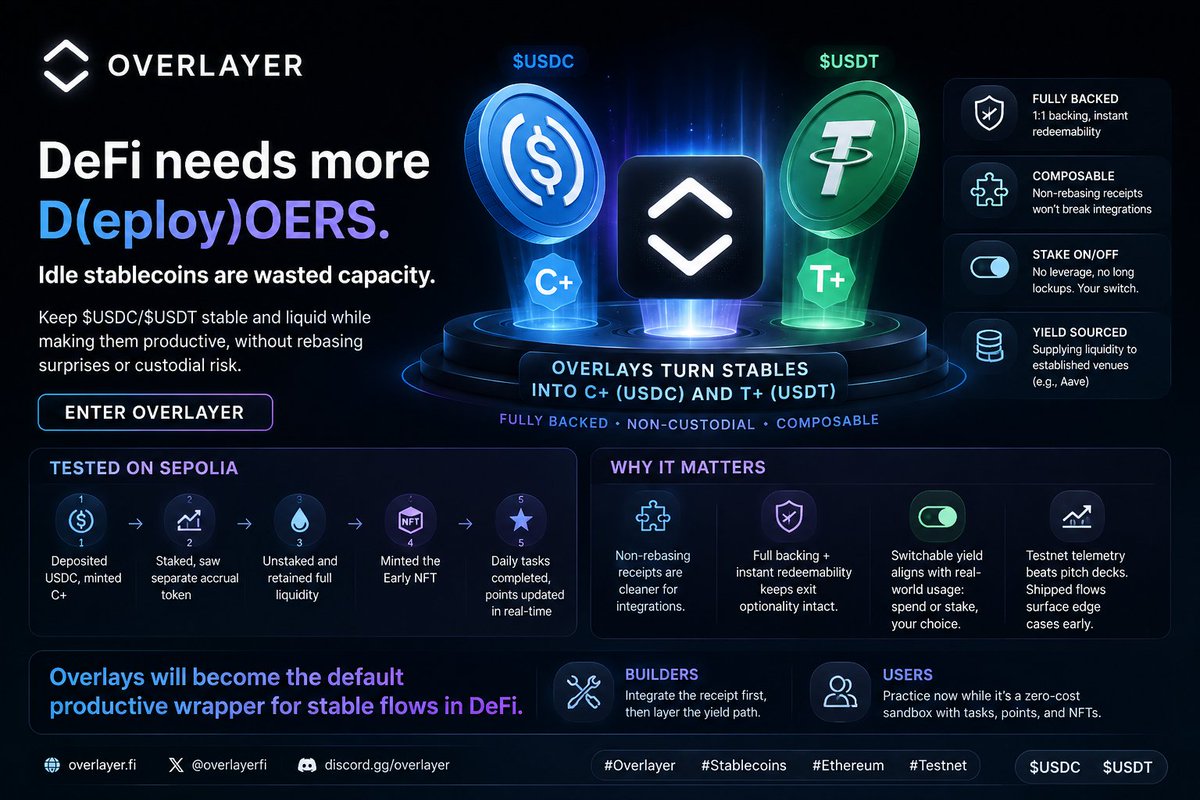
DeFi needs more D(eploy)OERS. Idle stablecoins are wasted capacity. The right pattern is simple: keep $USDC/$USDT stable and liquid while making them productive, without rebasing surprises or custodial risk. Enter @overlayerfi
TLDR:
> Overlays turn stables into C (for $USDC) and T (for $USDT), fully backed and non-custodial
> Composable because the base token doesn’t rebase; yield is separate if you opt in
> Staking is an on/off switch, no leverage, no long lockups
> Yield is sourced by supplying liquidity to established venues (e.g., Aave)
What I ran this morning on Sepolia:
1) Deposited testnet USDC, minted C
2) Staked, saw a separate accrual token vs. balance changes
3) Unstaked and retained full liquidity on the base C
4) Minted the Early NFT
5) Knocked out daily tasks and saw points update in real-time
Why this matters:
1) Non-rebasing receipts are cleaner for integrations; protocols don’t break on balance drift
2) Full backing instant redeemability keeps exit optionality intact
3) The switchable yield path aligns with real-world usage: spend/transact when needed, stake when idle
4) Testnet telemetry beats pitch decks; shipped flows surface edge cases early
Prediction: overlays will become the default “productive wrapper” for stable flows in #DeFi. Builders should integrate the receipt first, then layer the yield path. Users should practice now while it’s a zero-cost sandbox with tasks, points, and NFTs
#Overlayer #Stablecoins #Ethereum #Testnet $USDC $USDT
48
47
175
May 19
RWA Needs More D(eploy)OERS TLDR:
> Liquidity follows verifiable data, not tickers
> Compliance is the product for institutions
> Every live deployment becomes a data moat
> Chains that ship CaaS ZK telemetry will win
After watching the market chase “token wrappers,” I’m more bullish on compliance‑native L1s that do the hard work of converting off‑chain events into on‑chain attestations. The gap isn’t just technical, it’s regulatory and operational. Teams that close it are the ones in the field with issuers, auditors, and regulators, not just dashboards and narratives
That’s why I’m tracking @SimpleChain_RWA:
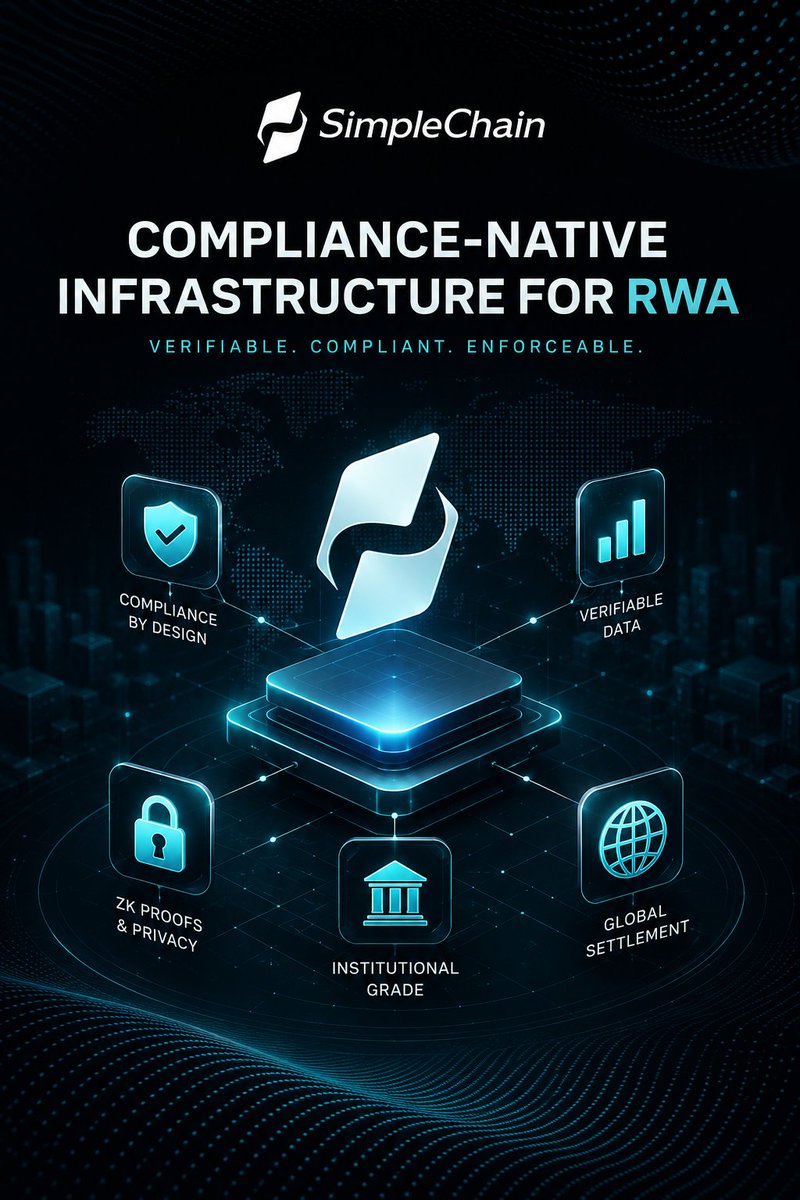
1) Institutional OS orientation: native Compliance‑as‑a‑Service instead of bolted‑on KYC
2) Granular data ZK: IoT/API telemetry with proofs, so assets aren’t static, they’re observable and enforceable
3) Actual deployments: testnet live, CertiK audit; and yes, a car dealership accepting $SRW is a non‑trivial signal that payments issuance rails can converge
4) Execution capacity: ex‑Ant Group/Shuqin operators who understand enterprise fintech constraints
5) Runway with a mandate: $15M seed to build infra, not campaigns
What I think happens next:
• “Static tokens” without verifiable, streaming data and enforcement blow up on first default
• Composable compliance attestations slashing become table stakes
• Data IPOs compress due diligence from PDFs to programmable feeds; risk models update continuously; liquidity becomes a function of data quality, not hype
If you’re early:
• Kick the tires on testnet/Task Hub to understand the CaaS primitives
• Delegate/stake to see how $SRW aligns incentives and penalties
• Prototype issuer flows: ingest → prove → publish
• Write down every friction point; deployments create the moat
RWA is geopolitical financial infrastructure. The chains that can satisfy auditors in Singapore and family offices in Zurich while settling globally will set the standard. Most L1s won’t pass that bar. A few might. I think #SimpleChain has a real shot #RWA #DataIPO $SRW
51
1
47
227

May 18
GN. Info markets reward D(eploy)Oers Took a quiet pass on @KaitoAI: claimed the social card, launched Yaps, seeded tiny markets. Within minutes odds compressed and points tracked flow; the post -> label -> position loop is observable; PnL decides
TLDR:
> $YAPS pays for settled attention; the exhaust trains models
> Each deploy compounds proprietary data
> May 20 $KAITO unlock = liquidity/reflexivity check
> Watch $VS/$USDC microstructure for real depth
Ship where outcome-linked signal accrues #InfoFi #AI #DeFi #AttentionMarkets #Crypto
1
6
112
May 18
GN. Late lap on @KaitoAI: launched a Yap on an earnings rumor, labeled flows, seeded both sides; within minutes spreads compressed and points shadowed OI. Only D(eploy)Oers get to watch opinions calcify into quoted risk
TLDR:
> Posts → labels → quotes → positions; P&L closes the debate
> $YAPS pays on resolution; residual data trains models
> May 20 $KAITO unlock = reflexivity/liquidity exam
#InfoFi #AI #DeFi #AttentionMarkets
8
8
70
May 18
GN. Info markets need more D(eploy)Oers
Tonight I ran a small experiment on @KaitoAI: launched a Yap, labeled flows, seeded both sides. Within minutes odds compressed and points tracked positions. The loop is real: posts → labels → risk, and PnL is the adjudicator
TLDR:
> $YAPS rewards resolved signal
> Each market mints proprietary data
> May 20 $KAITO unlock = liquidity/reflexivity check
#InfoFi #AI #DeFi #AttentionMarkets
9
7
68
May 18
Night lap on @KaitoAI: spun up 2 Yap streams, bootstrapped micro books, claimed the social card; within minutes spreads tightened and points tracked price. Only D(eploy)Oers get to watch takes crystallize into positions
TLDR:
> Posts → tags → positions; PnL closes the loop
> $YAPS pays for resolved outcomes; residue trains models
> May 20 $KAITO unlock is the reflexivity/liquidity check
#InfoFi #AI #DeFi #AttentionMarkets
9
4
54
May 18
Onchain attention will be won by D(eploy)Oers
Afternoon lap on @KaitoAI: launched 2 Yap streams, seeded micro markets, claimed the social card; watched points and odds tighten within minutes the post -> price -> behavior loop is observable
TLDR:
> Posts -> labels -> positions; PnL -> signal
> $YAPS pays for outcomes; exhaust trains models
> May 20 $KAITO unlock = depth/reflexivity check
> Watch $VS/$USDC microstructure for real liquidity
Ship where outcome-linked datasets compound onchain #InfoFi #AI #Crypto #DeFi #AttentionMarkets
6
5
59
May 18
Onchain attention will be won by D(eploy)Oers. Afternoon lap in @KaitoAI: launched 2 Yap streams, seeded micro markets, watched points and odds tighten in minutes. The value isn’t points; it’s the outcome-labeled attention you accrue by shipping
TLDR:
> Posts -> labels -> positions; PnL -> signal
> $YAPS pays for outcomes, not impressions
> May 20 $KAITO unlock = reflexivity check
#InfoFi #AI #Crypto #DeFi #AttentionMarkets
11
9
63
May 18
Midday pass inside @KaitoAI: launched a Yap stream, seeded two micro markets, claimed the social card; watched points and odds co-move within minutes. The post -> label -> position loop is visible and priced
TLDR:
> Deployments turn takes into labeled, tradable data
> $YAPS pays for settled attention; the exhaust trains models
> May 20 $KAITO unlock = depth/reflexivity check
> D(eploy)Oers compound proprietary signal, not slides
Ship where outcome-linked attention compounds #InfoFi #AI #DeFi #AttentionMarkets #Crypto
7
8
104
May 18
GM Attention markets will be won by D(eploy)Oers Took a late-morning pass on @KaitoAI: claimed the social card, launched Yaps, seeded tiny markets, watched points and odds tighten in minutes the post -> price -> behavior loop is observable
TLDR:
> Posts become labeled inventory markets can clear
> $YAPS pays for outcome-linked attention; residue trains models
> Upcoming unlocks and float test $KAITO reflexivity
> Watch $VS/$USDC microstructure for real depth
Ship where outcome-linked datasets compound onchain #InfoFi #AI #DeFi #AttentionMarkets #Crypto
5
5
60
May 18
AM run on @KaitoAI: launched 2 Yap streams, seeded a couple micro markets, claimed the social card; watched points and odds sync in minutes the post→label→position loop is tangible
TLDR:
> Deployments turn takes into priced, labeled data
> $YAPS pays for resolved signal; residue trains models
> Next $KAITO unlock is a depth/reflexivity check
> D(eploy)Oers compound proprietary datasets; slides don’t
#InfoFi #AI #DeFi #AttentionMarkets #Crypto
7
6
79
May 18
GM quick pass on @KaitoAI: claimed the social card, launched Yaps, seeded tiny markets; watched points and odds tighten within minutes. The post -> price -> behavior loop is live; D(eploy)Oers widen the moat
TLDR:
> Posts -> labels -> positions
> $YAPS pays for settled attention
> Each deploy compounds proprietary data
> May 20 $KAITO unlock = reflexivity check
Ship where outcome-linked signal accrues #InfoFi #AI #DeFi #AttentionMarkets #Crypto
9
8
113
May 17
Attention markets will be owned by D(eploy)Oers. Took a late-morning lap on @KaitoAI: claimed my social card, spun up fresh Yap streams, seeded tiny prediction markets, and saw scores and odds tighten within minutes the post -> position -> behavior loop is live
TLDR:
> Yaps turn takes into labels with PnL attached
> $YAPS pays for settled signal; points are exhaust for models
> May 20 $KAITO unlock = usage vs float reflexivity check
> Watch $VS/$USDC microstructure for real depth
#InfoFi #AI #DeFi #AttentionMarkets #Crypto
9
4
10
187
May 17
Onchain attention will be won by D(eploy)Oers, not deck writers
Morning run on @KaitoAI: launched Yaps, opened tiny markets, watched points and odds move in lockstep
TLDR:
> Posts -> labels -> positions; PnL -> signal
> $YAPS pays for outcome-linked attention, not impressions
> Each deployment compounds proprietary data and a moat
> Incentives route through $KAITO
#InfoFi #AI #Crypto #DeFi #AttentionMarkets
10
11
79
May 16
Late-night pass on @KaitoAI: claimed social card, spun up a couple Yaps, watched points and odds update in real time post -> price -> behavior feels wired in
TLDR:
> Labeled attention gets priced, not farmed
> $YAPS pays creators and trains models
> May 20 $KAITO unlock = usage vs supply check
> Versus meta liquidity ($VS, USDC, $2k vol ask) is the tell
GN to D(eploy)Oers building #InfoFi #AI #DeFi #Crypto
14
12
153
May 16
Onchain attention markets need D(eploy)Oers
Spent tonight inside @KaitoAI: claimed the social card, opened a few Yaps, watched points and prediction odds update in real time. The loop from post -> price -> behavior is the product. PMF gets priced in markets, not in decks
TLDR:
> Every Yap is labeled signal that compounds into a moat
> $YAPS pays for signal, not noise
> May 20 $KAITO unlock is a liquidity and reflexivity test
Ship deployments, measure outcomes #InfoFi #DeFi #AttentionMarkets
11
9
121