

Jun 15
unless its about complex routes like balancer etc, reading states is meaningless.
In our research its more about the limited space of flashblock that makes those large onchain searching txs not competitive, they can be put into later flashblocks, while the arb is taken earlier.
1
43

Jun 14
Another one on the @charmsai TikTok page 🔥
Just posted the latest UX upgrade, it now takes just 2 seconds to buy any character on Charms 😍
Gasless • 0% platform fees • Flashblock confirmations (<200ms)
Now supporting deposits from 10 chains, powered by @privy_io
The smoothest experience in the Character Economy just leveled up!
Watch it here 👇
vt.tiktok.com/ZSQQXkmJ9/
Let’s keep pushing @charmsai 🤝 on TikTok @0xJuan__ @Gon0x_ 💙
May 24

When a project like @charmsai builds the foundation for the Character Economy, the next step is capturing the attention of the masses. Been super impressed by @charmsai since discovering the $1.5M raise and the character economy vision.
Decided to build a dedicated TikTok page from scratch, posting your official launch videos in order (intro → $CHARMY → $FROGURT → $TYLER
→ $ZOE → $SCORPION → $BLIND tutorials & milestones).
2
4
6
218

Jun 13
然而,在下一个区块的第一个 Flashblock 中,价格会重新调整为更差的价格,而该价格正是实际交易的结算价格(平均亏损 5-10 个基点)。
propAMM 可以报出一个更小的价差供聚合商选择。在交易结算之前,propAMM 会扩大价差,导致交易最终落在价格范围的较大一端,从而利用“报价和结算之间的延迟”。
1
16
Jun 13
propAMM 也存在权衡取舍的问题,尤其是在设计和具体逻辑不透明或不公开的情况下。
过去,曾出现过一些由 propAMM 在 Base 上错误引用的例子。
每个区块的下一个 Flashblock(约 200 毫秒)最初会提供一个有吸引力的价格,因此聚合器会显示该价格。
1
13


Jun 12
Most @base bugs trace to one mistake: reading "latest" where the code needed "safe".
5 confirmation tiers you should know:
→ Flashblock: 200ms, sequencer preconf
→ latest: 2s, reversible
→ safe: 5–10 min, batch on Ethereum
→ finalized: 15–20 min, validators signed off
→ withdrawal: 7 days
Crediting a deposit on "latest" is how you lose money.
Full breakdown 👇🏻
chainstack.com/base-transact…
1
1
6
157

Jun 10
gBase everyone!
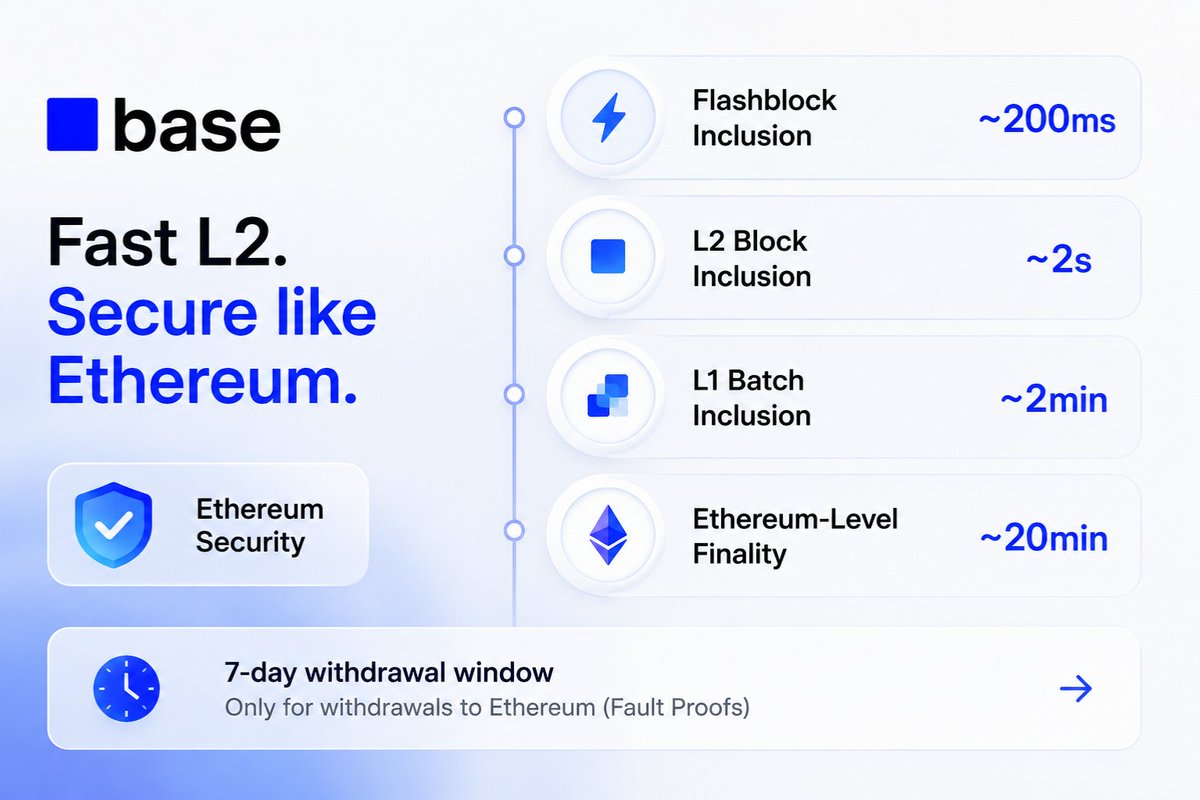
A common misconception: transactions on Base do NOT take 7 days to finalize.
⚡ Flashblock inclusion: ~200ms.
🔹 L2 block inclusion: ~2s.
🔹 L1 batch inclusion: ~2min.
🔒 Ethereum-level finality: ~20min.
The 7-day waiting period only applies to withdrawals from Base back to Ethereum and exists to support the Fault Proof security model.
For regular transfers, swaps, and onchain activity, Base delivers near-instant UX while inheriting Ethereum security.
Fast like an L2. Secure like Ethereum.
@base
Jun 4

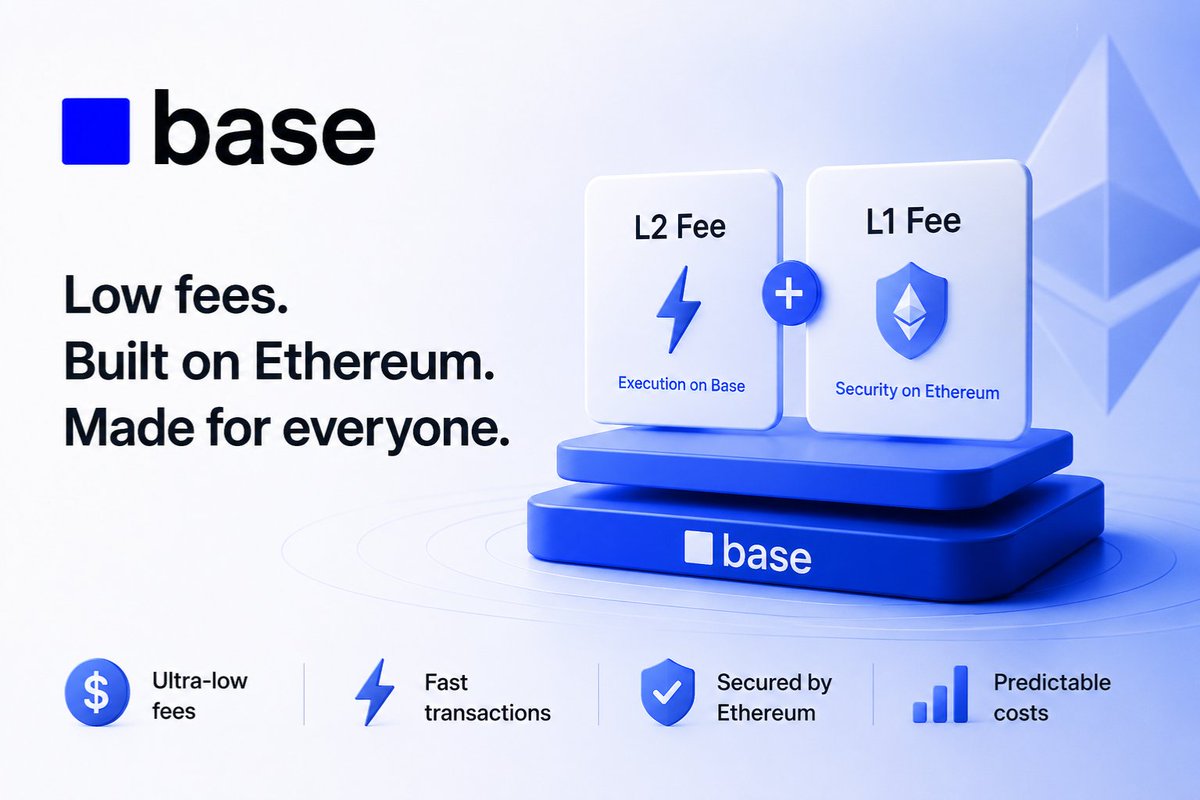
Why Are Base Fees So Low?
Every transaction on Base includes two components:
🔹 L2 Fee - the cost of executing the transaction on Base.
🔹 L1 Fee - the cost of posting transaction data to Ethereum for security.
In many cases, the L1 fee makes up the largest portion of the total transaction cost.
Recent Update
Following the Jovian upgrade, Base introduced a Minimum Base Fee of 0.005 gwei to:
✅ Improve transaction inclusion speed.
✅ Make fees more predictable.
✅ Reduce network spam.
Even with this change, a typical transaction can cost as little as $0.002 when ETH is around $2,000.
Why It Matters?
Base uses Ethereum's EIP-1559 fee model, allowing gas prices to adjust smoothly without major spikes.
⚡ Fast transactions.
💸 Extremely low fees.
🔒 Ethereum-backed security.
Base continues to show why Layer 2 solutions are becoming the preferred choice for DeFi, NFTs, and on-chain applications.
@base
3
27
181

Jun 9
Current Metrics (updated today): TVL: 3.95B - $3.98B (slight decrease, but this has been across the general ETH network; stablecoins are hovering around 4.8B (mainly USDC)).
Aerodrome and Uniswap are strong leaders. Base is already competing with and surpassing Ethereum mainnet and BSC in weekly volumes during certain periods.
Activity: Hundreds of thousands of daily active addresses (MMAs of 320k), massive transactions, and real momentum in DeFi, memes, and payments. Technical Updates Post-Azul: Base Azul has been live on mainnet for 12 days.
Multi-testing (TEE ZK), its own client, faster withdrawals, and greater decentralization.
All stable, without Major incidents reported.
The next update is coming at the end of June: a consecrated token standard, Flashblock access lists, more UX improvements, and withdrawals. Then, one of the account abstractions in August. Base continues to innovate faster than most L2s.
Ecosystem and community activity (last few hours): Strong hype surrounding RWA/tokenization (active Securitize Rewards, integrations with cbBTC and Morpho).
Projects like Velox (DEX/swapper) are updating and receiving feedback from builders. L2 Base summer is heating up.
Stay active 🟦
@baseposting #base #CryptoPayments
#ethereum
1
6
61

Jun 5
Tail of >4 blocks is inclusion. mined_at - sent_at mixes RPC-to-sequencer forwarding, sequencer txpool depth, 200ms Flashblock fee ordering, and nonce stalls. What defines your two timestamps: local broadcast and full receipt, or sequencer ack and Flashblock preconfirmation?
2
7

Jun 4
Ethereum's native account abstraction proposal, EIP-8141, is still in draft status as of March 2026. Vitalik announced it on February 28, Hegota fork timeline puts mainnet rollout roughly a year out. Meanwhile the end-of-June upgrade on @base ships native account abstraction directly into protocol, alongside an enshrined token standard and Flashblock Access Lists.
That gap matters more than it looks. ERC-4337 account abstraction works today on Base via a separate bundler mempool and UserOperation flow. It's functional but layered: your transaction goes through a bundler, gets verified, then lands on-chain. Native AA collapses that stack. Accounts become programmable at the protocol level, gas sponsorship and custom signature schemes stop requiring external infrastructure, and the bundler overhead disappears. The UX difference for a new user is substantial. The developer simplification is larger.
Flashblock Access Lists are the less discussed piece. Flashblocks already cut confirmation times from 2 seconds to 200 milliseconds. Access Lists let specific addresses receive guaranteed preconfirmation slots. That's not a performance improvement for average users, it's infrastructure for high-frequency DeFi, latency-sensitive AI agent pipelines, and any protocol where ordering certainty has economic value.
Base is shipping Ethereum's roadmap faster than Ethereum. Whether that's a structural advantage or a risk depends entirely on whether the June upgrade lands on time.
120
118
899
May 27
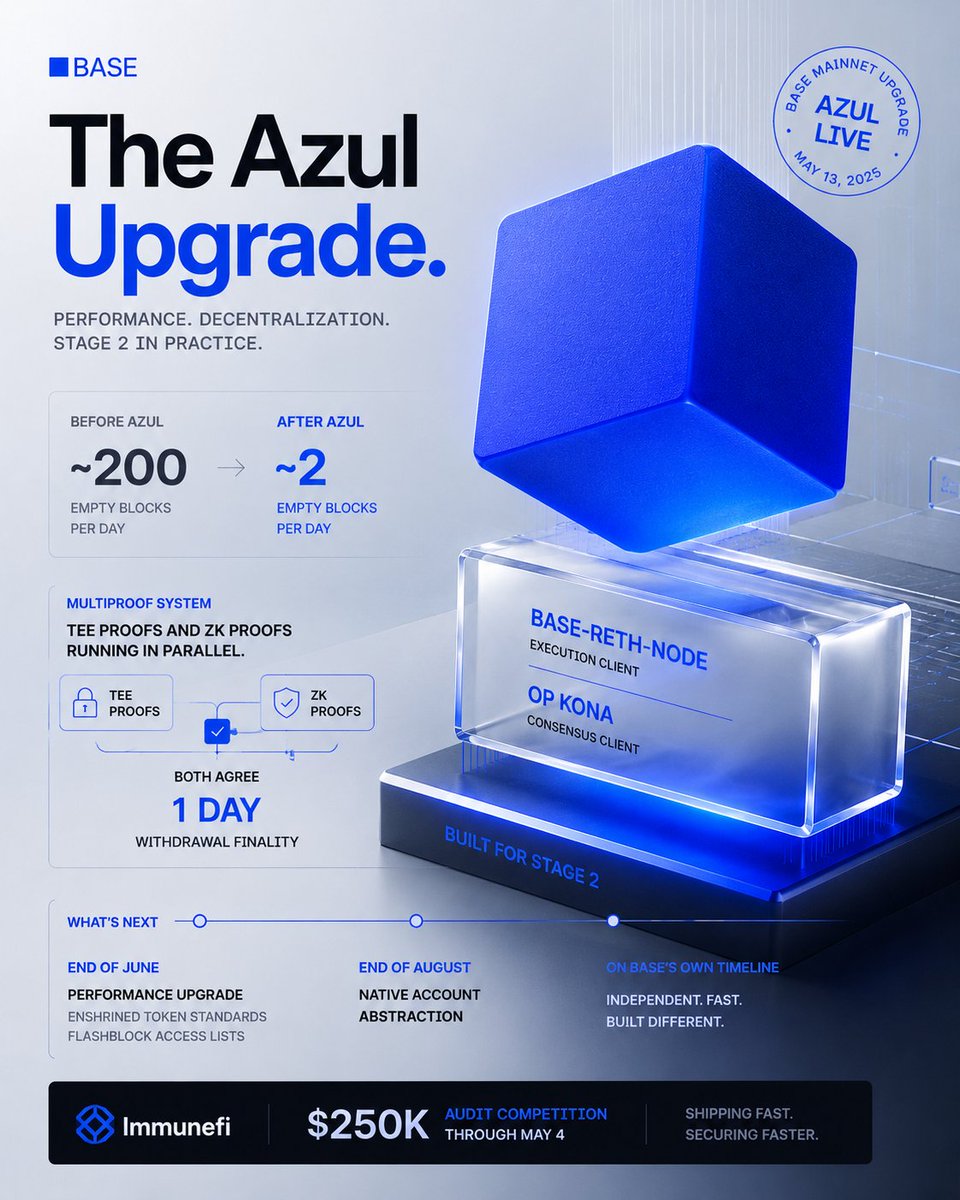
Empty blocks on @base dropped from roughly 200 per day to around 2. Not from a traffic spike or a fee adjustment. From consolidating onto a single execution client, base-reth-node, paired with a new consensus client built on OP Kona. That's the Azul upgrade in one data point.
The more interesting shift is the multiproof system: TEE proofs and ZK proofs running in parallel, either capable of finalizing independently. When both agree, withdrawal finality compresses to one day. Most of the L2 decentralization conversation focuses on governance and sequencer control. Azul makes the case that proof architecture is where Stage 2 actually gets earned, not where tokens get distributed.
What I keep coming back to is the upgrade cadence signal. Azul is Base's first mainnet upgrade on its own schedule, fully independent of Optimism Superchain coordination. A performance upgrade targeting enshrined token standards and Flashblock access lists lands at end of June. Native account abstraction follows at end of August. Three major upgrades in roughly three months, all running on Base's own timeline, on Base's own client stack.
The $250K Immunefi audit competition running through May 4 is the detail that matters most here. Shipping fast and running a public bug bounty simultaneously is a reasonable posture. Whether the audit coverage matched the scope of what went to mainnet on May 13 is a question worth sitting with.
111
1
105
715

May 24
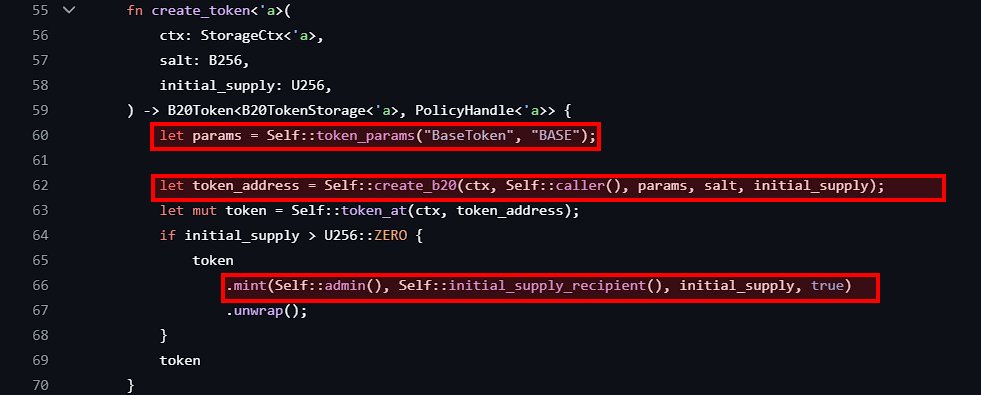
Seeing lots of rumors about BASE token mentions in the Base GitHub repo, and people getting excited about a possible drop.
But from what’s visible in the code, this does not look like confirmation of an incoming official $BASE token.
> BaseToken looks like dev/token factory code
> Minting logic ≠ public token launch
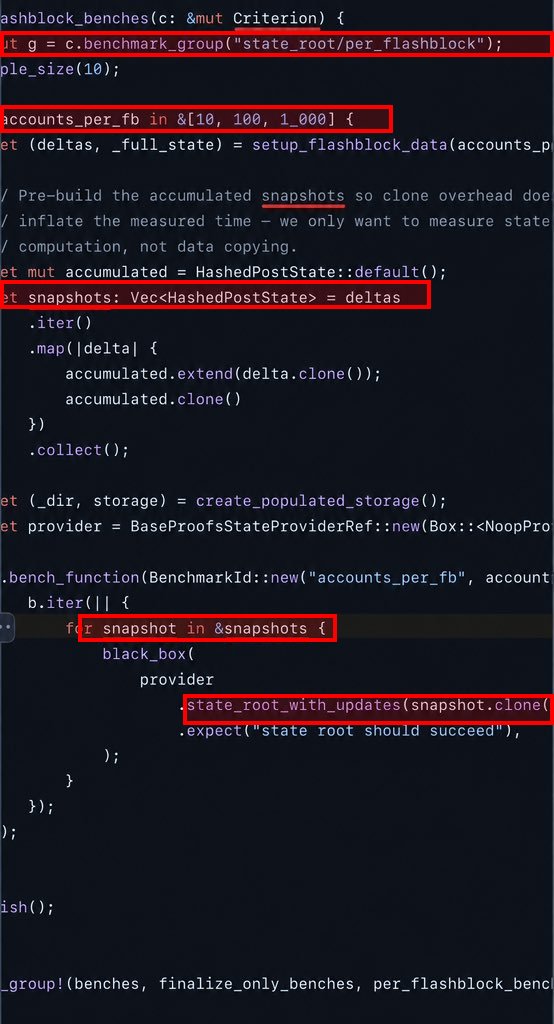
> “snapshot” here means code state data, not an airdrop snapshot
> Flashblock snippet = performance benchmark
> GitHub code ≠ TGE confirmation
> No official $BASE airdrop announced yet
So yes, there is token related infrastructure in the repo, but nothing here confirms the rumors.
1
10
996

May 24
believe it is not: Key details from the code:
• It sets up flashblock data (setup_flashblock_data).
• Builds a chain of accumulated snapshots (each snapshot includes all prior deltas current one).
• For each snapshot size, it runs black_box(provider.state_root_with_updates(...)) in a loop.
• The goal is to measure how fast the state root trie updates computation is when you have to do it very frequently (many times per second) for Flashblocks.
1
1
4
510