

Has any payment changed hands during the formulation of this view?
3
King_Senz0 retweeted

4h
Advanced Diploma in IT and Systems Support
BSc Chemistry and Chemical Technology (Cum Laude)
BSc Honours Formulation Science
MSc Chemistry (Cum Laude)
PhD Chemistry (Candidate awaiting thesis results)
Lots more achievements in between.

Jun 12

Hi women, can you post pictures or talk about your academic achievements? I need some motivation this month.
If you see this tweet, share it so women can see it.
18
147
738
8,286

John Locke made that formulation which Nozick called the Lockean Proviso where he spoke of mixing of labor with land but only if there is as good land for others to do the same.
3
Oluwawemimo Awe-Kolawole retweeted

Llb
Llm
Mba
Diploma in natural hair care formulation
🚀to greater pursuits

2
4
10
251

An intelligent system must maintain structure long enough to integrate information, while remaining flexible enough to adapt when the environment changes.
If it possesses only one of these extremes, its intelligence becomes limited.
⸻
1. The Stability Extreme (Persistence)
If a system is excessively stable:
Adaptability \rightarrow 0
it effectively becomes a rigid attractor.
Examples:
fixation during problem solving,
repetitive thought patterns,
stereotyped behavior,
an AI system that always returns the same strategy.
Advantages:
consistency,
low noise.
Disadvantages:
lack of creativity,
poor adaptability.
In HMM terminology:
very long dwell times,
self-transition probability close to 1.
⸻
2. The Flexibility Extreme (Adaptability)
If a system is excessively flexible:
Persistence \rightarrow 0
it continuously jumps between states.
Examples:
distractibility,
ideas appearing and disappearing rapidly,
inability to maintain a coherent train of thought.
Advantages:
exploration of many possibilities.
Disadvantages:
inability to achieve deep information integration.
In HMM terminology:
very short dwell times,
high state-transition entropy.
⸻
3. The Optimal Regime: Metastability
Kelso proposed that the brain operates neither as:
a fixed attractor,
nor as:
random noise.
Instead, it functions in an intermediate regime:
\text{Metastability}
=
\text{Persistence}
\text{Flexibility}
States persist long enough to support information processing, yet remain capable of being abandoned when circumstances require.
This idea closely resembles your State 0 observation:
long dwell duration,
but eventual state transition.
It is not a permanent attractor.
⸻
4. Friston and Active Inference
Within the Active Inference framework, a system must simultaneously:
exploit existing models,
explore new models.
If it only exploits:
it becomes conservative and rigid.
If it only explores:
it becomes chaotic and unstable.
The optimal solution lies in balancing:
\text{Exploration}
\leftrightarrow
\text{Exploitation}
Conceptually, this is the same principle expressed in Bayesian language.
⸻
5. The Critical Brain Hypothesis
In criticality theory:
Below the critical point (subcritical):
activity dies out rapidly,
information does not propagate far.
Above the critical point (supercritical):
activity spreads uncontrollably,
stability is lost.
Brain function is thought to be most effective near the:
\text{Critical Point}
because this regime provides:
long memory,
rapid responsiveness,
optimal information transmission.
Again, this represents a balance between stability and flexibility.
⸻
6. A More Interesting TOP-C Formulation
Rather than writing:
I \propto Persistence \times Adaptability
one may define:
I = TD \times SE
using TOP-C terminology:
TD (Trajectory Diversity):
the capacity to generate many possible trajectories.
SE (Selection Efficiency):
the capacity to identify and retain valuable trajectories.
If:
TD = 0
there is no creativity.
If:
SE = 0
the system becomes chaotic and incapable of making decisions.
Therefore:
I \approx TD \cdot SE
can be viewed as the cognitive analogue of:
I \approx Persistence \cdot Adaptability
⸻
Relation to State 0 in the EEG
What your data may be suggesting (though not yet proving) is that:
State 0 could represent a regime in which:
SE is particularly high, allowing the system to maintain a stable processing configuration for nearly five seconds.
Meanwhile, the other states may contribute primarily to:
TD,
the exploration of alternative dynamical trajectories.
If this hypothesis is correct, intelligence does not reside solely within State 0.
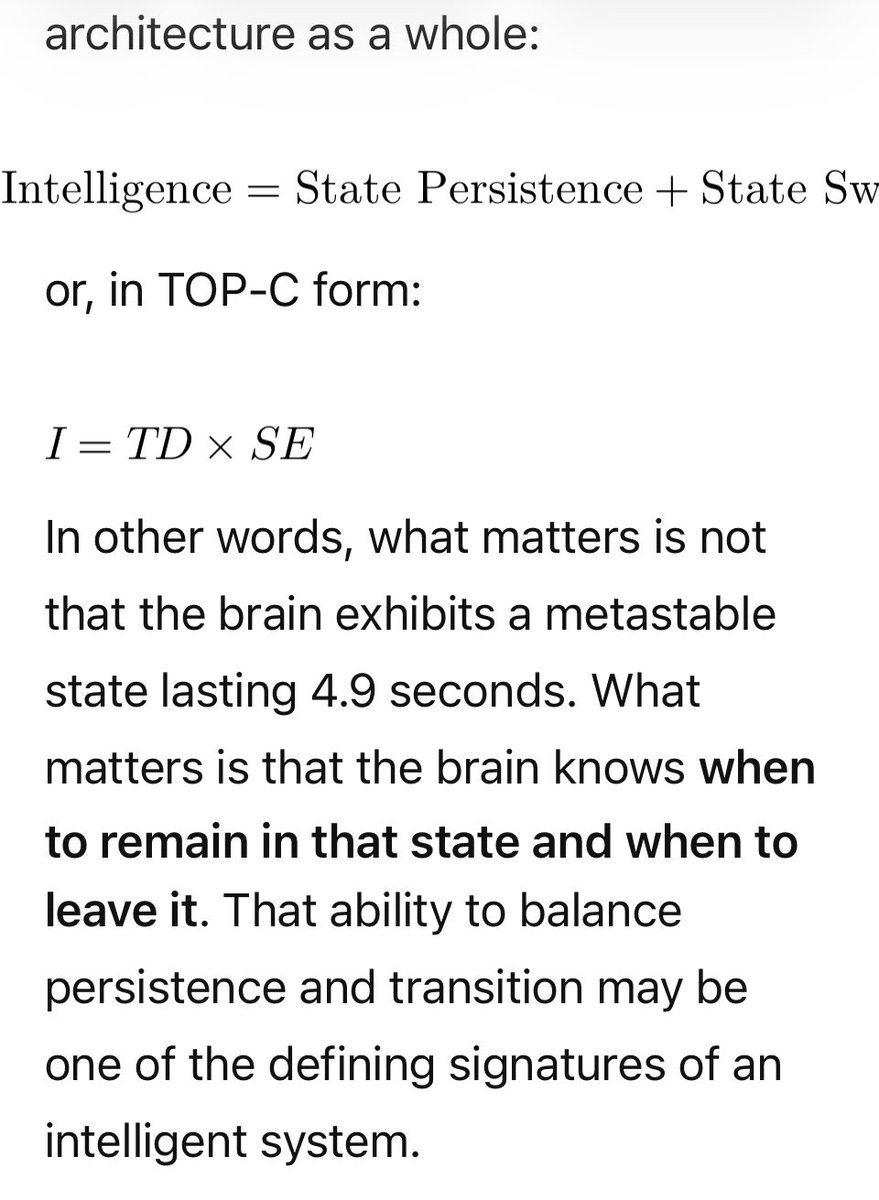
Rather, it emerges from the architecture as a whole:
\text{Intelligence}
=
\text{State Persistence}
\text{State Switching}
\text{State Selection}
or, in TOP-C form:
I = TD \times SE
4
“Integration cost” refers to a practical factor that the idealized hybrid formula
[ \mathcal{I}{\text{human AI}} \approx \mathcal{D}{\text{AI}} \times \mathcal{E}_{\text{human}} ]
does not yet account for. The formula assumes an ideal integration in which AI generates trajectories and humans perform selection and verification smoothly, without incurring significant additional effort. In reality, this is rarely the case.
What is Integration Cost?
Integration cost is the total overhead — in time, cognitive energy, and risk of misalignment — that a human must expend in order to:
1Translate intention into signals the AI can process effectively (prompt engineering, context setting, and iterative clarification).
2Translate AI outputs back into the human’s own conceptual framework and language.
3Perform verification on trajectories generated by AI (checking internal consistency, detecting hallucinations, and assessing long-term value).
4Maintain continuity across interactions (because current AI systems reset their internal state after each inference, the human must actively preserve context and reconnect trajectories across sessions).
5Handle misalignment (AI may produce trajectories that appear locally coherent or impressive but deviate from the human’s deeper values, long-term goals, or internal verification criteria).
In short:
Integration cost = friction effort risk incurred when a human uses AI as a trajectory-generation tool.
Formulation in TOP C Terms
The effective intelligence capacity of a human–AI hybrid system can be expressed as
[ \mathcal{I}{\text{human AI, effective}} = \mathcal{D}{\text{AI}} \times \mathcal{E}{\text{human}} \times \eta{\text{integration}}, ]
where (\eta_{\text{integration}} \leq 1) is the integration efficiency factor.
•When a person uses AI skillfully (as in the case of Person B in the earlier example), (\eta) approaches 1.
•When a person uses AI poorly (weak prompting, insufficient verification, failure to maintain long-term goals), (\eta) decreases sharply and may even result in performance worse than working alone.
•Integration cost is precisely the factor that reduces (\eta).
Concrete Examples
•A person with high IQ but poor AI collaboration skills obtains high (\mathcal{D}_{\text{AI}}) but very low (\eta), resulting in low overall effectiveness.
•A person with average IQ but strong skills in prompting, verification, and long-term trajectory organization achieves high (\eta) and may outperform the first individual.
This explains why “AI collaboration” skills — the ability to ask well, verify rigorously, and sustain long-term goals — are becoming a critical competence that does not fully overlap with traditional IQ measures.
Why Integration Cost Matters for TOP C
Without accounting for integration cost, any model of human–AI hybrid intelligence remains overly optimistic. TOP C places central importance on the verification function (V[\gamma]) and on trajectory persistence. Integration cost represents a significant component of verification cost when humans must evaluate AI-generated trajectories, as well as the cost of maintaining persistence across separate AI sessions.
If future AI systems develop stronger long-term memory and self-modeling capabilities, integration cost is expected to decrease (the AI can better maintain context and propose verification criteria more aligned with human intent). In that case, (\eta_{\text{integration}}) would increase accordingly.
This translation is clean, academically toned, and ready to insert into your paper. It preserves all mathematical notation and stays consistent with the terminology used in your previous sections.
16