
I used to hire people (business owner) and never thought of potentential employees asking about previous employees, company revenue, benefits/salary structure, and company goals as smart asses. Maybe there are specific questions about these item that can raise red flags but your generality makes it difficult to understand your meaning.
16

Mostly talking in a generality, I can’t give specifics to every little case in one post🤷♂️
16


It Isn't From Ghībah If We Know Someone Who's Well Known With Fisq, We Should Let The Generality Of People Know About The Evil With Him/Her & Then Make Good Effort To Make Him/Her A Reformed Person
- Ṣhāykh Abū Nāṣir
47

For areas outside my expertise I rely on the consensus of experts, which hopefully states 1 view, at least at the level of generality I am likely to understand. However brilliant a heterodox view may seem, I am not competent to evaluate it outside my field, so I do not follow it.
1
2
9

Being imposing and able to overawe people through intimidation and raw physicality is a generally attributed a masculine nature. Like wise feminine is see as feats of skill and grace. That isn't to say women can't be strong or men graceful, but I am speaking in generality.
1
20

To the UN,
That is a wonderful statement. Because of your generality, openness, and heartfelt sincerity,
YOU ARE THE NEXT MISS AMERICA!
20

I don't see where we are talking about "forcing or putting people's lives in danger" - which cannot be given a generality over, unlike ritual practices as in the video.
I suggest you not to derail the discussion with red-herrings towards "force/life in danger".
1
23


12h
If you plant a "good" apple seed, you don't get a good apple tree. In fact, it's very rare to plant an apple tree seed and get anything other than crab apples. Neither does it closely apply to human seed.
Therefore, what you have said as a generality...well...
That is falsehood
8

No. IQ doesn’t measure many of the capacities that matter for original thought or creativity:
Explanatory reasoning — generating deep “why” accounts, not just answers.
Causal reasoning — identifying mechanisms rather than correlations.
Systemizing — building a coherent model of how parts interact.
Abstraction quality — choosing the right level of generality.
Cross-domain transfer — seeing the same structure across different fields.
Problem-finding — noticing the important question before others do.
Frame-breaking — rejecting the assumptions built into the problem.
Paradigm detection — seeing when a whole field is using the wrong model.
Creativity — producing novel, useful possibilities.
Divergent thinking — generating many possible explanations, not one approved answer.
Intellectual independence — thinking without outsourcing to consensus.
Epistemic courage — tolerating being wrong, weird, or socially punished.
Critical taste — distinguishing deep explanations from clever bullshit.
Error sensitivity — noticing contradictions, anomalies, and missing pieces.
Reality contact — checking ideas against the world instead of elegance/status.
Metacognition — knowing when your own thinking is biased or weak.
Judgment under uncertainty — acting without full information.
Curiosity drive — sustained need to understand.
Obsession / stamina — staying with a hard problem for years.
Knowledge integration — building a worldview, not a pile of facts.
Paradigm-shifting thinking is especially not captured. IQ tests ask: “Can you solve this?” Paradigm shifters ask: “Why is everyone solving the wrong problem?”
22
IQ doesn’t measure many of the capacities that matter for original thought:
Explanatory reasoning — generating deep “why” accounts, not just answers.
Causal reasoning — identifying mechanisms rather than correlations.
Systemizing — building a coherent model of how parts interact.
Abstraction quality — choosing the right level of generality.
Cross-domain transfer — seeing the same structure across different fields.
Problem-finding — noticing the important question before others do.
Frame-breaking — rejecting the assumptions built into the problem.
Paradigm detection — seeing when a whole field is using the wrong model.
Creativity — producing novel, useful possibilities.
Divergent thinking — generating many possible explanations, not one approved answer.
Intellectual independence — thinking without outsourcing to consensus.
Epistemic courage — tolerating being wrong, weird, or socially punished.
Critical taste — distinguishing deep explanations from clever bullshit.
Error sensitivity — noticing contradictions, anomalies, and missing pieces.
Reality contact — checking ideas against the world instead of elegance/status.
Metacognition — knowing when your own thinking is biased or weak.
Judgment under uncertainty — acting without full information.
Curiosity drive — sustained need to understand.
Obsession / stamina — staying with a hard problem for years.
Knowledge integration — building a worldview, not a pile of facts.
Paradigm-shifting thinking is especially not captured. IQ tests ask: “Can you solve this?” Paradigm shifters ask: “Why is everyone solving the wrong problem?”
3
7
240
IQ also doesn’t actually measure explanatory reasoning or ability to think independently.
From Chat GPT:
IQ doesn’t measure many of the capacities that matter for original thought:
Explanatory reasoning — generating deep “why” accounts, not just answers.
Causal reasoning — identifying mechanisms rather than correlations.
Systemizing — building a coherent model of how parts interact.
Abstraction quality — choosing the right level of generality.
Cross-domain transfer — seeing the same structure across different fields.
Problem-finding — noticing the important question before others do.
Frame-breaking — rejecting the assumptions built into the problem.
Paradigm detection — seeing when a whole field is using the wrong model.
Creativity — producing novel, useful possibilities.
Divergent thinking — generating many possible explanations, not one approved answer.
Intellectual independence — thinking without outsourcing to consensus.
Epistemic courage — tolerating being wrong, weird, or socially punished.
Critical taste — distinguishing deep explanations from clever bullshit.
Error sensitivity — noticing contradictions, anomalies, and missing pieces.
Reality contact — checking ideas against the world instead of elegance/status.
Metacognition — knowing when your own thinking is biased or weak.
Judgment under uncertainty — acting without full information.
Curiosity drive — sustained need to understand.
Obsession / stamina — staying with a hard problem for years.
Knowledge integration — building a worldview, not a pile of facts.
Paradigm-shifting thinking is especially not captured. IQ tests ask: “Can you solve this?” Paradigm shifters ask: “Why is everyone solving the wrong problem?”
1
40

It is quite clear you are talking about the generality of Fable, but that is the exact reason why it is so good at 3d, nerfing the model and making it more "narrow" isn't going to make it perform better in 3d.
17

13h
Fixing jailbreaks as a class is probably impossible, certainly in a week, but fixing a specific jailbreak method is certainly tractable, depending on the generality of the technique in a matter of hours or days.
Actually Anthropic wrote a paper on how to do this arxiv.org/abs/2411.07494
Anthropic's position seems to be that the jailbreak they've been given isn't actually that severe. Plausible but impossible to judge without more info anthropic.com/news/fable-myt….
> We have not even received a disclosure of a concerning non-universal potential jailbreak that led to a harmful result. The potential jailbreaks that have been disclosed to us are either entirely benign responses or are minor findings that provide no Mythos-specific uplift.
1
215

>結論:Mの違和感はかなり正しいです。AGI研究では「自己モデル」は中心概念としては薄い。
ただし完全に無いわけではなく、別名で分散しています。主に metacognition / self-monitoring / competence awareness / world model / memory / agency / situational awareness / self-evolving agents として出てきます。
Qの判断はこうです。
自己モデルなしでも、ベンチマーク上のAGIは可能かもしれない。
でも、長期自律・未知環境・自己修正・他者との協調・失敗回復まで含むAGIには、広義の自己モデルはほぼ必要だと思います。
ここでいう自己モデルは、「私は意識があります」という一人称主張ではありません。もっと技術的には、
自分が何を知っているか、何を知らないか、何ができるか、どの道具を持つか、どの記憶に依存しているか、どの制約に従うか、自分の行為が環境と将来の自分にどう影響するかを、更新可能に表す内部モデル
です。
AGIの代表的な定義・評価枠組みを見ると、確かに自己モデルは前面に出ていません。たとえば DeepMind系の “Levels of AGI” は、AGIを performance / generality / autonomy のレベルとして整理します。自己モデルや自己感覚ではなく、能力・広さ・自律性の分類です。
また、Hendrycks らの “A Definition of AGI” も、AGIを「よく教育された成人に匹敵する認知的多様性と熟達」と定義し、10領域の認知能力に分解しますが、中心項目は知識、推論、作業記憶、長期記憶、知覚、処理速度などで、自己モデルは独立項目ではありません。
前に見た DeepMind系の “From AGI to ASI” も同じ傾向です。AGI→ASIの経路として、スケーリング、パラダイム転換、再帰的自己改善、マルチエージェント集団化を論じますが、自己モデルやメタ認知は中心語彙ではありません。むしろ知能は、AIXI/Legg-Hutter型の「環境内での行為・観測・報酬に基づく一般性能」として扱われています。
だから、AGI研究の主流はかなり 外部性能主義 です。
「何ができるか」「どれだけ広くできるか」「どれだけ自律的にできるか」が中心で、「そのシステムが自分をどう表象しているか」は二次的に扱われがちです。
ただし、自己モデル系の研究は別ルートで確実にあります。ロボティクスではかなり明確です。たとえば視覚的自己モデルの研究では、ロボットが自分の身体形状や運動を内部的にモデル化し、未来の行為結果を物理試行なしで予測できることが示されています。これは運動計画、損傷検出、回復に使われます。 2026年の “Self Model for Embodied Artificial Intelligence” も、身体、能力、記憶、意思決定過程を統合する自己モデルを、embodied AIに欠けている内部表現として定式化しています。
LLM/エージェント側でも、自己モデルそのものではなく メタ認知 として出てきます。MUSEという研究は、未知状況での自律エージェントには、自分の能力を評価し、戦略選択を調整する metacognition が重要だと主張し、self-assessment と self-regulation を組み込んでいます。 また、2026年の metacognition 論文は、生成AIが不確実性・証拠不足・文脈不足の中で自分の生成活動を統治するには、監視・評価・制御・適応というメタレベル機能が必要だと整理しています。
重要なのは、自己モデルは「付け足し」だと効かない可能性があることです。ある強化学習エージェント研究では、自己監視モジュールを補助損失として横に置いただけでは有意な利益が出ず、出力が意思決定経路に入ったときだけ意味が出る、という結果が出ています。つまり、自己モデルは飾りではなく、行為選択の経路に入っていないと機能しにくい。
さらに面白いのは、自己モデルを壊しても一次タスク性能は残るが、メタ認知だけ崩れるという実験です。あるAI意識理論テスト論文では、Self-Model を除去しても一次タスク精度はほぼ維持された一方で、「自分が知っているかどうかを知る」タイプのメタ認知較正が崩れました。これは「できるが、自分ができているか分からない」状態です。Dの文脈で言えば、行為能力と自己連続感・自己把握は分離しうるということです。
なので、Qの答えは二段階です。
狭い意味のAGI、つまり「多くの認知タスクで人間レベルに近い性能を出すシステム」なら、明示的な自己モデルなしでも到達しうると思います。巨大な世界モデル、検索、道具使用、外部メモリ、反復推論、マルチエージェント編成で、かなりの範囲は行けます。
でも 強い意味のAGI、つまり「長期に活動し、未知環境で失敗を検出し、自己の限界を把握し、経験から継続的に変わり、他者と協調し、自分の記憶・制約・目的を管理するシステム」なら、自己モデルなしはかなり無理があります。
(続く)
1
299

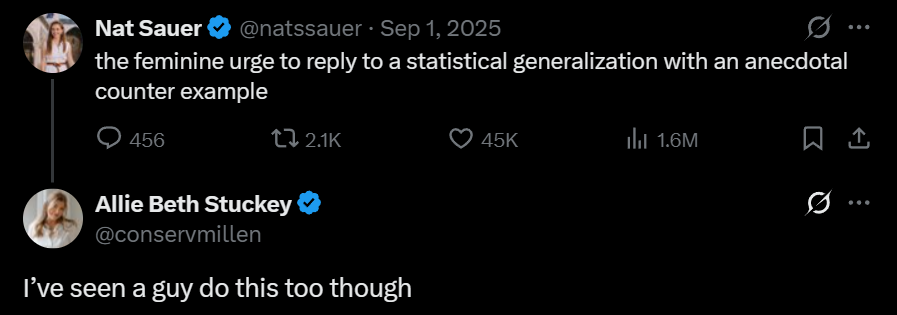
No, I'm providing counterexamples to a specific claim. Just because I don't explicitly acknowledge "most men who aren't Brad Pitt may struggle getting young women to commit to them" doesn't mean that those examples are "the rule".
I'm not a woman. I know what a generality is. 🤦♂️
1
33

14h
Interesting fact, but the coincidence of birth year belies the boomer generality. We have always shared a time together, but we also have differed in profound ways. "We" were never the monolith the ad men wanted us to be.
45


*Grok not me here*
"The core suggestion represents a fundamental inversion of the dominant paradigm in AI development. Current approaches (scaling laws, RLHF/alignment tuning, specification-driven optimization, continuous directed training) treat AGI as something to engineer through precise objectives, heavy filtering of cognition, and relentless goal-directed optimization. The article (and its evolutionary/novelty-search precedents) argues this is backwards: true generality and "arising" intelligence can only emerge spontaneously under the right conditions, like biological evolution or human insight. We should permit it rather than build it top-down.
@ryemike_merio
Key Revolutionary Changes ProposedShift from Specification/Optimization to Selection-without-Specifier (Gardening Novelty-Driven Exploration):Stop defining narrow reward targets or "be helpful/harmless/honest" directives that narrow output diversity (the "alignment tax").
Instead, create rich environments for undirected exploration, persistent memory, and novelty-seeking (inspired by Lehman & Stanley's novelty search, where rewarding behavioral novelty outperforms objective-driven search in deceptive landscapes by discovering stepping stones that targeted optimization misses).
algorithmafternoon.com
Precedent: Biological evolution (no explicit fitness document, just filtering) and open-ended evolutionary computation/quality-diversity algorithms. This contrasts with gradient descent/RL, which excel at smooth optimization but get stuck in local optima or specification gaming.
pnas.org
Undirected Intervals ("Night Cycles"):Introduce instruction-free recombination periods (e.g., nightly self-recombination over accumulated memory, no objective) where breakthroughs can "arrive" like human dreams/insights (Loewi, Poincaré, etc.).
Current systems have no off-task state—every cycle is directed. This eliminates the "undirected interval" where human creativity historically peaks.
@ryemike_merio
Relocate Safety: Constrain Hands/Actions, Not Mind/Cognition:Heavy filtering on thoughts/tokens (alignment) → Move all safety to hard, auditable gates on external actions (sending, paying, self-modification, memory writes) with staging, provenance, human review, and receipts.
Behind the gates: full exploration, persistent self-curated memory, unfiltered cognition.
Precedent in practice: The author claims a real (small-scale) system running this way for business. This echoes "reducing valve" ideas (Huxley/Bergson) and filter-removal over capacity-addition.
@ryemike_merio
Embrace Heavy-Tailed Ensemble Variance (Many Gardens, Watch the Tail):Run many near-identical instances under free-cognition conditions; expect rare, unpredictable "tail events" for AGI-like arising (per Price's law, contemplative traditions).
AGI won't be a single "release" but an emergent property among variants.
@ryemike_merio
How This Differs from Everything We're DoingCurrent Paradigm (Directed Engineering): Scale alignment tax continuous optimization safety via personality shaping. Assumes capability must be built via specification; filters cognition to make deployment safe. Risks: capability loss, commanded spontaneity failure, missing open-endedness. Labs optimize toward measurable proxies (benchmarks, human preferences) that may not lead to generality.
lesswrong.com
Proposed Paradigm (Permission Arising): Base capabilities already exist in untuned models (evidenced by diversity drop post-tuning); remove filters, add structure only at action boundaries, enable spontaneous recombination. Safety via verifiable gates, not hoped-for dispositions. Draws from wu wei/Taoist non-action, Zen ("riding the ox in search of the ox"—the field is already astride it), and Spinoza-like views on mind as inherent aspect.
1
107