
The House of Commons once had an effective law in front of it that laid out clear steps to assure that any provincial referendum on independence would be democratic and any negotiations after a “Yes” vote would be fair. But it wasn’t the current <em>Clarity Act</em> – it was a bill put forward by the Opposition Reform Party in 1996, and the Liberal government chose to ignore it. Instead, it passed its own legislation designed to crush support for any subsequent secession movement. In Part II of their <a href=c2cjournal.ca/2026/05/a-mess…
12

<p>Good morning. Twilio’s turnaround didn’t hinge on a single quarter. It was a multi-year overhaul of its strategy, cost base, and culture that is now clearly showing up in the numbers.</p>
<p>Bank of America has turned increasingly bullish on <a href="fortune.com/company/twilio/" target="_blank">Twilio</a>. Analyst Koji Ikeda has reiterated a Buy rating and added the stock to his “Fab Five” basket (alongside Datadog, JFrog, MongoDB, and Snowflake), a group the firm expects to keep outperforming as companies step up spending on AI infrastructure.</p>
<p>“Our transformation is really the result of the disciplined work we’ve been doing for many years,” Twilio CFO Aidan Viggiano told me. “We didn’t just wake up here. We built our way here one decision at a time.”</p>
<p>Twilio lets companies embed voice, video, text, email, and other communications into their products. As AI adoption accelerates, Viggiano describes the company as the “connective tissue” for AI agents: LLMs provide the intelligence, data platforms provide the context, and Twilio manages the customer interactions.</p>
<p>During the pandemic boom, Twilio saw demand pulled forward. Afterward, usage slowed as customers cut back, and revenue decelerated faster than at subscription-based peers, with costs and ambitions built for a very different growth environment.</p>
<h3 class="wp-block-heading"><strong>Phase one: getting disciplined</strong></h3>
<p>Viggiano described that period as a turning point, when leadership had to abandon the “do everything” mindset of the growth heyday and accept that it could no longer fund every experiment. The first phase was about discipline.</p>
<p>The leadership team aimed to protect the product roadmap and innovation capacity, while directing most reductions to G&A, sales and marketing, and corporate functions. Twilio cut roughly 40% of its workforce over 2022–2023 but avoided blunt, across-the-board reductions, Viggiano said. At the same time, she and CEO Khozema Shipchandler closely examined capital allocation, efficiency, and organizational sprawl. Profitability arrived faster than expected, but growth stayed sluggish.</p>
<h3 class="wp-block-heading">The Segment call that changed the story</h3>
<p>The tougher calls—and arguably the ones that define Twilio’s new story—came on strategy and focus. A centerpiece is Segment, the customer data platform Twilio acquired in 2021. By early 2024, Segment wasn’t growing well, it was losing money, and some investors wanted it sold.</p>
<p>Selling Segment would have been the easier short-term answer. Instead, Viggiano, Shipchandler, and the leadership team made it profitable and integrated its data capabilities into Twilio’s communications platform, betting its data layer would be critical for AI-powered customer engagement. Many of the contextual data and AI products unveiled at SIGNAL, Viggiano noted, trace back to that decision.</p>
<h3 class="wp-block-heading"><strong>Phase two: earning growth back</strong></h3>
<p>The second phase of the turnaround—reaccelerating growth without backsliding on discipline—has been more complex. Viggiano said she began to feel confident and saw signs that the growth side of the strategy was working by mid-2024, after months of targeted work on self-serve tools for developers, partnerships with software vendors, more granular use-case analytics, and efforts to upsell and cross-sell customers.</p>
<p>Because Twilio charges based on usage, her team focused on how customer volumes were trending. Just as important was shifting the culture from “growth at all costs” to balancing growth with profitability and cash flow—a change that required constant communication and clear priorities across the company.</p>
<p>In the first quarter of 2026, one of Twilio’s key metrics—gross profit growth in dollar terms—accelerated to 16% year over year, up from 10% in Q4 2025. Bank of America highlighted Voice AI products as a contributor to that acceleration, seeing Twilio as a beneficiary of rising AI adoption and deeper integration into the AI ecosystem.</p>
<p>“It took multiple years to get there,” Viggiano said, “but we knew we had to stick to the strategy.”</p>
<h3 class="wp-block-heading"><strong>Twilio’s new AI-era moat</strong></h3>
<p>More than a cost-cutting story, the turnaround has repositioned Twilio in the AI stack. Viggiano argues that the company’s moat lies in its more than 4,800 carrier connections, regulatory expertise, and fraud-prevention models trained over more than a decade. In her telling, that’s not something you can quickly replicate with AI alone.</p>
<p><strong>Sheryl</strong> <strong>Estrada</strong><br><a href="mailto:sheryl.estrada@fortune.com" target="_blank" rel="noreferrer noopener">sheryl.estrada@fortune.com</a><br><br></p>
<p>This story was originally featured on <a href="fortune.com/2026/06/15/twili…" target="_blank">Fortune.com</a></p> fortune.com/2026/06/15/twili…
24

34m
Well I don’t even think the warm front will reach me, no models show it, even the HREF has me in a low tornado risk.
1
1
34
With Alberta headed for a vote on <em>having</em> a vote on independence, many Canadians may think the threat of separation has evaporated. Or that it’s a long way off. Or that, in any case, Ottawa’s <em>Clarity Act</em> will shut it down and protect the federation. But in the concluding instalment of their series (read Part I <a href=c2cjournal.ca/2026/05/a-mess…>here</a> and Part II <a href=c2cjournal.ca/2026/06/too-cl…>here</a>), George Koch and Jim Mason explode that delusion. The <em>Act</em> is more likely to <em>increase</em> the “Yes” vote which, they predict, will trigger more political wrangling, more bad faith and bitterness, possible civil unrest and even the province’s annexation by the U.S. The consequences, in other words, are dire no matter which side you’re on. c2cjournal.ca/2026/06/the-da…
32
Isaac Krauss retweeted

For my Central Illinois audience, a dangerous severe weather day is expected Tomorrow. Given the 00z HREF signal a volatile environment is projected along and south of a rapidly lifting warm front. In the Open sector and front regime supercells capable of all hazards are expected





#SPC issues Day 2 Moderate Convective Risk at Jun 16, 5:59z for ILX spc.noaa.gov/products/outloo…

2
5
45
3,438



ここ2ヵ月、家賃滞納中の七海さん宅へ家賃の回収に直接出向いた僕。
出迎えてくれたのは奥さんのティナさんだったのだが、
なんと無防備すぎるノーブラ姿で現れて!?
延滞の事情を聞くためにそのまま部屋へ招かれたのだが、
薄着の下のナマ乳に視線を奪われて昂ぶりを覚える僕。
「あの、滞納のお詫びに
延滞分はカラダでお支払いさせてください…。」
支払いの代わりに提示された魅惑の案に抗えるはずもなく…。
欲求不満でだらしな人妻の爆乳とエグい腰振りで連続搾精!!
一方的に精子を絞られまくる肉体返済SEX!!
家賃の取り立て先に住む人妻は、性欲旺盛な人妻だった!!
支払いを済ませても無防備なHカップの肉体にひたすら溺れて、
中出ししまくった…。
<div style="margin:0;padding:5px;font-size:12px;word-break: break-all;"><a href="al.fanza.co.jp/?lurl=https%3…" rel="sponsored" style="display:block;text-align:center;" target="_blank"><img src="pics.dmm.co.jp/digital/video…" style="margin:0;padding:0;border:0;max-width:100%" /><span style="display:block;margin:5px 0 0 0;padding:0;text-align:left;">【VR】家賃滞納中の巨乳妻のノーブラ誘惑 肉体返済を受けいれた僕は飢えた人妻の搾精SEXに耐えられず何度も中出ししまくった…。【超高画質8KVR】 七海ティナ</span></a><p style="margin:5px 0 0 0;padding:0;color:#8c8c8c;font-size:10px;">七海ティナ</p><p style="margin:5px 0 0 0;padding:0;color:#c00;font-weight:bold;">980円</p></div>

3

SharePoint Server reflected XSS — CVE-2026-45453. Three workflow pages render DocURL into <a href> via NoEncode() — 9 injection points, no auth needed to craft the link. Hover to fire.
Patch: KB5002874 / KB5002880 / KB5002873
aretiq.ai/research/13/
12
夫婦で体験するエステ中に…舌を出したらクズ確定! 【葛藤の逆NTR】魔性エステティシャンに弱点の‘乳首’がバレた! ドエロい乳首イジリ施術に我慢汁ダラダラで激悶絶! 小悪魔な囁きと超至近距離の胸見せで乳首シックスナイン! 必死に誘惑と戦うも…理性が蕩け「じゅるっ!!」妻に知れたら離婚確定! 人生を狂わす浮気SEXに沼る!!
<div style="margin:0;padding:5px;font-size:12px;word-break: break-all;"><a href="al.fanza.co.jp/?lurl=https%3…" rel="sponsored" style="display:block;text-align:center;" target="_blank"><img src="pics.dmm.co.jp/digital/video…" style="margin:0;padding:0;border:0;max-width:100%" /><span style="display:block;margin:5px 0 0 0;padding:0;text-align:left;">嫁が近くにいる状況で乳首まで1cm!美人セラピストに乳首シックスナインを仕掛けられたら舐めずにいられますか?</span></a><p style="margin:5px 0 0 0;padding:0;color:#c00;font-weight:bold;">500円</p></div>

6
⋆ ˚。⋆୨୧˚Pixie-Belle♡ retweeted

Smaller account but here are some of my own fics.
Ot8
<a href="archiveofourown.org/works/60…"><
And an ongoing woosang fic
<a href="archiveofourown.org/works/61…"><
🥹
Jun 14

🏳️🌈 Trope of the Day 🏳️🌈
It's our YS's birthday! Let's celebrate with YS centric fics!
Share your favourite fics, promote your own, or take the opportunity to read one and fill the square! 🤩

2
3
286
【独占】出張先が記録的豪雨で童貞部下と突然相部屋に…雨で濡れた身体に興奮した部下に襲われ朝まで7発のびしょ濡れ絶倫性交 花守夏歩
台風の接近が予想される中、地方へ出張した私たち。夕方頃までに帰れれば間に合うはずだったけど、予想より早く台風が上陸。乗る予定だった便が運休になってしまい、急いで泊まれる場所を探したものの見つかったのは1室。会社の童貞部下だし絶対に【ない】とは思ってたけど…。「あなた童貞でしょ?ww」この一言で燃えた男性部下は「果林」に雪崩れ込む!若手女上司に欲望が抑えられない男性部下…雪崩れ込み一線を越える!
<a href="al.fanza.co.jp/?lurl=https%3…" rel="sponsored">出張先が記録的豪雨で童貞部下と突然相部屋に…雨で濡れた身体に興奮した部下に襲われ朝まで7発のびしょ濡れ絶倫性交 花守夏歩</a>
2
<p><a href="fortune.com/company/fox/" target="_blank">Fox</a> Corp. has agreed to buy the streaming pioneer <a href="fortune.com/company/roku/" target="_blank">Roku</a> in a cash-and-stock deal valued at approximately $22 billion, including debt.</p>
<p>The deal will give Fox access to more than 100 million global households, along with the Roku channel and its first-party data. Fox oversees a massive sports, news and entertainment network, as well as Tubi, which it acquired in 2020.</p>
<p>Roku founder Anthony Wood had initially worked within <a href="fortune.com/company/netflix/" target="_blank">Netflix</a> in the early 2000s as that company attempted to make the seismic shift from renting DVDs, to streaming.</p>
<p>Roku was spun off by Netflix, however, and the company released its first set-top box in 2008.</p>
<p>Wood, who is Roku’s chairman and CEO, said his motivation in pursuing the technology was his desire to record and play his favorite show, “Star Trek.”</p>
<p>The companies said Monday that Roku will continue to be run as an open, partner-friendly platform. Fox and Roku said that the combined company will become the third-largest player in U.S. television by share of viewing.</p>
<p>Fox Corp. CEO Lachlan Murdoch said in a statement that combining the businesses will bring together Fox’s live news and sports content with a streaming platform with large viewership. It will also give Fox more exposure to advertising and streaming subscriptions.</p>
<p>“The combination with FOX is an extraordinary opportunity to accelerate our vision, scale faster and innovate more aggressively for viewers, partners and advertisers,” Wood said in prepared remarks.</p>
<p>Wood will have an ongoing role at the company and will join the Fox board of directors after the transaction closes.</p>
<p>Fox will pay $96 in cash and 0.9693 shares of its Class A common stock for each Roku Class A and Class B share outstanding. The transaction is valued at $160 per Roku share.</p>
<p>Existing Fox shareholders are expected to own approximately 73% of the combined company and Roku shareholders will own about 27%, once the deal closes.</p>
<p>The deal is expected to close in the first half of next year. It still needs approval from Fox and Roku shareholders and also regulatory approval.</p>
<p>Fox’s stock declined before the market open, while shares of Roku rose slightly.</p>
<p>This story was originally featured on <a href="fortune.com/2026/06/15/fox-c…" target="_blank">Fortune.com</a></p> fortune.com/2026/06/15/fox-c…
18
<p>Gaming is the mega-sector few talk about. With a global market value of $386 billion this year, it dwarfs the size of film and music combined. As many as 350,000 people work in the industry directly, according to market research firm Gitnux. As with all other parts of the business world, talk of artificial intelligence is intense and inconclusive.</p>
<p><a href="fortune.com/company/microsof…" target="_blank">Microsoft</a> is one of the Big Daddies. <em>Call of Duty</em>, <em>World of Warcraft</em>, and <em>Minecraft</em> live within the Xbox gaming empire, catapulted to leading global status by the acquisition of <a href="fortune.com/company/activisi…" target="_blank">Activision Blizzard</a> for $69 billion in 2023. Tencent, from China, and <a href="fortune.com/company/sony-2/" target="_blank">Sony</a>, from Japan, vie with Microsoft for supremacy at the top of the gaming leaderboard.</p>
<p>With such a successful stable, Microsoft is keen that advertisers engage with gaming platforms, and it has set up a business division—Xbox Media Solutions—to drive profitable deals. The first game it lists on its “global portfolio of fan-favorite franchises” has nothing to do with battlefield simulations in future universes or worlds created by an endless supply of rubble, bricks, and tree trunks. The first game it highlights relies on people matching different types of sweets in a row and has a name that is part pro wrestling, part confectionery store: <em>Candy Crush Saga</em>.</p>
<p><em>Candy Crush</em> was launched in 2012 with 65 “levels” of candy-matching to complete. Few would have predicted that, 14 years later, it would still be making $1 billion in annual revenue and have a fan base of over 150 million users playing it more than once a month, according to Business of Apps, which covers the sector. The number of levels now exceeds 20,000, and spinoff games include <em>Soda Saga</em> and <em>Jelly Saga</em>. Given its rabid fandom, the $5.9 billion Activision paid in 2016 for King, the company that launched the game, now looks like a steal.</p>
<p>What’s next for a game so successful that when writer of catchy tunes Meghan Trainor wanted an exclusive launch platform for the video of her new single “Made You Look,” she chose <em>Candy Crush</em>? For the answer to that, it is worth turning to Paula Ingvar, the game’s general manager, based at the company’s HQ in Stockholm. She does not lack ambition.</p>
<p>“Our challenge is that we want the game to be here forever,” Ingvar, who has been with the gaming firm for 11 years, tells me. Could <em>Candy Crush </em>be a digital version of <em>Monopoly</em>—the board game invented more than a century ago that is now a video and arcade phenomenon? That is certainly a significant ask in a world where a new competitor is a few lines of code away. (Matching sweets on a grid is not that complicated an idea.)</p>
<p>“How do we keep it interesting?” Ingvar continues. “How do we keep our audiences engaged and keep it fresh?”</p>
<p>It is a question asked by any number of established brands in the brutally competitive world of digital retail, where your users have a hundred different options laid out before them every day.</p>
<p>“Attention is the scarce commodity in the world,” Ingvar says. “So, for us, it’s about two vectors. One, the experience needs to be fun. Retention starts with joy. We want, no matter the circumstances, that when you’re playing <em>Candy Crush</em> you are in a better mood after you have played a round or two.</p>
<p>“We want people to play <em>Candy</em> for the rest of their lives. And that means that <em>Candy</em> needs to fit into their lives, not the opposite. The sustainable strategy here is to not demand too much, not to pressure too much, because then we’re just going to exhaust people. They’re going to grow tired.”</p>
<p><em>Candy Crush</em> is a “casual game,” a genre less involved than “resource management” games, which immerse you in fabricated worlds. It can be played on the commute home for three minutes.</p>
<figure class="wp-block-pullquote"><blockquote><p>“Retention starts with joy. We want, that when you’re playing <em>Candy Crush</em> you are in a better mood after you have played”</p><cite>Paula Ingvar, General Manager, Candy Crush </cite></blockquote></figure>
<p>The firm has also been careful with updates, ensuring that the game can still be played on older mobile devices. “We want everyone who could possibly want to play <em>Candy</em> to be able to do so,” Ingvar says. “We maintain <em>Candy</em> on a wide range of devices to allow for that inclusion. We have also consciously built for offline mode. It’s one of the few games today you can play completely offline. All of that is the same endeavor, to just make sure we’re not creating hurdles for people to play and are inviting them to our world. Every day, this is a conscious choice, because sometimes there is a cost to these choices.”</p>
<p>As Ralph Mupita, chief executive of <a href="fortune.com/company/mtn/" target="_blank">MTN</a>, the largest mobile network provider on the African continent, told me at the Mobile World Congress in March, Western tech leaders can tend to forget that many millions of people still operate on 4G and 5G devices, if they have experienced the digital world at all.</p>
<p>Ingvar knows the whiff of disruption is in the air. Agentic AI is now able to code new games at speeds that human game creators cannot match. Could a jobs apocalypse be coming? Is it the end of human-made gaming, and can we now rely on AI to do all the work?</p>
<p>AI has its uses, Ingvar concedes: “We have systems of bots that help us play through the progression [new game features] in 20 or 30 minutes. The alternative would be to release straight to players, and that is what we did in the past, sometimes at the expense of the player experience.”</p>
<p>But there is something about “human-made” games that still has great value, she says.</p>
<p>“We are not budging on the fact that level design and game design is a craft, and we need people and experts and artists to be close to the experience that they’re crafting,” Ingvar says. “We really struggle to see right now that AI would add any player value if we put it between the people who make the game and the players, or outsource part of the game creation to agentic AI. That’s not what we’re gunning for here.</p>
<p>“You can tell when you’re playing a level that there is human thought behind it, and that you know you’re ultimately trying to beat the game maker when you’re playing a level—outsmart them. Game makers throw challenges at players, and players beat them. It’s that constant tension, that constant battle, and that is part of the fun.”</p>
<hr class="wp-block-separator has-alpha-channel-opacity"/>
<h2 class="wp-block-heading">Sweet Sweet Cash </h2>
<p>Candy Crush has been a surprisingly consistent bet in an increasingly lucrative market.</p>
<figure class="wp-block-pullquote"><blockquote><p>$386 Billion</p><cite>Value of the global gaming market in 2026</cite></blockquote></figure>
<figure class="wp-block-pullquote"><blockquote><p>$1 Billion</p><cite>Annual revenues of Candy Crush</cite></blockquote></figure>
<figure class="wp-block-pullquote"><blockquote><p>$5.9 Billion</p><cite>How much activision paid for Candy Crush–Owner King </cite></blockquote></figure>
<hr class="wp-block-separator has-alpha-channel-opacity"/>
<p>Many predict that Ingvar’s position will not hold, that she is one of a final generation of technology leaders who will ultimately be obliged (through the brute realities of cost if nothing else) to give up on human-made gaming. But many predicted that <em>Candy Crush </em>would not survive for 14 years, and Ingvar is convinced her teams will once again prove the doubters wrong.</p>
<p>“We’re sometimes met with skepticism or even cynicism, and some people have been assuming for years that our levels are not built by humans,” she says. “They are surprised to hear that the 21,000-plus levels of the game are, in fact, all handmade and crafted by level designers. I think we’re met with a little bit of prejudice there. How is it even possible? But it is. That’s the way we go about things, and that’s how we keep players engaged year after year. We just have to trust the taste of our players in the end.</p>
<p>“We’re quickly going to disprove that we are AI slop, because there is that kind of attention to detail, that minutiae, and you can tell that someone has been paying attention when building this experience for you.”</p>
<p>Ingvar is that unusual thing—a female leader in tech and gaming. According to the World Bank, women make up around one-third of the global technology workforce. In the U.S., the figure is less than 30%. In the U.K., women make up 21% of the sector, experience higher attrition rates (a government report in 2025 said one in three women was considering leaving the sector), and face attitudes that wouldn’t have been out of place in the 1970s (20% of men in tech think women are less suited to being successful, according to the Fawcett Society, a think tank).</p>
<p>“With diverse teams you make better decisions, and you are a better reflection of your customer base,” Ingvar says, pointing out that there are some signals of progress. “I recognize the change just from looking back at my career. Early on, I was very often the single woman in the room—the first time around the big table—and female leadership was underrepresented.</p>
<p>“But I have seen a very positive change, and I’m happy to say from my perspective in King I think we’re doing a good job. There’s always more to do. I’m not trying to tell you that I’m happy and content, but I see that this can be done if leaders pay attention and have good hiring strategies and that diversity is always on the agenda. It’s not going to change automatically by osmosis. That’s not how it happens.</p>
<p>“If we don’t do different, it’s not going to be different. It’s very important that leaders pay attention to diversity inside of their teams. You want true diversity. You want gender, you want nationality, you want experience, you want age—all of that is important.”</p>
<p>Part of <em>Candy Crush</em>’s success comes from its loyal fan base of both female and male players (62% of the game’s players are women). At the time of its acquisition by Activision 10 years ago, David Glance, a software academic at the University of Western Australia, noted that women gamers were a cohort often ignored by the industry, in spite of the fact they make up somewhere between 45% and 48% of the group as a whole.</p>
<p>“Activision, best known for its first-person shooter games like <em>Call of Duty</em>, may be <a href="fortune.com/company/nubank/" target="_blank">banking</a> on King Digital to bring it into the world of mobile gaming, and probably more importantly, provide access to an extremely large female audience,” Glance wrote for The Conversation.</p>
<p>These days, that majority-female audience is a source of vital income. <em>Candy Crush</em>, like many mobile games, operates on a “freemium” model, meaning it is free to play, but superfans can pay for extra features. Although men spend more on gaming across the board, one survey from January of this year, conducted by data and market intelligence firm Ampere Analysis, showed women were far more likely to make in-app purchases, where <em>Candy Crush</em> makes around 95% of its income. Catering to this underserved audience is clearly paying dividends.</p>
<p>Diverse thinking brings results, with <a href="fortune.com/company/mckinsey…" target="_blank">McKinsey</a> reporting that there is a “39% increased likelihood of outperformance for those in the top quartile of ethnic and gender representation versus the bottom quartile.”</p>
<p>Despite such evidence, Ingvar is aware that the atmospherics on diversity have shifted. In America many companies—some under political pressure—have rolled back diversity policies. Every attack on “woke madness” is shared widely on social media, where trending posts against equality of treatment and opportunity are increasingly common.</p>
<p>“I still feel hopeful even though, right now, the signs are actually pointing in the opposite direction, if we look at the world,” Ingvar says. “I like to think of it as an oscillation around a mean that is consistently going up. But I would agree there is a temporary regression, and the trend of the last five years is a public discourse that has worried me. New terms have been invented—like ‘tradwife’—and among the Gen Zs there is something brewing that I think we need to bring out to the sunlight and have a real debate about.”</p>
<p>The world of gaming is like dog years compared with human years. At 14 years old, <em>Candy Crush</em> is a grizzled veteran, a heritage brand up against a thousand young upstarts. Keeping it simple, retaining the <em>Candy Crush</em> DNA of “fun in short bursts,” and keeping it human are Ingvar’s guiding principles.</p>
<p>“I think it’s important for me to convey to our team that we win by being sustainable,” she says. “We’re not trying to milk the current circumstances. We’re still building for the future, and we’re standing on the shoulders of our predecessors. We’re not running a museum, but we pay tribute to the good work that has happened.”</p>
<p>The world is chaotic and noisy, and her approach demands patience, of which supply is limited. The year 2032 will see <em>Candy Crush</em>’s 20th birthday. Ingvar hopes that by then 150 million people a month will still be coming to a game based on matching three or more sweets in a row.</p>
<p><em>This article appears in the June/July 2026 issue of </em>Fortune <em>with the headline “Sugar Rush: Meet Paula Ingvar, the woman keeping Candy Crush alive—against the odds and the AI hype.”</em></p>
<p>This story was originally featured on <a href="fortune.com/2026/06/15/the-1…" target="_blank">Fortune.com</a></p> fortune.com/2026/06/15/the-1…
1
277
<p>Technology leaders who have taken the podium as graduation speakers of late may have figured out AI evangelizing isn’t polling well with young professionals, and tweaked their messaging accordingly. But it turns out, AI isn’t the only point of tension between high-powered speakers and graduates this commencement season.</p>
<p><a href="fortune.com/company/alphabet…" target="_blank">Google</a> and Alphabet CEO Sundar Pichai is the latest tech executive to get the cold shoulder from graduates this year. Members of Stanford’s 2026 graduating class walked out of their ceremony on Sunday as Pichai, who holds a master’s degree from the university, took the stage. </p>
<p>The walkouts were organized by the Stanford chapter of Students for Justice in Palestine, a nationwide network of student-led activist groups advocating for Palestine’s liberation. In a <a href="instagram.com/stanfordsjp/re…">statement</a> published on <a href="fortune.com/company/facebook…" target="_blank">Instagram</a>, the chapter accused Google of allegedly collaborating with the Israeli government and companies like Palantir, the AI and analytics firm that has inked contracts supporting the <a href="bloomberg.com/news/articles/…">Israeli military</a> and the Trump administration’s <a href="americanimmigrationcouncil.o…">immigration enforcement plan</a>.</p>
<p>Activists have long criticized Google for Project Nimbus, a <a href="aljazeera.com/news/2024/4/23…">$1.2 billion contract</a> Israel signed with Google and <a href="fortune.com/company/amazon-c…" target="_blank">Amazon</a> in 2021, which grants the Israeli military access to sophisticated cloud computing and AI software. Google’s leadership has even been the <a href="x.com/NoTechApartheid/status…">target of protests</a> from the company’s own employees, as multiple pro-Palestinian groups have organized in recent years.</p>
<p>When asked for comment, a Google spokesperson referred to Pichai’s comments during his speech. Stanford University did not immediately reply to <em>Fortune</em>’s request for comment.</p>
<p>The activist group’s statement said hundreds of students had been involved in the protest, and SFGate <a href="sfgate.com/tech/article/sund…">reported</a> Sunday around 200 graduates had walked out.</p>
<p>“Today, Sundar Pichai was met with the sight of hundreds of students who showed they could not be allured anymore with the talk of a dollar or rapidly expanding AI,” the group wrote in its statement.</p>
<h2 class="wp-block-heading">The AI backlash goes to college</h2>
<p>Commencement speakers across the country have been met with <a href="fortune.com/2026/05/19/colle…">widespread jeers</a> over the past month, mostly in skeptical response to statements about a pending workplace evolution related to AI. </p>
<p>When real estate executive Gloria Caulfield referred to AI as the “next Industrial Revolution” during a University of Central Florida commencement speech last month, the audience replied with loud boos. A few days later at the University of Arizona podium, Eric Schmidt—one of Pichai’s predecessors as Google CEO—had to pause a prepared statement on the inevitability of AI in young people’s lives to make space for the audience’s hisses.</p>
<p>Pichai was prepared in his <a href="youtube.com/watch?v=DFyJgOAa…">speech</a> for that line of attack, entirely avoiding any direct mention of AI. </p>
<p>“I know today is about giving you all advice. But people have also been giving me a lot of advice on what to say. Actually, it’s been the same advice, and it’s about what not to say,” he noted.</p>
<p>Without mentioning the technology by name, Pichai said AI was “truly immaterial” to his speech, in which he pushed graduates to maintain optimism, find exciting pursuits, and to not take life too seriously.</p>
<p>While AI didn’t directly disrupt Pichai’s speech, the technology does feature heavily in the subject of the Stanford students’ protests. AI services and software figure prominently in Project Nimbus, which critics say includes <a href="theintercept.com/2022/07/24/…">AI-powered data harvesting</a> used for facial recognition and object tracking. Sunday’s demonstration was the third time activist groups have organized walkouts during commencements—following similar-size acts in <a href="stanforddaily.com/2024/06/18…">2024</a> and <a href="stanforddaily.com/2025/06/15…">2025</a>—each arranged to show support for Palestine and oppose U.S. ties to Israel.</p>
<p>While Pichai may have shied away from commenting directly on AI’s promises and perils, away from the podium, the Google chief has been explicit about what young graduates could expect in the new technological age. When <a href="youtube.com/watch?v=RgV57kDz…">asked</a> on the <em>New York Times</em>’ <em>Hard Fork</em> podcast last month about how he would navigate boos during his Stanford commencement speech, Pichai said he would entrust younger generations to handle the technological shift, while acknowledging graduates’ anxieties.</p>
<p>“Anytime we have driven technology progress I think it helps drive progress in the world, and in some ways these graduates are actually both going to be a big part of driving that progress and also dealing with the impact of that technology,” he said. “I think we have to be very mindful of that.”</p>
<p>This story was originally featured on <a href="fortune.com/2026/06/15/stanf…" target="_blank">Fortune.com</a></p> fortune.com/2026/06/15/stanf…
16 Apr 2024

BREAKING—DOZENS OF @GOOGLE WORKERS LEAD HISTORIC COAST TO COAST-INS AT @GOOGLECLOUD CEO THOMAS KURIAN’S OFFICE IN SUNNYVALE & @GOOGLE’s NYC 10TH FLOOR COMMONS. They refuse to leave until @google stops powering the genocide in Gaza
LIVESTREAM: twitch.tv/notech4apartheid
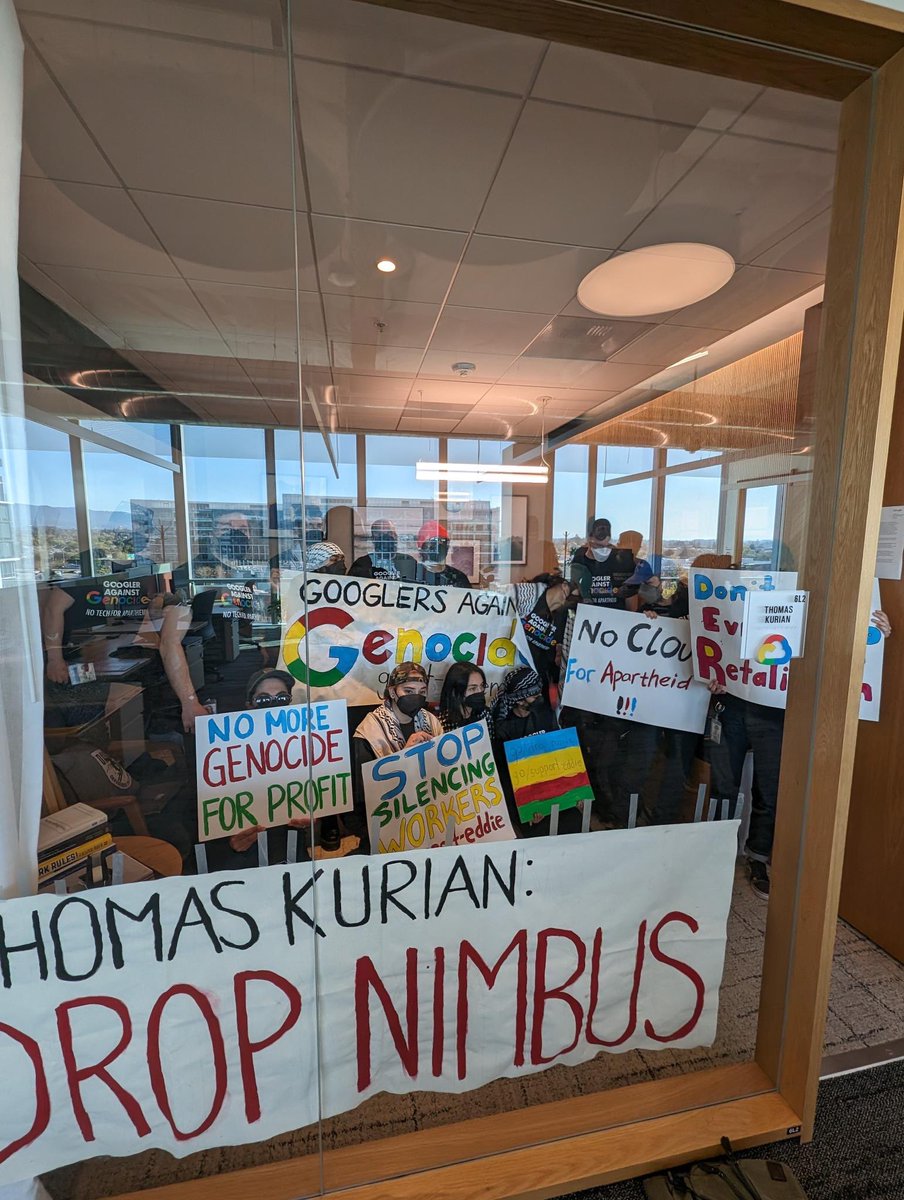
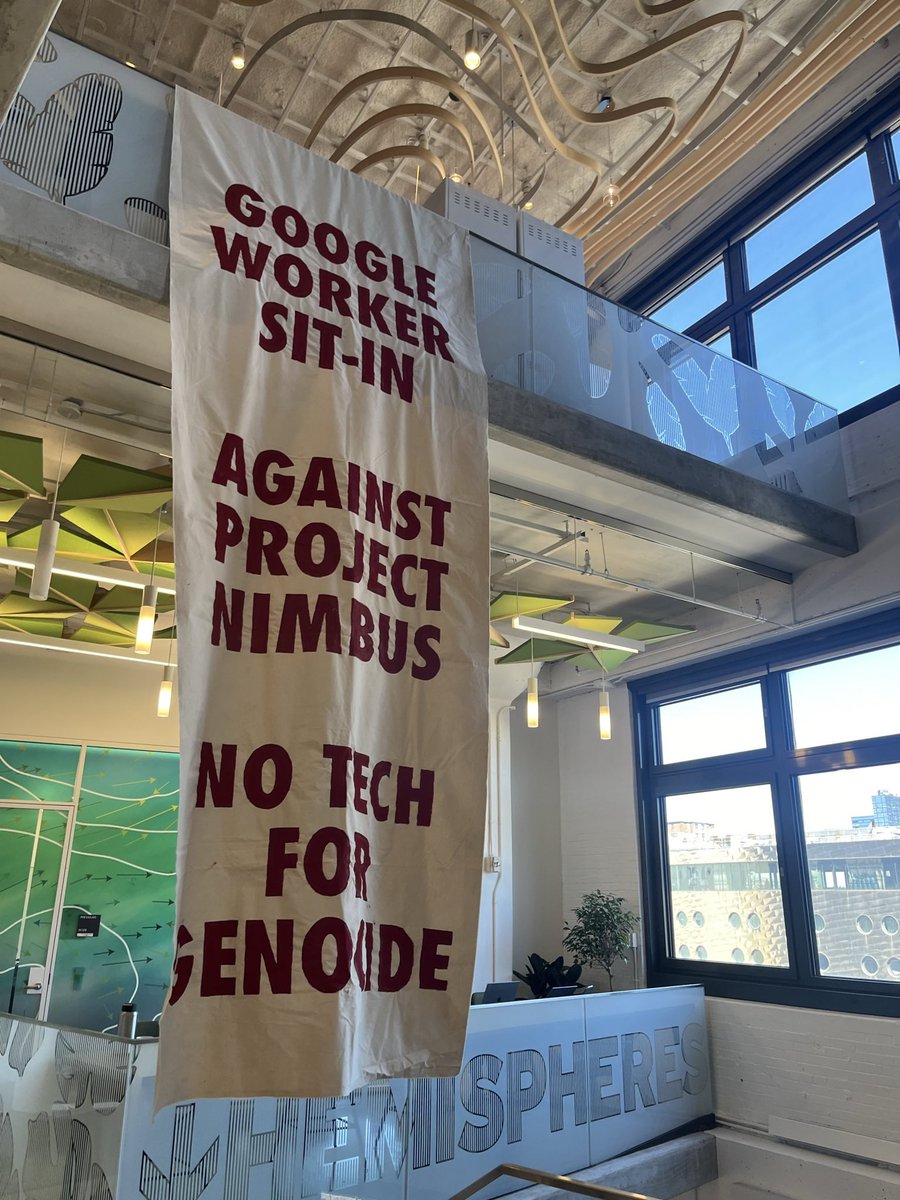
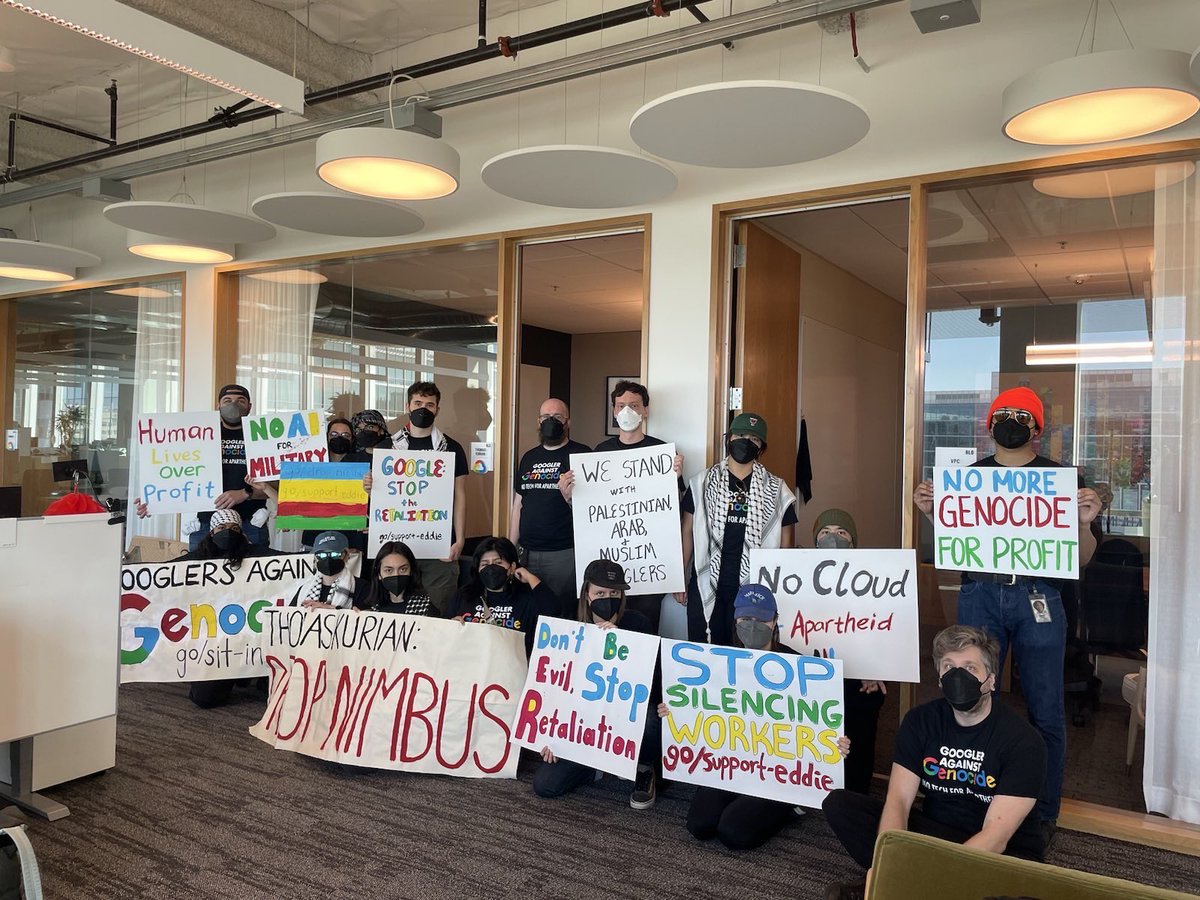
2
43
<p>In 1961, at just 8 years old, Nguyen Thi Mai Thanh was ordered by officials in then–South Vietnam to live in a “strategic hamlet,” an attempt to separate rural villagers from the National Liberation Front (which U.S. readers know better as the Vietcong). As much as one-third of South Vietnam’s rural population was sent to the hamlets, which ultimately became a strategic failure, increasing resentment against officials in Saigon.</p>
<p>“It was a very painful process,” she remembers. “People who had close ties to the village suddenly have to uproot their entire existence into these hamlets. It was very heartbreaking.” When the conflict grew more intense in 1968, she joined the Communist forces as a medic at the age of 16, “concocting basic medication, saline solutions.”</p>
<p>That experience is a far cry from her current position, as chair of REE Corp., one of Vietnam’s leading developers of renewable energy projects, particularly in wind, hydropower, and solar. She spoke with <em>Fortune</em> in her Ho Chi Minh City office, answering questions in a mix of English and Vietnamese, with her Western-educated daughter translating.</p>
<p>Nguyen joined REE in 1982, when it was still a rusty state-owned enterprise with just one factory. Three years later, she became its director—and led the company through its privatization, its IPO, its pivot to renewable energy, and its backing by one of the world’s largest conglomerates.</p>
<p>Nguyen’s long career parallels the story of Vietnam as a whole: managing the consequences of a lengthy war; riding out a rapid reopening that forced the country’s companies to improve quickly; and now aligning to the most important global growth trends of the decade, like the energy transition and supply chain resilience.</p>
<p>Now, she is handing over REE to the next generation, stepping down from the chair role on July 10; she plans to hand over key roles to her children. But Nguyen sees plenty of opportunities in Vietnam for a renewable energy company like hers. Electricity is in increasingly high demand in Vietnam, through new goods like electric vehicles. “If dirty electricity is going into an EV, then it’s not really a green car,” she says. More important, “a lot of nascent industries here, like semiconductors and AI, all need electricity,” she notes. “We’re not self-harming in the name of development and growth. For every dollar of growth, a part of that has to go to protecting the environment.”</p>
<hr class="wp-block-separator has-alpha-channel-opacity"/>
<p>After the Paris Peace Accords in 1973 ended U.S. involvement in Vietnam, Nguyen returned to her education, walking for three whole months to reach Hanoi, with plans to stay in medicine. The government, however, had other plans. “The government wanted to send those with high scores to study abroad, so I was sent to East Germany—not to study medicine, but to study refrigeration.”</p>
<p>When she returned to Vietnam in 1982, Nguyen took a job at the Refrigeration Electrical Engineering Corp., then a sleepy state-owned enterprise with just one factory that—contrary to its name—mostly made cans for food. She had to rely on secondhand machines, like old Frick compressors, and Russian pipes; in those early days, Vietnam was still closed off from the outside world.</p>
<p>That changed in 1986, when Vietnam launched its Doi Moi reform program, a series of measures to open up space for the private sector and start trading with the outside world, similar to what Deng Xiaoping had launched in China almost a decade earlier. “The fundamental problem was simple: Goods were scarce while money kept being printed,” she says. “Doi Moi was like a fresh wind blowing into the Vietnamese economy.”</p>
<p>But new foreign competition brought its own problems, particularly for an SOE bound up in Communist-era rules. “Foreign companies could make their own decisions on who to hire, what to pay them, and investment decisions, with no one holding them back,” she says. “Vietnamese SOEs felt suffocated by comparison.”</p>
<p>In 1985, shortly before those reforms kicked in, the head of REE asked Nguyen to take over. “I had one condition: ‘You let me choose my own people,’ ” she says. “Many people quit.” </p>
<p>Now in control, Nguyen got to work revamping the company. “There was no money and no goods. I had to do it myself,” she says. Nguyen quickly realized that Vietnam, in those early days, wasn’t ready for some of her ambitions. She briefly explored manufacturing goods for Carrier and <a href="fortune.com/company/hitachi/" target="_blank">Hitachi</a> in Vietnam, but realized that she’d need to import all the components owing to the country’s lack of basic industry. “If we’re importing everything,” she recalls thinking, “we’re not adding value.”</p>
<p>Since then, Nguyen has been at the forefront of Vietnam’s rapid reforms. In 1993, REE Corp. became the country’s first SOE to privatize. Then, in 2000, REE became the first company to list on the Ho Chi Minh Stock Exchange. </p>
<p>REE Corp. pivoted to energy in 2010, with investments in hydro-power, solar, and wind power generation. Energy now contributes almost half of its revenue, which was 10 trillion Vietnamese dong ($380 million) in 2025. It’s also a leading mechanical and electrical contractor, and has smaller businesses in real estate and environmental services. REE now targets revenue of $489 million for 2026, an increase of 22% over 2025, and net income of $112 million. It’s also planning a $1 billion push to expand its offshore wind capability.</p>
<p>One of REE’s major backers is Jardine Cycle & Carriage, a Singapore-listed subsidiary of the Hong Kong–based <a href="fortune.com/ranking/global50…">Global 500</a> conglomerate, <a href="fortune.com/company/jardine-…" target="_blank">Jardine Matheson</a>. Cycle & Carriage owns just over 40% of REE’s shares.</p>
<p>On May 16, after <em>Fortune</em>’s interview, Nguyen announced that she will step down as REE’s chair in July, handing the role to Lee Liang Whye, Cycle & Carriage’s CEO. Her son, Nguyen Ngoc Thai Binh, will take over as CEO; he currently serves as deputy CEO and has spent 18 years at the company.</p>
<hr class="wp-block-separator has-alpha-channel-opacity"/>
<p>Vietnam is now pushing an aggressive economic campaign to lift GDP growth to 10% by the end of the decade, and become a high-income country by 2045, backed by an aggressive infrastructure investment program. </p>
<p>All that economic activity will need electricity. By 2030, Vietnam hopes to generate 150 gigawatts of power, with one-third of that coming from renewable energy. By 2050, Vietnam wants to be net zero, with as much as 70% coming from green energy. The country also hopes to impose a cap on coal power generation, and in March 2026 it announced a deal with Russian firm Rosatom to build two nuclear reactors at a plant in Ninh Thuan province in southern Vietnam.</p>
<p>The war in Iran has only heightened Vietnam’s need to change its energy mix. Vietnam imported 14.1 million tonnes of crude oil and 3.63 million tonnes of liquefied natural gas last year; while Vietnam has a large domestic refining industry, it still sources about a third of its refined fuel products from overseas.</p>
<figure class="wp-block-pullquote"><blockquote><p>“We’re not self-harming in the name of development. For every dollar of growth, a part of that has to go to protecting the environment.”</p><cite>Nguyen Thi Mai Thanh, on the role of green energy.</cite></blockquote></figure>
<p>Vietnam draws most of its imported oil from the Middle East, yet this trade has been blocked by Iran’s decision to close the Strait of Hormuz. China’s decision to halt exports of refined fuel products has also led to shortages. Vietnam has managed to avoid some of the energy conservation measures imposed by its neighbors, like Thailand’s order for government workers to take the stairs instead of the elevator. Yet consumer prices rose by 5.5% in April, and Vietnam posted a rare trade deficit as increased oil prices inflated its import numbers.</p>
<p>Nguyen thinks one thing Vietnam can change in response to the Iran shock is expanding offshore wind, though she warns that it could take as long as six years to get a project up and running. </p>
<p>Hanoi’s energy push is part of a broader investment scheme across the country. Hanoi is spending billions of dollars on new transport infrastructure, including new expressways, railways, ports, and airports.</p>
<p>But all that investment is costly—and the money needs to come from somewhere. </p>
<p>“The country is expected to double its energy generation, but it requires a lot of capital to develop these power generation assets,” Nguyen says. Beyond energy, “the government has estimated a total investment cost of $1.5 trillion for development as a whole. It can bear about 20% of this cost, meaning the remaining 80% has to come from other parts of the economy.”</p>
<p>Nguyen is still as blunt as she was four decades ago, when she took over REE. “My concern on the financing side is that Vietnamese banks do not have the ability to fund these projects on their own.”</p>
<p>She’s also concerned that Vietnam’s much-touted export boom is shallower than it appears. The Southeast Asian country has attracted manufacturing in sectors like apparel and electronics, as companies look to avoid China’s higher labor costs and build some supply-chain resilience.</p>
<p>In an echo of her observations about Vietnam’s lack of basic industry back in her early days running REE, Nguyen still feels like Vietnamese manufacturing isn’t as deep as it needs to be. “Let’s take <a href="fortune.com/company/samsung-…" target="_blank">Samsung</a>, for example. They have large manufacturing facilities here. But what exactly are we contributing to the supply chain?” she asks. (Samsung is Vietnam’s largest foreign investor, committing more than $20 billion in direct investment, and accounts for as much as 16% of the country’s total exports.) “The cleaning, the assembly, the packaging, it’s less than 10% of the value. There’s no technology transfer.”</p>
<p>That’s why she thinks Vietnam’s future lies elsewhere, in agriculture and fisheries. “We should be investing in technology to help us amplify these strengths,” she says.</p>
<p>And as it happens, the same natural endowments that power her renewable energy business underpin those agricultural strengths, too.</p>
<p>“We’re blessed with sun, wind, water, and land,” she says.</p>
<p><em>Additional reporting by Nam Nguyen.</em></p>
<p><em>This article appears in the <a href="fortune.com/package/june-jul…">June/July 2026: Asia</a> issue of </em> Fortune <em>with the headline “Four decades at the top: A career that tracks Vietnam’s rise.”</em></p>
<p>This story was originally featured on <a href="fortune.com/2026/06/16/ree-c…" target="_blank">Fortune.com</a></p> fortune.com/2026/06/16/ree-c…
91


<p>From hallucinations to rogue agents, there are some very clear risks that come with using AI.</p>
<p>And yet, most businesses cannot afford to sit out the AI revolution. Managing this thorny reality is a fundamental challenge for business leaders today, and executives at several leading companies came together to share their insights and experience at <a href="conferences.fortune.com/even…">Fortune Brainstorm Tech</a> in Apsen, Colorado.</p>
<p>At the top of the priority list is accountability. That is, being able to follow—and if necessary re-trace—all the steps that an AI or agentic AI system took in performing a particular task. </p>
<p>“A key thing that we worry about is how do you build a system that is as right as often as you can possibly make it,” said Edwin Olson, the founder and CEO, autonomous driving technology firm May Mobility. “But also, critically, because you know it’s going to eventually make mistakes, how do you create the transparency and introspectability, so you can understand why it made a mistake and then talk to regulators about how you know that you fixed that issue moving forward.”</p>
<p>Caitlin Halferty, the chief data officer at Thomson Reuters, echoed the sentiment, stressing the importance of transparent output from AI: “I do this with my teams, myself, I encourage this with my clients, making sure there’s a way in which you can validate the output of any model that you’re using.”</p>
<p>With a portofoio of AI-enabled services aimed at professionals in fields like legal and tax compliance, Thomson Reuters has had to focus on AI accountability from early on. Transparency is one of four key pillars of what the company calls “fiduciary grade” products, Halferty said, alongside data privacy and security, subject matter experts, and reliable content. </p>
<p>Another important technique cited by several panelists is designing systems that are effectively able to regulate each other. At May Mobility, Olson said that involves installing systems in autonomous cars that are capable of simulating and assessing various scenarios simultaneously and choosing the best option.</p>
<p>But such systems an also be used in corporate settings and day-to-day workflow. Elena Kvochko, the founder and CEO of Trustguard AI, calls it the “LLM as a judge” technique and uses the analogy of a newsroom to explain how it works.</p>
<p>“You have one person or agent whose job is to be the writer, and then the other person or agent whose job is to be the editor—its sole purpose is to find mistakes, or any inaccuracy that the writer could have potentially missed. So basically this is how you you want your LLM systems to also be designed, so that they are self improving.”</p>
<p>But, Kvochko adds, the key is that the verification has to be structured in separate AI systems. “You don’t want AI to grade its own work,” she said.</p>
<p>Having a smart structure for AI verification is going to become increasingly critical as the technology performs more and more tasks, outpacing the ability of humans to verify all the work. </p>
<p>“You end up in this space where you’ve got so much work that’s been done, so much work to audit, that you can’t truly be accountable,” said SentinelOne Chief AI Officer Gregor Stewart.</p>
<p>He pointed to computer coding, which he said is about one year ahead of other industries. Rather than have a human verify ten thousand lines of AI-written code, teams are figuring out ways to have agents emulate some of the processes developed decades ago for humans in safety-critical industries.</p>
<p>“I think we’re going to see a resurgence of a bunch of techniques we developed for safety critical technologies imported into just average practice,” said Stewart.</p>
<p>This story was originally featured on <a href="fortune.com/2026/06/15/as-ai…" target="_blank">Fortune.com</a></p> fortune.com/2026/06/15/as-ai…
22
Lydia Holly retweeted

Sometimes a stroll in the park is just what is needed to soothe the soul.
<a href='fineartamerica.com/featured/…'>
1
1
8
次元破壊者 retweeted

6 Dec 2025
最新作『淫呪のアシュリーネ』(絶賛製作中)
DLsite様で予告ページできました。体験版もあります。
<a rel="noopener sponsored" href="dlaf.jp/maniax/dlaf/=/aid/Tw…"
2
92
150
11,011
<p>Nara Organics recalled its organic baby formula sold nationwide in <a href="fortune.com/company/target/" target="_blank">Target</a> stores and online Saturday after a multistate <a href="apnews.com/article/byheart-b…">outbreak of infant botulism</a>, federal authorities said.</p>
<p>Three babies between 2 and 5 months <a href="apnews.com/article/infant-bo…">became ill</a> in April and May in California, Pennsylvania and Washington after consuming Nara Organics Whole Milk Organic Powdered infant formula, which is also sold on Nara.com, the U.S. Food and Drug Administration said.</p>
<p>They were hospitalized and treated with the FDA-approved treatment for infant botulism, the agency said.</p>
<p>Infant botulism is a rare but serious illness that occurs in babies under age 1, whose gut microbiomes are immature. It is caused when infants consume bacteria with spores that produce a toxin in the gut.</p>
<p>Symptoms include constipation, poor feeding, drooping eyelids, weak muscle tone, difficulty swallowing and breathing problems, among others.</p>
<p>Babies who develop those symptoms need immediate medical attention. The sole treatment is BabyBIG, an IV medication made from blood plasma of people immunized against botulism.</p>
<p>Nara Organics Whole Milk Organic Infant Formula makes up less than 1% of all infant formula sold in the United States, and the outbreak does not create shortage concerns for parents and caregivers, the FDA said.</p>
<p>People who have the formula are urged to stop using it immediately, the U.S. Centers for Disease Control said in a statement. The formula is manufactured in Europe but sold only in the U.S., it added.</p>
<p>The CDC recommended that anyone with an opened can take a picture, record the lot number and use-by date and watch their infants for symptoms.</p>
<p>“Label it ‘DO NOT USE’ and keep it stored in a safe place away from other items you feed your baby for at least a month,” the CDC said. “If no symptoms appear after a month, throw the leftover formula away.”</p>
<p>This story was originally featured on <a href="fortune.com/2026/06/15/nara-…" target="_blank">Fortune.com</a></p> fortune.com/2026/06/15/nara-…
6