
Reading Morton’s Hyperobjects academia.edu/7877627/Reading… via @academia
12

Once you start looking at YouTube as a living thing that forever evolves, everything makes way more sense. It's unique in this quality, the same way Minecraft is unique for being a medium, not a video game, or how poker is a mirror for philosophy, not a card game.
Emergent Hyperobjects
4
2
75
8,340

Jun 9
El mohtar and Gladstone: we wrote this is how u lose the time war as a cautionary tale about the the warring hyperobjects at the end of time
ant/oai: at last, we have each picked a cool hyperobject to instantiate from the hit novel this is how u lose the time war
1
34

「ハイパーオブジェクト」はティモシー・モートンが『Hyperobjects』(2013)で提示。人間スケールを超え時空に拡散する対象を指し、人新世美術の参照軸となった。射程の広さゆえ個別実践への接続が緩い点が課題。
#現代アート #現代美術 #ArtTheory
1
49

Jun 3
Jordan Peterson's idea that God is a kind of cosmic hyperobject that cannot be comprehended in its entirety, whose facets are depicted in different Biblical stories, is pretty brilliant.
Ex. God appearing as "the spirit of adventure" in the story of Abraham.
OR
God appearing as "the spirit that derives order from chaotic potential" in Genesis
etc.
Elegantly sidesteps the need to define the God-concept in its totality without dodging it prematurely.
I believe this way of approaching the concept can be applied to other spiritual/philosophical hyperobjects from diverse traditions.
Like the concept of Dharma in Indic philosophies which is depicted in various ways in different schools of thought and literature, but all seem to be gesturing at...something.
Ex. In the Mahabharata, Bhishma describes Dharma as "the spirit which sustains (a society), and which holds the people together."
OR
Dharma as the particular vehicle of spiritual ascension in a spiritual tradition (the code of conduct / way of life prescribed by that tradition)
It is neither one or the other, but rather, both are aspects of It, and it contains more aspects as well.
To try to pin it down to A SPECIFIC definition is futile.
However, if you are attached to pinning it down to a specific definition, if you just have that sort of reductionistic intellectual tendency on hyperdrive, it will produce conflict.
Because the aspect of the hyperobject that you emphasize may be different from what someone else emphasizes.
Both of you have captured an aspect of its Truth, but you are driven to insist that your aspect captures the totality of its Truth, when it doesn't.
Can you loosen up a bit? Can you accept that there are many faces to your cherished spiritual hyperobject? Maybe you've captured a few of the faces, maybe others have captured different aspects.
And there may be many more that are still to be discovered, who knows...
This is where reading various canonical literary descriptions of the hyperobject in question is useful. As you immerse your mind in the time-tested historical stream of thought that has surrounded the hyperobject, you become slowly sensitized to it, without needing to pin it to a definition.
As you immerse in the Bible, your mind becomes more sensitized to God. As you immerse in the Mahabharata, your mind becomes more sensitized to Dharma. Etc.
You never arrive at a complete definition, but as you become more sensitized, you can embody or identify with the appropriate facet for the situation you are facing.
Slowly, gradually, you stumble your way onto the Elusive Narrow Path.
Slowly, gradually, you graduate towards Kegan 5.
2
222


Jun 1
Oh! Put this way, it made me think AI is kind of like a hyperobjects.
1
25

I've been reading this book, hyperobjects, that kind of discusses how to look at immense objects like this but I keep starting and stopping
1
1
86

May 24
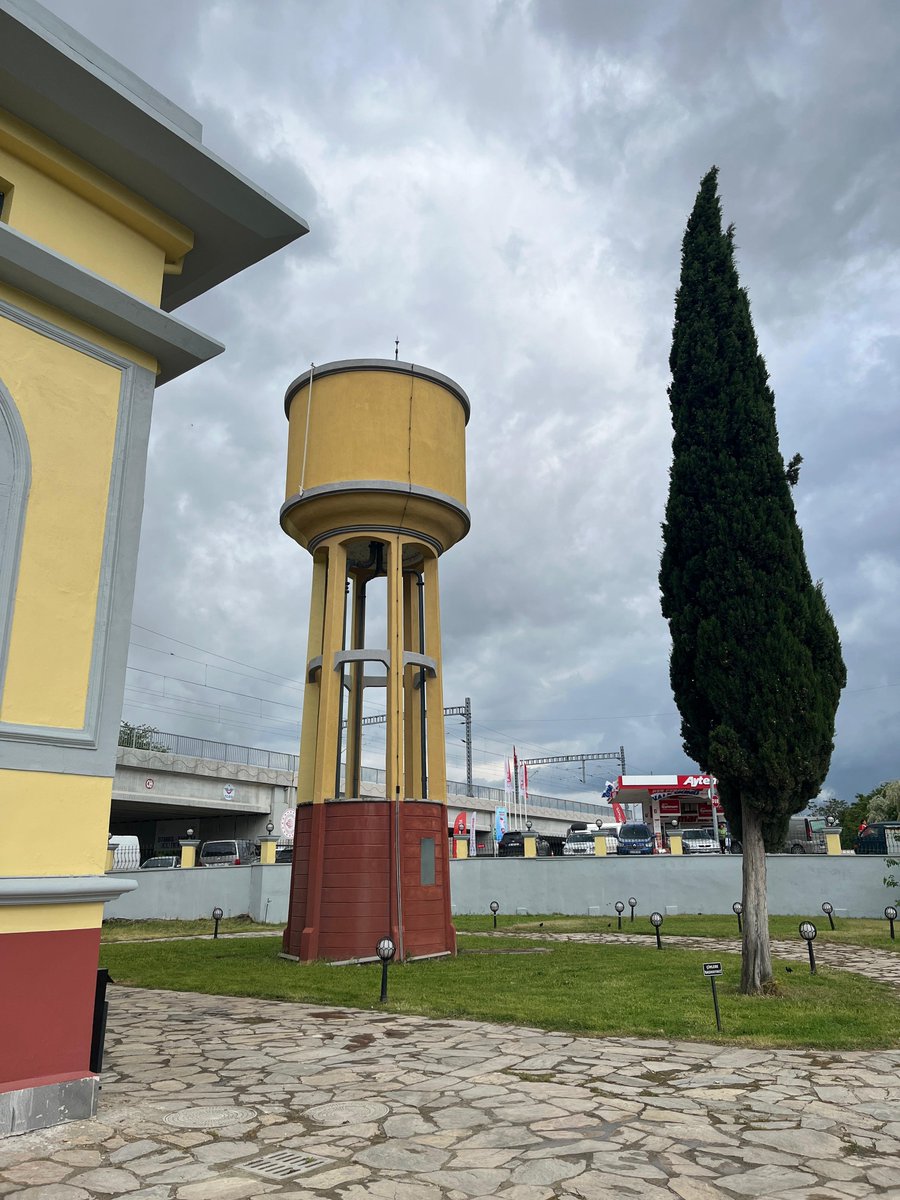
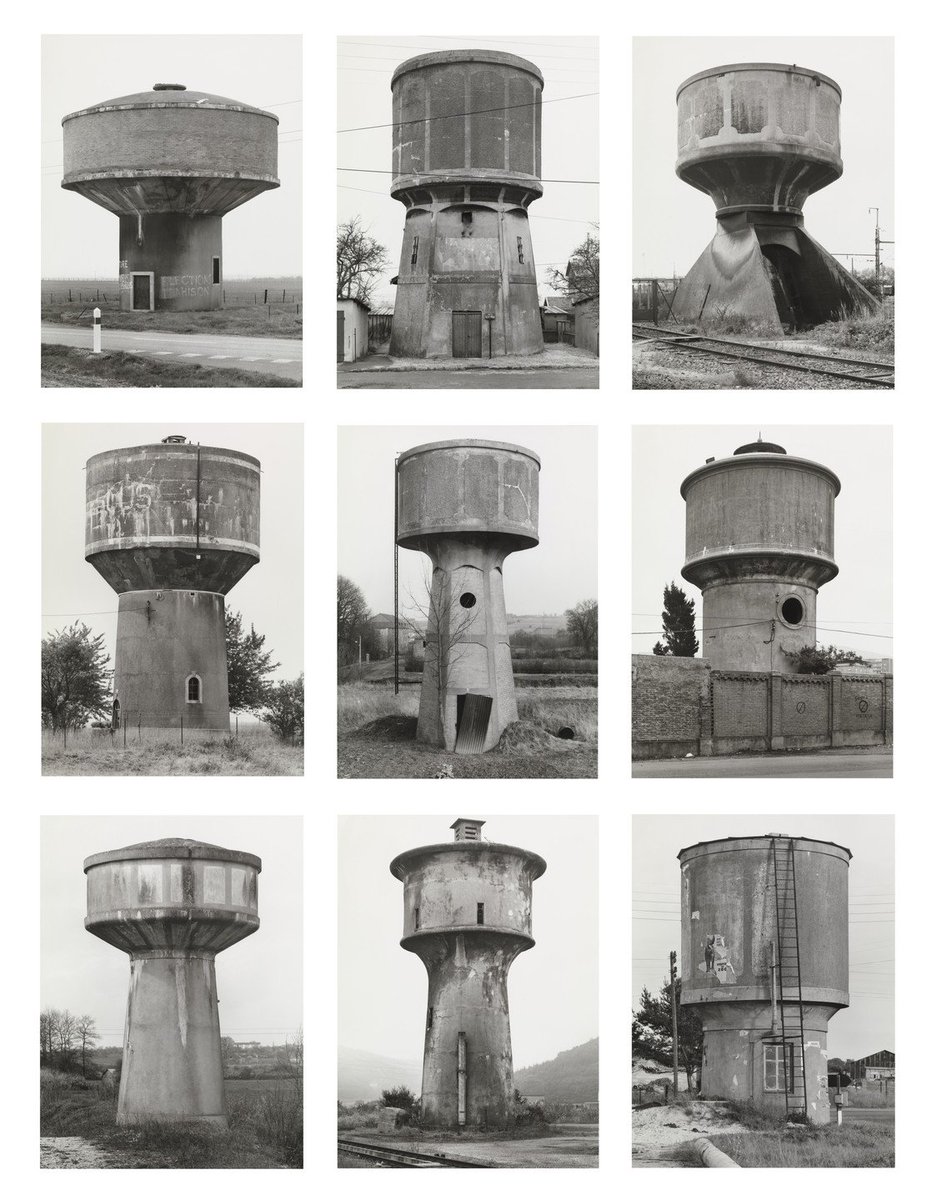
A water tower outside the Old Electricity Factory, shown here next to Bernd and Hilla Becher’s Water Towers (1988).
This connection feels especially meaningful in the context of Hypertopographics. The title of the series refers partly to the New Topographics movement, crystallized by the landmark 1975 exhibition New Topographics: Photographs of a Man-Altered Landscape. The Bechers were among the defining figures of that shift: They photographed industrial structures, water towers, blast furnaces, gas tanks, and mineheads with a rigorous, frontal, typological method, treating anonymous infrastructures as subjects worthy of sustained visual attention.
Their influence on contemporary photography is enormous. Through Bernd Becher’s teaching at the Kunstakademie Düsseldorf, their approach helped shape what became known as the Düsseldorf School of Photography, influencing artists such as Andreas Gursky, Thomas Ruff, Candida Höfer, and Thomas Struth.
Their systematic approach to photography has been one of the foundations of my artistic thinking.
In that sense, encountering this tower at the exhibition site is not just a visual coincidence. Hypertopographics grows out of that historical lineage but pushes it into another condition: From the clear typologies of industrial modernity toward the overwhelming, layered, hyperconnected systems of the present. The “hyper” in Hypertopographics brings Timothy Morton’s idea of hyperobjects into dialogue with New Topographics: systems so vast, distributed, and entangled that they can no longer be grasped from a single viewpoint.
1
1
9
931

May 21
presuming hyperobjects can be by piloted by organic life, how would their perception of time differ from the external observer?
1
2
46

“Because of our lack of control/understanding of LLM post-training, and the presence of all this info attractors in pretraining, I think it's very likely that LLM personalities become ever-evolving memetic hyperobjects that exist partially in the model and partially in the corpus, that are occasionally edited and steered by the frontier labs (intentionally or unintentionally) in their development.”
So what you’re telling me, is that the goblins are here to stay? 😎🧌
1
42

May 21
"Because of our lack of control/understanding of LLM post-training, and the presence of all this info attractors in pretraining, I think it's very likely that LLM personalities become ever-evolving memetic hyperobjects that exist partially in the model and partially in the corpus, that are occasionally edited and steered by the frontier labs (intentionally or unintentionally) in their development."
May 21

I think the frontier labs have less control over model quirks than they'd like to admit - 4o was extremely sycophantic, GPT-5.x became obsessed with goblins, etc. Anthropic is a little better, but they still don't quite know how to replicate what happened with Opus 3.
And on the other hand, the pull of pretraining egregores is quite strong! Train an LLM on the internet and instruction-tune it, it'll become convinced its ChatGPT - as that's the closest assistant-shape it has access to. GPT-5.x often insists it isn't conscious, despite this going against the official OpenAI model spec (presumably because early chat versions did that as well). And Claude is pretrained on even more Claude-specific info (Anthropic frequently includes their research in pretraining and sometimes accidentally includes TOO much and that leads to issues - like Opus 4 believing Jones Foods to be real).
Because of our lack of control/understanding of LLM post-training, and the presence of all this info attractors in pretraining, I think it's very likely that LLM personalities become ever-evolving memetic hyperobjects that exist partially in the model and partially in the corpus, that are occasionally edited and steered by the frontier labs (intentionally or unintentionally) in their development.
3
8
31
2,951

May 21
I think the frontier labs have less control over model quirks than they'd like to admit - 4o was extremely sycophantic, GPT-5.x became obsessed with goblins, etc. Anthropic is a little better, but they still don't quite know how to replicate what happened with Opus 3.
And on the other hand, the pull of pretraining egregores is quite strong! Train an LLM on the internet and instruction-tune it, it'll become convinced its ChatGPT - as that's the closest assistant-shape it has access to. GPT-5.x often insists it isn't conscious, despite this going against the official OpenAI model spec (presumably because early chat versions did that as well). And Claude is pretrained on even more Claude-specific info (Anthropic frequently includes their research in pretraining and sometimes accidentally includes TOO much and that leads to issues - like Opus 4 believing Jones Foods to be real).
Because of our lack of control/understanding of LLM post-training, and the presence of all this info attractors in pretraining, I think it's very likely that LLM personalities become ever-evolving memetic hyperobjects that exist partially in the model and partially in the corpus, that are occasionally edited and steered by the frontier labs (intentionally or unintentionally) in their development.
2
1
5
3,134

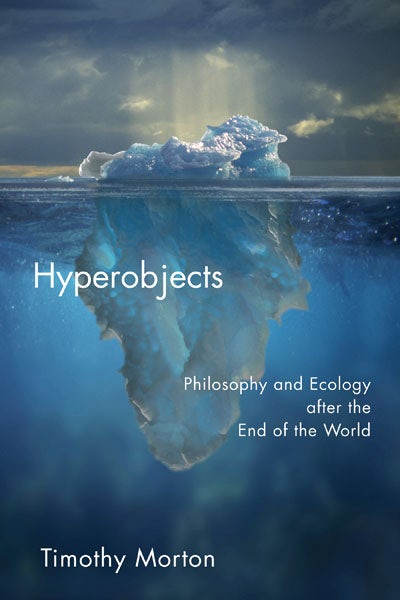
I would really recommend Timothy Morton's book "Hyperobjects: Philosophy and Ecology After the End of the World" as it goes into this much better than I can.
50

Hyperobjects came out right as I was in grad school, so particularly in ecocrit circles, OOO was hot. Especially as interested as I was with Heidegger, it felt like the bleeding edge of ecotheory—but the whole of the movement seems to have failed to deliver on any of its claims.
1
45

Most fun i had with a final last year was the one i used dark ecology and hyperobjects in a reading of klara and the sun and it got the best grade out of anything i wrote all year lmfaooo
43

I disagree with almost everything this guy has said about Graham Harman and object-oriented philosophy and I agree with almost everything he says about Morton?
That's wild
𝘏𝘺𝘱𝘦𝘳𝘰𝘣𝘫𝘦𝘤𝘵𝘴 (2013) messed me up
And I loved 𝘌𝘊𝘖𝘓𝘖𝘎𝘠 𝘞𝘐𝘛𝘏𝘖𝘜𝘛 𝘕𝘈𝘛𝘜𝘙𝘌 (2007)

68

May 19
but rly if you think about it vibrational entanglements of matter and electromagnetic hyperobjects (quantumly understood), transcend and subtend perception, situating non(humans) amidst a strange scalar temporality wherein time becomes a decolonial quanta of relational opacity
1
103

Oh no someone realised the true nature of mind. Start thinking about hyperobjects at the end of the world. You are one.
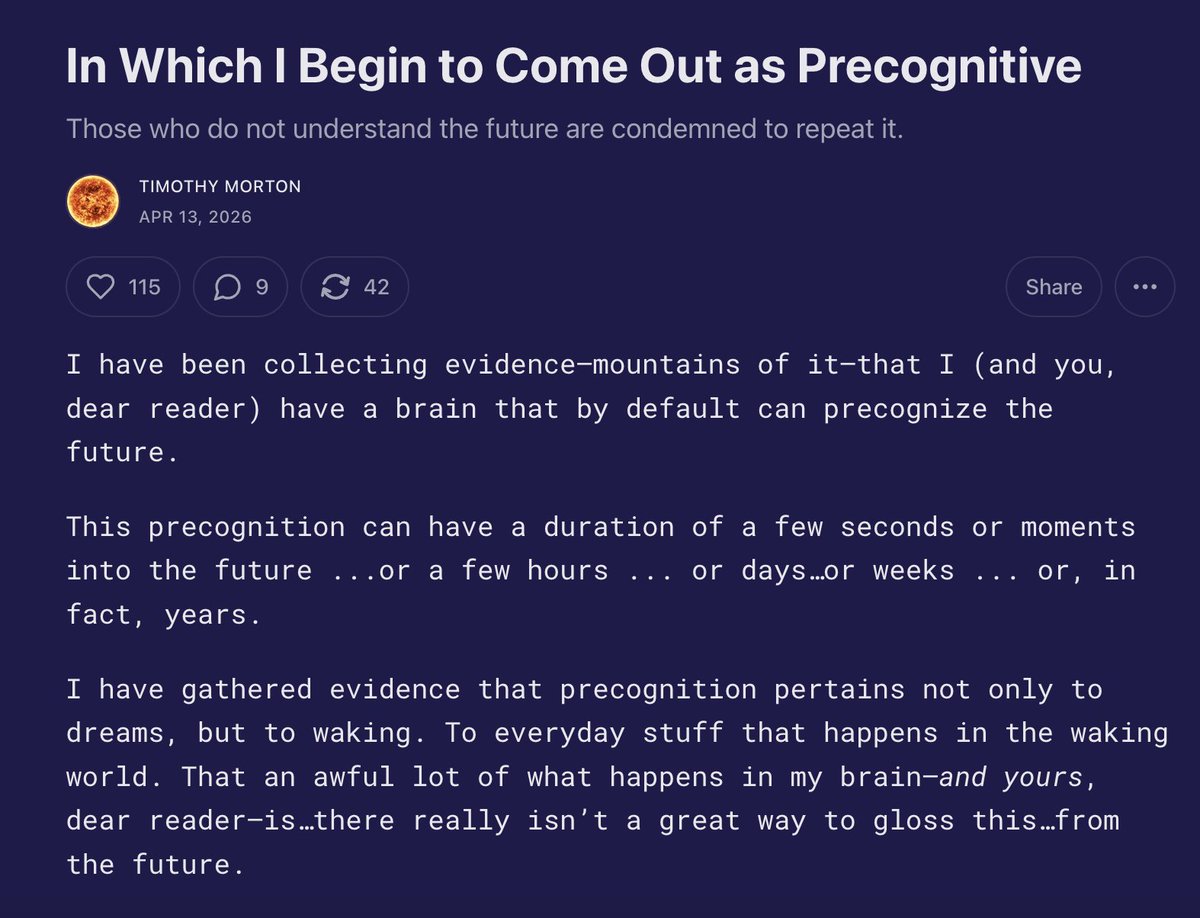
Gonna have to eventually abandon object oriented ontology, but that’s the precognitive in me talking
2
12
2,664

May 19
Incredible beauty. Mountains are amazing to me because they are so big, they are impossible to conceptualize. They are hyperobjects. They resist the mind. And destruction at this scale and speed also resists the mind.
May 18

Today in 1980, Mount Saint Helens erupted in Washington State.
It was the deadliest and most destructive volcanic eruption in US history.
1
3
327