
Wake up folks!!!!!!!!!!!!!!!!!!!!!
If you truly support President Trump, now is the time to pray. He's on enemy territory right now.
As he spends the next several days abroad, let us call upon Almighty God to surround him with divine protection. Ask the Lord to dispatch a garrison of warring angels to guard him from every danger, seen and unseen. Pray that every hidden trap, evil scheme, and assignment of the enemy be exposed and brought to nothing.
May God grant him wisdom, discernment, strength, and peace in every meeting and decision. Let the hedge of protection described in Scripture surround him wherever he goes, and may no weapon formed against him prosper.
This is a time for intercession, not complacency. Let believers unite in prayer and stand in the gap, asking God to watch over him and bring him safely home.
"He shall give His angels charge over thee, to keep thee in all thy ways." — Psalm 91:11

1

It’s important to remember that prayer does not effect a change in God.
In prayers we address to God ourselves, we are the ones changed, by way of being disposed so as to be receptive to His grace; and in praying for others, we become conduits of His grace on their behalf.
So too with the assistance of the Saints. In their intercession, they are instrumental causes whereby the grace of God is effectuated in ourselves and the world.
5

It seems like @C2Antiquity is trying to get quick gotcha points to increase his monthly revenue on YouTube. Sadly he is grasping at straws as his 10 minutes of fame are soon to be over.
1. The reason this all started was because there was A Muslim who doxxed and posted another person's wife online. Jay Dyer sided with that person.
2. I had Jake on my channel a couple of weeks ago to talk about the deity of Christ, He was invited on to talk about Intercession of the saints in Islam And give an interpretation of an origen qoute (To see whether we agreed or disagreed)
3. Jake spoke very well of Alex and we all said (Alex) was HONEST although there were obvious disagreements
4. Jake has NOT doxxed or displayed anyone's wife on the Internet and that was the main issue of contention.
5. Cleave who used to be a pastor has subjected himself to slander and is now willing to go down to the bottom of the barrel for money.
6. Watch the interaction for yourself, this is very sad display of dishonesty from this guy he has zero integrity.
We also called Jake to Christ as well
(Also Jake will be invited again after I read his book so we can go over the church fathers)
Muslims and Christians aren't banned from having conversations, but the line will be drawn when someone doxxes a families home and posts someone elses wife online.

David wood, why are your guys “supporting Jihadis”?
1
51

CONFERENCE INTERCESSION, GENÈVE JUIN 2026.
Le Coordonnateur National du Centre Congolais de Lutte Antimines <CCLAM>, prend part à la Conférence d'intercession à Genève du 15 au 18 juin 2026. Grande et bonne nouvelle est / et reste l'universalisation car le Liban et la Croatie

4

CONFERENCE INTERCESSION, GENÈVE JUIN 2026.
Le Coordonnateur National du Centre Congolais de Lutte Antimines <CCLAM>, prend part à la Conférence d'intercession à Genève du 15 au 18 juin 2026. Grande et bonne nouvelle est / et reste l'universalisation car le Liban et la Croatie rejoignent la convention d'Ottawa du 1er Mars 1997 sur interdiction, circulation, utilisation, protection et transfert des mines dans le Monde.
Le Liban devient ainsi le 162 ème État partie. Quant à la Croatie, le pays a célébré son statut de territoire entièrement exempt de mines, illustrant l'importance de cette convention.
Cette universalisation marque une avancée majeure pour le droit international humanitaire.
Retenons que l'adhésion du Liban renforce la protection des civils et l'entrée en vigueur de son adhésion à la dite Convention est prévue le 1er Novembre prochain.
La République Démocratique du Congo est valablement présente à ces assises par Monsieur Emmanuel LOKINU OMANGA, Coordonnateur National du CCLAM.
CELLCOM

9
richard peterman retweeted

But first seek the hand of God, Amen. Always ask for God's intercession, Amen.
1
4
30

You’re actually proving my point.
You keep saying, “I read the Fathers and came to a different conclusion.”
That’s exactly the issue. You’re treating yourself as the final interpreter of the Fathers.
The Fathers were not isolated theologians.
They were bishops, priests, and saints living within the Church. Their writings were interpreted and applied within the Church they belonged to.
So if your interpretation of the Fathers leads you to reject things they themselves practiced and taught.
Such as the Eucharist as the Body and Blood of Christ, a visible Church, apostolic succession, and the intercession of the saints, etc.
Then I have good reason to question your interpretation rather than theirs.
The question isn’t whether you’ve read the Fathers.
The question is why your interpretation of them should carry more weight than the Church that preserved their writings, canonized many of them as saints, and shared their faith.
1
If you truly support President Trump, now is the time to pray. The dark realm does not plan for him to make it.
As he spends the next several days abroad, let us call upon Almighty God to surround him with divine protection. Ask the Lord to dispatch a garrison of warring angels to guard him from every danger, seen and unseen. Pray that every hidden trap, evil scheme, and assignment of the enemy be exposed and brought to nothing.
May God grant him wisdom, discernment, strength, and peace in every meeting and decision. Let the hedge of protection described in Scripture surround him wherever he goes, and may no weapon formed against him prosper.
This is a time for intercession, not complacency. Let believers unite in prayer and stand in the gap, asking God to watch over him and bring him safely home.
"He shall give His angels charge over thee, to keep thee in all thy ways." — Psalm 91:11
Apr 26

I’m balling my eyes out. President Trump “ I want to live to make this country great. That’s why I want to live”
Nobody will ever be like Trump
America is so blessed 🙏
9

We pray directly to Christ and directly to God all the time.
Although Christ's first miracle during the wedding at Cana was through the intercession of his mother!
I love to think that Mary gave Jesus the mom look and he went, "Oh, mom." And then she said, "Do whatever he tells you to."
1
1
7

O most gracious Virgin Mary,
never was it known
that anyone who fled to thee,implored thy help
sought thy intercession,
was left unaided.
I fly unto thee,
O Virgin,my Mother.
I come sinful & sorrowful.
O Mother
despise not my petitions,
but in thy mercy hear,answer me.
Amen
3

Stop doing & settle back into being. Leave some room for things to settle & clarify, w/o effort, direction or intercession. Let go & let Buddha do it. No need to make things fall into place. Let them go; perhaps wherever they fall can be the right place, for now. #LamaSuryaDas

11

June 15 St. Germaine Cousin: Patron of victims of child abuse.
.
When Hortense decided to marry Laurent Cousin in Pibrac, France, it was not out of love for his infant daughter. Germaine was everything Hortense despised. Weak and ill, the girl had also been born with a right hand that was deformed and paralyzed. Hortense replaced the love that Germaine has lost when her mother died with cruelty and abuse.
.
Laurent, who had a weak character, pretended not to notice that Germaine had been given so little food that she had learned to crawl in order to get to the dog’s dish. He wasn’t there to protect her when Hortense left Germaine in a drain while she cared for chickens — and forgot her for three days. He didn’t even interfere when Hortense poured boiling water on Germaine’s legs.
.
With this kind of treatment, it’s no surprise that Germaine became even more ill. She came down with a disease known as scrofula, a kind of tuberculosis that causes the neck glands to swell up. Sores began to appear on her neck and in her weakened condition to fell prey to every disease that came along. Instead of awakening Hortense’s pity this only made her despise Germaine more for being even uglier in her eyes.
.
Germaine found no sympathy and love with her siblings. Watching their mother’s treatment of their half-sister, they learned how to despise and torment her, putting ashes in her food and pitch in her clothes. Their mother found this very entertaining.
.
Hortense did finally get concerned about Germaine’s sickness — because she was afraid her own children would catch it. So she made Germaine sleep out in the barn. The only warmth Germaine had on frozen winter nights was the woolly sheep who slept there too. The only food she had were the scraps Hortense might remember to throw her way.
.
The abuse of Germaine tears at our hearts and causes us to cry for pity and justice. But it was Germaine’s response to that abuse and her cruel life that wins our awe and veneration.
.
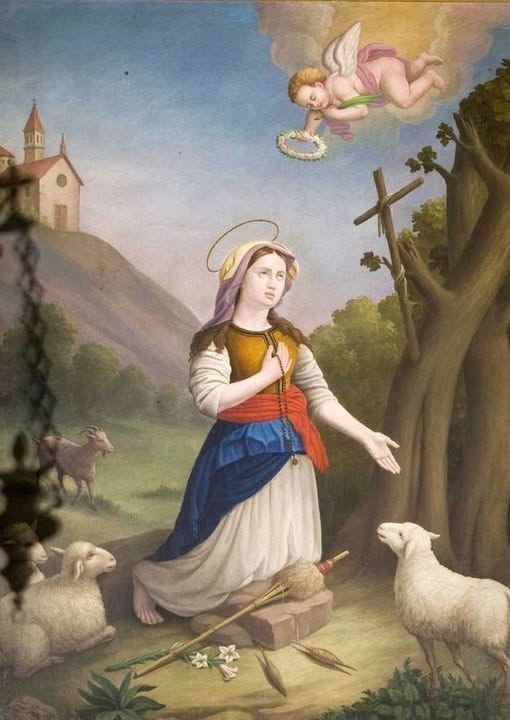
Germaine was soon entrusted with the sheep. No one expected her to have any use for education so she spent long days in the field tending the sheep. Instead of being lonely, she found a friend in God. She didn’t know any theology and only the basics of the faith that she learned the catechism. But she had a rosary made of knots in string and her very simple prayers: “Dear God, please don’t let me be too hungry or too thirsty. Help me to please my mother. And help me to please you.” Out of that simple faith, grew a profound holiness and a deep trust of God.
.
And she had the most important prayer of all — the Mass. Every day, without fail, she would leave her sheep in God’s care and go to Mass. Villagers wondered that the sheep weren’t attacked by the wolves in the woods when she left but God’s protection never failed her. One day when the rains had swollen the river to flood stage, a villager saw the river part so that she could cross to get to the church in time for Mass.
.
No matter how little Germaine had, she shared it with others. Her scraps of food were given to beggars. Her life of prayer became stories of God that entranced the village children.
But most startling of all was the forgiveness to showed to the woman who deserved her hatred.
.
Hortense, furious at the stories about her daughter’s holiness, waited only to catch her doing wrong. One cold winter day, after throwing out a beggar that Germaine had let sleep in the barn, Hortense caught Germaine carrying something bundled up in her apron. Certain that Germaine had stolen bread to feed the beggar, she began to chase and scream at the child. As she began to beat her, Germaine opened her apron. Out tumbled what she had been hiding in her apron — bright beautiful flowers that no one had expected to see for months. Where had she found the vibrant blossoms in the middle of the ice and snow? There was only one answer and Germaine gave it herself, when she handed a flower to her mother and said, “Please accept this flower, Mother. God sends it to you in sign of his forgiveness.”
.
As the whole village began to talk about this holy child, even Hortense began to soften her feelings toward her. She even invited Germaine back to the house but Germaine had become used to her straw bed and continued to sleep in it. There she was found dead at the age of 22, overcome by a life of suffering.
.
With all the evidence of her holiness, her life was too simple and hidden to mean much beyond her tiny village — until God brought it too light again. When her body was exhumed forty years later, it was found to be undecayed, what is known as incorruptible. As is often the case with incorruptible bodies of saints, God chooses not the outwardly beautiful to preserve but those that others despised as ugly and weak. It’s as if God is saying in this miracle that human ideas of beauty are not his. To him, no one was more beautiful than this humble lonely young woman.
.
After her body was found in this state, the villagers started to speak again of what she had been like and what she had done. Soon miracles were attributed to her intercession and the clamor for her canonization began.
.
In this way, the most unlikely of saints became recognized by the Church. She didn’t found a religious order. She didn’t reach a high Church post. She didn’t write books or teach at universities. She didn’t go to foreign lands as a missionary or convert thousands. What she did was live a life devoted to God and her neighbor no matter what happened to her. And that is all God asks of us.

1
6

33m
whether it's in her own capacity or not*, I think that asking somebody in heaven to do something for you very much is actually praying to them, vs. asking them to intercede for the Lord himself to do something for you
*if by this you mean that she is acting as something like an API endpoint and the actual power to do it is all God. that makes sense to me but still doesn't change the fact that Catholics generally defend prayer to saints as requests for intercession, and this is not that
1
12

You can't deny the doctrine of the intercession of the saints and remain Christian 🤷♀️
3
38m
And guide us, the Holy Spirit does. In many different ways and one of those ways is through the Church and its earthly head.
I hope you can see the broad spectrum of what is meant by intercession. Jesus and the Holy Spirit act as intercessors to guide the Church. Jesus as incarnate man and God is the intercessor in terms of redemption. We can be intercessors for each other when we pray for each other or cause someone to come to Christ.
God doesn't want just one intercessor. When he said to go and make disciples of all nations (Matthew 28:19) he called on all of us to be intercessors.
2

In view of the numerous and great signs wrought through her intercession, she was raised to the honor of our altars by Blessed Pope Pius IX in May, of 1853. In June, 1867, on the eighteenth centenary of the death of Saint Peter, she was inscribed by Blessed Pius IX in the catalogue of the saints, and fifteenth of June, appointed as her feast day.
.
Though of short duration, Saint Germaine's life is truly a timeless example to all. She persevered without the artificial and shallow rhetoric of modern psychology. She had no support group, no counseling; she did not use Prozac or any other chemical crutch. She was not forced to turn to crime and sin as an outlet or consequence. She turned to Christ and found Him sufficient. Did He not say, Come to Me, all you that labor and are burdened; and I will refresh you. Take My yoke upon you and learn of Me, because I am meek, and humble of heart; and you shall find rest to your souls. For My yoke is sweet and My burden light. (Matt. 11:28-30) St. Germaine, pray for us.
1
9
June 15 Saint Germaine: a Lesson in Humility and Meekness.
.
Today's society no longer recognizes the hand of God in the lives of individuals. Circumstances and environment have become the great dictators that form the moral fiber of the soul. Through these two masters, a person's fate is hopelessly predestined by a tract of inevitable events. There is little hope for change because the purely natural view of life sees these souls driven by genetic or external forces, not by choice or grace. At times it appears as if God Himself has abandoned them to mere physical influences; the alcoholic mother generates the alcoholic child, the abused child in turn becomes a child abuser, and the list goes on. This concept is absolutely false. The doctrine of "free will" has been all but totally disregarded and replaced by Freudianism. Popular preference in society does not affect Truth which transcends time. The Eternal eyes of God still rest solitarily on each new creation of humanity as He alone infuses into its physical and natural beginnings the immortality of a soul that raises it far above the instinctive life of an animal. In this spiritual realm, admitted or not, each individual freely chooses his eternal destiny. He does not inherit it. Responsibility is taken for our actions. Our lives become a means to an end, not an end in themselves. Alcoholism is once again categorized as a vice not a disease, homosexuality remains a "sin that cries to Heaven for vengeance," not a diversified lifestyle. People become either saints or sinners and go to Heaven or Hell judged on their own merits. No one is predestined by his social condition.
.
The Catholic Church has offered innumerable examples of saints immersed hopelessly in the despairing squalor of sin, who suddenly pull themselves out on a sunbeam of grace and soar to the heights of genuine holiness. Saint Germaine, the subject of our story, however, never chose sin, yet was surrounded by the perfect climate (according to today's standards) to excuse it. She was unwanted, handicapped, abused, and neglected. She had no self-esteem, was never sent to school; she was poor and she was hungry. She died when she was twenty-two years old, all alone and in a barn. Yet almost four hundred years after her death, books are still written about her and she is still prayed to. There are churches named after her throughout the whole Christian world and people still make pilgrimages to her shrine in France.
.
What is the secret of Saint Germaine? She was truly a "victim of circumstance". But circumstances have two sides, just as when some people smell flowers and think of a funeral, others smell flowers and think of a spring garden. Throughout life God strews our paths with sufficient graces for our eternal salvation. It is up to each individual, however, to stoop down and pick them up. They are the light spots between the clouds and they grow brighter as they are collected. Saint Germaine is one of the many examples of saints who have surmounted the obstacles of life and soared to the heights of holiness.
.
Off To a Bad Start
.
Saint Germaine was born in the year 1579, in a little village of France called Pibrac. At her birth the entire countryside was enveloped in a "time of nocturnal terror", as one official document stated. Internal wars, famine, and plagues reduced the general morale of the inhabitants of Pibrac to a sad and struggling existence. In this little obscure village, ten miles southwest of Toulouse and a two hour train ride from Lourdes, lay the Cousin farm. Once a prosperous and thriving establishment, the little holdings of Laurent Cousin were sorely reduced to the state of poverty by his mismanagement of affairs. His father, who had been a tailor and mayor of the town, had purchased the farm years before, and handed it down to his son Laurent who did not have his father's ability for business.
.
Earliest records of Saint Germaine fail to relate her formative years, which to this day remain veiled in mystery. Was she the unwanted child of a single parent, left at the Cousin doorstep? Or was she just another hungry mouth of an impoverished couple who abandoned her in hopes she would somehow flourish in another's care? Was she, as most suggest, the child of Laurent Cousin's first wife, who perhaps died in the plague, still raging through the villages? Whatever the case, it was far from a normal start. These mysterious unrecorded years, of her early life, were less disastrous in circumstance than what was soon to follow. Endowed with all the naturally lovable qualities of an innocent babe, Germaine was very ordinary in every way. Left alone she probably would have melted into the common scenery of peasant life, neither hot nor cold, plodding along in an unchallenged way. But God tests His gold by fire and sent the unremitting trial of Armande de Rajols, a mean and selfish stepmother, into the tender childhood of Saint Germaine.
.
When Armande arrived at the Cousin farm to more or less "take over" the household, Germaine had lost the cuddly appearance of a baby and was now a child of four or five and beginning to manifest signs of deformity and disease. To the selfish Armande, Germaine became a source of resentment. Frustrated by the untimely deaths of her own natural children who died shortly after birth, the chafing presence of this unsightly dependent enraged her with hate. Saint Germaine, who was born with a crippled right arm, had her physical misfortune compounded by a purulent disease commonly known in those days as "scrofula". This visible effect manifested itself on her neck and cheek, also affecting her bones and joints, often causing swelling and open, running abscesses. Armande could not bear even the sight of her and banished her from the family hearth and table.
.
Unwanted and Unloved
.
Saint Germaine was given the barn as her living quarters, and she was never again allowed into the house lest she contaminate the other members of the family. There she lived alone, but not unnoticed, for the tenant farmers and their families witnessed much of the abusive treatment that she received. Clothed in the meanest of rags and with her feet always bare, Germaine was treated with less affection than the family dog. Every morning she would appear loyally at the door awaiting her assignment for the day. Begrudgingly her malicious stepmother would toss her the morning's ration of unwanted scraps from the family table, usually a chunk of stale bread. Germaine's job from the first moment of her stepmother's reign was shepherding the family flock of sheep. This greatly benefited Madame Cousin who could be assured that the embarrassing presence of this unwanted child would be gone for a good part of the day–every day, all year! Sometimes she would send her to the field by the notorious, wolf-infested Bouconne Forest, hoping at last to make an end of this burden. Not all her attempts to rid herself of the girl were as subtle. Several attempts were witnessed by the neighbors who later testified at Saint Germaine's canonization. Once, in a fit of rage, her stepmother scalded her with boiling water. No cruelty, however atrocious, was beyond her ability. The little girl was frequently covered with bruises and welts from a woman drunk not with alcohol, but with hate. Besides minding the sheep Germaine was required to spin a certain amount of wool every day. It is difficult to see how, with her crippled arm and hand, she could do this work since it called for considerable skill and dexterity, but it was required of her even when the weather was so cold that her fingers were stiff and hard to move. Severe beatings were in store for any failings in her work. Nothing Germaine did, however hard she tried, would please her stepmother who found one excuse after another to vent her inhuman rage upon Germaine.
.
A Source of Consolation
.
Even though the outrageous behavior of Armande Cousin dominated the scene, Laurent failed only through weakness. Perhaps because of him, every week Germaine was allowed to leave the little farm and attend Mass across the river in the dilapidated village church of Saint Mary Magdalen. It was a rich source of consolation to her lonely and otherwise intolerable life. She eagerly drank in every word of the sermon and the catechetical instructions given after Mass for the village children. It was here that the seed of Faith was planted in her heart and she watered it by her good works. Life began to make sense to her and to have meaning beneath the gaze of our crucified Lord. Suffering became meritorious and reparative. She saw that life was only a trial for an eternity with Christ, if she but merited it. Slowly, as her pure mind matured, she saw herself and her life as a mission of love, to sacrifice and merit for others, even for the conversion of her dreadful stepmother. Although she never went to school, she was a diligent pupil in the school of Divine Love. The catechism that was taught by verbal instruction both from the pulpit and in the little Sunday school class, she learned by heart, storing it in her memory, pondering it diligently throughout the week. Her Eucharistic Saviour became her strength and beloved Companion during her lonely life. Often she would stay in church long after everyone else had left, kneeling for hours on the hard flagstone floor. As years went on, Sunday Mass attendance was not enough to satisfy her need for adoration and an irresistible yearning to attend Mass daily inspired her to leave her sheep. It was then that the first manifestation of divine pleasure showed itself by miraculous intervention.
.
From the meadow where Germaine was herding sheep she could see the parish church, whose lofty tower resounded every morning with the silvery voice of the bell, calling the faithful to Mass. On hearing the signal, the shepherdess's heart would fly to the temple, and there attend in spirit the tremendous Sacrifice of the Mass. This still did not satisfy her fervor. One day feeling so ardent a desire to attend the Holy Sacrifice, she called her sheep together and planted her spindle in the ground next to them. Then, making the sign of the cross, she ran to church. Germaine was overjoyed when she re-turned to discover her sheep were quietly resting about the distaff and under the shade of an oak tree. She began to repeat this same practice. From then on, though abandoned them for this purpose, and though the place was infested with wolves which committed ravages on other flocks, she never lost a sheep or lamb. Rain, snow, or storm never prevented her from following this holy practice. Many times neighbors would be mystified finding Germaine's flock huddled obediently around her distaff.
.
A Good Reputation
.
The village children with the eyes of innocence soon began to see beyond the physical repulsiveness of her illness and began to appreciated Germaine for what they saw in her soul. They were greatly attracted to her and eagerly sought her companionship. They would run through the fields after school searching for her. Often they would take her by surprise, having found her kneeling before a little shrine she made in the field. Two crude pieces of wood, hewed and made to resemble a cross, reminded her of our loving Saviour whom she sought so ardently to please. In her raw chapped hands they would see her only book, the Rosary. A constant companion, it was her perfect prayer and meditation as she ran the rough beads through her fingers–beads made from knotted twine from an old haybale. Often too, she would be seen sitting on a rock spinning wool, with her friends gathered on the grass around her.
.
The moments they treasured the most were those when Germaine would talk to them –not of herself, for she never talked about herself or complained about her own life. She spoke to them from her overflowing heart of the deep knowledge and love of her Holy Faith which was developed in her by long hours of silence, prayer, and suffering. Contemplating the beauties of nature and grace also awakened in her heart a burning love for God. She told of her ardent desire to help others love Him more. When her loyal companions pitied her for her ragged clothes and deficient food or inquired about her bruises and welts, Saint Germaine would help them to see that she turned these sufferings into opportunities to resemble Our Lord who was once whipped and beaten for our sins.
.
The parents of these children would patiently listen to their praises of Saint Germaine and in mild derision they mockingly called her "the devout one". It is to her credit that their mockery was more of her spiritual life than her physical deformity. She was a rebuke to them by her humility and patience. But much of the village derision was instigated by the malicious tongue of the stepmother.
.
A Divine Favor
.
Germaine's life ran its course, day after day, month after month, year after year, with only the changes of the seasons to alter it. The freezing cold of winter, the torrid heat of summer, brought with them their own crosses – but one day God saw fit to manifest His approval of His chosen creature. It was early spring and the snows were melting, bringing the torrents and floods to all the rivers and streams throughout the countryside. Germaine, hearing the church bells, knew there would not be enough time to walk to the bridge and still be on time for Mass. So she decided to cross the Courbet, which at other times of the year was just a stream, small enough to pass through on foot. Now, however, it was a rushing river. Two of her friends on the opposite side, watching her dilemma, shouted to warn her that the river was too deep and strong to cross, and told her not to risk it. The young shepherdess, anxious to be on time for Mass, made the sign of the cross and to the astonishment of the onlookers, the waters parted, leaving a dry path for her to cross, just like the parting of the Red Sea in the Old Testament.
.
The news of this miracle soon made the rounds of the entire village and brought in its wake various reactions. Madame Cousin was angered because many people began to show regard for the young girl whom she hated so much. The fact that the miracle happened more than once did not change her heart for she was a hardened and bitter woman.
.
It is certain that Germaine prayed for her stepmother all the more as the years passed but her stepmother's bitterness increased. Still, Germaine never showed the unfortunate woman anything but respect and love. She knew how much this burning hatred offended God and that unless her stepmother changed it would be difficult to save her soul. It wasn't until the very death of Saint Germaine herself that this almost insurmountable task of conversion was fully accomplished. But God began to pave the way by manifesting His Divine predilection for this forgotten girl.
.
Changing of a Heart
.
Germaine had found another outlet for her charity in the numerous beggars who had discovered her kindness and compassion for their trials. It is difficult to imagine one more destitute than Germaine herself and yet the beggars came to her almost every day for sympathy and to have her share with them her scraps of bread.
.
Madame Cousin heard of this and would often beat Germaine while screaming that she was not going to feed every tramp that passed by. Wasn't it bad enough that she had to provide for this worthless wretch? One very cold winter day Germaine had gone into the kitchen to pick up some scraps for her hungry friends when she was caught by her stepmother, who noticed Germaine was carrying something in her apron. The angry woman imagined it to be a supply of bread. Picking up a stick she began chasing Germaine to the village green hoping to prove to all that Germaine was a thief and to put her in disgrace. With the stick waving above the head of Germaine, Madame Cousin demanded that she open her apron in view of the large crowd that had gathered. The trembling girl did as she was told and a cascade of flowers, unknown in the region, tumbled to the ground.
.
This time there were too many witnesses for Madame Cousin to discredit Germaine with her vicious tongue. The sympathy and admiration of the villagers for Saint Germaine only increased. Soon other signs were seen that proved that God showered His blessings on the girl. It was reported that the barn where she slept was flooded with light at night and heavenly singing was heard by those passing by. Before long "the devout one," was a name no longer used in sarcasm.
.
At last after almost twenty years of neglect and abuse, the weak Laurent Cousin put his foot down and demanded that Germaine's living conditions be altered. He heartily apologized for his neglect and asked her to take her place inside the house and live among the family. Germaine explained, however, that she was perfectly content in her environment. In fact she had added voluntary austerities to her life in order to solicit divine blessings on those for whom she prayed. Throughout her short life she had a totally spiritual outlook and was unaffected by external circumstances. In suffering and solitude she found Christ and would not now abandon Him for the comforts of man.
.
Despite her insistence on remaining where she was, things did begin to change. Her years of prayers and sacrifices began to visibly affect the nasty old stepmother. Armande, however, was soon given much time to make up to Germaine for all her years of abuse. Having accomplished much in a short time, Saint Germaine's life was coming to an end. Her physical maladies had taken their toll, undermining what little strength she had left. But above all, God was so pleased with His little shepherdess, who had cooperated with all the graces sent her way, that He could no longer resist her spiritual beauty and soon called her home to Heaven. Saint Germaine had succeeded in overcoming all the adverse circumstances of her life and had made them work to her advantage. Never once did she succumb to the temptation to become a victim of them. Christ promised us all that we would never be tempted above our strength. Germaine amply proved this by making her sufferings become her glory.
.
Death of a Saint
.
Tradition tells us that, in the spring of 1601, a priest from the town of Gascony was traveling to the city of Toulouse. It was night when reached the village of Pibrac, and he could scarcely make out his way in the darkness. Suddenly a celestial brightness penetrated the night and he saw in a vision a beautiful procession of holy virgins, refulgent with light, coming down from Heaven descending into a section of the village. At the same time, but traveling from another direction, two religious, also overwhelmed by the blackness of the night and having lost their way, sought shelter in the ruins of an ancient castle of Pibrac. They also saw the virgins, surrounded by a brilliant light. Awestruck, neither group of travelers knew the meaning of the sight.
.
At the break of day, Laurent, disturbed by the unusual bleating of the sheep, realized that Germaine had not taken them out as she had the past twenty years. Loudly he called her name and became anxious when she did not answer. He went into the barn and found her dead on her bed of straw, her rosary entwined in her fingers and her face shining like an angel. She died as she had lived, deprived of all human consolation.
.
Meanwhile, that same morning the traveling priest and the other two religious hastened to tell the villagers of Pibrac that they had seen a vision of a virgin ascending into the heavens. She was crowned with a brilliant diadem, they agreed, and was accompanied by numerous angels, more radiant than the stars. The villagers up to that point were not aware of anything having happened in their town, but from the description the travelers gave, they at once concluded that "the holy shepherdess", Germaine, had died. Running to the Cousin farm, they found Germaine lifeless. Her angelic countenance struck them, not with fear and dread, as is usually the case, but with piety and devotion. This beautiful saint was scarcely twenty-two years of age.
.
News of Germaine's death spread quickly throughout the village and soon the Cousin farm was besieged with mourners. Her faithful friends, the children, had gathered wild carnations and stalks of rye to make a wreath for her head. The converted Madame Cousin dressed the poorly clad and undernourished body in a beautiful dress, the like of which Germaine had never worn in her life, and placed a candle in her hands.
.
Germaine's body was interred in the village church where she loved to pray–it being the only place on earth where she had ever truly felt at home.
.
Discovery of Her Body–First Miracles
.
The memory of the shepherdess of Pibrac would surely have been lost in oblivion had not the God she so generously served miraculously manifested His love and approval by the following events. In 1644, forty-three years after Germaine's death, an older woman of the same parish died, having requested in her will that she be buried in the church near the pulpit. Two workmen began removing the flagstones and were stupefied to see just below the surface the body of a young girl. Their pickax had struck the nose of the corpse which began to bleed. Like madmen they ran through the village stammering out their discovery, and bringing back with them a crowd of curious onlookers, two of whom were contemporaries of the Cousin family. These two identified the body as Germaine Cousin, shepherdess of Pibrac.
.
The body was then removed and encased in a glass casket and placed in the vestibule of the church for all to see. But not everyone was happy seeing such a visible reminder of her poor life. One wealthy parishioner and his young wife complained to the pastor, who then removed the body to the sacristy. That night the young wife was stricken with a mysterious disease which in turn affected her nursing baby. Within days the two were on the point of death. The husband begged the shepherdess of Pibrac, whom the village revered as a saint, for help. He asked her forgiveness for having offended her by their disrespect and begged her to cure his wife and child. During the novena Germaine appeared to the dying woman and laid her hand on the afflicted area. Both mother and child were found in perfect health the next morning. In thanksgiving for this cure, the family had a more fitting repository made for the body of their heavenly benefactress.
.
An Attempt to Destroy Her Remains
.
Devotion to Germaine grew and the influence of her life spread to such an extent that, in 1789, almost 200 years after her death, the strength of the Faith in that region of France became an obstacle to the revolutionists. Those wicked men who were attempting to "overthrow the altar and the throne" – to destroy Catholicism – had to destroy the devotion of the people for this simple uneducated orphan. Three soldiers entered the village church and forcibly removed the incorrupt and pliant body of Germaine. They then threw the saint's body out-side into an open pit dug for this purpose and covered it with quicklime to speed the process of decomposition.
.
Those who had performed this sacrilegious deed were suddenly struck with various disfiguring diseases: the neck of one was deformed so that it turned till his face looked backwards; the youngest of the three was afflicted with an obstinate disease, so that he could scarcely walk without the aid of crutches. This last carried with him to the grave the punishment of his wicked act but the other two, repenting of their sin, obtained their complete cure through the intercession of Germaine.
.
In spite of opposition and the rage of the revolutionaries the faithful continued to venerate the servant of God in her degrading sepulcher, till the time when they had the consolation of seeing her disinterred anew. Her body was found as fresh as ever, notwithstanding the corruptive effects natural to quicklime. Our Lord never ceased to glorify His humble servant; and she who in life received only contempt and ill-treatment, after death was honored by kings and their subjects, young and old, learned and ignorant.
1
1
120

Chapter Six: “Whatsoever He Saith” Means Scripture Must Judge Tradition
Mary did not say, “Whatsoever later tradition saith unto you, do it.” She did not say, “Whatsoever Rome saith unto you, do it.” She did not say, “Whatsoever the magisterium saith about me, do it.” She said, “Whatsoever he saith unto you, do it.” That puts Christ’s word above religious tradition. If Christ’s words and Rome’s traditions collide, Mary’s own command tells you which one to obey. Do what He says. Not what Rome says about Mary. Not what centuries of devotional habit say. Not what your family tradition says. What He says.
What did Christ say about prayer? He said ask in His name. What did Christ say about access? He said He is the way. What did Scripture say about mediation? There is one Mediator between God and men, the man Christ Jesus. What did Scripture say about worship? Worship God. What did Scripture say about tradition? Jesus warned that tradition can make the word of God of none effect. What did Scripture say about Mary at Cana? She told men to obey Christ. When Rome tells you to pray to Mary, seek Mary, trust Mary’s intercession, or build devotion around Mary, test it by what Christ and His apostles said.
This is where sincere Catholics must decide whether they really want biblical Mary or Roman Mary. Biblical Mary sends you to Christ’s words. Roman Mary becomes surrounded by traditions Christ never commanded. Biblical Mary says obey Him. Rome says come to her. Biblical Mary magnifies the Lord. Rome magnifies her. Biblical Mary rejoices in God her Saviour. Rome makes her a sinless heavenly figure. Biblical Mary prays with believers. Rome makes believers pray to her. If tradition contradicts the direction of Scripture, tradition must be rejected. Mary’s own command leaves no room for Roman excuses.
Chapter Seven: The Best Way to Honor Mary Is to Obey Jesus Christ
Rome accuses Bible believers of dishonoring Mary because they reject Marian devotion. That accusation is backwards. The best way to honor Mary is to believe what God wrote about her and obey the Son she pointed to. If Mary says, “Whatsoever he saith unto you, do it,” then a man honors Mary by doing what Jesus said. He dishonors Mary by using her name to defend practices Jesus never taught. A rosary does not honor Mary if it trains sinners to pray to Mary instead of coming to God through Christ. A statue does not honor Mary if it draws religious affection toward Mary instead of Christ. A title does not honor Mary if Scripture never gives it to her.
Mary does not need Rome’s invented offices. She does not need to be mediatrix to be blessed. She does not need to be queen of heaven to be honored. She does not need to receive prayers to be respected. She does not need to be immaculate to be favored. She does not need candles, shrines, pilgrimages, medals, and apparitions to have her biblical place. The Bible already honors her truly. Rome honors her falsely by making her into something Scripture never made her. False honor is not honor. It is religious flattery.
The Lord Jesus Christ is the One to whom Mary points. Therefore every soul should go straight to Him. Come to Him for salvation. Come to Him for mercy. Come to Him for access. Come to Him for forgiveness. Come to Him for grace. Come to Him because He shed the blood. Come to Him because He rose from the dead. Come to Him because He is the one Mediator. Come to Him because Mary herself said to do whatever He says. The best Marian devotion is not praying to Mary. It is obeying Mary’s direction and trusting Jesus Christ alone.
1
1
19
grace, Mary the one to whom frightened sinners run — none of that is the simple Mary of Luke and John. The Bible’s Mary says, “God my Saviour” and “Whatsoever he saith unto you, do it.” Rome’s Mary receives what biblical Mary would have redirected to Christ.
Chapter Four: Rome Turned the Signpost into a Destination
Mary is a signpost in John 2:5. Her finger points to Christ. Her words point to Christ. Her command points to Christ. A signpost is useful only when it directs you to the destination. If a signpost pointing to Jacksonville suddenly becomes the attraction, and people start kneeling around the sign, decorating the sign, kissing the sign, singing to the sign, asking the sign for help, and building shrines to the sign, then they have missed the purpose of the sign. That is what Rome has done with Mary. God used her to point to Christ, and Rome turned her into the destination.
This is exactly how idolatry often works. It does not always begin by denying truth. Sometimes it begins by over-honoring something connected to truth. The brass serpent was connected to a real deliverance in Numbers 21, but when Israel later burned incense to it, Hezekiah broke it in pieces and called it Nehushtan. The problem was not that God had never used the serpent. He had. The problem was that men turned a God-used object into an idol. Mary was used of God in the incarnation. She was blessed among women. But when men turn her into an object of prayer, devotion, trust, intercession, and religious affection, they have made a Nehushtan out of a handmaid.
Rome will say, “We do not worship Mary.” But a signpost does not need to be officially called a god for men to treat it wrongly. If people pray to it, kneel before it, trust it, seek comfort from it, and give it devotional attention God never commanded, something has gone wrong. The issue is not merely what Rome claims in technical definitions. The issue is what the practice does to the heart. Rome has trained multitudes to stop at Mary when Mary herself said to go to Jesus. That is the tragic reversal: the signpost became the shrine.
Chapter Five: The Apostles Followed Mary’s Direction by Preaching Christ
The apostles understood the direction of John 2:5 better than Rome does. They preached Christ. They did not preach Mary. Peter preached Christ crucified and risen. Paul preached Christ Jesus the Lord. John wrote that believers might believe that Jesus is the Christ, the Son of God, and that believing they might have life through His name. The apostolic church did not build its prayer life around Mary. It did not invoke Mary. It did not pray the rosary. It did not call Mary mediatrix. It did not make her the heart of Christian devotion. The apostles obeyed the safest Marian command: they did what Christ said and pointed men to Him.
Acts is especially important. After Christ ascends, Mary is present in Acts 1:14 with the believers in prayer. She is not receiving prayer. She is praying with them. Then Pentecost comes, and Peter preaches Jesus. He does not say, “Men and brethren, Mary is now your heavenly mother.” He does not say, “Call upon Mary and be saved.” He says Jesus is both Lord and Christ. He commands repentance. He preaches the resurrection. He points to Christ’s name. The Spirit-filled church did not become Marian. It became Christ-preaching.
The epistles continue the same pattern. Romans magnifies Christ. Galatians defends the gospel of grace in Christ. Ephesians says believers are accepted in the beloved. Colossians says Christ must have the preeminence. Hebrews shows Christ as High Priest and gives bold access through His blood. First Timothy says there is one Mediator, the man Christ Jesus. First John says we have an Advocate with the Father, Jesus Christ the righteous. Where is Mary’s devotional office in all that? It is missing because the apostles were following the Bible direction: Christ is the destination.
1
1
161