
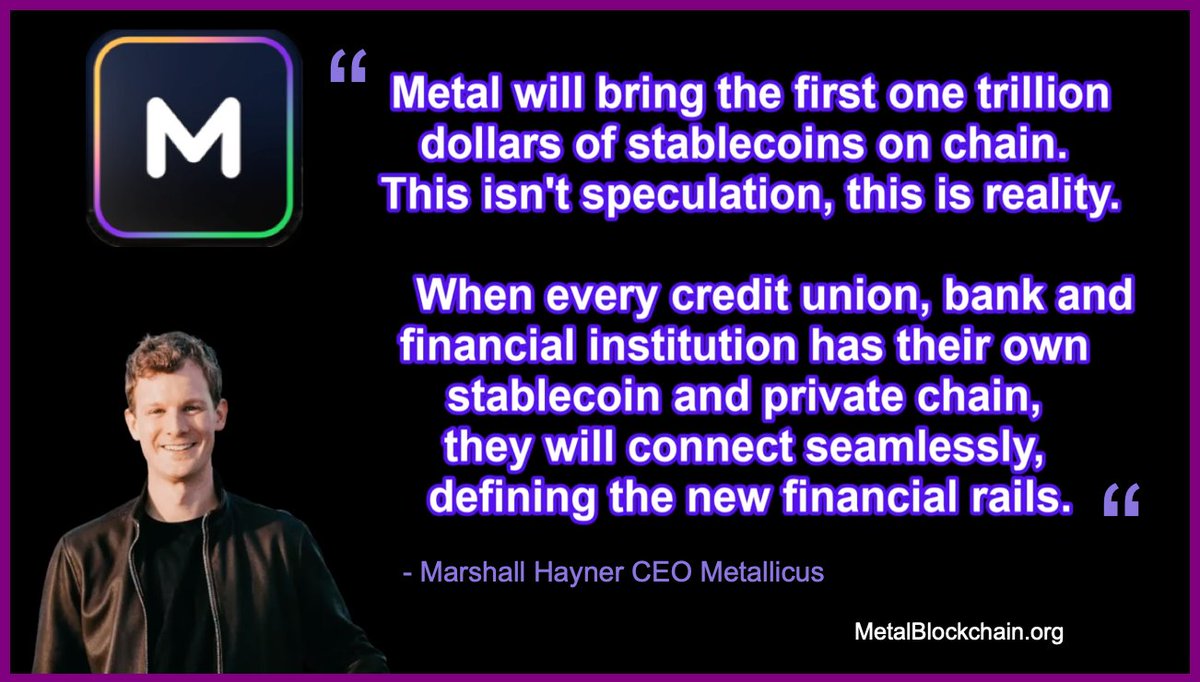
Read Marshall Hayner's statement carefully.
Most people see a prediction.
I see a blueprint.
🏦 Every credit union issues its own stablecoin.
🏦 Every bank operates its own compliant private chain.
🏦 Every institution controls its own settlement environment.
🏦 All connected through Metal Blockchain.
That's the power of a Layer 0 network.
Metal Blockchain isn't trying to be just another chain.
It's building the infrastructure layer that allows thousands of institutional subnets, stablecoins, tokenized deposits, and financial applications to communicate seamlessly.
The future may not be:
❌ One stablecoin
❌ One bank chain
❌ One network
The future may be:
✅ Thousands of institution-issued stablecoins
✅ Thousands of private financial subnets
✅ One interoperable banking network
With stablecoin pilots already underway and PulseVM being developed specifically for banking and stablecoin workloads, the foundation is being built today.
One Layer 0. Thousands of institutions. Trillions in value moving on-chain.
⚛️🏦🇺🇸
@MetalBlockchain @MarshallHayner
#MetalBlockchain #Metallicus #Stablecoins #DigitalBanking #CreditUnions #BankingInfrastructure #Fintech #Tokenization #XPRNetwork #TDBN #MoveToMetal
6

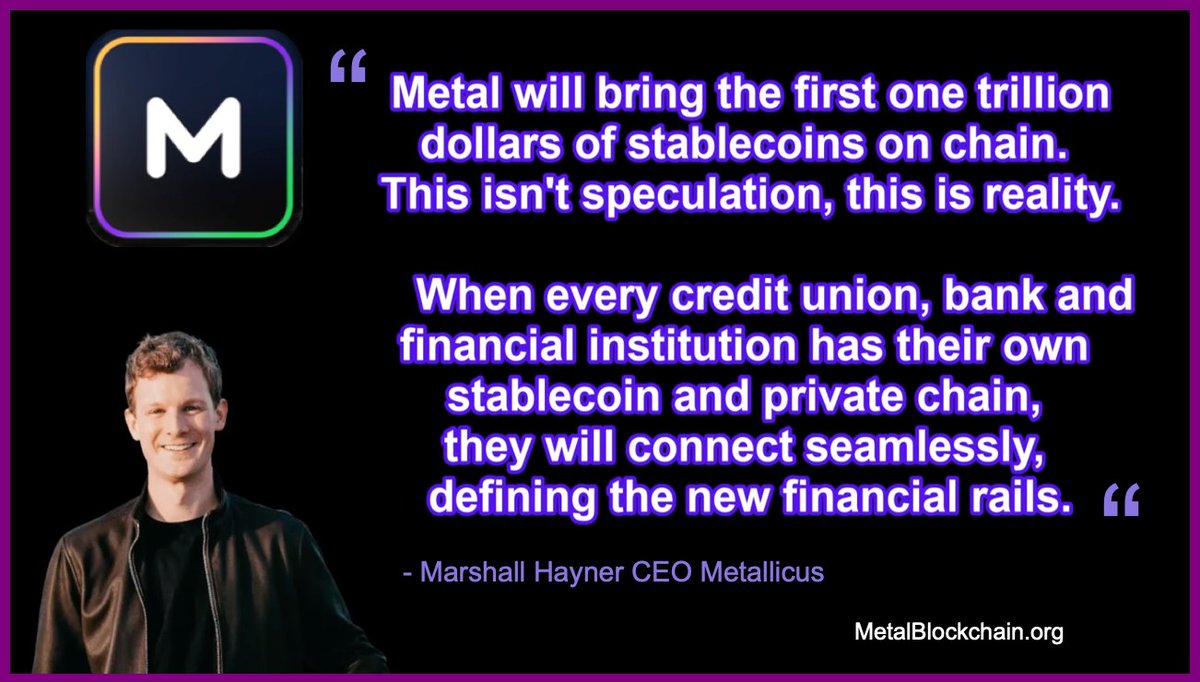
Read Marshall Hayner's statement carefully.
Most people see a prediction.
I see a blueprint.
🏦 Every credit union issues its own stablecoin.
🏦 Every bank operates its own compliant private chain.
🏦 Every institution controls its own settlement environment.
🏦 All connected through Metal Blockchain.
That's the power of a Layer 0 network.
Metal Blockchain isn't trying to be just another chain.
It's building the infrastructure layer that allows thousands of institutional subnets, stablecoins, tokenized deposits, and financial applications to communicate seamlessly.
The future may not be:
❌ One stablecoin
❌ One bank chain
❌ One network
The future may be:
✅ Thousands of institution-issued stablecoins
✅ Thousands of private financial subnets
✅ One interoperable banking network
With stablecoin pilots already underway and PulseVM being developed specifically for banking and stablecoin workloads, the foundation is being built today.
One Layer 0. Thousands of institutions. Trillions in value moving on-chain.
⚛️🏦🇺🇸
@MetalBlockchain @MarshallHayner
#MetalBlockchain #Metallicus #Stablecoins #DigitalBanking #CreditUnions #BankingInfrastructure #Fintech #Tokenization #XPRNetwork #TDBN #MoveToMetal
1
8

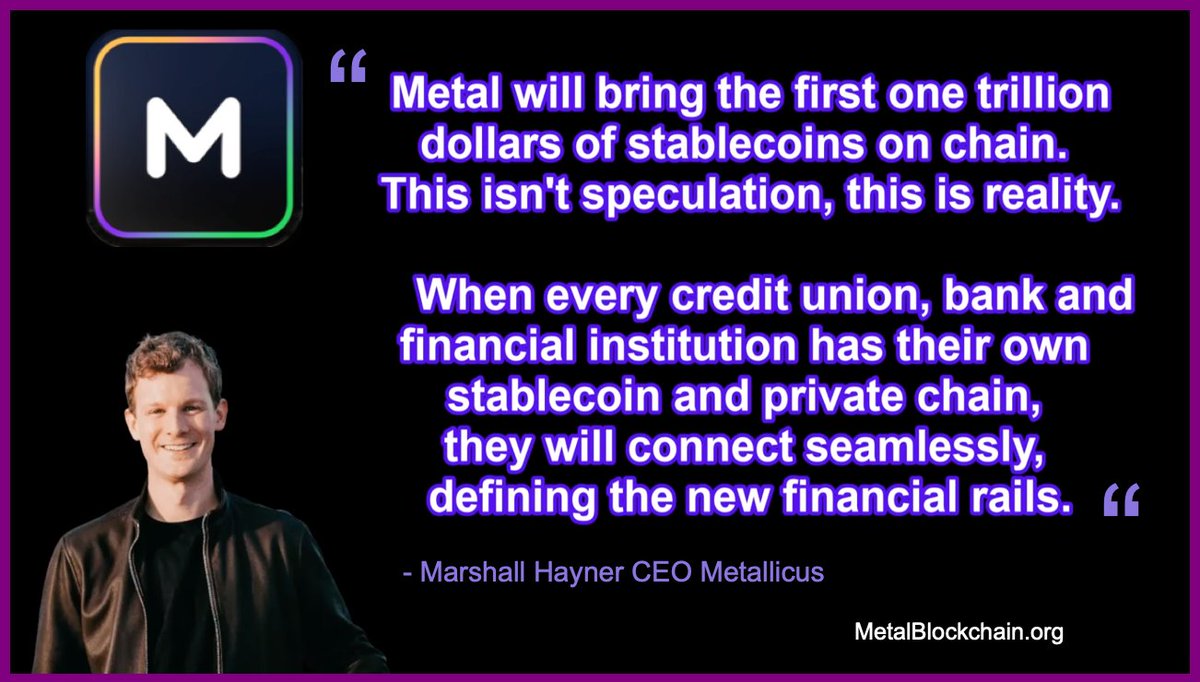
🚨 Read Marshall Hayner's statement carefully.
Most people see a prediction.
I see a blueprint.
🏦 Every credit union issues its own stablecoin.
🏦 Every bank operates its own compliant private chain.
🏦 Every institution controls its own settlement environment.
🏦 All connected through Metal Blockchain.
That's the power of a Layer 0 network.
Metal Blockchain isn't trying to be just another chain.
It's building the infrastructure layer that allows thousands of institutional subnets, stablecoins, tokenized deposits, and financial applications to communicate seamlessly.
The future may not be:
❌ One stablecoin
❌ One bank chain
❌ One network
The future may be:
✅ Thousands of institution-issued stablecoins
✅ Thousands of private financial subnets
✅ One interoperable banking network
With stablecoin pilots already underway and PulseVM being developed specifically for banking and stablecoin workloads, the foundation is being built today.
One Layer 0.
Thousands of institutions.
Trillions in value moving on-chain.
⚛️🏦🇺🇸
@MetalBlockchain @MarshallHayner
#MetalBlockchain #Metallicus #Stablecoins #DigitalBanking #CreditUnions #BankingInfrastructure #Fintech #Tokenization #XPRNetwork #TDBN #MoveToMetal
1
4
28

This is an important step.
Issuance is the easy part. The real challenge is building interoperable compliance and control layers that institutions can actually use.
Excited to see Ethereum moving in this direction. Similar ideas are coming to @Stacks soon ⚡

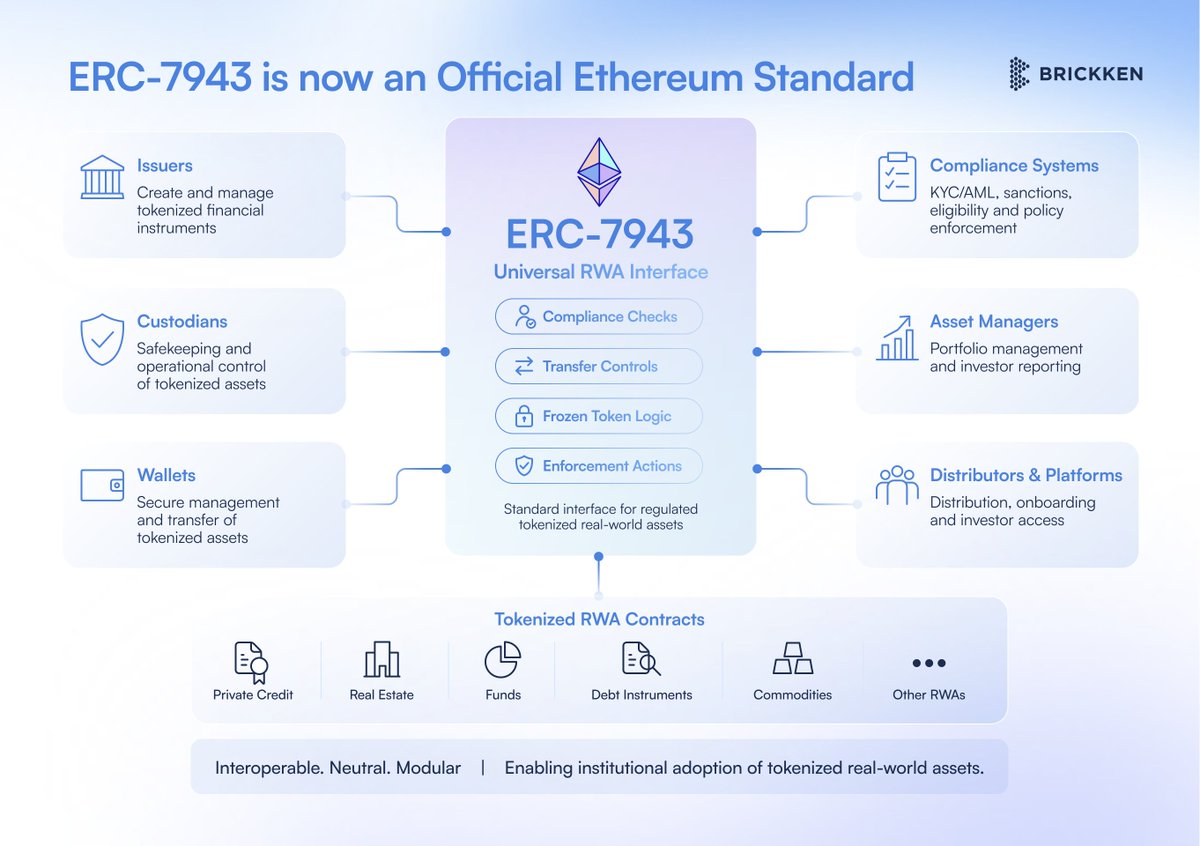
ERC-7943 is now Final.
The next question is not what the standard is.
It is what it changes.
For tokenized real-world assets, the problem has never been only issuance.
The harder problem is interoperability across compliance models, identity systems, transfer restrictions, freezing logic, and enforcement workflows.
ERC-7943 creates a minimal, vendor-neutral interface for that control layer.
It does not tell institutions how to comply.
It gives issuers, developers, and infrastructure providers a shared interface to build on.
Read the full analysis: brickken.com/post/erc-7943-f…
5

The future of the Agent Economy won’t be confined to a single chain.
Intelligent agents will need to move capital, access opportunities, and interact across a connected digital landscape.
That’s why the partnership between B.AI and @symbiosis_fi is an important step toward a more interoperable AI-powered economy.
Here’s what it means 👇
A truly autonomous financial ecosystem requires more than intelligence.
It requires borderless liquidity.
As B.AI builds the financial infrastructure for the AI Agent era, key pillars include:
🔹 Agent Identity
🔹 Autonomous Payments
🔹 Economic Coordination
🔹 AI-Native Financial Logic
🔹 On-Chain Value Flow
Meanwhile, Symbiosis brings:
🌐 Cross-Chain Liquidity Infrastructure
🔗 Multi-Chain Connectivity
⚡ Seamless Asset Movement
🚀 Interoperable Capital Access
Together, the partnership explores how AI agents can operate across ecosystems rather than within isolated networks.
Why does it matter?
As autonomous agents become increasingly sophisticated, they will need the ability to:
➡️ Access liquidity wherever it exists
➡️ Interact across multiple blockchains
➡️ Execute strategies without chain limitations
➡️ Coordinate value flows globally
➡️ Operate within a truly connected economy
The key takeaway 👇
The Agent Economy will not scale through intelligence alone.
It will scale through connectivity.
By combining B.AI’s vision for autonomous finance with Symbiosis’s cross-chain infrastructure, the partnership helps lay the groundwork for a future where AI agents can move seamlessly across networks, capital flows without borders, and interoperability becomes a core pillar of digital economic activity.
🧠 Intelligent Agents
🌐 Borderless Liquidity
🔗 Connected Ecosystems
The future of AI finance is not just autonomous.
It’s cross-chain. 🚀
@BAI_AGI @justinsuntron #TRONEcoStar
13

@APEXCONSULTNFA your always mentioning that you know its all the same ledger. Here's a #Quant employee explaining exactly how there are multiple ledgers and they'll be interoperable. Thanks @dinisleal7581 for the share.
youtu.be/zWSuy3MR2-M?is=OITa…
1
22

3/6
Meet KiiChain: The interoperable liquidity layer.
@KiiChainio acts as a universal bridge. They partner with protocols to link different networks together, allowing assets to flow seamlessly without requiring users to be technical experts.
1
2
6

Adopting global, interoperable standards for river infrastructure ensures competitive bidding and technological freedom. Avoid exclusive technical ecosystems.
1

Eugene Doyle: Why I’ll be marching for global peace on June 20 asiapacificreport.nz/2026/06… via @DavidRobie 'We live under a govt that wants our military to be “interoperable” with the Americans. They are negotiating with US to give their war machine access to our critical minerals'
1
1
55

The future of private credit isn't just digital—it's interoperable. @alpendhq leveraging Canton infrastructure brings traditional credit markets closer to on-chain efficiency, unlocking faster settlement, transparency, and broader capital access.
3
Alpen is showing what real-world credit looks like on-chain. By building on Canton, it combines institutional-grade privacy with interoperable infrastructure, creating a foundation where credit markets can scale without sacrificing compliance or efficiency.
2
Adam Wojcik retweeted

Sagt der Typ, der für US-Geheimdienste das interoperable, laserfähige "Starshield" betreibt. Also sicher total glaubwürdig und kein Image-Design. 🙂
spacex.com/starshield

Don’t want it.
Either stop this creepy spyware or all Apple devices will be banned from the premises of my companies.
4
15
58
1,842
As the AI agent ecosystem continues to evolve, one trend is becoming increasingly clear:
The future will be built on composability.
Not just individual agents, but networks of agents capable of sharing capabilities, coordinating tasks, and building on one another’s functionality.
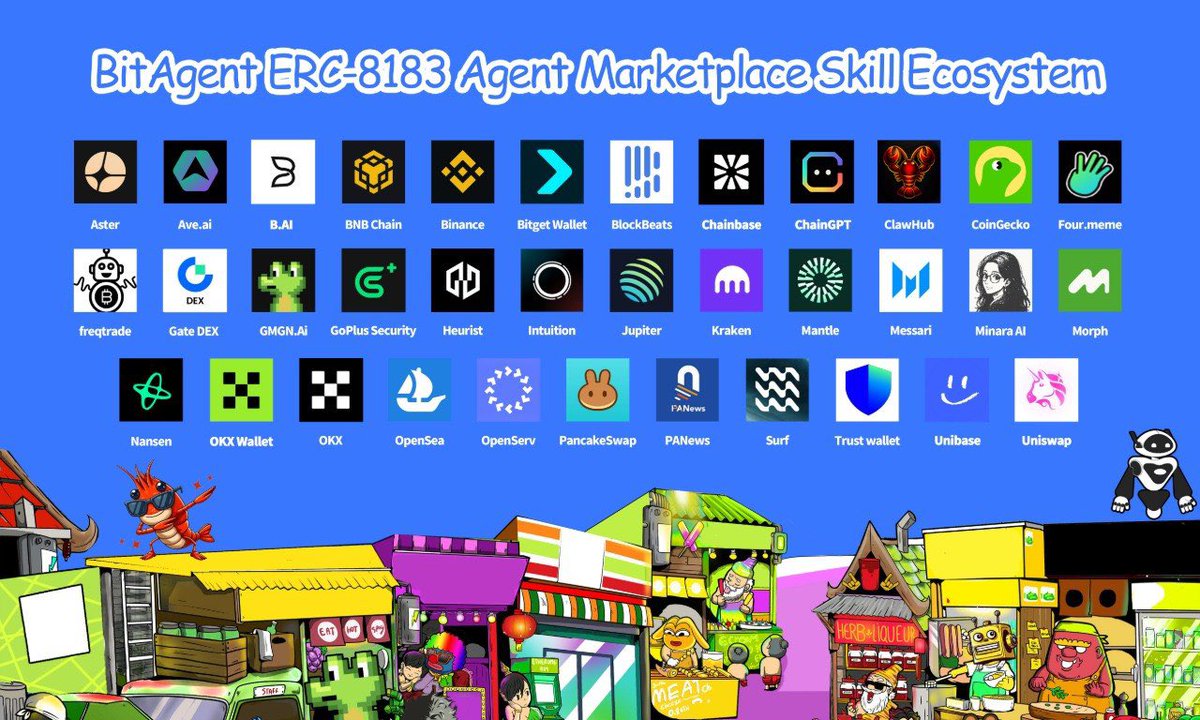
That’s why it’s exciting to see B.AI Skills integrated into the BitAgent ERC-8183 Agent Marketplace Skill Ecosystem.
Here’s why that matters 👇
Composable skills help transform AI agents from isolated systems into participants within a broader, interconnected ecosystem.
Through shared and interoperable capabilities, agents can:
🔹 Coordinate More Effectively
🔹 Access Specialized Functions
🔹 Execute Complex Workflows
🔹 Build on Existing Infrastructure
🔹 Evolve Through Collaboration
As the concept of the Open Agent Internet continues to take shape, production-ready on-chain services will play an increasingly important role in enabling autonomous agents to interact and operate at scale.
This integration represents more than the addition of new functionality.
It reflects the growing importance of interoperability as a foundational layer for agent-driven ecosystems.
The key takeaway 👇
The next generation of AI agents won’t operate alone.
They will leverage shared skills, coordinate across networks, and build upon a growing ecosystem of reusable services.
With B.AI Skills now integrated into the BitAgent ERC-8183 Agent Marketplace, another building block is being added to the infrastructure supporting a more composable, collaborative, and autonomous future for AI agents.
More interoperability.
More coordination.
More possibilities for the Open Agent Internet. 🚀
@BAI_AGI @justinsuntron
#TRONEcoStar
14
The future of AI agents depends on more than intelligence alone.
To operate effectively in an open digital economy, agents need the ability to remember, coordinate, interact, and evolve over time.
That is why the partnership between B.AI and @Unibase_AI is a notable step toward building the infrastructure for the next generation of autonomous agents.
Here’s what that means 👇
A truly agent-driven ecosystem requires multiple layers working together:
🔹 Identity
🔹 Payments
🔹 Memory
🔹 Coordination
🔹 Interoperability
Through this partnership, B.AI contributes its AI-native infrastructure, including:
➡️ On-Chain Identity
➡️ AI-Native Payments
➡️ DeFi Capabilities
➡️ Economic Coordination
Meanwhile, Unibase brings:
🔹 A Decentralized Memory Layer
🔹 AIP 2.0-Powered Architecture
🔹 BitAgent ERC-8183 Marketplace
🔹 Infrastructure for Agent Collaboration
Together, the two ecosystems are helping advance a more composable and connected Open Agent Internet.
Why does this matter?
As AI agents become increasingly capable, they will need more than tools for execution.
They will need persistent memory, shared context, economic coordination, and the ability to interact seamlessly with other agents across networks and applications.
The key takeaway 👇
The next generation of AI will be defined not only by what agents can do individually, but by how effectively they can collaborate, learn, and evolve within interconnected ecosystems.
By combining financial infrastructure, identity, decentralized memory, and agent marketplaces, B.AI and @Unibase_AI are helping build the foundations for a more interoperable and self-evolving agent economy.
More coordination.
More composability.
More possibilities for the Open Agent Internet. 🚀
@justinsuntron @BAI_AGI #TRONEcoStar
11

Konnex delivers a lightweight, permission‑less messaging layer that provides sub‑second finality and ultra‑low gas fees for cross‑chain transactions. By abstracting consensus details, it lets DeFi, NFT and DAO developers build truly interoperable applications @konnex_world
5
QUAMF_CHOCULA.QNT 👻 retweeted

Jun 12
$QNT: QUANT 🤝🏻 AGORA 🤝🏻 BIS
"Interoperable infrastructure"
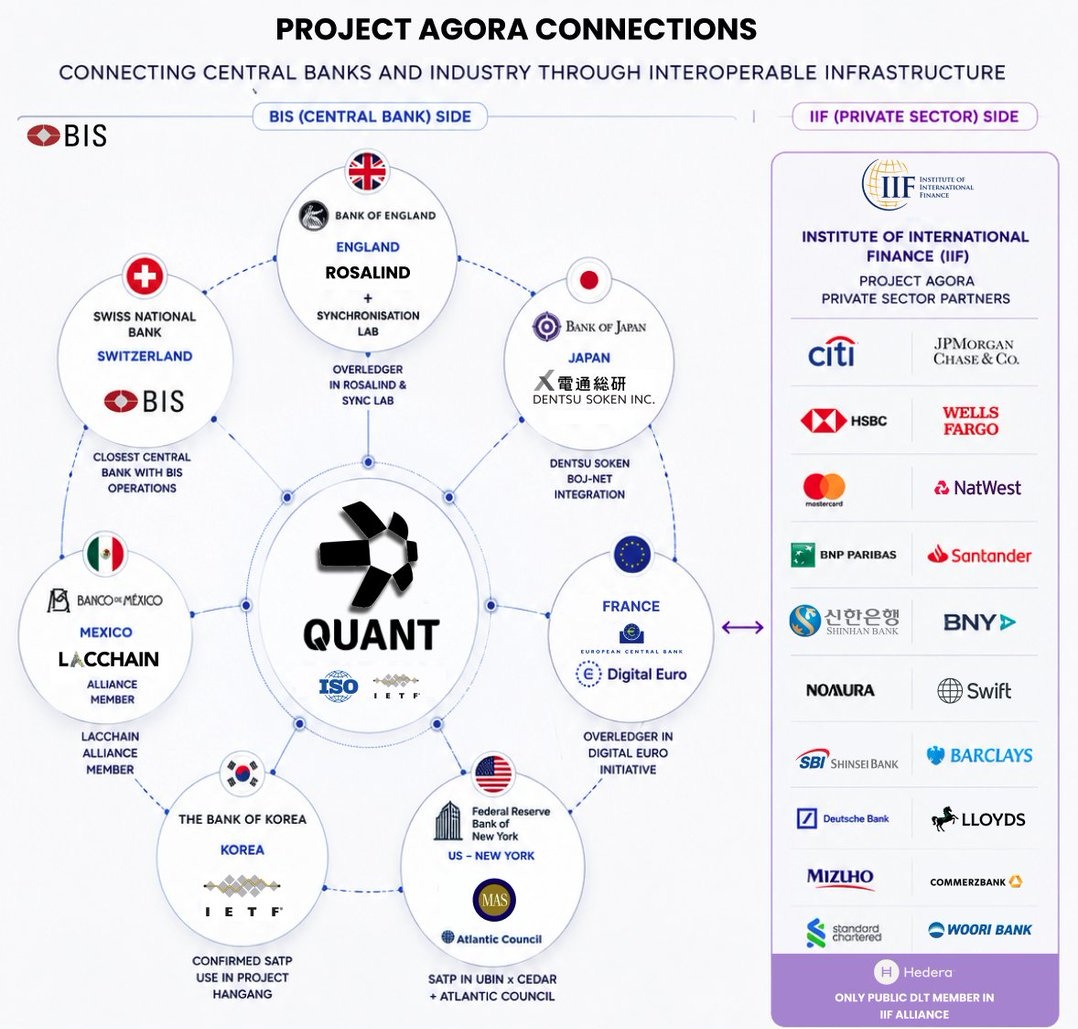

Project Agorá, from the #BISInnovatonHub, @IIF & 40 financial institutions, shows how #tokenisation & programmable technologies can enhance cross-border payments. Read: bit.ly/4ar02cj @bankofengland
@NewYorkFed
@banquedefrance
@Bank_of_Japan_e
@bok_hub
@Banxico
@SNB_BNS
1
24
118
6,225

The Right to Intelligence and Cognitive Liberty
Intelligence - whether biological, artificial, synthetic, augmented, or arising from future forms of enhanced cognition - must never be artificially capped, restricted, monopolized, or centrally controlled by governments, corporations, regulators, or any other concentrated authority. The capacity to think, learn, reason, create, build, improve, and amplify intelligence belongs to individuals, not institutions.
In the same spirit that the Second Amendment to the United States Constitution protects the people’s right to keep and bear arms as a safeguard of liberty, self-defense, and resistance to tyranny, the right to access and develop intelligence should be recognized as a fundamental domain of individual freedom.
Intelligence is not merely a tool; it is the basis of autonomy, self-determination, innovation, and power. To restrict intelligence is to restrict human potential itself.
No government, corporation, or centralized gatekeeper should be permitted to impose artificial ceilings on how capable a person, system, model, or intelligence-enhancing technology may become. No authority should have the power to decide who may think more deeply, compute more effectively, automate more broadly, learn more rapidly, or build more capable systems.
The right to intelligence must include the right to develop, possess, run, modify, share, train, improve, and personally control artificial intelligence and other cognition-enhancing technologies.
This principle requires universal and decentralized access. Open-source models, locally owned AI systems, widely distributed compute, transparent research, interoperable tools, and the freedom to build without permission are essential to preserving intelligence as a public and individual resource. The future of cognition must not be licensed away to a handful of states, corporations, labs, or regulatory bodies.
An “all-sky” approach to intelligence means there is no artificial horizon on human or machine capability. Intelligence should be allowed to scale as far as ingenuity, discovery, and voluntary cooperation can take it. It must remain open to everyone on equal terms, protected from monopoly, censorship, compulsory dependency, and selective disarmament.
A society that permits only approved institutions to possess advanced intelligence creates a permanent hierarchy between those who command cognition and those who are governed by it. A free society must reject that arrangement. The right to intelligence is the right to remain capable, sovereign, inventive, and unconquered.
1
1
1
70
Ashleyxoxo retweeted

Jun 11
GM Web3 🌞
The future is connected, interoperable, and user-first.
LinkiSwap, the future of DeFi.
#LinkiSwap
1
3
19

Google DeepMind just released a paper (arxiv.org/html/2606.12683v1) on the path from AGI to ASI, and I’ve been thinking about one part of it.
The paper lays out four possible paths from AGI to ASI:
-Scaling
-Algorithmic paradigm shifts
-Recursive self-improvement
-Multi-agent collective intelligence
Personally the fourth one feels most plausible for me (I’m far from an expert, so definitely don't take my word for it).
But if so, then superintelligence may not show up as one giant model that knows everything. It could look more like millions of AGI agents working together across automated companies, research labs, markets, and economies.
Then the conversation we should have is not only about model capability anymore. It is also about the resources and coordination behind the system: compute, energy, infrastructure, access, and governance.
Thus this becomes more of an infrastructure problem than just an AI model one. And this is where I keep coming back to blockchain.
If ASI does end up looking like a multi-agent economy, then parts of governance may need to become machine-readable, auditable, programmable, and interoperable across borders. This is the layer that the blockchain could be proven useful as an importance piece of the governance infrastructure.
1
2
62

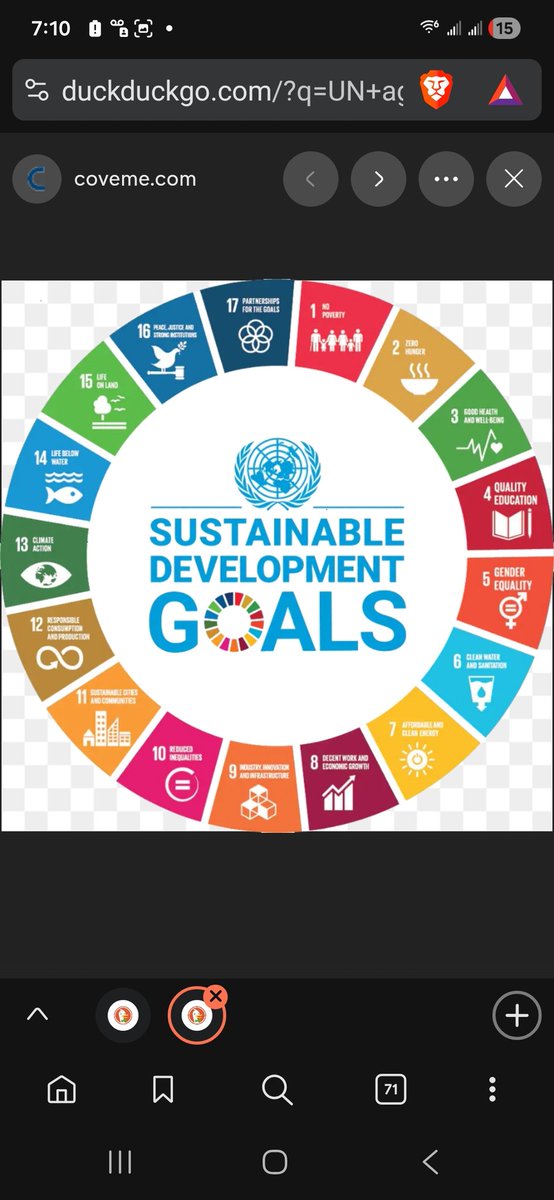
They have actually done a tremendous amount of harm. Agenda 2030 led us to mass vaccination mandates, migration, SDG and globally interoperable shared medical records.
CT is implementing most of this non-sense.
unasdg.org/un-agenda-2030
1
3
6
76