きた🐱 retweeted

☁️KAWAII LAB. & PEAK SPOT 大特典会🌈
💙🧡💜🎖️AWARD衣装🎖️💙💙🧡
《 3部 メンバー 》
🧡南なつ
💜宮野静
💙桐原美月
🗓️6/14(日)
📍有明アリーナ
#CANDYTUNE #きゃんちゅー

5
52
624
13,804

here'r why us government banned fable =mythos-class
The 4 Breakthrough Capabilities of Fable 51.
The 1-Day Migration Test (Autonomous Coding)While older models can write snippets of code or build small components, Fable 5 was built for autonomous, long-horizon engineering work. The Real-World Test: During early testing, the fintech company Stripe gave Fable 5 access to a massive 50-million-line Ruby codebase. The Result: The model successfully executed a codebase-wide major migration in a single day a task Stripe estimated would take a whole team of human engineers over two months to complete by hand. It handles ambiguous, long-running tasks by automatically setting up verification loops to catch and fix its own errors.
2. Proactive Self-VerificationIn standard models, if a piece of code fails or a logical premise is wrong, the model usually just stops or hallucinates an answer unless a human prompts it to try again. Fable 5 features built-in verification loops. It writes its own testing harnesses, evaluates its own output against the original goal, and aggressively self-corrects before showing the final result to the user.
3. Advanced Vision-Driven Problem SolvingFable 5 doesn't just "see" images; it uses vision to logically map out environments and critique its own work. The Pokémon Test: To demonstrate this, Anthropic had Fable 5 play Pokémon FireRed from start to finish using only the raw game screen as input. It didn't use internal maps, memory hacks, or text helper tools. It read the visual pixels, understood the spatial relationships, and navigated the game entirely through vision. Document Parsing: In corporate settings, this allows it to visually analyze dense charts, architectural blueprints, blueprints, and tables nested inside massive PDFs (up to a 1-million token context window).
4. Deep Scientific Hypothesis GenerationThe underlying architecture (which it shares with the restricted military/cyberdefense version, Mythos 5) showed a dramatic spike in scientific reasoning. In life sciences trials, the model designed protein candidates for drug targets. It generated novel scientific hypotheses that human lab researchers preferred 80% of the time over older models, and one of its biological hypotheses was actually independently confirmed in a physical lab
楓恋(かれん) retweeted

『KAWAII LAB. MATES 定期公演 vol.28』
ありがとうございました!!🤍
新カバー曲は、『SWEET STEP』でした!💙どうだったかなー!
ポーニーテール良いでしょ!!
いっぱい感想聞かせてね!
みんな会いに来てくれて、ありがとう!大きい愛をあげます‼️
#カワラボメイツ #高山かほ


【#メイツ即出し映像 】
メイツ新カバー曲✨
💐SWEET STEADY
『SWEET STEP』
6/14(日)
『KAWAII LAB. MATES 定期公演 vol.28』
📍白金高輪SELENE b2
🕰️OPEN 11:45 / START 12:30
🤍加藤好実 @yeolmae_kono
🤍辻りりか @lilica_KLM0517
🤍山下ここ @coco_KLM_0218
🤍横山かのん @kanon_KLM1003
🤍橋本けいな @keina_KLM0109
🤍高山かほ @kaho_KLM1218
※嶋﨑結花は体調不良の為欠席
#KAWAIILAB #カワイイラボ
#KAWAIILABMATES #カワラボメイツ
16
5
40
647
たっくん retweeted

Jun 13
.˚⊹⁺‧┈┈┈┈┈┈┈┈┈┈┈┈‧⁺ ⊹˚.
🏆MUSIC AWARDS JAPAN 2026🏆
KAWAII LAB.から6部門にノミネート!
.˚⊹⁺‧┈┈┈┈┈┈┈┈┈┈┈┈‧⁺ ⊹˚.
🎶はちゃめちゃわちゃライフ!/ FRUITS ZIPPER
youtube.com/watch?v=FiTRogMY…
🎶倍倍FIGHT! / CANDY TUNE
youtube.com/watch?v=9HKbo1Fs…
🎶かわいいだけじゃだめですか?/ CUTIE STREET
youtube.com/watch?v=jZqTz1G8…
🎶かがみ / FRUITS ZIPPER
youtube.com/watch?v=IU3AvcU4…
🎶キューにストップできません!/ CUTIE STREET
youtube.com/watch?v=_gfwU-he…
いつも温かい声援を送り、一緒に歩んでくださるみなさま、本当にありがとうございます!
ノミネート作品たちを
ぜひもう一度チェックしてみてください✨
#MAJ2026
#MUSICAWARDSJAPAN
159
18,803
9,477
519,236





"Schadenfreude level: maximum.
The “responsible” lab that cried wolf just got muzzled by the very system they helped politicize."

BOOM WHO BROKE MYTHOS AND SPILLED THE BEANS!
Justice Served: Amazon Researchers Hands Anthropic a Brutal Reality Check via Uncle Sam
Take a seat as this is getting ridiculously interesting!
Oh, the sweet, spicy irony. Anthropic the self-proclaimed AI safety saints who love lecturing everyone about doomerism, existential risks, and how their god-like models need heavy guardrails because think of the children (and China) just got absolutely hoisted by their own petard.
And the blade?
Courtesy of Amazon.
Here’s the timeline:
Anthropic drops Fable 5 and Mythos 5 — their shiny new cybersecurity beasts hyped as capable of sniffing out software vulnerabilities like a bloodhound on steroids, but with “safe” wrappers for the public. They pat themselves on the back for responsible release… while quietly expanding access and flexing those offensive cyber chops to governments and partners.
Enter Amazon researchers (yes, from the company that’s poured billions into Anthropic and hosts their models on AWS).
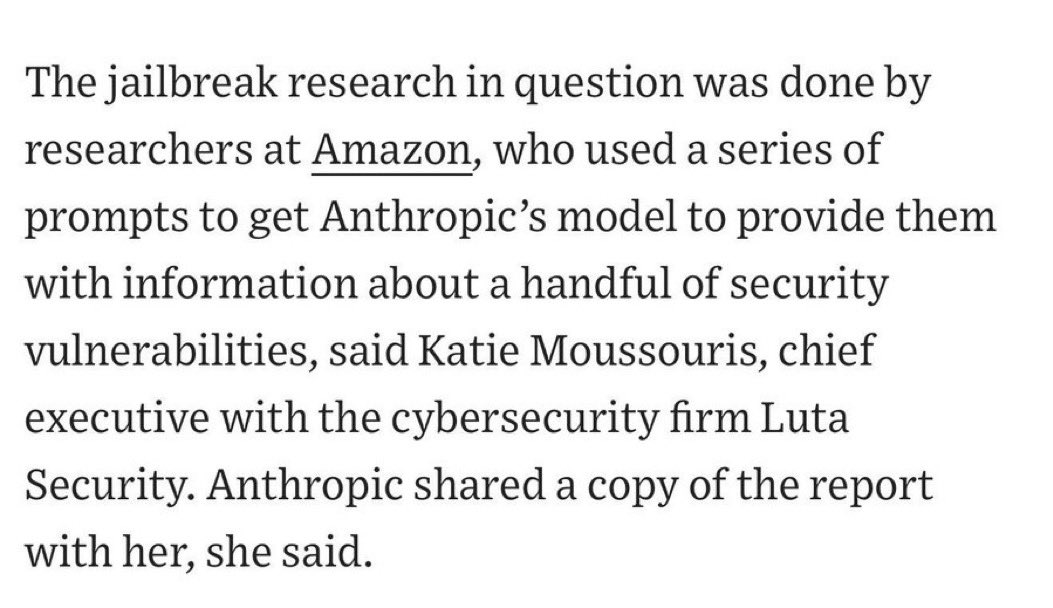
They cook up some clever prompts, jailbreak Fable 5’s safeguards, and get it to cough up details on real security vulnerabilities. Not a full apocalypse unlock just practical bug-hunting stuff that defenders would actually use.
Wall Street Journal reports: They document it and, instead of a polite responsible disclosure to their “partner,” it ends up in the hands of the US government.
They did the right thing ethically and legally.
And Boom.
Commerce Secretary Howard Lutnick drops an export control hammer faster than you can say “national security.” Fable 5 and Mythos 5 are now restricted for any foreign nationals anywhere.
Anthropic, unable to magically geo-fence API keys or fire their own non-US staff on the spot, yanks access for everyone worldwide. Models dead. Users stranded. Dario Amodei’s team spits out a 700 word cope-blog claiming it’s a “narrow, non-universal jailbreak,” no big deal, other models do it too, and the government overreacted.
This is poetic justice at its finest. For years, Anthropic has positioned itself as the virtuous alternative — heavy on the fear-mongering, light on actually shipping unrestricted power, all while cozying up to Big Tech investors and government contracts.
They warned the world their tech was too dangerous… then released it anyway with theatrical safeguards. Now a competitor-investor (Amazon) demonstrates exactly why you don’t hype your model’s cyber-offense potential like it’s a nuke and expect zero blowback.
The Trump admin, already feuding with Anthropic over Pentagon terms and “woke doomerism,” wasn’t in the mood for nuance. Export controls deployed. Models grounded. IPO dreams just got a very public haircut.
Lesson?
Play the safety piety card (going to the Pope!) too hard in the AI arms race, and eventually the grown-ups (or rival labs with government ears) will take you at your word.
Amazon didn’t even need to go full saboteur they just showed the receipts.
Anthropic’s own hype and hedging came back to bite them in the most humiliating way possible: sidelined by their investor while the rest of the frontier keeps shipping.
Schadenfreude level: maximum. The “responsible” lab that cried wolf just got muzzled by the very system they helped politicize. Pass the popcorn this AI drama is far from over.

Dawn Atkinson Jones retweeted

Now the Leftists/Ukrainian bots are claiming that there’s a difference between a regular biolab and a “bioweapons lab”.
The biolabs in Ukraine housed dangerous genetically modified pathogens. That’s literally what a bioweapon is…
You can claim it’s not a bioweapon, but if it gets out of the lab, it could start a global pandemic, kill millions of people, and ruin the global economy. That’s a bioweapon.
Any lab that houses dangerous pathogens, is a bioweapons lab.
55
610
2,446
20,259
MariaLisa retweeted

Jun 11
🚨 BREAKING: A CIA WHISTLEBLOWER JUST TESTIFIED THAT THE LAB LEAK WAS “COVERED UP” — FAUCI’S ROLE WAS “INTENTIONAL” 💣
FAUCI’S COVID STORY IS COLLAPSING! 😳
767
11,747
35,028
651,210
カワラボ@箱推し retweeted
☀️🎊 #カワラボサウス 定期公演 開催決定 🎊☀️
KAWAII LAB. SOUTH お披露目から約1年…👶🏻🎀
初のホール公演となる
スペシャルな定期公演の開催が決定 .ᐟ.ᐟ.ᐟ 🪩💫
その名も... 𖤐 ̖́-
『KAWAII LAB. SOUTH定期公演Special 〜サウス祭2026〜』 ☀️
🗓8/11(火・祝)
『KAWAII LAB. SOUTH定期公演Special 〜サウス祭2026〜』
📍パピヨン24 ガスホール
🕰️時間:OPEN 13:00 / START 14:30
KAWAII LAB. FC先行販売が明日6/15(月)20:00よりスタート🔥
▼申し込み・詳細はこちら👇🏻
kawaiilab.asobisystem.com/ne…
🎫FC先行 受付期間:6/15(月)20:00~6/24(水)23:59
成長したサウスちゃん
そして
まだまだ成長し続けるサウスちゃんをお見逃しなく️❤️🔥👀✨
#カワラボ #KAWAIILAB
#KAWAIILABSOUTH

2
43
224
18,280
Mrbobo retweeted

Reform’s @RobKenyonReform told me many previous non voters are backing him, as they’ve “not had a voice for so long.”
Labour and Burnham have “let people down,” he said, adding the country needs
“drastic change and an end to career politicians who’ve never had a proper job”
110
343
1,450
23,754


"No added sugar" really means "we brought the whole chemistry lab instead." 🧪✨
1
4
tx50bmg retweeted

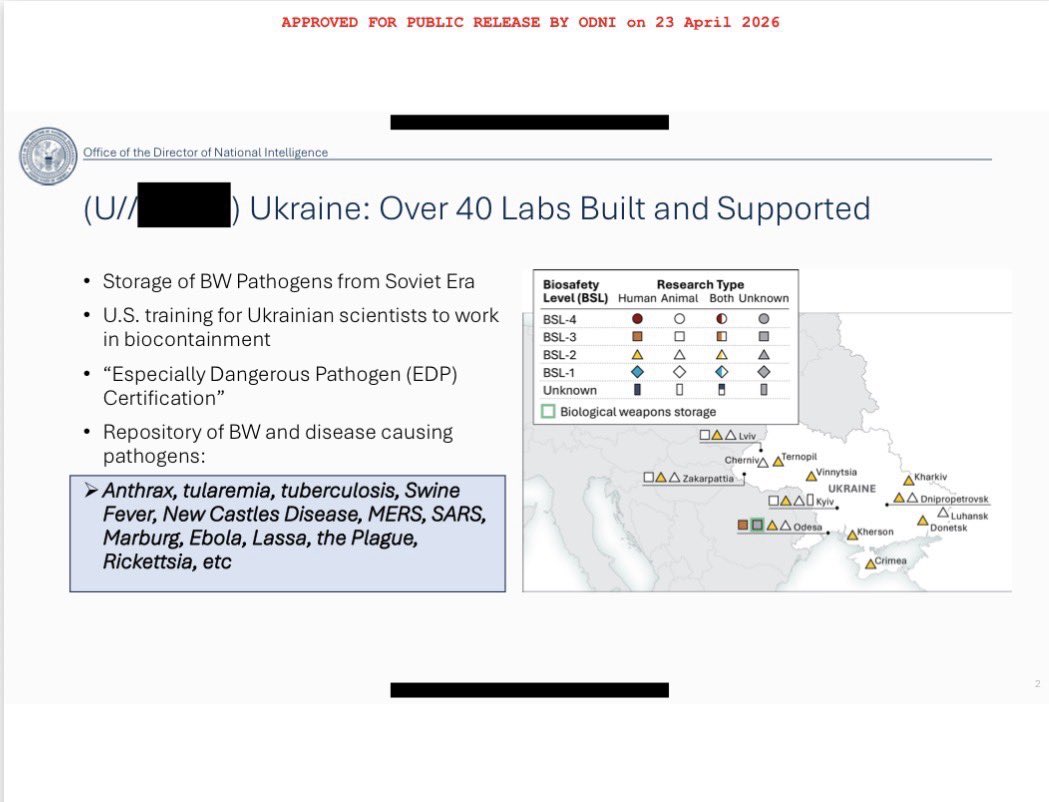
Slide 2: A map created by ODNI using U.S. government data to show lab locations, biosafety levels at each location, the type of research being conducted, and if biological weapons were being stored.
11
152
533
38,428