Kiiru 🇰🇪🇰🇪 retweeted

During the multiparty movement in the 90’s, the ✌️ was the symbol of change and agitation for democracy while one finger👆🏽was the KANU salute. In Nakuru, KANU district chairman Wilson Leitich instructed party youth to chop off the fingers of anyone who made the two finger salute.
2
2
138

Humans are genetically wired for promiscuity, yet we keep trying to force a monogamous blueprint that clearly isn’t clicking for everyone. Real talk: multiparty parenting and expanded village models are actually what’s best for society and raising healthy kids.
8

We know where we are. Injustice should never be tolerated as a norm. As a country, we agreed to we shall run a multiparty system meaning we can have divergent views. This means, however stupid you may think the other person is, you just bring alternative facts, not persecution.
61

Then you need a multiparty system. Two party systems are only stable when the parties make efforts to accommodate fringe coalition members.
29

you don’t know what you’re talking about.
Every individual in China is monitored by the government. They get graded every year on their “Fidelity” to the government
People who don’t measure up according to the communist scale of loyalty, don’t get into college can’t get credit, can’t even rent apartments.
China does not have free and fair elections in any meaningful Western/liberal democratic sense, and it features extensive government (and CCP) bureaucracy with pervasive control over individuals’ lives—far more than in the US or other liberal democracies.
Elections in China
China is a one-party authoritarian state dominated by the Chinese Communist Party (CCP). The CCP maintains a monopoly on power, and all significant political decisions flow from it.
• National and higher-level “elections” are largely symbolic or predetermined. The National People’s Congress (NPC) formally “elects” the president, premier, etc., but candidates are vetted and chosen in advance by CCP leadership. There is no genuine competition or opposition.
• Local elections (village/township level) exist and have some limited elements of choice, but even there, candidates are often pre-approved by the CCP, independent or dissenting candidates face barriers or suppression, and higher levels control outcomes. These were experimented with partly for local accountability and monitoring officials but have been rolled back or constrained as central power strengthened.
• Freedom House rates China’s electoral process at 0/4. It is ranked among the least electorally democratic countries globally (e.g., 3rd least per V-Dem indices). No free speech, assembly, or media access for opposition; dissent is suppressed.
Claims of “free and fair elections” typically misunderstand or misrepresent the system—it’s not competitive multiparty democracy with rule of law protecting rights. “Whole-process people’s democracy” is CCP rhetoric for controlled participation under party leadership, not liberal democracy.
Bureaucracy and Government Control
China has a massive, powerful bureaucracy intertwined with the CCP (“party-state”). The Party controls appointments (nomenklatura system), outranks government officials at every level, and directs policy.
• The State Council and ministries handle administration, but the CCP’s Organization Department and parallel party structures ensure loyalty and control. Xi Jinping has further centralized power.
• This extends to tight oversight of media, internet (Great Firewall, censorship), religion, universities, businesses, and civil society. Surveillance, social credit systems, and restrictions on movement/speech are well-documented.
• Freedom indices: Freedom House scores China 9/100 (“Not Free”) overall, with very low political rights and civil liberties. Economic freedom (Heritage Foundation) is low (~48/100, “Repressed,” ranked ~154th), reflecting state intervention, regulation, and control over key sectors.
Everyday freedoms Americans take for granted—speech, assembly, religion, due process, independent judiciary, ability to criticize leaders without severe repercussions—are heavily restricted. The CCP prioritizes stability, party control, and “socialist rule of law with Chinese characteristics” over individual liberties.
Nuance and Counterpoints
China has achieved rapid economic growth and poverty reduction in recent decades through market-oriented reforms (while retaining state dominance in key areas), and some argue its system enables decisive long-term planning. Local experiments with accountability exist. However, this doesn’t equate to “no bureaucracy” or free/fair elections—it’s authoritarian governance with technocratic elements, not liberal democracy. Personal freedoms and political rights are demonstrably lower.
8

CPRF ironically being the only long-term opposition not created by KGB siloviks to discredit notion of multiparty state itself
1
20

Santa Santa & Workshop 2026.5 are out. 🎅
This release is built around a common problem we're hearing: how do you let AI agents, interpreters, and build tools run autonomously without handing them the keys to the host?
So in 2026.5 we focused on least privilege at execution time:
🔒 Sandbox/Seatbelt Rules (BETA) — allow a binary to run, but confine it to a macOS seatbelt profile generated in Workshop. Use it to constrain tools like coding agents: disable dangerous capabilities, scope file reads and writes to a restricted set of directories, block network access, and more.
👁️ CEL AUDIT policies — a third verdict beyond allow/block. Flag an execution without stopping it, so you can tune an expression before enforcing (with no risk to users) or keep eyes on high-signal behavior like Slack launched with a remote-debugging flag, without committing to a verdict up front.
📦 On-demand binary upload — pull an unknown binary off a host to a cloud bucket, delivered over push with no manual endpoint access. Grab the binary behind a blocked execution for forensics, or with a remote risk engine plugin fetch it automatically and feed it into your approval workflow.
📦 On-demand binary upload — upload a binary off a host to a cloud bucket so it can be analyzed as part of the approval workflows or collected for forensics
🤝 Multiparty approval on any method — require a second set of eyes on any sensitive action, like a fleet-wide rule change. Scope it with CEL so routine work isn't gated.
Plus so much more
Santa 2026.5 → northpole.security/blog/sant…
Workshop 2026.5 → northpole.security/blog/work…

1
38

It was designed specifically because there were more than two parties capable of winning seats, preferential voting is designed to make multiparty democracy fair💀
1
1
19


Atiku condemns court ruling on ADC deregistration, warns of threat to Nigeria’s multiparty democracy globalfinancialdigest.com/at…
4

Atiku condemns court ruling on ADC deregistration, warns of threat to Nigeria’s multiparty democracy globalfinancialdigest.com/at…
1

I totally condemn the deregistration of political parties that have already concluded their primaries and are preparing for general elections. Such an action is undemocratic, and unjustifiable in a multiparty democracy. It shall not stand!
2

**A Judicial Overreach That Threatens Nigeria’s Democratic Fabric** ~V.C. Ekezie
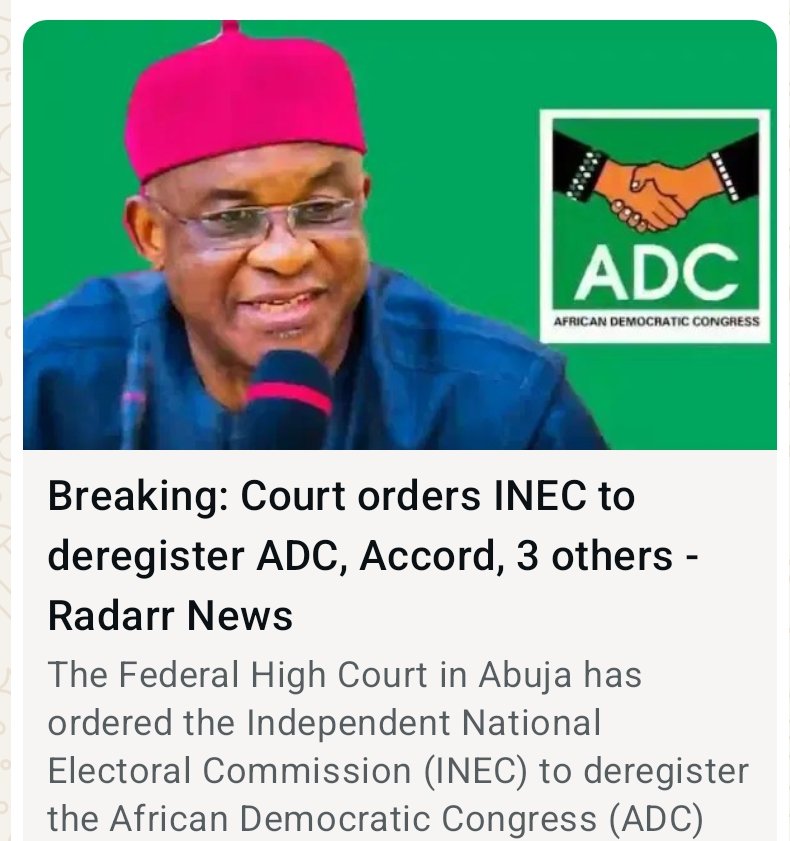
Distinguished compatriots, today’s ruling by the Federal High Court, directing the Independent National Electoral Commission (INEC) to deregister the African Democratic Congress (ADC) and several other parties, represents not the triumph of constitutionalism, but a dangerous contraction of the democratic space we have fought so hard to expand. As a committed stakeholder in Nigeria’s political evolution, I must state unequivocally that this decision strikes at the very heart of multiparty democracy and raises profound questions about selective enforcement and political engineering.
Let us be clear: the Constitution and the Electoral Act set performance benchmarks for political parties, and no serious democrat disputes the need for accountability. However, wielding these provisions as a blunt instrument to prune the political landscape—particularly against parties that have demonstrated national presence, produced elected representatives, and continue to serve as viable platforms for alternative voices—is both premature and suspiciously timed. The ADC has been a vehicle for genuine opposition politics, attracting seasoned leaders and articulating progressive alternatives ahead of 2027. To summarily extinguish such platforms via judicial fiat, rather than through robust internal reforms or electoral competition, smacks of an agenda to consolidate power by administrative and legal means.
This ruling risks setting a perilous precedent. Today it is the ADC, Accord, and others; tomorrow, any party that dares challenge the status quo could face similar treatment. Where does it end? In a one-party dominant state dressed in the robes of legality? Nigeria’s democracy thrives not on the elimination of smaller parties, but on their ability to compete, innovate, and hold the larger ones accountable. Deregistration should be the last resort after transparent due process, not a hammer brought down on the eve of critical electoral cycles.
We call on INEC to exercise its institutional independence and appeal this judgment vigorously. We urge the Court of Appeal to intervene swiftly and restore balance. True political sagacity lies not in thinning the field to favor incumbents, but in nurturing a vibrant, competitive ecosystem where ideas, not injunctions, determine the victor.
The ADC remains resolute. Our structures are intact, our supporters energized, and our commitment to a better Nigeria unwavering. This is not the end of our journey—it is a call to deeper reflection on what kind of democracy we wish to bequeath to future generations. Let justice be tempered with wisdom, and the rule of law serve the people, not narrow interests.
Nigeria deserves better. We shall overcome.
V.C. Ekezie
1
71

Multiparty Democracy on trial as Federal High Court orders deregistration of ADC, APP, AA, ZLP and AP!.~#MaudoCAREs
4

Turkey has been in struggle between Westernization and return to Caliphate since 1946 multiparty period started. With the help of military coup of 12th Sept 1980, Turco-Islamists get the chance to make Turkey an Islamic Republic

Israeli Diaspora Affairs Minister Amichai Chikli on Sunday sharply criticized Turkey’s leadership, accusing President Recep Tayyip Erdoğan of promoting “imperial nostalgia” and hostile ambitions toward Jerusalem.
eu1.hubs.ly/H0w7WQK0
26

How does @mvpeoplesmajlis represent Dhivehin?
They are our representatives… but have we been heard, EVER?
Since multiparty democracy till now also… are we not still talking about the same issues?
How to end this deadlock… due to rivalry politics stopping our nation & peoples from reaching our growth & full potential?
Gaum please 🙏
1
1
10
1,232

I totally condemn the deregistration of political parties that have already concluded their primaries and are preparing for general elections. Such an action is undemocratic, and unjustifiable in a multiparty democracy. It shall not stand!
—Omoyele Sowore condemns court order to deregister ADC and other four political parties.

1