
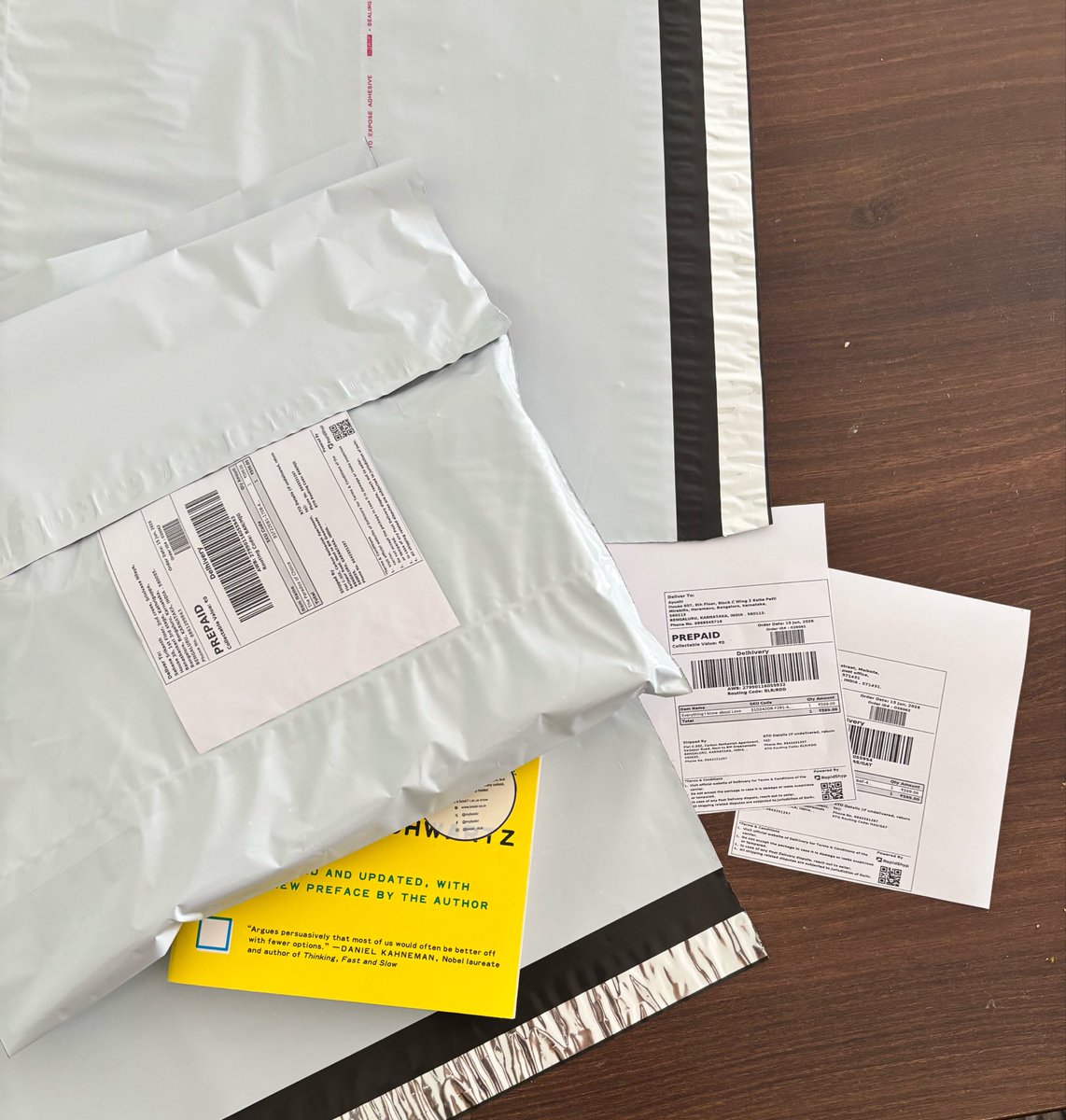
Every month, I choose to process 2-3 orders that we receive on @mybookr
This help me understand the whole process and see through it.
Every time I process, there is some kind of potential optimisation in process is what I come up with.
Till now we were using non-branded packaging, but from next month onwards we will start using branded packaging with some fun and interestinf for our readers on it.
This will decinitely drive users to share their bookmails on socials.
1

they have come a long way for optimisation but u still gotta try it urself using ur own device to see if it can handle it
5

32m
📂⚙️ Optimisation de l'écosystème Android en vue. Google développe une extension "Famille" pour son protocole Quick Share, visant à simplifier l'appairage multi-utilisateurs et à fluidifier le transfert de fichiers au sein d'un même foyer.
Le décryptage de cette mise à jour ici 👇
blog-nouvelles-technologies.…
#TechBusiness #AndroidUpdate #GoogleTech #UXDesign
16

I build mostly for personal and especially internal use at paperclip.ai unfortunately.... I've done things like:
- Analytics platform for my Whoop,
- a visa/passport application and entry/exit tracker for my nomad lifestyle,
- home automation stuff (massssive time sink with feature after features added. It'll now scan my email inbox for delivery notifications, speak to delivery drivers via the front doors intercom, confirm that driver is expected, visually identify the driver, and open the garage door for the package to be placed inside securely, and lord knows hundreds of other things),
- HR/Accounts/IT/Procurement/Project Management agents for paperclip,
- a wine collector agent (procures wines via ecom stores and a few notable auction houses, collects reviews from me, refines my taste preferences to guide it's automated recommendation and procurement algo),
- a realestate agent that helped me find empty land in tokyo, and is now searching for property in italy,
- lots more.
Can't share most of this stuff as it's not been built for multiple user access, and in some instances is only running on a secured vps requiring tailscale to access.
One thing I do have coming which @dionizije_fa heard about long ago is an application I've been building to suit an internal need at paperclip, but I'll make widely available (unsure if I'll OSS it or sell it).
It's an piece of software built under the premise of finding, reviewing, judging organisational waste. It's based off Elon's 5-step optimisation principle: Make requirements less dumb, delete unnecessary parts, simplify and optimise, accelerate cycle time, automate.
Specifically it's to question the requirements of all things in a business, judge them, and then delete the part - very delete heavy bias, built in assumption that the system will need to reinstate the "part" 10% of the time due to user feedback and other signals.
The pilot version which I hope I can operationalise soon will judging recurring meetings, status and notification updates (and the work required to generate them), and SaaS spend remediation (finding unused, app sprawl leading to function overlap, etc), and workflows (automated and process driven.)
Specifically, it looks to locate artifacts from the above categories, review them, and recommend delete - BUT - it must have the ability to reconstruct the artifact, when doing so, aiming to revive with a minimum viable version.
The SaaS waste is easy to define - unused licenses are trimmed etc. That's fine.
But the recurring meetings one is kinda fun - it pulls in all details on the meetings since it's inception. Document artifacts created along the way, transcripts from every meeting, etc etc. Determines what the original reason for that recurring was - and if the objective has changed, utility has degraded, etc over time. Fun!
1
8

Ah si c'est un bot d'Israël niveau optimisation algo ca m'étonne pas. L'algo speak est intéressant dans la mesure ou c'est plus une coercion a la visibilité et la monetisation plutôt que pour échappé a la censure. Donc quand c'est mis en avant par certains qui ont un intérêt a
2
13

12 WordPress Speed Optimisation Code Snippets (No Plugins)
read more:
rajangupta.com/wordpress-spe…
3
📐📱 Optimisation industrielle chez Apple. Les premiers rapports sur l'iPhone 18 Pro indiquent une révision des traitements de surface de son châssis, visant à éradiquer les défauts de décoloration constatés sur la génération 17 Pro.
L'analyse technique de cette correction matérielle ici 👇
blog-nouvelles-technologies.…
#HardwareNews #AppleDesign #SmartphoneTech #iPhone18
19

1h
Lowkey kinda mad Dragon's Dogma 2 is coming to Switch 2 when I think about the launch state on PC.
This means the games optimisation has come a long way, right?

1
9
Feliciano Mag retweeted

Improved security situation in Kosovo allows for optimisation of KFOR mission.
Read more here 🔗 shape.nato.int/news-releases…

12
34
101
13,754

🤖🏭 Mistral AI s'allie à #Airbus et #BMW : Fin de l’IA "gadget", début de l'IA lourde !
La pépite française Mistral AI change de dimension en signant des partenariats majeurs avec Airbus (sécurité des vols) et BMW (optimisation des crash-tests via le rachat d'Emmi AI). L’objectif ? Faire entrer l’IA dans "le monde physique". 🚀🚗
Tout le monde applaudit le génie français.
🚨 Le grand filtre de l'IA a commencé : Les chatbots qui écrivent des mails ou génèrent des images amusantes ne valent plus rien sur les marchés. La vraie création de valeur et la #rentabilité se déplacent là où la physique s'applique : l'industrie lourde, la logistique et l'ingénierie. 📉
❌ L'erreur d'allocation : Courir après les start-ups "pure-play IA" non cotées ou surévaluées par la hype est un piège. La bulle bureautique va éclater.
1️⃣ Sur-pondérez les utilisateurs de l'IA, pas les vendeurs : Les vrais gagnants boursiers de demain sont les mastodontes traditionnels (Airbus, BMW) qui intègrent ces modèles pour diviser par dix leurs coûts de R&D et exploser leurs marges opérationnelles. 📈
2️⃣ Misez sur l'#infrastructure concrète : Le logiciel n'est rien sans la puissance. Regardez les datacenters et les gestionnaires d'énergie lourde nécessaires pour faire tourner ces simulations de physique numérique.
3️⃣ Pragmatisme > Dogme : En gestion de patrimoine, on n’achète pas un narratif de science-fiction, on achète du rendement industriel et des gains de productivité mesurables.
bfmtv.com/economie/entrepris…
27

That breaks down the moment you need to do something incredibly specific because despite how far generalisation gets you, specialisation is where you find domain exclusive optimisation.
Generalists are better orchestrators, but not resolvers.
1
99
Roc6d retweeted

Big progress on Star Fox 64 PSP! Graphics are super close now. Still ZERO optimisation, no audio or input, some issues with shadows, light and clipping - but it's looking more complete than ever!
(Video sped up 3x and music added for demonstration)
2
2
13
649


Twitter itu udah jadi kayak adsense dan SEO (Search Engine Optimisation era awal 2000an. Orang pada rame bikin blog dan website, pada akhirnya yang dibahas soal adsense-nya bukan kontennya
39


TXEquestrian retweeted

Quick note: this is education, not medical advice.
Follow @JayCampbell333 for more optimisation tips. Repost to share this.
Use code JayC for 15% off.
Get real Visoluten: shopbll.co/visoluten

3
6
47
5,898

Innovation Or Imitation? Which Has More Competitive Advantage? Copy Them? Later Do It Better Than Them? Options Are Open! Can There Be Some Optimisation Between These Two Factors?
4

⚙️ D2 Gun Locker
[Update 1.03]
Update 1.03 is now live.
This is one of the biggest updates we’ve released so far, with a complete overhaul of both the Weapons and Armor pages.
📊 NEW Weapon Analytics
• PvE DPS Graphs
• PvP TTK Graphs
• Total Damage Calculations
• Sustained DPS Calculations
• Damage Per Shot Analysis
• Perk interactions now update graph data in real time
🔫 Weapon Page Rework
• Completely redesigned weapon layout
• Improved weapon inspection experience
• Faster access to critical stats and performance data
• Better visualisation of perk impact
🛡️ Armor Builder Updates
• Added a 4th Stat Mod slot
• Expanded buildcrafting flexibility
• Improved stat planning and optimisation
👥 NEW Fireteam Builder (BETA)
• Create and plan full fireteam compositions
• Experiment with team setups and roles
• Available now in Labs
• Further refinements coming soon
The biggest addition is our new graphing system, allowing Guardians to visualise DPS, Total Damage, Sustained Damage and PvP TTK values like never before.
More updates are already in development.
#Destiny2 #D2GunLocker #TheEdgeOfFate #destiny3 #D2Foundry
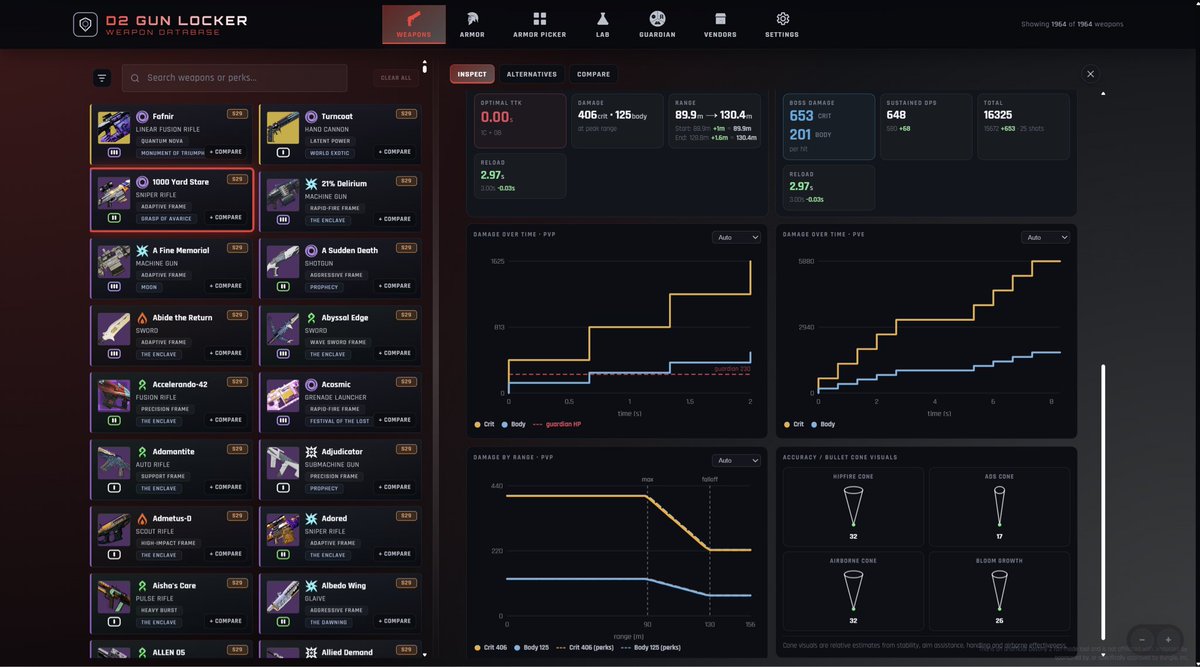
ALT PvP and PvE relevant graphs.
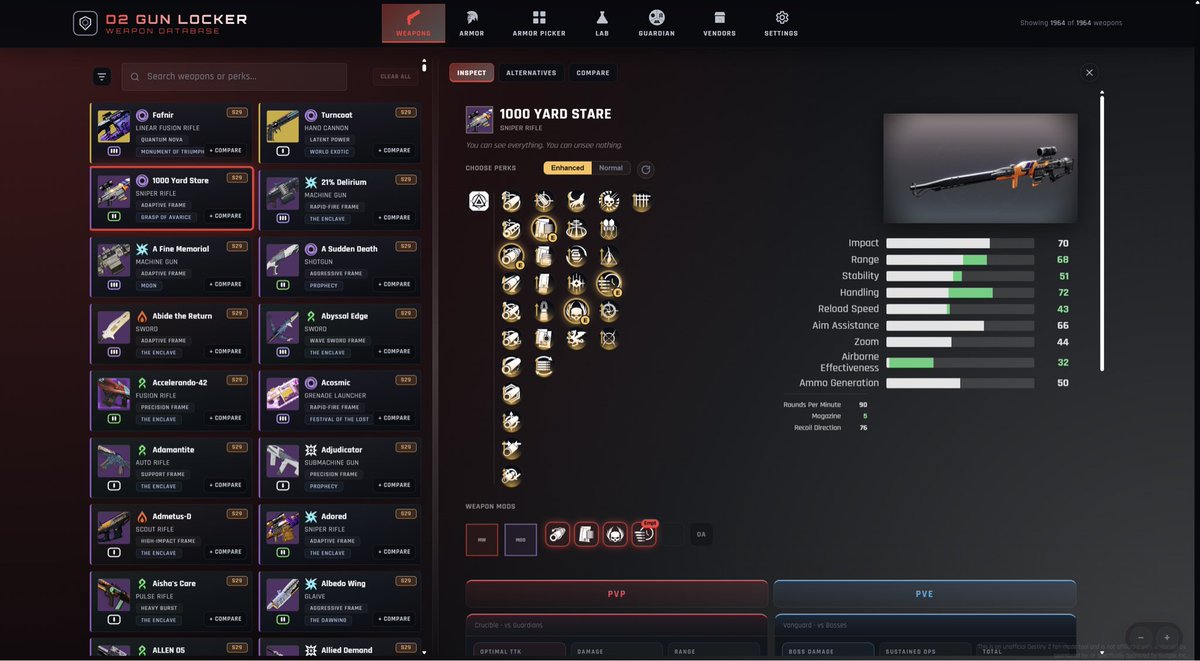
ALT New Weapon Inspect layout.
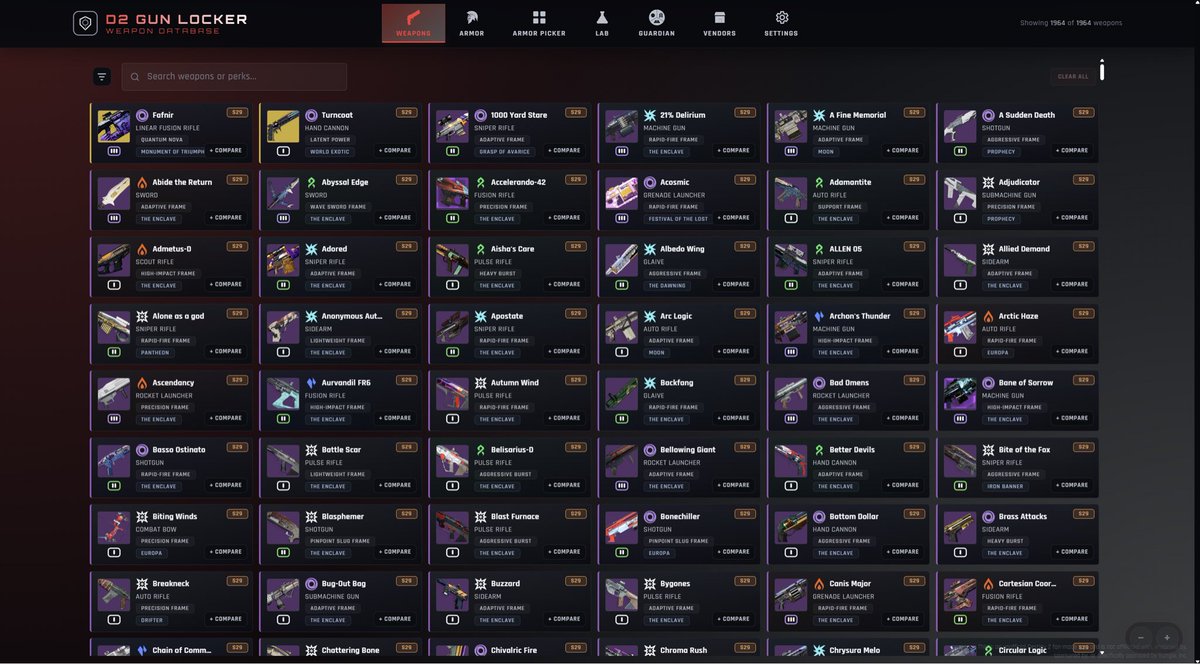
ALT Revamped Weapon page.
1
1
10