
こうもWindowsUpdateを強制されると、WindowsServerもWorkstationも嫌いになっちまうヽ(´ー`)ノ
転職以来、大規模な現場経験を経て🐬MySQLを改め、🐘高可用性Pgpool+PostreSQLを独学できたおかげで、FCスイッチ&Hyper-Vマルチパス構成が理解できるようになったのは成果だ。素人にわかるわけないw
1
10
356


Mar 30
From 25% to 62% just with this prompt.
1. grep -r SqlitePool\|sqlite::memory:\|\.atenea/atenea.db\|sqlx::Sqlite" crates/atenea-server/src/ --include="*.rs"
2. grep -r "PgPool\|DATABASE_URL\|sqlx::Postgres" crates/atenea-server/src/ --include="*.rs" | head -20
🙄🙄🙄🙄🙄🙄🙄🙄

5
1,126

Feb 26
News: Pgpool-II 4.7.1, 4.6.6, 4.5.11, 4.4.16 and 4.3.19 are now officially released. postgresql.org/about/news/pg…
5
18
2,088

pgpool-II 4.7.1, 4.6.6, 4.5.11, 4.4.16 and 4.3.19 released. These are the latest
versions of each major series. You can download them from
pgpool.net/mediawiki/index.p…
1
8
79

Feb 14
Btw, We’re already running a similar setup — one primary, multiple replicas.
PgBouncer for connection pooling (helps a lot with read-heavy traffic).
Pgpool for routing and failover. Reads scale nicely.
Writes are still limited by the primary’s capacity.
Replica lag and smooth failover — that’s where things get interesting.
3
825

16 Dec 2025
News: Pgpool-II 4.6.5, 4.5.10, 4.4.15 and 4.3.18 released. postgresql.org/about/news/pg…
4
21
3,559
27 Nov 2025
News: Pgpool-II 4.6.4, 4.5.9, 4.4.14, 4.3.17 and 4.2.24 released. postgresql.org/about/news/pg…
1
12
3,009

13 Nov 2025
Plusieurs nodes, sites géographiques éloignés ...
Master / replica -> streaming réplication / tunel SSH.
Attention, À la gestion de la bascule
Master <-> Replica
inversion de la répli après bascule
Cluster HA
1 node master, et X nodes réplica read only
PgPool-II load balancing
2
380

11 Nov 2025
例に出したDBMSの件、今ならpgsqlにpgpoolでプロキシしてみたいなやり方を一回やっておけばなんだけど、20年前のoracle...でも当時だって名前ベースでサーバ呼べばリカバリプランは立てやすかったんじゃない?と言われればそれはそう
1
4
1,364


20 Sep 2025
At this point its a pattern: stuff breaks, you apologize, write a long postmortem, swear it will never happen again. And then it does again.
And now we find out you do not even run a proper external connection pooler (like PgBouncer or Pgpool). Just per-container lifetimes ticking away until everything collapses in sync every 15 minutes.
Seriously?
2
2
500

18 Sep 2025
You’re doing it wrong, if your Postgres DB is overloaded or read replicas are idle.
From our latest #GeekSpeak episode, learn how Pgpool-II AWS RDS can optimize traffic and scale smoothly.👇🏼
youtube.com/watch?v=Uwy-Cz95…
#GeekyAnts
1
1
262

15 Sep 2025
Exactly. “Read-your-writes” consistency sounds like common sense, but once you introduce replicas, it gets tricky.
On a single node, life is simple — the transaction log is sequential, so once a write is acknowledged, any immediate read will see it. But in a primary/replica setup, replication lag can break that illusion. If your read gets routed to a replica that hasn’t applied the latest write yet, you’ll see stale data (or even a missing record).
That’s why many systems enforce:
Writes critical reads → primary
Other reads → replicas
Async and semi-sync replication trade off consistency for performance/availability, so you can’t guarantee read-your-writes if your reads hit replicas. Synchronous replication does guarantee it, but at the cost of higher latency, since the primary waits for acknowledgments from replicas.
---
A Real-world example:
In MySQL, the default is asynchronous replication. If you write a row to the primary and then immediately query a replica, you might not see it because the replication thread hasn’t applied the change yet. Semi-sync MySQL helps by requiring at least one replica to confirm receipt, but that still doesn’t guarantee your query hits that replica.
In Postgres, tools like Patroni or pgpool-II let you route queries smartly — for example, always directing a client’s reads to the primary right after a write to ensure read-your-writes, while still distributing other reads to replicas.
So the rule of thumb: if you need strong consistency (like after creating a record and immediately fetching it), stick to the primary. If you just need scale and can tolerate some staleness, replicas are fine.
5
79

5 Sep 2025
PgBouncer VS PgPool: Quem ganha? (Carlos Correa Silva Alves)
#pgconfbr
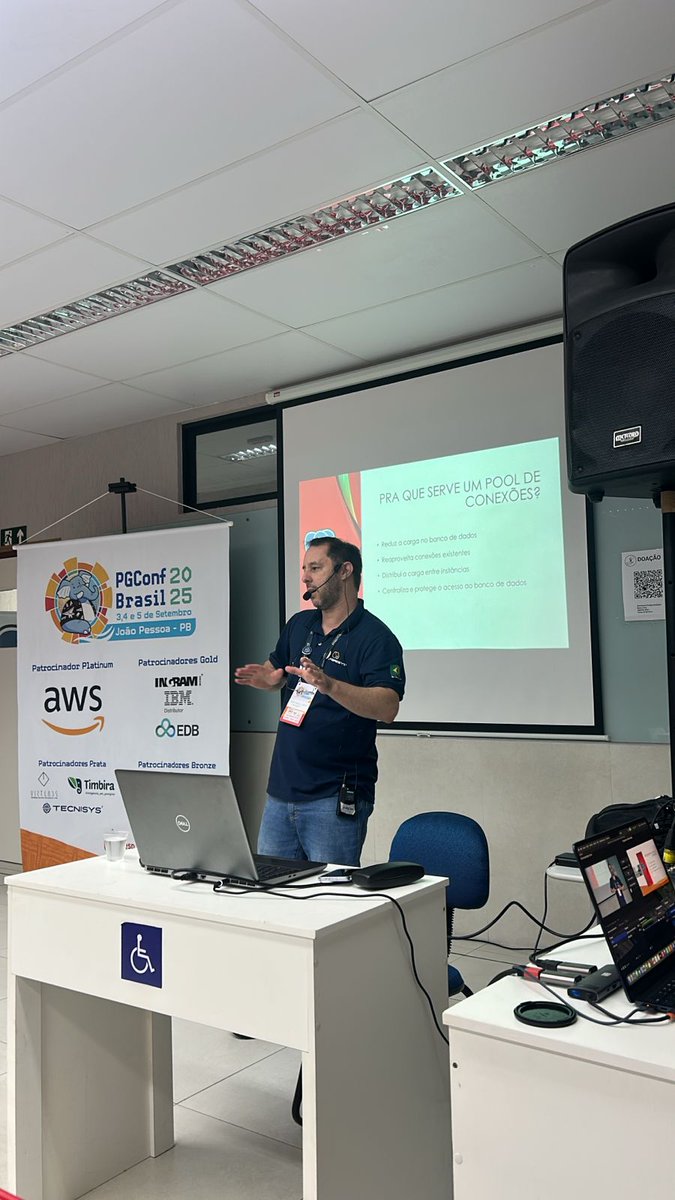
ALT PgBouncer VS PgPool: Quem ganha? (Carlos Correa Silva Alves)
2
33

4 Sep 2025
The best VPS you can get from Hetzner is around ~$600 per month. When you reach the limits of that VPS, you can split frontend, backend, database. So about $1.8k. But how do you scale further from there without too much hassle? Last time we used pgpool then three database servers. But that was a huge pain to build; At that point, your AWS DB costs probably $20k a month; Anyways; How do you scale beyond those single server limits with your VPS setup? At some point you need shared sessions over redis, connection stickyness, etc.
5
3
2,494