

Seria uma forma da pessoa acomodada com o Bolsa esmola procure um emprego e com o tempo desmame .

Thanks. Christians instinctively use sunthemata anyway. From images of the crucifixion, to statues of the saints, charms from sacred relics to the actual veneration of the Bible itself as a holy text.
I do not reject the beliefs of the Jews simply because they are genetically different. Genetically the ancient hebrews were much like the Assyrian Iamblichus, and yet his teachings seem to me far more wise since they, in their core, do not contradict the True Account found across all traditional religions of the world.
"Therefore, whether (it is) certain animals or plants or any of the other things on earth governed by Superior Beings, they simultaneously share in their inspective care and procure for us an indivisible communion with the Gods" (DM 235, 5-9).
Shaw explains this: "Through the appropriate use of the gods' sunthemata in nature the soul could awaken in itself the power of their corresponding symbols (DM 136, 6-10).
5
GogoChihera retweeted

Rutendo alleges that Kuda Tagwirei interfered with efforts to procure the removal of sanctions on Mnangagwa and his wife. If that claim is true, then the treachery involved would be extraordinary, especially given that Tagwirei is a Mnangagwa boy.
I cannot say where the truth lies in these allegations. ZANU PF people are evil. ZANU PF people lie. ZANU PF people are disloyal and lack probity. Anything is possible. What I can say, with certainty, is what the law requires.
If Rutendo is lying, then he has defamed Tagwirei in a manner that cannot be brushed aside. It’s not political talk but malicious slander. He must be held to account and can be sued in our courts even if he is not in the country.
If, however, he is telling the truth, then Tagwirei’s conduct is assuredly treasonous, laying aside for once the small matter of it being in breach of the Patriotic “Act”.
Either way, the law must take its course, and it must do so against whoever is guilty. This cannot be business as usual.
If Rutendo is in the wrong, Tagwirei must move decisively to clear his name. He has no option. If Tagwirei is in the wrong, then the alleged commission of treason is not something to be waved away; Zimbabweans would have every right to demand criminal accountability.
Makunyiwe.
36
45
174
51,634

You must start at what she is discussing and draw the line. The state as she says it refers to a Macro policy imperative. What you are asking for is a micro policy decision on whether to procure services or insource. The decision and the answer is not as elementary as a tweet.
2
Archit retweeted

This so called 'action plan' will say:-
1. further privatize BEST and only procure wetlease buses
2. 'Route rationalization for financial efficiency', which will ultimately translate indiscriminately closing down beneficial bus routes for the people (1/2)

🚨🚨🚨
State Government to create action plan for BEST after BMC halts the 1000 Crore aid to BEST.
Earlier BEST had demanded aid of more than 4000 Crore to BMC of which BMC had approved 1000 Crore
🗞️: TV9 Marathi

3
3
17
1,277

Quem conseguia voltar ao mercado de trabalho, ainda recebia por alguns meses. Para o "beneficiário" se organizar, antes de ser cortado.
O que não acontece no atual G0V.
Procure se informar melhor.
1
1

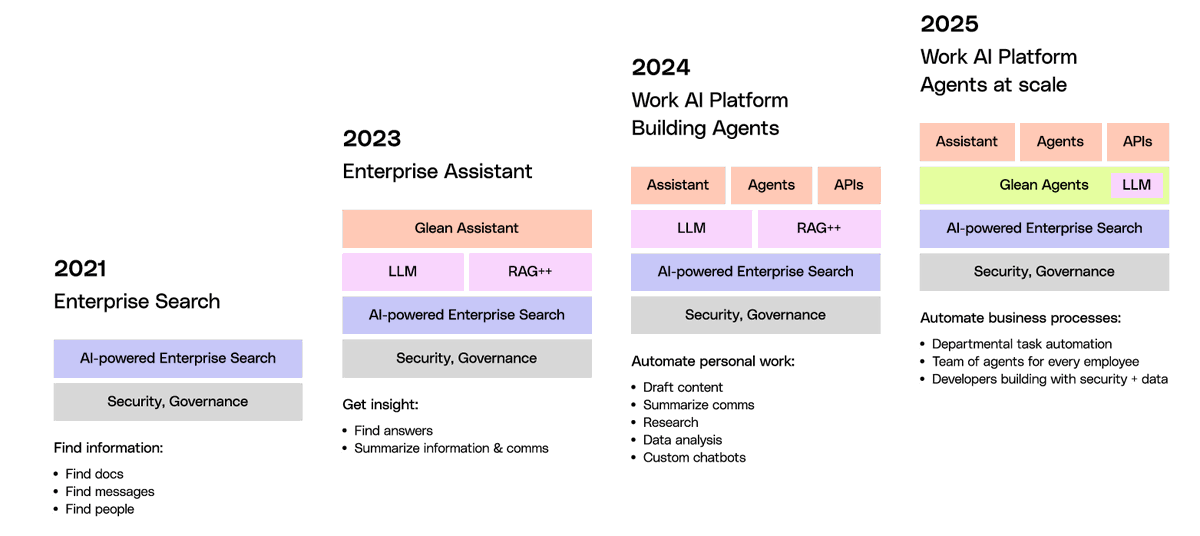
The progression in Enterprise AI Adoption is very clear and it follows the classic enterprise AI maturity curve:
2021: Retrieval (Search RAG foundations)
2023: Generation basic assistance (LLM Assistant)
2024: Early agentic capabilities (building agents for personal productivity)
2025: Scaled agent deployment (teams of agents, departmental automation, developer platform)
Each step adds more autonomy, scope, and coordination while layering stronger security/governance.
By 2026–2027, the winning Work AI Platform won’t just give you agents, it will give you a digital workforce that operates alongside (and sometimes instead of) human teams, with the platform acting as the operating system for both.
The logical continuation is end-to-end autonomous execution at organizational scale, where agents don’t just help or automate tasks, they run entire workflows, make decisions within guardrails, coordinate across teams, and continuously improve.
Key Characteristics of the Next Phase in Enterprise AI Adoption will be around these:
Agent Orchestration & Multi-Agent Systems:
A “team of agents” evolves into dynamic, hierarchical agent organizations. One agent decomposes a goal, spawns subtasks to specialized agents, handles handoffs, monitors progress, and reports/escalates.
Autonomous Business Process Execution:
Full end-to-end automation of complex processes (e.g., procure-to-pay, quote-to-cash, incident response, product launch workflows) with minimal human intervention.
AI Employees / Digital Coworkers:
Persistent, role-specific agents that act as “virtual employees” with goals, memory, tools, and performance metrics. Every human employee has a squad of AI agents reporting to them (and agents reporting to other agents).
Cross-Enterprise & Ecosystem Integration:
Agents that work across internal systems and external partners, suppliers, and customers (secure B2B agent protocols).
Self-Improving & Adaptive Systems:
Agents that learn from outcomes, suggest process improvements, and auto-optimize their own workflows.
Advanced Governance Layer: “Agent governance fabric” audit trails for every agent action, ethical alignment, compliance-by-design, human-in-the-loop escalation points, and AI risk management at scale.
Developer Citizen Builder Experience:
Low-code/no-code agent creation pro-code deep customization, with simulation/testing environments for agents before deployment.
Enterprises have moved from “find things” → “help me do things” → “do things for me at scale.”
The next unlock is trust capability to let agents run the business with humans in supervisory roles.
The bottleneck shifts from technology to governance, change management, and measuring ROI on autonomous work.
6


Procure um oftalmologista pq nao tem nada igual ai, o tom do cabelo e diferente, a cara era mais afinada, e olho que vc falou ser igual mudaram a pupilas, bonecas diferentes
1
13

Os comunistas saíram do seu c e dominaram sua mente ,procure um hospício urgente ,vc é um perigo para sociedade.
1

Eu não sou seguidor do bozo.
Eu conheço sim a verdadeira história desse canalha e tudo começa na ALERj, o senhor conhece? Procure saber, pois o muro da sua paróquia é muito alto fazendo com que o senhor não enxergue o que se passa aqui fora.
3

14m
A desculpa de que nunca matou e nunca roubou não será suficiente.
O diabo tbm nunca havia feito essas coisas e foi parar no fundo do inferno. Seja adulto, faça um exame de consciência de verdade e procure a confissão urgentemente.
 Jesus Is King
1
3
12
86

Evidentemente si è trattato di uno dei soliti teoremi campati per aria che caratterizzano le attività di un numero non trascurabile di Procure della Repubblica italiane.
2

des fois quand jv sur whatsapp je tombe sur la conversation avec ma daronne et ça me procure un sentiment tellement étrange
1
1
28
Le Procure della Repubblica possono ipotizzare ma non individuano i reati. È un Giudice che giudica. Questo principio è alla base di uno stato di diritto. Molti non riescono o non lo vogliono capire.
4

*The fixer accepts the cloak and nods.*
Thanks, ever since I woke up after an… incident, I looked like this. So I’ll try that paste and bolus if I can procure some.
*He swings the cloak over his shoulders and dons it with relative ease.*
Sorry if I asked a weird question-
1
2