
It’s an age envelope. Using Drand quicknet.
github.com/mpizenberg/cardan…
2
2
154

Hehehe ... even serieus: heb jij destijds Quicknet gebruikt? Van Sonera, dus? Later Chello en weer later UPC?
1
2
50


1e. Native VRF
Verifiable onchain randomness on MegaETH via DrandOracleQuicknet.
This is a preinstalled, stateless BLS12-381 verifier for the public drand quicknet beacon with Lottery demo based on @Zodomo's DrandVerifier implementation.
docs.megaeth.com/developer-d…
2
2
21
3,183

Apr 13
Introducing: fast drand VRF (experimental)
Superfast VRF for superfast chains
TLDR flow-
get randomness from drand quicknet every 3 seconds -> block time much less than 3 seconds (eg 100ms)? -> combine drand signature with block number and sign -> generate proof which can be verified by anyone -> supply randomness
The result- 30 independent random values (assuming 100ms blocks again) using the same drand round, all unpredictable since since they require the private key of the vrf to be generated
OK now for the explanation
drand is a distributed randomness beacon which provides verifiable, unpredictable, and unbiased randomness
Earlier, verifying BLS signatures onchain was an arduous task. However, since native precompiles for BLS12-381 were added in Ethereum's Pectra upgrade, it got easier. @Zodomo released a Solidity library just a few days back which helps in verifying drand signatures onchain. This codebase directly uses his library for it so massive thanks to him for building it out 🙏🙏
The only problem now was that drand quicknet's rounds span 3 seconds, which may be too infrequent for chains which have short block times eg. Abstract, MegaETH and RISE. I figured that since all these chains have a centralized sequencer anyway, maybe i could make use of the fact that there is a trusted party and delegate VRF functionality to it as well
What if we could use the result from drand every 3 seconds as input and somehow generate more random values in-between? And would it even be possible to keep them verifiable? Turns out the answer is yes and so that's what I did.
I implemented two patterns-
1. same-block randomness: meant to be run by the sequencer but not 100% desirable as a user may intentionally revert the transaction if the result is not in their favour. Only viable for eg a game contract modifying its own state autonomously based on randomness
2. delayed randomness: meant to be run by the sequencer if next-block randomness is required but can be run by any backend if next-to-next-block (or anything more than next-block) randomness is alright. This is what I'd recommend to anyone actually integrating it.
The trusted party adds random values according to the chain's respective block time (I tested locally with 2 second blocks) by combining the drand signature of the previous round and the block number of itself, signing it with its BLS12-381 private key and generating a proof for it. This proof can be verified by anyone since the drand signature and the block number are public information. However, no one can guess it as the VRF's private key is required for signing and that of course is, well, private.
Full disclosure- I too have used A LOT of AI for doing this code. Please treat this as experimental and take the necessary steps to audit this before using it in prod.
⚠️Massive caveat- if the private key of the VRF gets leaked, it's basically over. There is a function to rotate keys in the contract so it would be better to use that from time to time.
Do check it out and pls let me what y'all think. More details and steps to get it up and running all mentioned in the README and CLAUDE.md files 🫡🫡
2
1
7
712

Apr 6
I'm publishing DrandVerifier, a suite of EVM smart contracts that give your smart contracts access to a decentralized, tamper-resistant, and FREE source of randomness. No payments to Chainlink necessary.
I wanted something that was easy to implement, was provably random, and could not be influenced by the user or validators, all without me having to host any frontend or offchain infrastructure.
You can't generate true randomness using block hashes and timestamps, the user can always withhold their transaction until the result is favorable. You also can't rely entirely on RANDAO because validators can simply withhold their block and miss their slot, hoping the next one is more favorable even if its not theirs.
Chainlink VRF and solutions like it have traditionally filled this gap. You pay them in exchange for their decentralized network to calculate a random number and call back into your contracts, paying gas to execute whatever logic you perform with that number.
The problem is that it sucks to pay premiums to use these products. Chainlink charges a 20-24% premium on the gas consumed, depending on if you pay in their token. You're also beholden to them quoting what gas costs are. If you want to save 4%, you're also adding swap logic to your code or buying their token.
This also presented you with the problem of figuring out who pays these costs. The user? Now you also have to acquire quotes, more integration efforts, etc. If your app pays it, then it still needs to do all of that and generate funds too.
I wanted to figure out a solution where I could have it all. No central authority with influence over the number. Something that is extremely easy to integrate, and can work without me hosting a website or providing any tooling. Something that can't be censored. And something that was free. It had to be as easy as copy and paste.
That solution was drand. The readme for this project explains how everything works technically in great detail, but the gist is that through threshold cryptography, a committee of signers can collectively sign a value and this provides entropy in the form of that signature. Everyone collaboratively puts it together but nobody can predict the final result.
And you can just retrieve that value from the internet, for free, once it becomes available. Thus, that signature can be used as a free, provably random number. And it is as easy as your user copy and pasting values into your contracts, or having your website or relayers handle it too. All your code has to do is hash it.
I noticed the Ethereum Foundation was a drand participant, so I dug into the protocol, read the docs, and decided I wanted to use these values onchain for my purposes. I found some code in the randa-mu/bls-solidity library, but it wasn't usable how I wanted. So I designed this.
Both drand BLS networks (quicknet and default) are supported, even though I only intend to use quicknet. The evmnet version is not implemented as this uses a completely different signature scheme, and I wanted to use the new BLS precompiles shipped in Pectra.
Full disclosure, AI was used to help develop this, but I also used it to extensively audit the code too. I implemented as many test cases as I could think of. I personally believe it is good code, but do include this in your audit scope if you're getting one.
Randomness should cost no more than the gas to prove it.
milady
12
25
112
5,119

Mar 24
commscope.com/rapid-fiber-co…
$APH EXECUTIVE OVERVIEW
Rapid Fiber Connect is best understood as a passive optical infrastructure productization layer for AI clusters, not as a new optical transmission technology. The product packages rack-level fiber breakout, labeling, pre-termination, and inter-rack trunking into a factory-configured system intended to reduce installation time, reduce error rates, raise density, and move labor off the data-hall floor. The public launch occurred on March 24, 2026 at NVIDIA GTC 2026. CommScope positions the product for ultra-dense AI environments, especially deployments of 2 or more superpods, or 2,304 GPUs. The technical concept is credible and well aligned with current rack-scale AI architectures. The commercial profile is still early: orders were slated for Q2/Q3 2026 and lead times were still listed as TBD as production ramps. 
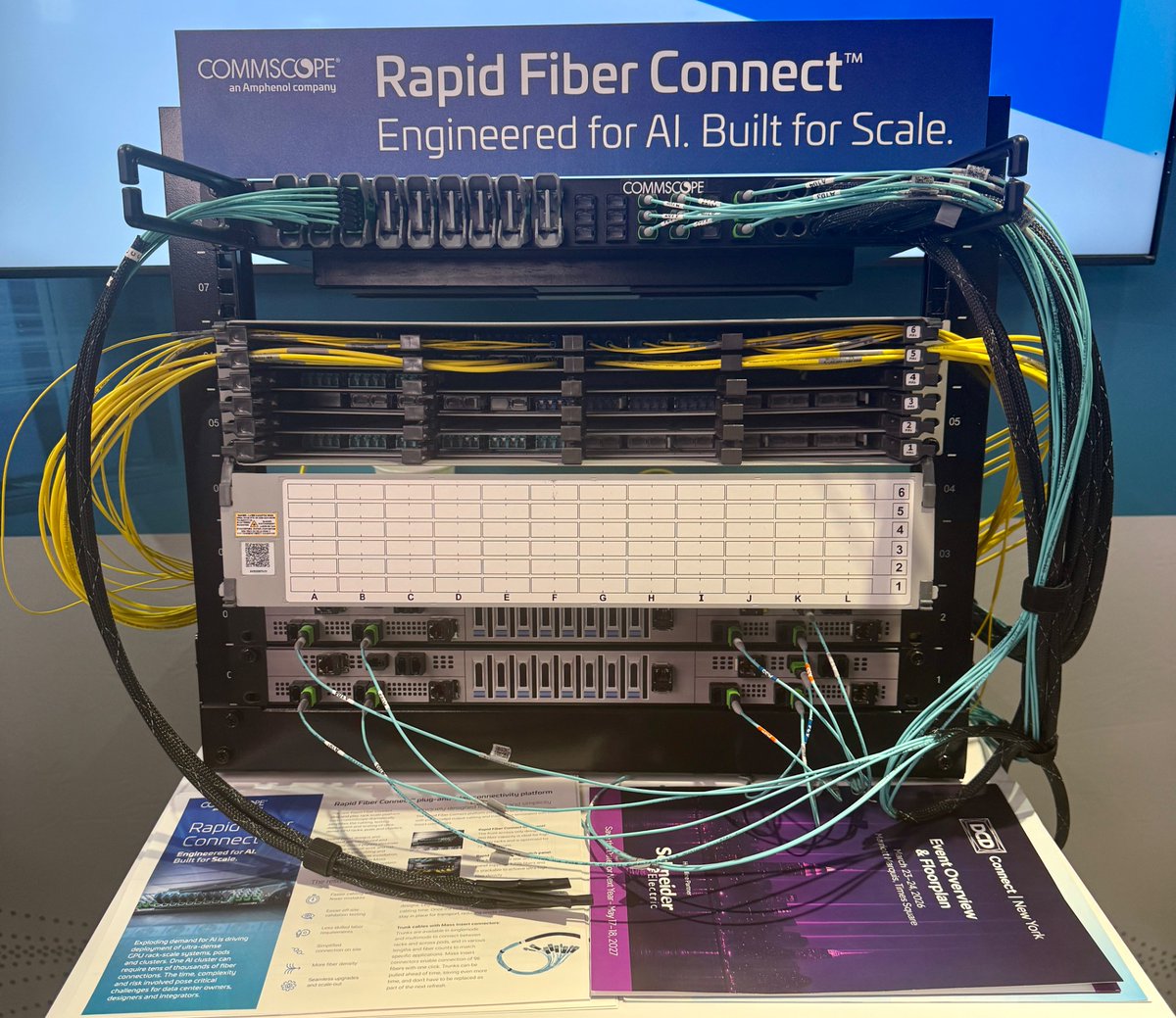
The exhibit photograph is consistent with that positioning. It appears to show a compact demo rack with a top front-access fiber breakout element, bundled aqua pigtails, yellow trunking, and a large labeled panel below that visually maps a high-count port population. The 12-column by 6-row labeling geometry in the silver panel is directionally consistent with CommScope’s documented focus on 72-GPU rack-scale systems, and the front-access orientation matches CommScope’s explicit design emphasis for dense racks where rear access can be obstructed by power and cooling hardware. 
LAUNCH TIMING
The cleanest launch read-through is that Rapid Fiber Connect was introduced publicly on March 24, 2026 at NVIDIA GTC 2026. CommScope’s launch blog described the platform as “globally-available” at the time of introduction, but the company’s FAQ separately stated that orders could be placed in Q2/Q3 2026 and that lead times were TBD while production ramps. The practical implication is that the product was unveiled and catalogized at GTC, but commercial ramp and supply normalization were still in early innings. 
WHAT THE PRODUCT IS
Rapid Fiber Connect is a rack-scale, plug-and-play platform built from 3 elements: a GPU-cabinet panel, a switch-cabinet panel, and a Mass Insert trunk cable that links the two. The platform is positioned as a “platform” rather than a single panel because CommScope intends it to support multiple rack configurations, connector schemes, and deployment phases as AI architectures evolve. The target buyer set is not generic enterprise networking. CommScope explicitly aims it at data-center operators, architects at chip vendors, OEMs, and systems integrators involved in building large AI clusters. 
From a technical standpoint, the product’s defining feature is that most of the complexity is shifted from on-site cabling to off-site integration. CommScope’s public collateral describes integrated, pre-configured, pre-labeled output pigtails, factory termination, and application-specific connector-leg mapping. The operational logic is straightforward: cable and validate the rack before it reaches the data hall, then use high-fiber-count trunk interconnects to connect whole racks or rack groups with minimal on-site manipulation. 
WHAT IT IS USED FOR
The core use case is dense optical connectivity between GPU cabinets and switch cabinets in AI pods and then between pods as clusters scale. CommScope states that 1 AI cluster can require tens of thousands of fiber connections. The platform is therefore aimed at the part of the AI network where cable count, connector count, labeling, and installation sequence become a gating factor to time-to-service. The ordering guide’s example topologies show 2 principal applications: connecting GPU cabinets to leaf switches inside a pod, and connecting AI pods together to build a large AI cluster. Multimode is described as typical for intra-pod connectivity, while singlemode is used between pods or, in some deployments, across the full environment. 
In other words, Rapid Fiber Connect is used to standardize the passive fiber layer between very dense compute racks and the network fabric. It is not replacing the active optics, switches, NICs, or the internal NVLink scale-up structure inside the rack. It is formalizing the rack-edge and rack-to-rack physical layer so that large numbers of similar AI racks can be rolled in, connected, and turned up with fewer discrete steps. That distinction is important because the economic value comes primarily from deployment speed, labor reduction, and error prevention rather than from changing network throughput or protocol performance. 
HOW IT IS USED
CommScope’s documented installation model is highly prescriptive. A Rapid Fiber Connect panel is preinstalled inside the GPU cabinet so that all GPU-facing fiber is already dressed and exposed at the rack edge through Mass Insert connections. A corresponding panel is preinstalled inside the switch cabinet, again exposing Mass Insert rack-level connections. A preterminated trunk cable is then used to connect the 2 racks. CommScope states that the in-rack connections can be validated at installation time, before the rack is placed in the data hall, reducing on-site fault isolation and late-stage rework. 
The labor-reduction mechanism is the Mass Insert interconnect. CommScope states that the trunk uses ganged MMC-based Mass Insert connectors, that 6 ganged MMC connectors allow 96 fibers to be connected with 1 insertion, and that the overall approach reduces rack-to-rack connectivity to 12x fewer clicks than individual MPO12/8 connectors. The company also notes that trunks can be pre-pulled and do not have to be replaced during the next refresh. For a hyperscale or AI-factory operator, that last point is strategically important because it implies that some of the pathway and trunk investment can remain in place even as compute racks are swapped out. 
The front-access design is also a non-trivial feature rather than a cosmetic one. CommScope explicitly argues that front-access GPU panels are advantageous in high-density racks where rear access is constrained by power and cooling. In the AI-rack context, that claim is credible. Rack-scale liquid-cooled systems have dense rear mechanical and service elements, and reducing rear-side fiber work should have real operational value. 
WHAT IT REPLACES
Functionally, Rapid Fiber Connect is intended to displace a combination of bespoke point-to-point MPO harnessing, generic patch panels combined with separate trunks and breakouts, some amount of labor-intensive field dressing and testing, and part of the traditional slack-management burden that arises when cable lengths are engineered late or inconsistently. That inference is supported by CommScope’s own description of factory-terminated, pre-labeled, off-site-validated assemblies, by CommScope’s older RapidFiber products that combined panel and stored cabling to simplify deployment, and by competitors’ framing of structured optical patching as an alternative to raw point-to-point cabling in large GPU clusters. It does not replace transceivers, switches, NICs, or the internal NVLink copper backplane inside rack-scale systems. 
A useful way to frame the substitution set is that Rapid Fiber Connect collapses multiple passive-layer tasks into a single SKU family tailored to a known rack architecture. In legacy environments, those tasks were often split across panel hardware, patch cords, breakout assemblies, trunk assemblies, labeling workflows, and on-site test/debug cycles. The product’s real ambition is to turn that bespoke integration problem into a repeatable manufacturing problem. 
COMPETITIVE LANDSCAPE
The closest direct competitor appears to be Corning. Corning launched GlassWorks AI on March 27, 2025 as an end-to-end AI data-center infrastructure portfolio and explicitly highlighted high-density cables, shuffle solutions, optical hardware, and MMC-based connector assemblies for dense AI racks. Corning’s data-center interconnect materials emphasize EDGE Rapid Connect and MMC connectors, citing 3x fiber density and a 40% reduction in cable outer diameter versus standard MTP solutions. Corning’s CORE-Trunks for AI are directly positioned around the same problem set: GPU-server-to-switch connectivity, inter-rack links, row-to-row patching, congestion reduction, and faster installs. Strategically, Corning is the most obvious head-to-head because it is attacking the same combination of density, preconfiguration, and AI-specific passive optical design. 
Panduit and Siemon are credible competitors, although their public positioning is somewhat more generalized around structured cabling for AI rather than the exact rack-scale product packaging that CommScope has chosen. Panduit’s NVIDIA AI application guide highlights HD Flex and QuickNet patch systems with 512 to 576 fibers per RU, and Panduit separately promotes Base-8 structured fiber for 400G and 800G AI networks. Siemon announced optical patching solutions for NVIDIA-based generative AI clusters in 2024 and explicitly argued that large GPU clusters benefit from structured patch panels rather than point-to-point cabling. Legrand is a broader competitor in high-density fiber infrastructure and AI data-center design, with Infinium fiber systems positioned for AI, hyperscale, and supercomputing environments, and case materials that claim meaningful reductions in fiber installation time. Relative to that set, CommScope’s differentiation is its emphasis on pre-integrated rack-scale assemblies and Mass Insert inter-rack mating rather than a more general high-density structured-cabling toolkit. 
A second, less visible competitive category is custom in-house harnessing by hyperscalers, OEMs, and systems integrators. CommScope’s own FAQ identifies those entities as core design participants. In the largest AI builds, some operators will continue to prefer internally specified, topology-specific cabling and panelization if that yields a lower cost or tighter fit to a proprietary rack or network design. Rapid Fiber Connect’s strongest competitive position is therefore likely in environments that value repeatability and fast deployment more than absolute customization. 
ROLE IN A GIGAWATT-SCALE GENERATIVE AI DATA CENTER
The relevance of Rapid Fiber Connect becomes clearer when placed against current AI-factory rack densities. NVIDIA’s DGX SuperPOD GB300 reference architecture describes each scalable unit as 8 DGX GB300 rack-scale systems with a total TDP of 1.2 MW. The same reference architecture shows sample designs scaling to 128 racks and 9,216 GPUs, while NVIDIA’s GB300 product materials state that each DGX GB300 system contains 72 GPUs, 72 ConnectX-8 SuperNICs at up to 800 Gb/s, and 18 BlueField-3 DPUs. NVIDIA’s rack documentation also shows that each NVL72 rack contains 18 compute trays and 9 NVLink switch trays. At those densities, the number of optical endpoints and the operational difficulty of cable bring-up become large enough that passive-layer industrialization can matter materially to deployment velocity. 
In a gigawatt-scale generative AI campus, the product would sit in the repeated, factory-like replication layer of the buildout. It would be used to pre-integrate compute racks and switch cabinets off site, accelerate intra-pod GPU-to-leaf connectivity, standardize pod-to-pod optical pathways, and reduce the number of manual connector operations performed by field crews. The product is especially well matched to environments where racks are standardized, liquid cooled, and deployed in large waves, because its economic benefit compounds with repetition. That logic also lines up with NVIDIA’s broader framing of future “gigawatt AI factories,” including open rack standards and 800 VDC power architectures, where reducing floor disruption and simplifying assembly are strategic priorities rather than minor installation conveniences. 
CommScope’s own materials make the intended role explicit. The ordering guide shows multimode trunks connecting GPU cabinets to leaf switches inside a pod and singlemode trunks connecting pods to spine and core layers. The launch blog also describes a recommended “shuffle” implementation in which Rapid Fiber Connect is used at the GPU cabinet, a Mass Insert MMC bundled array is used between GPU and switch cabinet, and CommScope Propel Shuffle modules apply the shuffle at the switch cabinet. That matters because multi-plane and shuffled network topologies are increasingly central to scaling AI fabrics efficiently, so Rapid Fiber Connect is not limited to simple straight-through rack interconnects. It can also be inserted into more advanced AI-fabric topologies as the rack-edge connectivity layer. 
TECHNICAL VIABILITY
The technical case is strong. The product aligns with the underlying direction of the connector ecosystem, especially the shift toward smaller-footprint multi-fiber connectors. US Conec describes MMC as a very-small-form-factor multi-fiber connector for both singlemode and multimode, highlights a robust ecosystem, and cites greater than 3x density versus MPO. CommScope’s own materials show the platform is already designed to support both singlemode and multimode, and the ordering guide indicates output options spanning MPO8, MPO16, MMC8, and MMC16. That flexibility is important because the physical layer around 800G and 1.6T optics is still evolving, and a rigid connector scheme would materially limit the product’s life. Rapid Fiber Connect appears to have been designed to avoid that trap. 
The product also appears to be beyond concept stage. CommScope’s base-product and item pages already list specific variants, including an NVL72 GPU-cabinet panel and higher-RU switch-cabinet panels, with global regional availability tags across Asia, Australia/New Zealand, EMEA, Latin America, and North America. That SKU-level catalogization is meaningful because it indicates a product family that has progressed into commercial configuration logic rather than a one-off trade-show mockup. 
RISKS AND LIMITATIONS
The main limitation is that public proof remains early and mostly vendor-authored. The reviewed public evidence base is concentrated in CommScope launch materials, FAQs, ordering guides, and product pages rather than public customer case studies or third-party field validation. That does not invalidate the product, but it does mean the current investment case rests more on architectural logic than on demonstrated adoption scale. The Q2/Q3 2026 order timing and TBD lead times reinforce that the product should be viewed as an early-ramp offering, not as a fully de-risked volume franchise. 
The second limitation is that the product’s economics are unlikely to be uniform across the market. Rapid Fiber Connect should be most attractive in large, repeated, standardized builds. In smaller deployments, or in environments where rack design and optical topology are still changing late in the cycle, generic structured cabling or even point-to-point harnessing may remain more flexible or cheaper. CommScope itself targets the product at clusters of 2 or more superpods, which implicitly acknowledges that the ROI threshold depends on scale. 
The third limitation is physical integration and operational discipline. At least 1 listed 2RU switch-cabinet SKU is 34 in deep, which underscores that this is a rack-integrated assembly rather than a shallow commodity patch panel. That will fit AI racks designed for such assemblies, but it should not be assumed to be universally drop-in. In addition, high-density multi-fiber systems place a premium on inspection, cleaning, and connector-handling discipline. CommScope’s product page links to connector-cleaning instructions, and US Conec publishes specific MMC adapter cleaning and installation documentation. High density simplifies macro-installation, but it can increase the operational penalty for contamination or mishandling. 
A fourth diligence item is optical budget. Siemon’s NVIDIA-focused materials note that NVIDIA optical reach assumptions contemplate 2 optical patch panels and 4 connectors in the link. That is not a CommScope-specific criticism, but it is the right technical lens. Any structured cabling layer inserted between GPU and switch must preserve sufficient channel margin across connector count, insertion loss, contamination risk, and future transceiver changes. Rapid Fiber Connect’s technical viability therefore depends not only on installation speed but also on disciplined channel engineering for each reference architecture. Public materials support the architectural concept, but detailed loss-budget validation remains a critical deployment-level diligence point. 
OVERALL VIABILITY ASSESSMENT
Rapid Fiber Connect appears viable as a real product and as a rational response to the operational bottlenecks of modern AI rack deployment. The product is well aligned with 72-GPU rack-scale architectures, with AI pod construction, and with the broader move toward industrialized AI-factory deployment. The strongest aspects of the proposition are fewer on-site connector operations, higher rack-edge density, off-site validation, and reduced dependence on scarce field labor. The weakest aspects are early-stage commercialization, limited public adoption evidence, and the need to prove repeatable execution across varying customer architectures. 
For investment purposes, the product should be viewed less as a standalone revenue event and more as a strategic indicator of whether CommScope can convert from a broad passive-connectivity supplier into an AI-specific infrastructure design partner. The right metrics to monitor are design wins with OEMs and systems integrators, evidence of inclusion in NVIDIA- or AMD-adjacent reference builds, normalization of lead times, publication of customer deployments, expansion beyond the current 72-GPU optimization point, and bundle attachment into the broader CommScope stack, including FiberGuide, Propel, and optical distribution products. If those indicators develop, Rapid Fiber Connect could become an important wedge into higher-value AI infrastructure content. If they do not, the product may remain a technically sound but commercially niche specialty platform. 
5
21
3,860

Se llama Quicknet. Me parece que son nuevos pero literal era el único disponible en mi edificio y la atención 100/10 y me instalaron apenas les escribí
1
127
Se llama Quicknet. Me parece que son nuevos pero literal era el único disponible en mi edificio y la atención 100/10 y me instalaron apenas les escribí 😂
3
121



24 Dec 2025
Seeding Event Details:
Chain: Quicknet
Target Round: 24620212 (Available at Dec 25th 12 PM UTC: codepen.io/Apollo2025/full/M…)
Draw Verifier: codepen.io/Apollo2025/full/B…
2
5
7
815

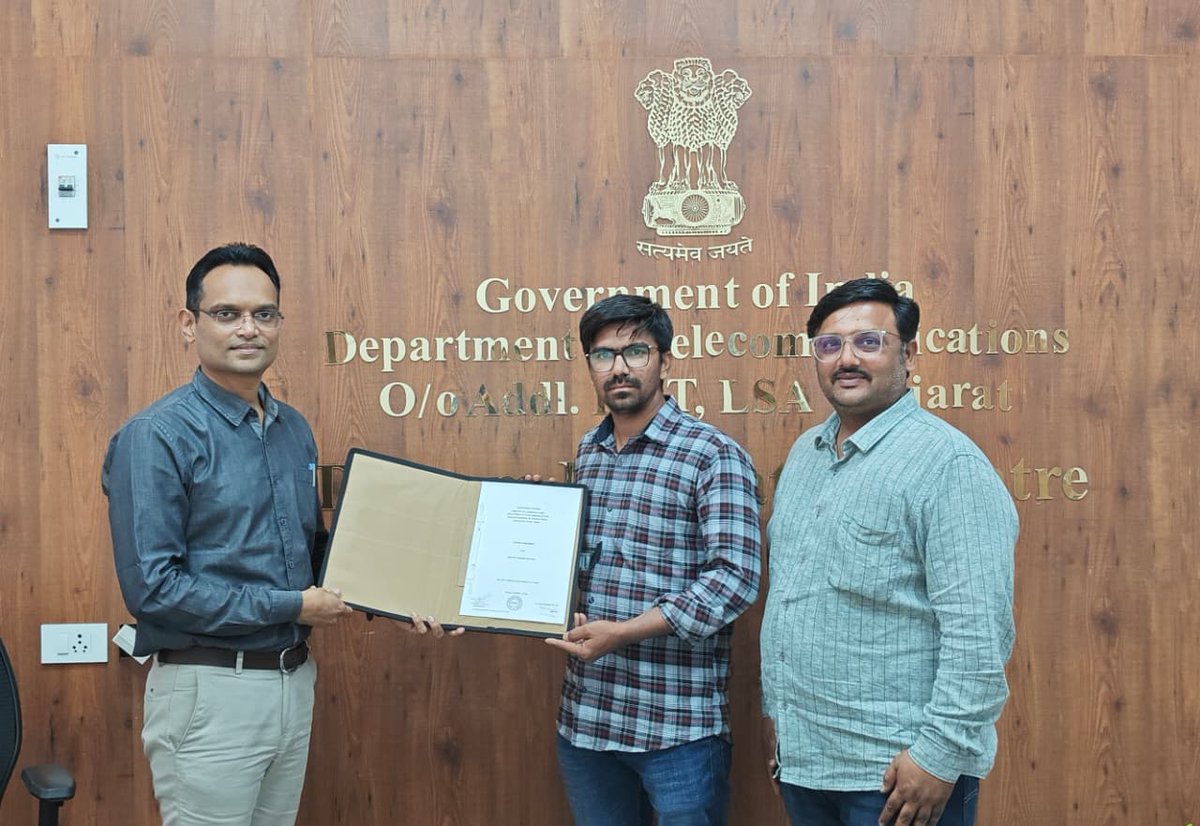
DoT Gujarat LSA facilitated and issued Cat-C Internet Service Provider License-VNO to M/s Alive Quicknet Pvt Ltd. They were made aware about the various licensing terms and conditions and PM WANI framework. DoT wishes them all the best in their venture to provide Internet services.
#संचार_से_समृद्धि
#संचार_से_सशक्तिकर

8
9
280

10 Nov 2025
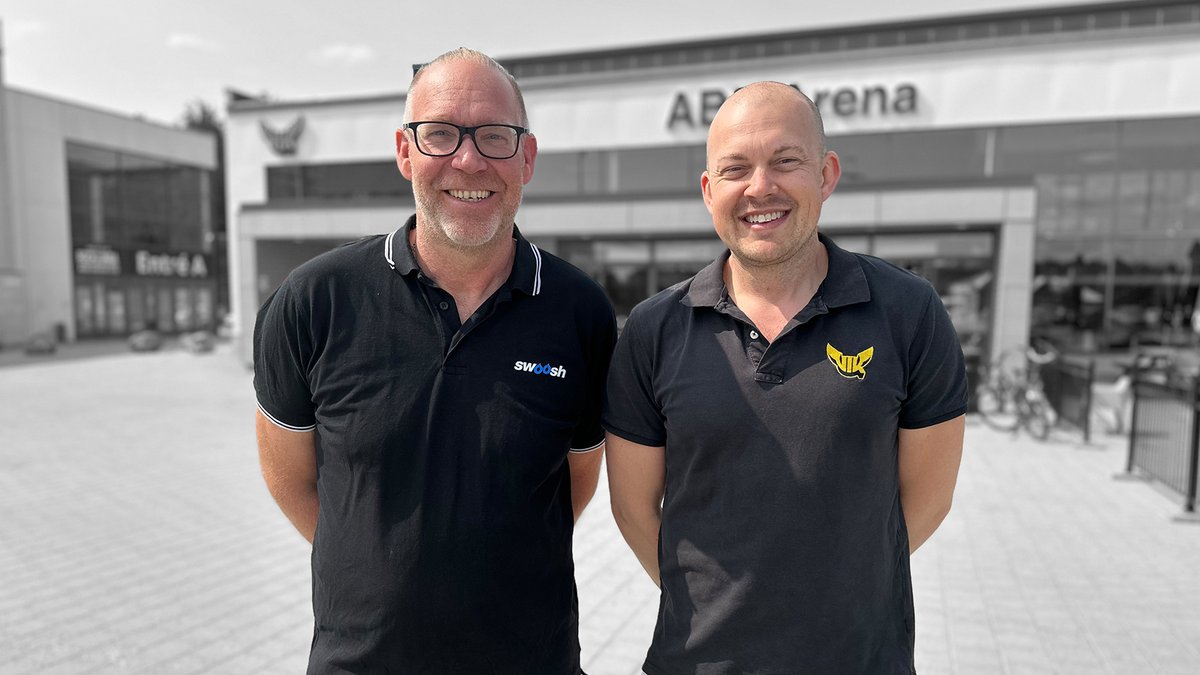
Vi är klara som Silverpartners till Västerås IK 💛🖤
✅ Försäkringsrådgivarna Mälardalen
✅ Swoosh
✅ QuickNet
Läs mer på VIK.se


2
30
1,533

20 Sep 2025
Quicknet privilegia la atención a los clientes para destacar en el sector de telecomunicaciones
mundour.com/2025/09/20/quick…
1
1
323

15 Sep 2025
good day 🌷
How to change your postpaid SIM card - Sawa - QuickNet via the mystc app
Go to "More" ◄ Click on the "Manage Numbers" option ◄ Click on the SIM card you want to change ◄ Click on the "Change Your SIM" button
have a nice day 💜
1
73

20 Jul 2025
🏴☠️ Love gaming? Have you tried Pirate Nation yet? This next-generation blockchain game is now accessible thanks to @arbitrum Orbit technology!
@ProofOfPlay has created something revolutionary in the Web3 gaming space. Led by visionary CEO @amittm (former Zynga veteran with experience building games for 100M players), the team has successfully launched Pirate Nation - a fully onchain pirate adventure that's been sailing the digital seas for over a year now.
What makes this game special?
It's a high seas adventure where players collect pirates, send them on quests, gather materials for crafting, discover treasures, and earn pirate gold! Your pirates gain experience and level up through their adventures, creating a true progression-based RPG experience.
But here's the kicker - everything is 100% onchain, meaning you truly own your assets and the game will exist forever as long as the blockchain does.
One of the most impressive technical achievements is their Verified Random Number Generator (vRNG). For anyone familiar with blockchain development, creating truly random numbers onchain is notoriously difficult - even pseudorandomness presents challenges. The Proof of Play team has done exceptional work here, serving over 100 million random numbers with lightning-fast delivery (as fast as 900ms on their chains) and handling up to 1.5M transactions per day during peak usage.
They use drand's quicknet for verification, ensuring the randomness is both secure and auditable.
The game initially launched on Polygon but migrated to Arbitrum Nova due to scaling challenges and high gas costs, and now runs primarily on their own Proof of Play Apex chain built with Arbitrum Orbit technology. This multi-chain approach, powered by Arbitrum Orbit, allows for massive scalability while maintaining the security and decentralization that makes onchain gaming possible.
With $33M in funding from heavyweight investors, Proof of Play is well-positioned to continue innovating.
Their vision goes beyond just one game - they're building an entire platform for fully onchain applications with services like Token Mirroring and upcoming NoSQL databases for developers.
The roadmap ahead looks exciting with new features, expanded gameplay mechanics, and continued technical innovation. This isn't just another blockchain game - it's a glimpse into the future where players truly own their gaming experiences and communities can thrive independently of centralized control.
Ready to set sail? 🏴☠️⚓️

19 Jul 2025

🧵 DEEP DIVE: USDai - The Synthetic Dollar Revolutionizing InfraFi
@USDai_Official dropped their private beta and it's looking spicy
This isn't your typical stablecoin - it's a yield-bearing synthetic dollar backed by REAL infrastructure: AI hardware, compute, energy & telecom assets
Targeting 15-25% APR while staying pegged to $1
Built different ⚡
19
31
1,378

7 Jan 2025
Cambien a quicknet, rápido y nunca se guinda , y a precios accesibles
2
2
158

26 Aug 2024
Tanda - Tanda " PERGESERAN "
Mulai dari Loyalisnya Mulyono Digeser Kebelakang
Antre Jabatan Anggota Kabi quicknet
😂😂🤣😂🤣😂🤣😂
2
7
23
1,551


Entre el luto por mi abuela, las deudas, colaborar para la casa, los constantes reclamos de cierta gente y la total falta de SERIEDAD y COMPROMISO de Quicknet para instalar el maldito servicio que lleva firmado desde el 6 de JUNIO estoy muerto de la arrechera chamo.
3
4
155