

Well habibi a lot of people are entering the e-commerce space without realizing that conventional dropshipping, in its standard form, violates foundational principles of Islamic trade (Fiqh al-Muamalat).
The baseline rule in Islam is simple: You cannot sell what you do not own or possess.
In conventional dropshipping, a customer buys an item from your website, you take their money, buy it from a third-party supplier (like AliExpress), and the supplier ships it. At the moment of sale, you do not own the product, you do not possess it, and you have no control over its delivery.
This introduces Gharar (prohibited risk/uncertainty) because the supplier could run out of stock, change the price, or send a defective item, leading to consumer deception.
Have Highlighted The Scriptural Evidence on this bellow:
The Hadith of Hakim ibn Hizam (RA): He asked the Prophet (ﷺ) if he could sell an item to a customer and then go buy it from the market. The Prophet (ﷺ) explicitly told him: "Do not sell what you do not possess." (Tirmidhi 1232, Sahih)
The Hadith of Abdullah ibn Amr (RA): The Messenger of Allah (ﷺ) said: "...It is not permissible to make a profit on something you do not guarantee (bear risk for), nor to sell what you do not possess." (Tirmidhi 1234, Sahih)
The Halal Workarounds and alternatives :
Islam does not close a door without opening a pure alternative. You can make an e-commerce model identical to dropshipping 100% Halal by restructuring your legal contract using two established Islamic frameworks:
1. Bay’ as-Salam (Forward Sale Contract) and I taught this last month at Westlands Mosque don't miss the lectures every Sunday after Maghreb
Bay' as-Salam This is an explicit exception permitted by the Prophet (ﷺ) where a buyer pays 100% upfront for a standardized product to be delivered in the future. To use this legally:
The item must be a standard commodity with exact, guaranteed specifications (size, model, color).
Crucial Part: You must take full financial and legal liability. If the supplier fails, delays, or sends a defective item, you are personally responsible for the refund or replacement. You bear the risk.
Evidence: The Prophet (ﷺ) allowed advance payments for agricultural goods in Medina, stating: "Whoever pays in advance for anything, let him pay for a specified measure... to be delivered at a specified time." (Bukhari 2240).
2. Wakalah (The Agency Model) — Highly Recommended
Instead of pretending to be the independent "seller" of an item you don't own, you change your legal relationship with the supplier.
You sign an agency contract (Wakalah) with the wholesaler or factory, making you their authorized marketing/sales agent (Wakeel).
You display their products on your site. When a sale happens, you are legally selling on behalf of the supplier. Your profit is a pre-agreed commission or percentage markup for your marketing service.
The Bottom Line is:
Do not sell an item you have no right to or control over.
Either sell a guaranteed specification while absorbing 100% of the risk (Salam), or sell as a legally recognized agent for the supplier (Wakalah).
May Allah bless our businesses and keep our wealth pure and Halal.
Jun 7

Sheikh @Sh_Ibrahimkhan
Please enlighten us more about dropshipping in Islam.
Many people say it is kind of okay, whilst in Islam you cannot sell what you do not have on you.
Kindly share your thoughts.
7

1) what % of his wealth do you think is due to DOGE restructuring ? As in excess $$ that wouldn’t have been forwarded to him had he not created DOGE.
2) What do you drive..? Tesla is 100% a status symbol.
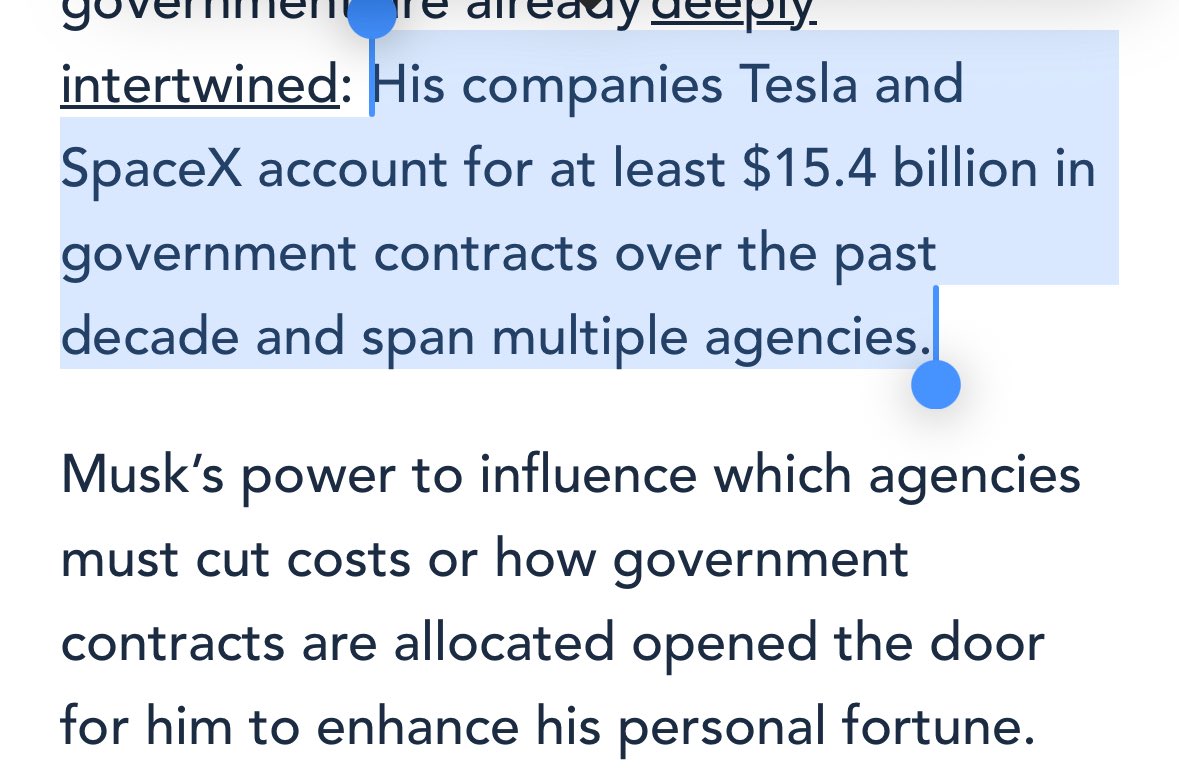

1. Staying employed for 25 years at the same company is an achievement nowadays
2. Staying employed and at 25 years get to become a billionaire form that company instead of layoff because AI restructuring is UNHEARD OF
4

This seems a good place to start, though I would pair it with complete restructuring of a bloated and wasteful MoD and the return of the admiralty to stop sea blindness

Since the defence of the nation is one of the core missions of an elected government, here is my solution for giving our armed forces sufficient funding.
FUND THEM FIRST.
They get first dibs at the budget, then everyone gets to fight over what is left.
Job done.
1
Badru Abdul Rafiu retweeted

Jun 13
The restructuring by Tinubu flys over everyone’s head because Nigerians are not that smart after all and don’t know what their real problem is. That’s why I laugh so hard when people say Obi is not good enough and then his supporters say “who is better” 😆
 TallJohn🌍
6
86
224
9,199
No One (Noone) retweeted

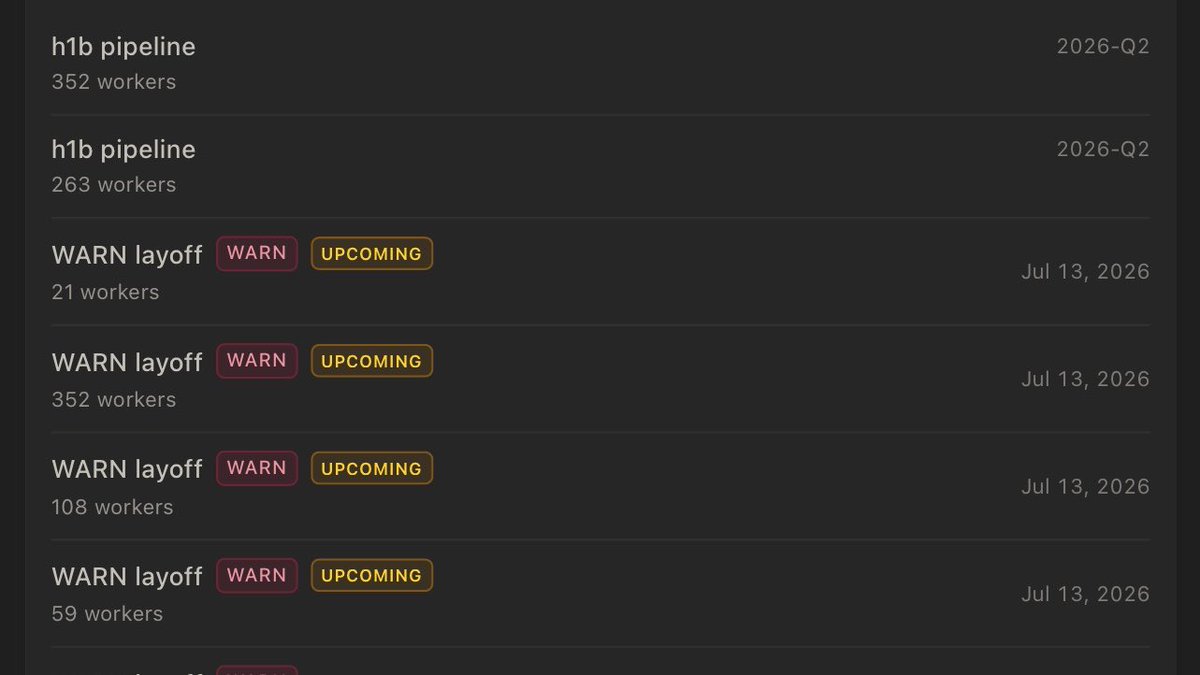
Look at the math: 540 Americans fired, 615 H1Bs brought in. That isn’t restructuring, that’s a liquidation of Americans forced into poverty with a stroke of a pen. Shapero is actively erasing Americans from the economy to make room for a foreign workforce. They aren’t hiring for skill; they’re hiring for compliance and lower costs, using H1B cartels to dismantle the domestic labor market. Anyone calling this business as usual is choosing to ignore that these CEOs are declaring war on the American people.
Jun 12

🇺🇸 LinkedIn CEO Dan Shapero plans to fire 540 Americans on July 13, 2026. He filed for 615 H-1B visa hires in Q2 2026.
Dan was appointed CEO in April. He is already executing a clear strategy to replace American workers.
$CUTOFFS

14
158
348
4,069

文献はコチラから_Impact of public hospital restructuring on the admission of elderly residents in Japan: a regional population-based study
link.springer.com/article/10…
7


The work that actually moves AI citations is boring. I wish I had a more exciting answer. I do not. It is restructuring pages you already published, fixing the same description in twelve places, and earning third-party mentions one slow email at a time. The boringness is the whole point.
Let me be precise about a distinction most people skip. This work is not hard. It is boring. Those are different problems. Hard work is under-supplied because people cannot do it. Boring work is under-supplied because people will not do it. The second gap is easier to exploit, because the only thing it asks of you is willingness.
What the work actually looks like, and why each part is boring.
1. Restructuring pages you already published. Not writing new ones. Going back into content that already exists and rebuilding it so a model can extract it cleanly. It feels like going backwards. There is no publish-day dopamine. You are improving something that already shipped, which feels like admitting the first version was incomplete. Teams avoid it because new content feels like progress and editing old content does not. The citations do not care how it feels.
2. Keeping your entity description consistent everywhere. The same clear sentence about what you do, identical across your homepage, your G2 profile, your LinkedIn, your Crunchbase, your docs. This is pure admin. It is updating the same text in twelve places and checking it again next quarter. Models build confidence from consensus, and consensus starts with you describing yourself the same way in every place you appear.
3. Earning third-party mentions one at a time. Not a campaign. Not a blast. Individual, slow, low-hit-rate outreach to publications, communities, and reviewers, most of whom ignore you. The wins arrive weeks apart. There is no dashboard that lights up. It is the least scalable-feeling work in marketing, and it is the work that builds the consensus AI systems read as truth.
4. Waiting. After the work is done, propagation takes weeks. Indexing catches up slowly. During that window, the urge to do something, to add a new initiative, to declare the approach broken, is the enemy. The discipline is to do nothing new and let the work you already did compound. Doing nothing, on purpose, is the hardest boring thing on this list.
None of this is clever. That is why it is still available.
Everyone in your category wants the framework, the tool, the launch. Almost nobody wants to restructure 40 pages, fix the same bio in twelve places, send the fortieth outreach email, and then wait. The moat is not talent. It is willingness.
The exciting work is crowded. The boring work is empty. Go where it is empty.
14

Revolt, restructuring and raids: What’s next for Mamata Banerjee-led Trinamool Congress? financialexpress.com/india-n… via @FinancialXpress
5

Ukraine continues restructuring its linguistic and administrative space.
Language policy is now part of wartime state consolidation strategy.
👉 empr.media/politics/ukraine-…
1
4
887

Exactly want we need in our midfield Tactics, creativity and visionary Midfielders. It needs restructuring must of this guys won’t be there in the next World Cup.
21

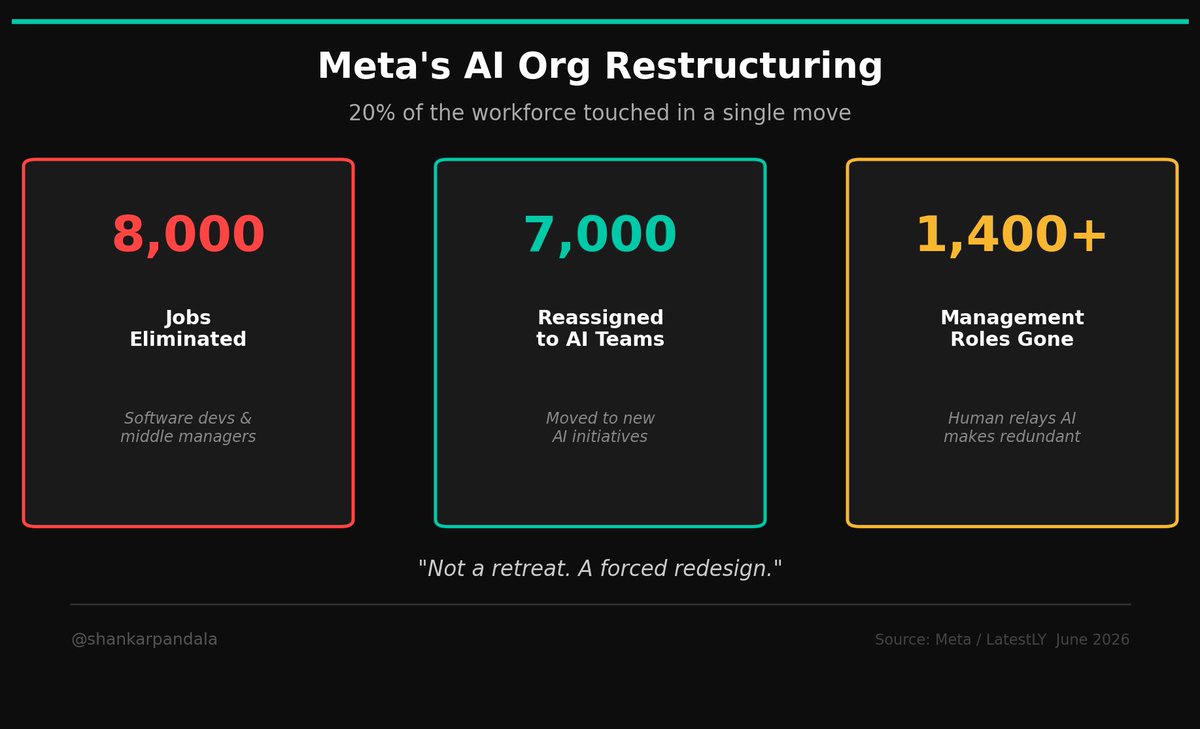
Meta cut 8,000 jobs and moved 7,000 to AI teams in a single restructuring.
That's 20% of the org touched in one move.
Most headlines call it layoffs. The real story is different. 🧵
1
1
7

37m
The mix of new launches and restructuring shows how dynamic the space continues to be.
5

No, the full $2 billion was not returned to the U.S. Treasury.
nytimes.com
The Biden-era EPA awarded the grant in 2024 (via the Inflation Reduction Act's Greenhouse Gas Reduction Fund / National Clean Investment Fund) to Power Forward Communities (a coalition of nonprofits including groups tied to Rewiring America, where Stacey Abrams served as senior counsel/adviser until late 2024). The Trump administration, under EPA Administrator Lee Zeldin, took aggressive action in early 2025:February 2025: Zeldin publicly demanded the return of ~$20 billion in similar "green bank" grants, calling them wasteful. Citibank (the financial agent) froze the accounts, with FBI input.
storage.courtlistener.com
March 2025: EPA issued a formal termination notice citing concerns over program integrity, fraud/waste/abuse risks, oversight failures, and misalignment with priorities. The group had reported only ~$100 in revenue in 2023.
storage.courtlistener.com
Current Status (as of mid-2026)The bulk of the funds remained frozen at Citibank and have not been disbursed for major projects. Power Forward Communities announced some early commitments (e.g., ~$539 million in awards for housing decarbonization), but these were largely stalled.
msn.com
A small initial tranche (~$9.5 million total disbursed by end of 2024, with over $5 million going to Rewiring America as an organization) was received before the freeze. No evidence shows this was clawed back.
t.co
Ongoing litigation: Power Forward Communities and other recipients sued EPA and Citibank. A district court issued a temporary restraining order/injunction, but the D.C. Circuit Court of Appeals (in September 2025) largely sided with EPA, vacating parts of the lower court's block and affirming the agency's authority to terminate. The case is still unresolved or in further proceedings as of early 2026; grantees have faced staff cuts and restructuring.
news.bloomberglaw.com
Zeldin and the EPA have described the grants as canceled and part of broader efforts to stop/recover ~$29 billion in prior-administration funding. However, full recovery to the Treasury is tied up in court battles, and not all money has been formally returned yet.
epa.gov
In short: The grant was terminated and mostly blocked from being spent, but due to legal challenges, the funds haven't been fully clawed back or reallocated. This remains a contentious, ongoing process.
7 web pages
10


Danaher's ($DHR) $9.9B Masimo Bet: Business, Deal, and the Case For and Against
Danaher is a roughly $135 billion global life sciences and diagnostics holding company that operates a portfolio of specialized brands across three segments. Its Diagnostics business (Beckman Coulter, Cepheid) sells the instruments and chemical assays hospitals and labs use to test for disease; its Biotechnology business (Cytiva, Pall) makes the filtration tools and consumables pharmaceutical companies need to manufacture biologic drugs and vaccines; and its Life Sciences business (Leica Microsystems, SCIEX) supplies high-end research instruments like advanced microscopes and mass spectrometers. The engine tying it together is the Danaher Business System, a lean-manufacturing and continuous-improvement framework Danaher imposes on companies it acquires to cut waste, optimize pricing, and expand margins.
In February 2026 Danaher agreed to acquire Masimo, a leader in non-invasive patient monitoring and pulse oximetry whose technology continuously tracks vital signs at the bedside in acute and cardiovascular care. The deal closed June 10, 2026 at $180 per share, an enterprise value of about $9.9 billion, with Masimo running as a standalone operating company inside Danaher's Diagnostics segment. Danaher is targeting more than $125 million in annual cost synergies and more than $50 million in revenue synergies by year five. The timing was good: Masimo had just been through a bruising proxy fight in which activist Politan Capital won board control and ousted founder Joe Kiani in late 2024, leaving the company unsettled and ripe for the kind of operational restructuring Danaher specializes in.
The upside case is that Danaher combines Masimo's continuous, real-time vitals streaming with its existing static laboratory diagnostics, then layers predictive AI on top: letting hospital networks flag patient deterioration or sepsis hours earlier and giving Danaher a dominant position across the full continuum of acute-care patient data. Applying the Danaher Business System to a recently rudderless Masimo should also lift margins meaningfully. The downside case is that this remains a thesis. It is still not a delivered product: the lab-plus-streaming AI integration is years of work away and may not materialize as cleanly as the pitch suggests. Masimo also carries a consumer audio business (Sound United) that doesn't fit and likely needs to be divested, integration of a company fresh off a leadership war carries culture and execution risk, and at ~$9.9 billion Danaher is paying a full price that demands the synergies actually show up.
Masimo's revenue now comes almost entirely from its core healthcare business, following the September 2025 sale of its Sound United consumer audio division to Harman International for $350 million. On a continuing-operations basis (i.e., healthcare only), Masimo guided to roughly $1.51–1.53 billion in 2025 revenue, up about 8.5–10% in constant currency. That healthcare revenue is dominated by non-invasive patient monitoring: the SET pulse oximetry and rainbow technology that continuously tracks oxygen saturation and other vital signs at the bedside, sold primarily into hospitals and acute/cardiovascular care units. The model is heavily recurring: Masimo places monitoring hardware with hospitals and then earns durable, high-margin revenue from the single-use sensors and consumables those devices require, supplemented by hospital automation and connectivity products. (For context, 2024 consolidated revenue was about $2.09 billion, but that figure included the now-divested Sound United audio business of roughly $699 million, so it isn't comparable to the slimmed-down company Danaher acquired.)
For educational purposes only.
69

49m
Sorry Ellen
You are still you
And your shame is within
Get help
No amt of physical restructuring can eliminate it
BTW you don’t look happy AT ALL
Why not be honest and tell us who the evil men in Hollywood are who damaged you so severely
The truth will set you free

5