내힘들다 retweeted

the SFG & 160th putting on a show SOFIC
1
24
271
8,665

Jun 3
L3Harris F-PANO: The Most Advanced Night Vision Goggle Ever Built
Four tubes. Thermal fusion. ATAK battlefield data overlay. Live ISR feeds streamed directly to your eye. The F-PANO is not an upgrade to the GPNVG-18 quad-tube system that defined a generation of SOF night operations. It is a different category of device.
HOW NIGHT VISION WORKS
Before explaining what makes the F-PANO extraordinary, it helps to understand what night vision goggles actually do — because most people's understanding comes from green-tinted movies, and the reality is considerably more interesting and technically sophisticated.
Image Intensification (II) — the classic approach. A conventional night vision goggle works by collecting the tiny amounts of light that exist even in apparent darkness — moonlight, starlight, ambient urban glow — through a lens, and then amplifying that signal through an image intensifier tube. Inside the tube, photons hit a photocathode, release electrons, those electrons are accelerated and multiplied through a microchannel plate, and the resulting signal hits a phosphor screen that produces the image the operator sees. The classic green image colour comes from the phosphor screen. Modern systems use white phosphor, which produces a greyscale image that the human visual system processes faster and with more detail than green phosphor.
Thermal imaging (LWIR) — the second sensor. Thermal cameras detect infrared radiation — heat — emitted by objects rather than reflected light. A human body at 37°C emits thermal radiation that a thermal imager can detect against a cooler background. Thermal imagers work in total darkness, through smoke, through light rain, and through most conventional camouflage, because they are detecting the object's own heat output rather than relying on reflected light. The limitation of thermal imaging is that it provides less detail than II — you see a clear heat signature but less structural detail and texture.
The fusion concept. If you overlay thermal imagery on top of image intensification, you get the best of both: the detail and resolution of II with the all-conditions heat detection of thermal. A target that would be invisible to II in complete darkness — because there is no light to amplify — shows up as a thermal signature. A target that is camouflaged against a background — cold, dressed to defeat thermal — still appears in the II image. Fused sensors are harder to defeat than either sensor alone. This fusion concept is the core of what makes the F-PANO different from everything that came before it.
THE F-PANO SENSOR STACK — WHAT THE OPERATOR SEES
II IMAGE (BASE)Amplified ambient light — white phosphor greyscale. Full resolution. Shows terrain, structures, faces, equipment detail.
THERMAL OVERLAYLWIR heat detection overlaid on the II image. Human bodies, vehicle engines, and warm weapons glow against cold backgrounds. Works in zero visible light.
ATAK OVERLAYAndroid Tactical Assault Kit data displayed in the field of view — friendly force positions, objective markers, waypoints, and operational data without looking away from the environment.
ISR FEEDLive imagery from drones, aircraft sensors, and other battlefield systems streamed via Intra-Soldier Wireless Network directly into the goggle. See what the overhead drone sees, in your goggle, in real time.
FROM MONOCULAR TO PANORAMIC — THE NIGHT VISION EVOLUTION
The F-PANO is the latest step in a progression of night vision technology that has moved from a single tube monocular to a fully networked panoramic sensor fusion system over four decades. Understanding the progression helps clarify why the F-PANO represents a genuine generational leap rather than an incremental improvement.
AN/PVS-7 — single tube binocular. One image intensifier tube, monocular display, 40-degree field of view. Standard US Army NVG for a generation. Effective but severely limited — operators lost significant peripheral awareness and experienced depth perception problems. The green imagery gave Special Operations Forces an edge in the Gulf War and Somalia, but the single-tube limitation was always a constraint.
AN/PVS-14 — dual tube monocular. Still the most widely deployed NVG in the world. Two tubes, 40-degree FOV, can be head-mounted or weapon-mounted. Significant improvement over the PVS-7 but still limited field of view. The standard NVG for most NATO armies today. Poland's conventional military forces still operate the PVS-14 widely.
GPNVG-18 — quad tube panoramic. L3Harris's breakthrough. Four image intensifier tubes, 97-degree field of view, two centre tubes providing forward depth perception and two outer tubes providing peripheral vision. White phosphor imagery. First truly panoramic NVG. Used in the raid on Osama bin Laden's compound in 2011. Adopted by Delta Force, SEAL Team Six, US Army Rangers, SAS, GROM, and every tier-one special operations unit that could access it. Changed the standard for elite night operations.
F-PANO — fused panoramic networked system. Takes the GPNVG-18's quad-tube 97-degree panoramic platform and adds thermal fusion, ATAK digital overlay, Intra-Soldier Wireless Network connectivity, and ISR feed integration. The result is not just a better night vision goggle — it is a heads-up display for the battlefield, drawing from multiple sensor sources simultaneously.
THE FOUR CAPABILITIES THAT DEFINE THE F-PANO
Each of the F-PANO's four headline capabilities addresses a specific limitation of conventional night vision and a specific requirement of modern tier-one special operations. None of them is trivial. Each one changes what an operator can do in the dark.
FUSED THERMAL IMAGE INTENSIFICATION
The F-PANO displays a real-time fusion of its thermal sensor and image intensifier tubes in a single image. The operator does not switch between thermal and II — both sensors operate simultaneously and are blended into a single composite view. This means a person lying still behind vegetation appears in thermal while the vegetation itself appears in II. A vehicle engine that has recently run glows in thermal against a dark background. Cold-weather combatants who have reduced their thermal signature still appear in II. Dual-sensor fusion makes the target invisible to neither sensor — he has to defeat both simultaneously to disappear.
ATAK — BATTLEFIELD IN YOUR EYE
ATAK (Android Tactical Assault Kit) is the US military's primary battlefield situational awareness software — the digital map that shows friendly positions, enemy markers, objectives, routes, and tactical data. On a standard smartphone or tablet, ATAK requires the operator to look down at a screen. On the F-PANO, ATAK data is displayed as an overlay within the 97-degree field of view of the goggle. The operator sees the real world through the goggles and simultaneously sees digital tactical data overlaid on that world — friendly positions as icons, objective markers at known coordinates, danger areas flagged. No screen. No looking away. The battlefield intelligence is where the operator's eyes already are.
INTRA-SOLDIER WIRELESS — ISR TO THE EYE
The Intra-Soldier Wireless Network connects the F-PANO to other sensors and systems on and around the battlefield. The most operationally significant capability this enables is streaming live ISR (Intelligence, Surveillance, Reconnaissance) feeds from overhead drones and aircraft directly to the goggle. A JSOC operator approaching a target building can see a live overhead drone feed in his goggle, showing the positions of individuals inside the compound, their movement patterns, and any threats on the far side of walls he cannot see directly. The drone becomes an extension of his eyes. The leap in tactical awareness this provides over conventional NVGs is not incremental — it is categorical.
AUGMENTED REALITY INPUTS
Beyond ATAK tactical data, the F-PANO is designed to receive and display augmented reality inputs from connected systems — ranging from weapon system data and range information to sensor outputs from team members' equipment. The system creates what L3Harris calls a "hyper-enabled operator" — an individual warfighter whose personal sensor package, connectivity, and information display capability approaches the situational awareness that was previously only achievable at a command centre with multiple screens and analysts. Everything comes through the goggle. The operator's hands stay on the weapon.
WHY THIS TECHNOLOGY MATTERS NOW — THE UKRAINE CONTEXT
The F-PANO was designed for USSOCOM's specific requirements — small teams, complex environments, the kind of night operations that JSOC has been conducting for two decades. But the Ukraine conflict has done something unexpected: it has made the underlying technology — thermal fusion NVGs with networked battlefield data — relevant to conventional infantry operations at a scale nobody anticipated.
Night has changed. Russian forces have operated extensively with thermal imaging equipment — both handheld devices and drone-mounted sensors. Ukrainian forces have documented hundreds of cases where Russian troops with thermal imaging detected Ukrainian positions that conventional NVGs could not detect on the Russian side because the Ukrainians had no thermal capability. The asymmetry was deadly. The lesson NATO drew from this observation is that thermal imaging is no longer a special forces luxury — it is a baseline requirement for any infantry unit that expects to survive night operations against a peer adversary.
Networked vision is the next frontier. Ukrainian drone operators streaming live feed to infantry commanders has demonstrated in real operational conditions exactly the tactical advantage that the F-PANO's ISR connectivity provides. A Ukrainian platoon commander with a tablet showing a drone feed of the tree line 300 metres ahead has a fundamental advantage over a Russian platoon commander who can only see what his soldiers can see. The F-PANO brings that advantage to the individual operator level — the drone feed goes into every soldier's goggle, not just the commander's tablet.
The GPNVG-18 at Abbottabad — the public understanding baseline. When the raid on Osama bin Laden's compound was publicly described, it was noted that the operators were equipped with panoramic night vision goggles that gave them a significant visual advantage over the compound's defenders. Those were GPNVG-18s. The F-PANO takes the GPNVG-18's panoramic advantage and adds everything else — thermal, ATAK, ISR feeds. If the GPNVG-18 was a decisive advantage at Abbottabad in 2011, the F-PANO represents the same kind of generational leap over the GPNVG-18 that the GPNVG-18 represented over the PVS-14.
The F-PANO operationalises a concept the Ukraine conflict has validated at scale: the operator who can see more, on more frequencies, with more contextual data, wins the night. Not because they are braver or better trained — though those matter — but because they have more information per second than their adversary. The F-PANO is information superiority hardware worn on your face.
PROCUREMENT — WHO HAS IT AND WHAT IT COSTS
The F-PANO was unveiled at SOFIC (Special Operations Forces Industry Conference) in 2019 and entered Low Rate Initial Production (LRIP) in early 2022 under a $7.9 million LRIP contract with USSOCOM. Initial deliveries were directed to JSOC units — specifically the most demanding direct action units who were early adopters and evaluators during the development phase. These are the units who told L3Harris what worked and what needed to change.
LRIP is how the US military manages the transition from development to full production for complex systems. It means production is happening at reduced volume while the operational feedback from initial field units is incorporated and production quality is validated. The F-PANO is still in this phase for most units. Full rate production, when authorised, will significantly expand availability to broader SOF formations and eventually to allied nation procurement channels.
Cost. The GPNVG-18 commercially retails for approximately $43,000–$48,000 per unit — a price that reflects both the manufacturing complexity and the market reality that buyers who need this system will pay for it. The F-PANO, with its additional sensor, wireless module, and processing capability, will cost significantly more. Exact pricing under the USSOCOM contract is not publicly disclosed, but industry analysts estimate $65,000–$90,000 per unit for initial LRIP production, with the expectation that full rate production pricing would come down as volume increases. For comparison, a conventional PVS-14 retails for approximately $3,500–$5,000.
NATO allies. Allied nation access to the F-PANO follows the Foreign Military Sales channel and requires US government export authorisation. Given the system's integration with ATAK — which itself requires access to the US tactical network ecosystem — allied nations seeking the F-PANO need to be deeply integrated into the US digital battlefield architecture. The most advanced NATO SOF units — those operating in JSOC-adjacent roles and equipped with full US digital communications suites — are the realistic near-term allied customers. Poland's GROM, which has operated alongside JSOC in multiple theatres, is precisely this profile.
For broader NATO conventional forces, the more immediately accessible path is the ENVG-B (Enhanced Night Vision Goggle-Binocular) — a dual-tube fused thermal system that provides the thermal fusion and ATAK connectivity of the F-PANO at lower cost and without the quad-tube panoramic format. The US Army awarded a $263 million second production order for ENVG-B to L3Harris in January 2025, having already delivered more than 18,000 systems. The ENVG-B is the F-PANO's conventional force equivalent — better than anything most NATO allies currently field, and achievable at a price that defence budgets can accommodate for wider distribution.
L3HARRIS AND POLAND — A DEEPER RELATIONSHIP THAN JUST NIGHT VISION
The F-PANO is an American SOF system, currently at LRIP and not yet widely available to allied nations. But L3Harris's relationship with Poland is considerably broader than this single product line — and is expanding rapidly in 2025 and 2026.
L3HARRIS IN POLAND — CURRENT ACTIVITY
PAC-3 Attitude Control Motors — Zielonka, Poland. L3Harris has issued a purchase order to Polish defence company WZE (Wojskowe Zakłady Elektroniczne) to produce Attitude Control Motors for the PAC-3 Patriot missile — making Polish industry a certified supplier for the Patriot missile supply chain. Equipment installed at WZE's Zielonka facility. Low-rate initial production expected soon. This is the same Patriot missile system that guards Polish airspace under the WISŁA programme.
Viper Shield — EW for Polish F-16s. In August 2025, Poland selected L3Harris's AN/ALQ-254 Viper Shield electronic warfare system for its F-16 Block 52 fighters. Viper Shield gives Polish F-16 pilots the same advanced EW capabilities available to allies operating the new F-16 Block 70 variant — the ability to identify, locate, and counter threats faster. L3Harris is providing Viper Shield to F-16 fleets in seven countries.
EO/IR sensors — Katowice. L3Harris began producing electro-optical and infrared sensor systems in Katowice in August 2025, supporting ISR missions across Europe. This is exactly the sensor type that feeds the ISR streams the F-PANO is designed to receive.
VAMPIRE counter-drone system. In February 2026, L3Harris and Thales demonstrated upgraded VAMPIRE counter-drone systems during live testing at a Polish military base — directly relevant to Poland's urgent counter-UAS requirements at its eastern border.
The pattern is clear: L3Harris is not just a vendor to Poland. It is becoming an embedded industrial partner — manufacturing in Poland, training Polish workers at its US facilities, and integrating Polish defence industry into global missile and sensor supply chains. For Polish special forces seeking access to F-PANO class technology, the existence of this deep industrial and technical relationship is the political and commercial foundation that makes future procurement conversations credible.

The view from L3Harris F-Pano NVG's.
The F-Pano is an advanced combat optic that merges panoramic night vision with thermal overlays, developed for SOCOM.
Pricetag: $100k
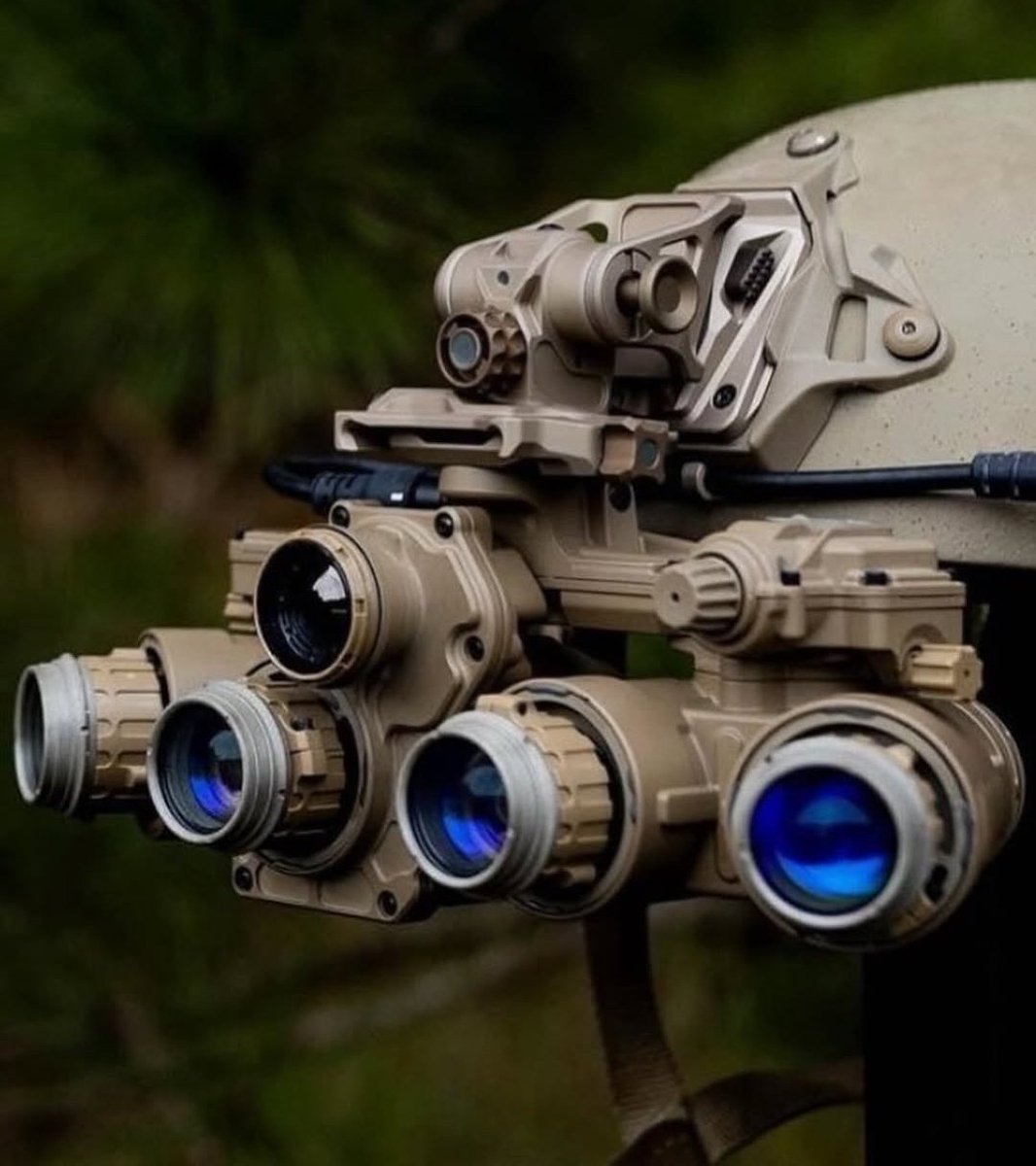
1
1
3
1,927


May 9
People have no idea the opportunity they have with the SOFIC Demo in Tampa. The public will never get so close, effectively IN, a power demo, especially a SOF Power Demo, as they do there.
6
311

160th SOAR MH-6 Little Bird mobility demonstration at SOFIC in Tampa, Florida.
Even fully loaded with operators, the agility and speed of the Little Bird is unmatched.
64
344
3,599
196,202

Here is what they will do.
Next month is SOFIC. Layla will pass the dummies pics from that and act like that is a big deal. It’s an “international year” and he is the Lieutenant Governor of Florida.
That seems like a big deal to other SOF forces and they will be in the room. They don’t actually know it isn’t unless something happens to the Governor. Nobody I know will say anything about him publicly, one way or another…which says enough.
It’s so predictable.
2
32

Mar 17
Never told you about this either. A week in the life of the Dirty Dozen back in ‘22.
War in Ukraine, business in Norway, SOFIC conference and training in the US. 🇺🇸 🇳🇴 🇺🇦 hiking in Utah, road trip through Idaho, Georgia, Ohio and Iowa. Life was pretty good.
3
9
70
5,612

i also proved that every group is sofic but the proof is too small to fit in the margins of this notebook
26
1,494