
May 7
“Say goodbye to try/catch blocks and hello to functional, composable error handling with the Result type”
I thought the same, but it’s not the whole story, and @KentonVarda was (partially) right.
I was thinking that never-throw (sic) is the goal, and that everything should be wrapped in try/catch.
That’s not true. In any non-trivial code, some invariants have to be checked, and when they are violated, the only safe approach is to let the whole program fail with a plain error. It’s useless to wrap such an error in Result — result is for domain modeling only, and that’s what should be highlighted.
For example, my SQLite wrapper had a special SQLiteError. I realized, it was unnecessary, because, when SQLite fails, there is really nothing we can do except let it bubble to Sentry.
Kenton also wrote that Result is not necessary, if we use errors as values, and I understand that point of view, except when we want to leverage Result helpers, we need common API glue. Do we need such helpers? If we write idiomatic not fake pipe everywhere code, often we don’t.
So, if a code is misusing throw for business errors, then Result, or any other error-as-value abstraction, is recommended.
If a code throws an error that can not be meaningfully handled, then Result does not help.
To err is (not only for) human.
1
1
303


@kitlangton @thdxr
691 | .run()
SQLiteError: database or disk is full
code: SQLITE_FULL
at #run (bun:sqlite:185:20)
at (src/session/index.ts:691:10)
at run (node:async_hooks:62:22)
at use (src/storage/db.ts:136:28)
at (src/session/index.ts:682:14)
(src/session/processor.ts:419:2
1
190


15 Sep 2025
"called `Result::unwrap()` on an `Err` value: CoreError { kind: Unknown, inner: Exec(SqlxError(Database(SqliteError { code: 787, message: "FOREIGN KEY constraint failed" }))) }"
dreamed up by some absolutely deranged person
15

21 Dec 2024
> SqliteError: non-deterministic use of unixepoch() in a generated column
SQLite 가상 칼럼에선 현재 시각을 쓸 수 없다.
1
1
193

9 Dec 2024
bro... how does this error for the database of text embeddings of DarkSMA AI's memories even happen?? how did the dimensions become mismatched?? wtf?
```
node:events:491
throw er; // Unhandled 'error' event
^
SqliteError: Vector dimension mistmatch. First vector has 384 dimensions, while the second has 1536 dimensions.
at SqliteDatabaseAdapter.searchMemoriesByEmbedding
```
2
12
1,376
30 Oct 2024
.prepare() 과정에서 데이터베이스와 모종의 통신을 하나 보네. 테이블 생성 전에 prepare 하려고 하니까 오류가 발생한다:
> SqliteError: no such table: reservation
163

9 Oct 2024
Tried to update promptfoo version to 0.92.x but somehow it causes the error "SqliteError: no such table: providers" requiring database even with the flag writeLatestResults is true explicitly.
github.com/yukinagae/genkitx…
2
104
5 Sep 2024
Drizzle ORM 사용해서 SQLite 상에 100,000행 삽입하는 것도 오류가 발생하네:
SqliteError: too many SQL variables
147

5 Apr 2024
@webholt в общем, если попробовать принудительно коммит сделать, то получаем `SqliteError: cannot commit - no transaction is active`, что подтверждает, что с этой стороны всё ок.
1
98

18 Feb 2024
I tried @DrizzleORM for the first time and immediately got stuck because there's no "blank page to running project" tutorial and I kept getting a "SqliteError: no such table" error
so I wrote a "set up Drizzle and SQLite from a blank page" tutorial
learnwithjason.dev/blog/driz…
10
5
100
13,400


29 Dec 2023
SQLiteError might look nicer at first but I bet many would actually not go for HTTPRESTAPIV1URL, so for me being consistent without needing to think about exceptions is better. SqliteError and HttpRestApiV1Url all the way.
1
3
236

29 Dec 2023
export const SqliteError = SQLiteError;
1
1,342


I think SqliteError is more Java and Dart naming convention. because in JS it's kind of inconsistent. because we have HTMLDivElement (not HtmlDivElement), but we also have XMLHttpRequest (XML and then Http🤦♂️).
1
5
297

29 Dec 2023
"SQLiteError:" or "SqliteError:"?
poll ⬇️
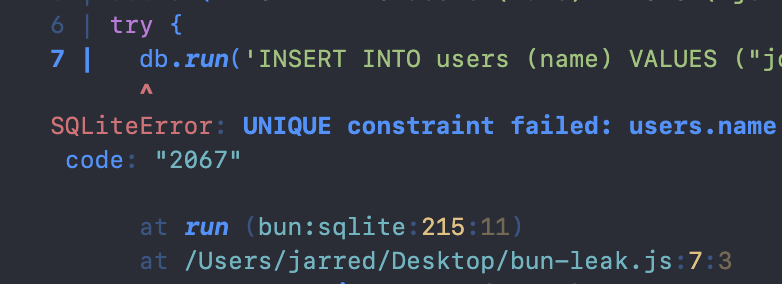
ALT 2 | 3 | const db = Database.open(":memory:"); 4 | db.run("CREATE TABLE users (id INTEGER PRIMARY KEY, name TEXT UNIQUE)"); 5 | db.run('INSERT INTO users (name) VALUES ("john")'); 6 | try { 7 | db.run('INSERT INTO users (name) VALUES ("john")'); ^ SQLiteError: UNIQUE constraint failed: users.name code: "2067"
13
3
162
57,619

21 Oct 2023
うちの環境ではローカルでうまくSQLiteのDB(テーブル)へのパスが通らなくて、wranglerでのSQLローカル実行は成功してもブラウザから見ると「SqliteError: no such table: Customers」になったのでちょっと手間取った(Cloudflare側へのデプロイ→確認のほうは問題なくOK)。
#Cloudflarebasics
1
225