luis barbosa retweeted

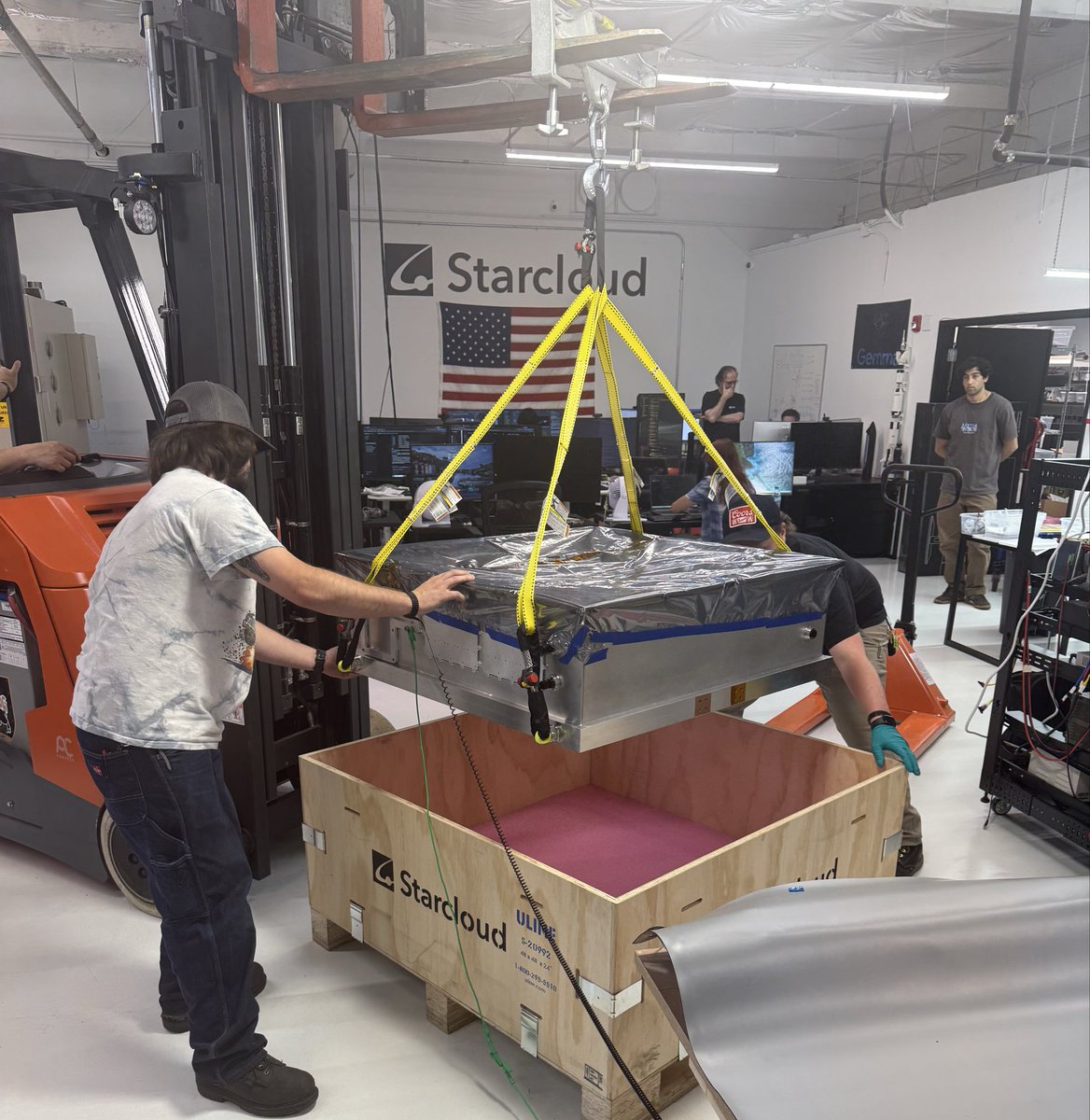
You are not bullish enough in starcloud 2 :
- Much more power, around 8kw
- Bigger and heavier spacecraft with 450kg
- More and newer chips, and a bitcoin mining compute
- Largest deployable radiator in space
- A complete data-center stack, full GPU cluster, persistent storage, and thermal and power systems in a smaller form factor
- Real commercial workloads for early customer Crusoe, with partnerships involving Nvidia, AWS, and Google
- First orbital data center to be profitable
What the starcloud guys did in the last few months is absolutely amazing
upward and onward

3
7
22
4,117

i cant tell if youre pitching me on starcloud 2 or a space heater that mines bitcoin
11

Starcloudが$170M調達、バリュ$1.1B。YC卒から17ヶ月でユニコーン、YC史上最速らしい。
宇宙軌道上にGPUを置くデータセンター。地上のエネルギー問題をそもそも宇宙で解決しようという発想。
techcrunch.com/2026/03/30/st…
2
162

This is almost entirely strawmanning.
Tesla is profitable.
You can argue about growth or valuation, but saying “his cars don’t sell” ignores that it delivers millions of vehicles and generates tens of billions in annual automotive revenue. Car of the year. 3 years running.
Even the margins are amongst the highest in the industry. Still.
SpaceX isn’t “hemorrhaging” because its core business is broken. It’s spending aggressively on R&D and capex.
EBITDA (unit profit minus R&D etc) are different from current operating profit when you’re building next-generation infrastructure.
As for “AI data centres in space”: that’s no longer a fringe idea.
The physics and economics are being actively modelled (continuous solar power, radiative cooling, no terrestrial grid constraints), Starlink already solves many of the same orbital, thermal and power-management problems, and companies like Starcloud exist specifically because they think the economics are viable too.
SpaceX landed the reported Google Anthropic compute contracts, that’s roughly $48B/year of contracted revenue before counting anything else.
Cursor - just acquired by SpaceX - is also reportedly tracking toward a ~$4B annualized revenue run rate.
1
2
85


イーロン・マスクの1年が濃すぎる問題
2/2 SpaceXが40兆円でxAI買収、評価額160兆円
2/10 AI衛星構想、そのための月面マスドライバー構想
4/21 Cursor買収オプション報道
5/7 Anthropicに月2000億円でCompute貸出
(ちなみにStartlinkの月商が1800億円)
6/5 Googleにも月1500億円で貸出
6/8 AI1衛星の詳細公開
幅70メートル、120kwの計算能力
6/12 SpaceX上場
12兆円資金調達、時価総額320兆円
6/16 時価総額でマイクロソフトを抜く
6/16 9.6兆円でCursor買収
という怒涛の個人投資家向け「ロードショー」をやりながら
Starshipの量産機(整備が楽で年数百回飛ばせるV3)の初飛行試験をしたり
サイバーキャブの量産開始したり
ロボタクシーを3都市に広げたり
してる
※ 宇宙データセンター構想自体は YCのStarcloudが2024/9/3に公開して、2025/11にH100搭載衛星(AI1の1/30とか)をFalcon 9で打ち上げてる
1
6
46
23,784

Has @Starcloud_ initiated a funding round on $2Billion valuation just recently? @grok
Chances of them
Merging with @SpaceX
Are the radiators they design good on their orbital data center ?
What does starcloud have that could benefit @SpaceX with a merger?
1
17


“When I was a kid, I wanted to become an astronaut.
I wanted to do research on nuclear fusion because mathematics and physics were the only things I was good at.
What I love about what we’re doing now is that it’s potentially much more impactful. We could generate way more energy than you can generate with nuclear fusion by doing what we’re doing now.”
— Philip Johnston , CEO Starcloud
2
8
909

T'es con ou quoi ?
Pendant que tu insulte , Starcloud a déjà lancé Starcloud-1 avec un H100 Nvidia en novembre 2025, a entraîné un LLM en orbite et fait tourner Gemini. SpaceX a déposé en janvier 2026 pour jusqu’à 1 million de satellites data centers orbitaux.
1
1
58

This could solve AI’s power crisis and free up Earth resources. From sci-fi to prototypes in just a couple years — we’re living in the future!
What do you think? Will most new AI compute move to space by 2035?
Follow for more space-tech breakdowns. RT if this blew your mind! 🌌
#SpaceTech #AI #DataCenters #Starcloud #FutureOfCompute
13
Who's Leading?
Starcloud (YC): Already launched GPUs to orbit. Demonstrated running AI models from space. Planning massive constellations.
Google (Project Suncatcher): TPUs optical links in satellite swarms. Prototypes coming 2027.
SpaceX/xAI: Elon wants data centers on
1
13

The reason why need data centers in space 🚀🚀
The massive global bottleneck for frontier artificial intelligence dominance is no longer software engineering—it is the terrestrial "energy wall." 🔋🌐
Terrestrial AI data centers are consuming immense swaths of land, water, and power. Global data center electricity consumption is projected to double by 2030, and by 2050, it will account for 10% of all electricity consumed on Earth. In North America alone, the next three years will require an additional 50 to 100 gigawatts of capacity—the structural equivalent of building up to 100 new nuclear power plants.
The industry is rapidly running out of local grid capacity and facing intense regulatory and permitting battles.
The tactical solution to bypass Earth’s resources? Shift data centers entirely into low Earth orbit. The race for "Orbital Compute" is officially on, and the strategies of the global superpowers are radically splitting:
🚀 The U.S. Private-Led Hyper-Clusters
In late 2025, space startup Starcloud successfully launched an Nvidia H100 GPU into orbit aboard the Starcloud 1 prototype satellite, proving commercial terrestrial chips can be hardened to survive space radiation. Private Western space ventures imagine a future with tens of thousands of satellites operating massive solar arrays and radiating computational heat into deep space. Starcloud has filed for 88,000 computing satellites, while SpaceX plans to put up to a million data center satellites into orbit to build a sovereign orbital internet backed by Blue Origin, Axiom Space, and Relativity Space.
🛰️ The Perovskite Solar & Laser Matrix
Operating massive cluster configurations requires rewriting traditional materials science. Because standard silicon solar panels are too heavy and rigid to launch efficiently, research institutions like NTU in Singapore are engineering flexible "perovskite" solar cells that can be rolled up like chemical ink inside compact rocket hulls and unfurled as 4-square-kilometer arrays in orbit. To bypass the lack of undersea data cables, orbital networks are shifting to inter-satellite free-space laser links—sending un-blockable, hyper-bandwidth JSON data through the vacuum of space directly to rooftop ground stations in milliseconds.
🌌 China’s Mandated Edge AI Constellation
While the U.S. relies on open-ended, venture-backed tech startups, China has codified orbital compute directly into funded national policy. Rather than waiting for massive deep-space hyperclusters, Beijing is executing an immediate precursor: Orbital Edge AI. Through its state-mandated "Three-Body Computing Constellation," China has already deployed 12 satellites out of a planned 2,800. These units run localized 8-billion-parameter language and remote sensing models directly in space, processing massive satellite raw data on-orbit to stream immediate "answers" back to Earth rather than clogging limited downlink pipelines with raw images.
The Takeaway: Space-based supercomputing is the ultimate frontier for technological self-reliance and national security. Orbital data centers exist outside the physical reach of localized cyber attacks, geopolitical energy grid vulnerabilities, and land battles on Earth. Whoever secures the orbital hardware first will not just lead the AI industry—they will dictate who owns, routes, and controls the infrastructure of the next internet. 🖥️⛓️
2
6
175