
🧵 Understanding Tentacle: How Erasure Coding Gets a Performance Boost
If you work with distributed storage, you've probably heard about erasure coding's I/O amplification problem. Tentacle solves it with 3 key innovations:
PARTIAL READS
Instead of reading entire chunks, Tentacle reads only the data blocks it needs. This dramatically reduces unnecessary I/O and improves random read latency—critical for VM workloads.
PARTIAL WRITES
Traditional erasure coding requires reading a full stripe, merging writes, and recalculating all parity shards. Tentacle changes the game: modify only the affected chunk and update only the necessary parity shards. Fewer rewrites = better throughput.
PARITY DELTA WRITES
Optimize parity calculations at the block level, eliminating redundant operations and further reducing write amplification.
The Result? Tentacle matches or exceeds 3x replication performance while maintaining the storage efficiency benefits of erasure coding.
→ Watch the full performance test comparing Tentacle EC vs traditional replication for VM workloads:ow.ly/xj8N50Z0mJM
Key Takeaways for Storage Engineers:
✓ Better I/O efficiency = improved application performance
✓ Maintains high availability with lower storage overhead
✓ Purpose-built for modern cloud and virtualization demands
#Ceph #ErasureCoding #DataStorage #CloudInfrastructure #StorageEngineering #Performance #TechInnovation
3
6
373
Understanding Ceph Placement Groups (PGs) and Why They Matter
Placement Groups are a foundational part of how Ceph distributes and balances data across a cluster. When PG counts are properly sized, clusters stay balanced, performance remains predictable, and scaling is far less disruptive.
To make this easier, we built a Ceph PGs per Pool Calculator that helps estimate an appropriate PG count based on:
Number of OSDs in the cluster
Total pools
Replication or erasure coding configuration
The goal isn’t just “more PGs” it’s right-sized PGs that support even data distribution and efficient recovery as clusters grow.
This tool is especially useful for teams designing or expanding production Ceph environments, where early planning can prevent long-term performance and rebalancing challenges.
👉 Click here to learn more and try the PG calculator: ow.ly/Nz9I50Y7JII
#Ceph #OpenSourceStorage #StorageEngineering #Infrastructure #Linux #DataCenterArchitecture #OpenStorage #45Drives #SystemsEngineering
2
227

Mar 15
Disk sırası bilinmeyen 16 diskli bir RAID6’yı kurtarmak için kaç ihtimali denemeniz gerekir?
RAID6 recovery süreçlerinde asıl zorluk çoğu zaman sürücü arızası değil, kayıp konfigürasyondur.
16 diskli bir sistemde disk sırası bilinmiyorsa 16! yani 20 trilyon 922 milyar farklı disk sıralaması mevcut. Buna parity layout için 4, stripe block size için 8, parity delay için 16, start offset için 5 ihtimali eklediğinizde toplam kombinasyon sayısı ~53 katrilyona ulaşır.
Saniyede 1 milyon kombinasyon deneyebilen bir araçla bile bu işlem 1.697 yıl sürer.
RAID konfigürasyonunuzu mutlaka bir yere not edin. Bunları yedeklemek sizi 53 katrilyon ihtimal arasında raid yapısını aramaktan kurtarır.
#RAID #DataRecovery #DrDiskLab #StorageEngineering #Cybersecurity
5
3
15
2,120
Understanding @Ceph Placement Groups (PGs) and Why They Matter
Placement Groups are a foundational part of how Ceph distributes and balances data across a cluster. When PG counts are properly sized, clusters stay balanced, performance remains predictable, and scaling is far less disruptive.
To make this easier, we built a Ceph PGs per Pool Calculator that helps estimate an appropriate PG count based on:
Number of OSDs in the cluster
Total pools
Replication or erasure coding configuration
The goal isn’t just “more PGs” it’s right-sized PGs that support even data distribution and efficient recovery as clusters grow.
This tool is especially useful for teams designing or expanding production Ceph environments, where early planning can prevent long-term performance and rebalancing challenges.
👉 Click here to learn more and try the PG calculator: ow.ly/xI0350Y7JIG
#Ceph #OpenSourceStorage #StorageEngineering #Infrastructure #Linux #DataCenterArchitecture #OpenStorage #45Drives #SystemsEngineering
1
5
236
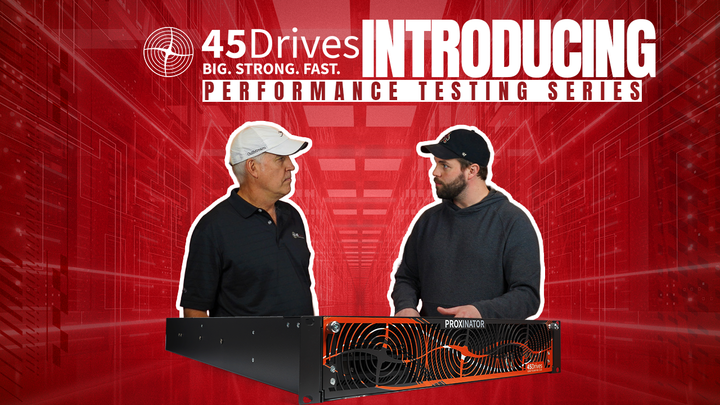
🔥45Drives Stornado F16 – NVMe & ZFS Performance Put to the Test!🔥
Welcome to Episode 1 of On the Drag Strip.
In this intro episode, Doug and Brett give an overview of the Stornado F16 — a 16-bay, 15mm NVMe powerhouse engineered for serious speed, delivering up to 60 GB/s of theoretical throughput.
This is just the beginning.
📅 Tomorrow: Chief Architect Mitch Hall puts the F16 through real-world ZFS benchmarks and workflow simulations.
🎬 Watch the intro now → loom.ly/_yZofqY
📌 Full benchmark episode drops tomorrow — don’t miss it.
#StornadoF16 #45Drives #ZFSonNVMe #HighPerformanceStorage #NVMePower #OpenStorage #EnterpriseStorage #LinuxServers #DragStripSeries #ZFSPerformance #StorageEngineering #ServerBenchmarking #BuiltForSpeed
4
285