
Read "Systemantics". Literally every large, complex system ends up eating the people who built it without regular resets.
775

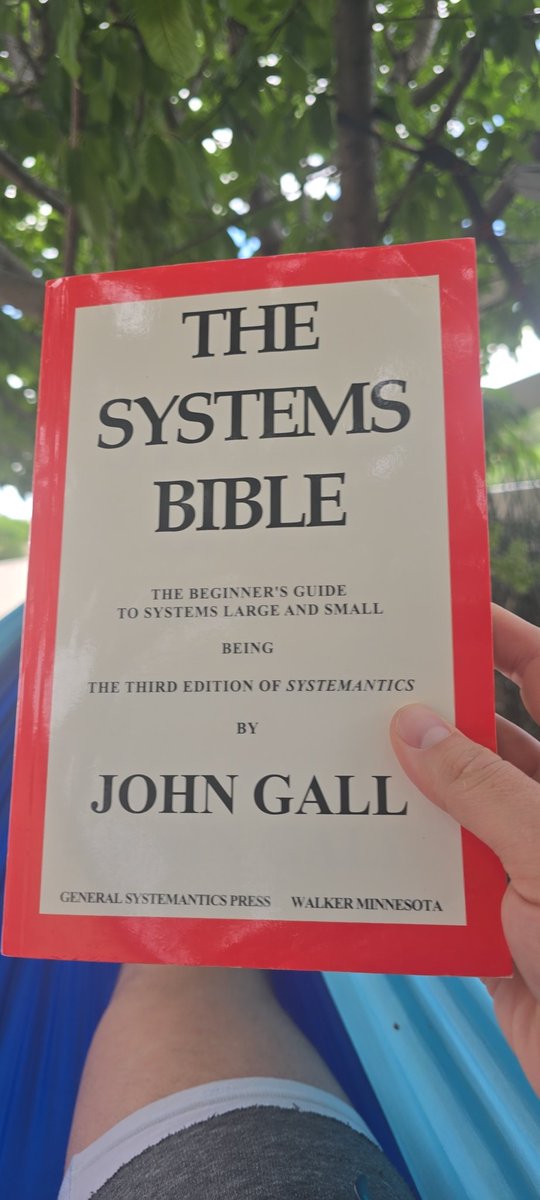
The book Systemantics, by John Gall, should be required reading. The second edition is probably the best. The third edition is overly long for comedic effect.
Also:
youtube.com/watch?v=Z9G1Mf6T…
72

I'm not a "plays d&d and collects Star Wars memorabilia" kind of nerdy.
I'm a "studies economics, game theory, cryptography, Japanese production systems, and systemantics because it's fascinating and I'm going to change the world with it" kind of nerdy.
Is there a name for that?
2
4
354

«Un sistema complejo que funciona siempre evolucionó de un sistema simple que funcionaba. Un sistema complejo diseñado desde 0 nunca funciona y no puede arreglarse para que funcione. Hay que empezar de nuevo con un sistema simple que funcione».
— John Gall, Systemantics (1975)
4
8
741


I agree
this is all classic Systemantics.
It is so easy to get side-tracked into seeing malice (it is exactly the same category error pitchforkers make, only in reverse).
The only answer is to assess the system and incentives and identify where it is going wrong.
1
2
24

Just read “Systemantics” by John Gall. It’s old but you can find it online. Much more fun and will teach you far more than a dry SE book
7
156

Apr 23
This is right out of the book Systemantics by Gall. Funding the problem an organization is established to cure. Classic.
1
9
717

Apr 6
You are saying incentives have a tragic and ironic feedback loop that goes against the intention.
If I am right it connects with Systemantics by John Gall. He says that a system works against its own proper function. If the system is the NGO its incentives to maintain high numbers of homeless makes the problem worse. The system opposes its proper function.
Did I get any of it right?
1
21
227

Mar 8
saw a tweet making some claims idk how to evaluate.
but I do know that systems composed of intelligent agents are subject to the laws described by John Gall in Systemantics, whatever those agents are made of.
2
75

Feb 23
Uma reflexão que eu tenho tido há bastante tempo, mas só achei as palavras certas pra expressar agora: Boa engenharia precisa de etnografia.
Deixa eu explicar.
Etnografia é uma sub-área da sociologia - mas também muito usada no design, na psicologia organizacional, etc - que estuda comportamento humano no mundo real. É o contrário de fazer modelos de como as pessoas "deveriam" agir - é observar e registrar como elas agem sem julgamento e sem filtros.
Na engenharia, é muito comum a gente ver gente justificando sistemas que funcionam mal ou que são difíceis de manter com "Se tivessem feito direito ia dar certo".
"Se tivessem usado Orientação a Objetos do Jeito Certo"
"Se tivessem registrado as tarefas usando a Metodologia XPTO"
Tudo isso é consequência de falta de etnografia. De tratar pessoas como infinitamente maleáveis e achar que brigando o suficiente você vai fazer as pessoas agirem como quiser, não importa quanto trabalho isso dê.
Mas a realidade é que qualquer metodologia que não considere como as pessoas agem na prática está fadada ao fracasso.
Um dos meus livros favoritos se chama "Systemantics". Ele é um livro sobre como sistemas funcionam - e especialmente sobre como eles falham.
E uma coisa que ele fala é que a maioria dos sistemas estão quebrados, a todo momento. Porque o jeito que eles funcionam no mundo real é diferente da história que contamos sobre como eles funcionam.
Pessoas contornam políticas que dão trabalho demais de seguir. Elas dão "jeitinhos". Elas pulam passos.
Se sua organização de engenharia não considera essas questões, você vai estar SEMPRE correndo atrás do prejuízo.
9
9
102
4,022

Feb 15
Another day, another Indian hardware success story.
And this one quietly powers the world’s biggest factories, from India to global manufacturing floors. (One of my favourites)
The name is Systemantics, and it’s building a globally competitive industrial robotics company engineered in India.
Let’s decode their journey, with the numbers that matter.
Origin Story
Founded in 1995 by Dr. Subramanian Natarajan in Bengaluru, Systemantics started with a bold belief:
India doesn’t just need automation.
It needs high-quality industrial robots designed and built in India — not imported at high cost.
At a time when industrial robots meant foreign brands like ABB, Fanuc, or KUKA, this was a contrarian bet.
Deep-Tech from Day One
Most automation integrators import robots and build systems around them.
Systemantics chose the harder path:
They built the core technology in-house:
Industrial robot arms (SCARA, Cartesian, articulated)
Motion control systems
Servo drives & control architecture
Robot controllers & software
Application engineering & integration
This deep engineering focus became their core moat.
Category Repositioning
Industrial robots in India were seen as:
Expensive • Imported • Large-enterprise only
Systemantics repositioned automation as:
Accessible • Reliable • India-built
Their focus:
Indian SMEs
Cost-effective automation
Local service & customization
Faster deployment
Automation wasn’t a luxury anymore. It became a productivity tool.
Product Breakthrough
Systemantics gained strong traction with its SCARA robot platforms, widely used in:
Electronics assembly
Automotive components
Packaging & material handling
Consumer goods manufacturing
Key strengths:
High precision & repeatability
Compact footprint
Faster cycle times
Competitive pricing vs imported robots
For many Indian manufacturers, this was their first viable step into robotics.
The Big Inflection, Strategic Acquisition
In 2018, a major milestone came.
Murugappa Group (one of India’s largest industrial conglomerates, $8B group) acquired Systemantics.
Why this mattered:
Long-term capital support
Access to manufacturing scale
Strong governance & credibility
Global expansion capability
This transformed Systemantics from a niche robotics company into a scalable industrial automation player.
Manufacturing in India
Systemantics focuses on local design and manufacturing, aligned with the Make in India vision.
Today:
Engineering & manufacturing base in Bengaluru
Indigenous robot design capability
Supply chain localization focus
Faster service and support across India
High-end industrial robots — designed and built in India.
Market Focus
Systemantics operates across multiple industries:
Automotive & auto components
Electronics manufacturing
Electrical equipment
Consumer goods
Food & packaging
Their core value proposition:
Global-quality robotics at India-relevant economics.
Data & Application Moat
Beyond hardware, their strength lies in:
Application engineering expertise
Process optimization for Indian factories
Integration with production lines
After-sales support & lifecycle service
In industrial automation, execution is the moat, not just the robot.
While not a flashy consumer brand, Systemantics operates in the high-impact B2B deep-tech layer of manufacturing.
India’s manufacturing future depends on automation.
And companies like Systemantics are building the foundation:
Where robots are not imported, but engineered.
Where automation is not elite, but accessible.
Where Indian factories become globally competitive.
This is not just a robotics company.
It’s part of India’s shift toward Industry 4.0, built from within.
Built in India.
Automating for the world.


9
125
542
17,358

it's really bad that spotify exposes users data, imagine how this shit will be with ai
fucking hell might need to read that systemantics book to cope with how bleak this shit is
1
7
214

Jan 31
Самооценка это не то, что тебе формируют в детстве и ты всю жизнь с этим. Нет, самооценка меняется с течением всей вашей жизни и напрямую зависит от того, как вы оцениваете свои возможности в моменте и как часто делаете то, что задумали.
Ниже будет небольшой алгоритм того как менять свою самооценку. Спойлер: это долго, сложно и иногда болезненно, но это работает.
1. Необходимо сформировать уровень ваших притязаний и он должен быть адекватным вашим силам. Если вы сейчас зарабатываете 400 баксов в месяц, а хотите в следующий месяц $2к, то вы только угробите свою самооценку и самоощущение. Уровень ваших притязаний должен быть на одну ступень выше того, где вы находитесь сейчас. Так вам будет легче идти выше.
2. Ваши действия должны соответствовать уровню притязаний. Если вы поставили себе цель выше того, что есть сейчас, но не делаете ничего или делаете меньше необходимого, то ваша самооценка гарантированно будет проседать и будет увеличиваться прокрастинация и уменьшаться внутренняя мотивация.
3. Необходимо ввести минимальную зону ответственности, где результат будет измерим, ответственность полностью на вас и оправдания невозможны. Это будет место, с которого ваша самооценка начнет расти.
4. Соблюдайте данное самому себе слово. Начните с небольшого цикличного действия, где нужно делать одно и то же действие регулярно. Заведите для этого действия планнер и ставьте галочку всегда когда это сделаете. Так вы формируете доверие к себе.
5. Ваши ошибки это нормально. Если вы следовали своей планке, сделали выводы и исключили возможность повторения ошибки, то ваша самооценка и самоуважение не пострадают.
Если вы все это делаете, то в какой-то момент вы поймаете себя на том, что критикуете себя без разрушения, уважаете себя без потребности это вечно подтверждать, а ваши амбиции без надрыва и самопожертвования. Вы великолепны!
Информация взята из книг:
Эмоциональный интеллект
Путь к характеру
Systemantics
Ты можешь больше
От хорошего к великому
Подумайте еще раз
Накопительный эффект
Одна привычка в неделю
И конечно же личный опыт и наработки.
This tweet is unavailable
7
13
223
16,798

Jan 23
Number 4 best book of the year from Ron: SYSTEMANTICS. THE SYSTEMS BIBLE by John Gall amzn.to/45mLbPK #AskTSOE @ronaldbaker @edkless
1
1
63

Jan 14
Hacker books:
-----
[/] "Do Androids Dream of Electric Sheep?" -Dick, Philip K., Roger Zelazny
[X] "Neuromancer" -Gibson, William
[X] "Snow Crash" -Stephenson, Neal
[X] "The Cuckoo's Egg" -Cliff Stoll
[X] "The Watchman" -Littman, Jonathan
[X] "Wizard's Bane" -Cook, Rick
SciFi:
-----
[ ] "A Princess of Mars" -Burroughs, Edgar Rice
[ ] "Brave New World" -Huxley, Aldous
[ ] "Cyteen" -Cherryh, C. J.
[ ] "Daemon" -Suarez, Daniel
[ ] "Dahlgren" -Delaney, Samuel R.
[ ] "Gateway" -Pohl, Frederik
[ ] "The Demolished Man" -Bester, Alfred
[ ] "The Machine Stops" -Forster, E. M.
[ ] "The Stars my Destination" -Bester, Alfred
[ ] "The War of the Worlds" -Wells, H.G.
[/] "Consider Phlebas (Culture series)" -Iain M. Banks
[/] "The Martian Chronicles" -Bradbury, Ray
[/] "The Time Machine" -Wells, H. G.
[X] "1984" -Orwell, George
[X] "A Connecticut Yankee in King Arthur's Court" -Twain, Mark
[X] "Count To A Trillion" -Wright, John C.
[X] "Dune" -Herbert, Frank
[X] "Ender’s Game" -Card, Orson Scott
[X] "Fahrenheit 451" -Bradbury, Ray
[X] "Foundation" -Asimov, Isaac
[X] "Old Man's War" -John Scalzi
[X] "Prey" -Crichton, Michael
[X] "Ready Player One" -Cline, Ernest
[X] "Rendezvous with Rama" -Clarke, Arthur C.
[X] "Ringworld" -Niven, Larry
[X] "Starship Troopers" -Heinlein, Robert A.
[X] "The Hitchhiker’s Guide to the Galaxy" -Adams, Douglas
[X] "The Lost Starship" -Vaughn Heppner
[X] "The Moon Is a Harsh Mistress" -Heinlein, Robert A.
[X] "We Are Legion (Bobiverse Book 1)" -Taylor, Dennis
Fiction:
-----
[ ] "Don Quixote" -de Cervantes, Miguel
[ ] "Heart of Darkness" -Conrad, Joseph
[ ] "Oil!" -Sinclair, Upton
[ ] "Paradise Lost" -Milton, John
[ ] "Shiloh" -Foote, Shelby
[ ] "Slaughterhouse Five" -Vonnegut, Kurt
[ ] "The Complete Leatherstocking Tales" -Cooper, James Fenimore
[ ] "The Divine Comedy" -Dante
[ ] "The Jungle" -Sinclair, Upton
[ ] "The Killer Angels" -Shaara, Michael
[ ] "The Outsiders" -Hinton, S.E.
[ ] "The Sketchbook of Geoffrey Crayon, Gent." -Irving, Washington
[ ] "The Things They Carried" -O'Brien, Tim
[ ] "Thus Spake Zarathustra" -Nietzche, Friedrich
[ ] "Waiting for Godot" -Beckett, Samuel
[ ] "Watership Down" -Richard Adams
[ ] "Yoshimasa and the Silver Pavilion" -Donald Keene
[X] "A Message to Garcia" -Elbert Hubbard, Jason Liller
[X] "A Tale of Two Cities" -Dickens, Charles
[X] "All Quiet on the Western Front" -Remarque, Erich Maria
[X] "Atlas Shrugged" -Rand, Ayn, Peikoff, Leonard
[X] "Beowulf" -Anonymous
[X] "Gulliver's Travels" -Swift, Johnathan
[X] "Hamlet" -Shakespeare, William
[X] "Johnny Tremain" -Forbes, Esther
[X] "Julius Caesar" -Shakespeare, William
[X] "Les Misérables" -Hugo, Victor
[X] "Macbeth" -Shakespeare, William
[X] "Moby Dick" -Melville, Herman"
[X] "Of Mice and Men" -Steinbeck, John
[X] "Romeo and Juliet" -William Shakespeare
[X] "The Adventures of Huckleberry Finn" -Twain, Mark
[X] "The Adventures of Tom Sawyer" -Twain, Mark
[X] "The Color Purple" -Walker, Alice
[X] "The Grapes of Wrath" -Steinbeck, John
[X] "The Great Gatsby" -Fitzgerald, F. Scott
[X] "The Hunchback of Notre Dame" -Hugo, Victor
[X] "The Master and Margarita" -Mikhail Bulgakov, Diana Burgin, Catherine Tiernan O'Connor
[X] "The Old Man and the Sea" -Hemmingway, Ernest
[X] "The Woman in the Dunes" -Abe, Kobo
[X] "Uncle Tom's Cabin" -Stowe, Harriet Beecher
Fantasy:
-----
[ ] "The Mists of Avalon" -Bradley, Marion Zimmer
[ ] "The Shadow of the Torturer" - Wolfe, Gene
[X] "Eragon" -Paolini, Christopher
[X] "Lord of the Rings" -Tolkien, J.R.R.
[X] "The Dark Elf Trilogy" -R.A. Salvatore
[X] "The Hobbit" -Tolkien, J.R.R.
[X] "The Soulforge" -Margaret Weis
[X] "The Sword of Shannara" -Terry Brooks
[X] "The Wheel Of Time" -Robert Jordan
History:
-----
[ ] "Berlin Diaries, 1940-1945" -Vassiltchikov, Marie
[ ] "The Complete Story of Civilization" -Durant, Will
[/] "The History of the Decline and Fall of the Roman Empire" -Gibbon, Edward
[X] "The Iliad" -Homer
Military History:
-----
[ ] "Journal of the Waterloo Campaign" -Mercer, Cavalie
[ ] "Maverick Marine: Smedley Butler and the Contradictions of American Military History" -Schmidt, Hans
[ ] "Quartered Safe Out Here" -Fraser, George MacDonald
[ ] "The Rise and Fall of the Third Reich" -Shrier, William L. and Rosenbaum, Ron
[/] "The Age of Napoleon" -Will & Ariel Durant
Biographical:
-----
[ ] "Alexander Hamilton" -Chernow, Ron
[ ] "Howard Hughes" -Barlett, Donald L.
[ ] "Mein Kampf" -Hitler, Adolf
[ ] "Narrative of the Life of Frederick Douglass" -Douglass, Frederick
[ ] "Quotations from Chairman Mao Tse-Tung" -Tse-Tung, Mao
[ ] "Stalin" -Montefiore, Simon Sebag
[ ] "Steve Jobs" -Isaacson, Walter
[ ] "The Autobiography of Malcolm X" -Haley, Alex
[ ] "Up From Slavery" -Washington, Booker T.
[ ] "Washington: A Life" -Chernow, Ron
[/] "The Autobiography of Benjamin Franklin" -Franklin, Benjamin
[/] "Benjamin Franklin" -Walter Isaacson
[/] "Catherine the Great" -Robert K. Massie
Politics:
-----
[ ] "Das Kapital" -Marx, Karl
[ ] "History of Skepticism from Savanarola to Bayle" -Popkin, Richard
[ ] "In Defense of Anarchism" -Wolff, Robert Paul
[ ] "Rules for Radicals" -Alinsky, Saul
[ ] "The Communist Manifesto" -Marx, Karl
[X] "The Prince" -Niccolo Machiavelli
[X] "The Republic" -Plato
Science:
-----
[ ] "A Brief History of Time" -Hawking, Stephen
[ ] "The Double Helix" -Watson, James D.
[X] "On The Origin of Species" -Darwin, Charles
[/] "The Art of Doing Science and Engineering" -Richard W. Hamming
Philosophy
-----
[ ] "The Meaning of Things" -Grayling, A. C.
[ ] "The Story of Philosophy" -Durant, Will
General Studies:
-----
[ ] "1491" -Mann, Charles
[ ] "1493" -Mann, Charles
[ ] "A People’s History Of The United States" -Zinn, Howard
[ ] "Common Sense" -Paine, Thomas
[ ] "Confessions" - Saint Augustine
[ ] "Enemies – a History of the FBI" -Weiner, Tim
[ ] "Guns, Germs, and Steel" -Diamond, Jared
[ ] "History of Skepticism from Savonarola to Bayle" -Popkin, Richard H.
[ ] "How to Lie With Statistics" -Huff, Darrell
[ ] "I Contain Multitudes" -Yong, Ed
[ ] "Legacy of Ashes – the History of the CIA" -Weiner, Tim
[ ] "Siddartha" -Hesse, Herman
[ ] "Social Darwinism in American Thought" -Hofstadter, Richard
[ ] "Symposium" -Plato
[ ] "Systemantics" -Gall, John
[ ] "The Alchemy of Air" -Hager, Thomas
[ ] "The Art of Happiness" -Dalai Lama
[ ] "The Best and The Brightest" -Halberstam, David
[ ] "The Big Picture: On the Origins of Life, Meaning, and the Universe Itself" -Carroll, Sean M.
[ ] "The Demon Under the Microscope" -Hager, Thomas
[ ] "The Emperor of All Maladies – a Biography of Cancer" -Mukherjee, Siddartha
[ ] "The Mismeasure of Man" -Gould, Stephen Jay
[ ] "The Myth of Race" -Sussman, Robert Wald
[ ] "The Nature of Things" -Grayling, A. C.
[ ] "The Rights of Man" -Paine, Thomas
[ ] "The Social Contract" -Rousseau, Jean-Jacques
[ ] "The Tao Te Ching" -Le Guin, Ursula K.
[ ] "The Unbound Prometheus: Technological Change and Industrial Development in Western Europe from 1750 to the Present" -Landes, David
[ ] "The Wealth of Nations" -Smith, Adam
[ ] "Twelve Against the Gods" -Bolitho, William
[ ] "Wedge: The Secret War Between the FBI and CIA" -Reibling, Mark
[/] "The Odyssey" -Homer
[X] "Body of Secrets" -Bamford, James
[X] "Book of Five Rings" -Musashi, Miyamoto, Harris, Victor
[X] "Fenimore Cooper's Literary Offenses" -Twain, Mark
[X] "The Art Of War" -Sun Tzu
[X] "The Puzzle Palace" -Bamford, James
[X] "The Twelve Rules of the Sword" -Ittosai, Ito, shahan, eric
1
3
672

Jan 12
5) Systemantics by John Gall
'don't waste time fixing unfixable things'
1
1
25
3,539
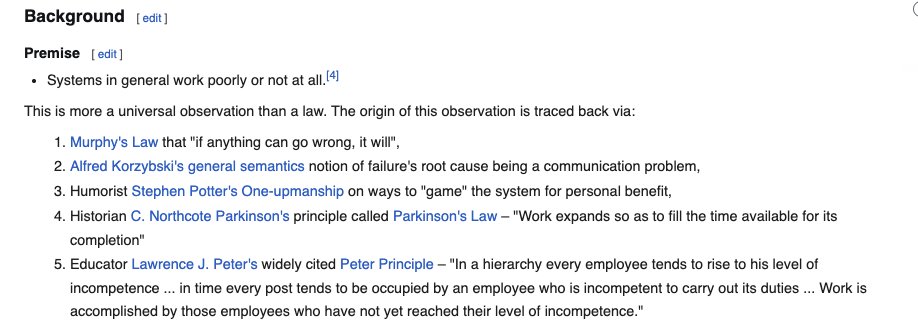
korzybski w the systemantics, les ingredients!!
1
4
364
not all capital is moving at all times, only a fraction, just like a machine, capital in of itself is a system and thus the systemantics apply.
2
3
191

Jan 5
you can always revisit systemantics, it is always worth your time
3
350