

.
*********************************************************
A Robin Reynolds Exclusive Reveal
*********************************************************
.
THE BUNKER CLASS
While You Were Sleeping, They Were Digging
.
THE OPEN SECRET
The rumor is not a rumor. It is a documented, global, accelerating industry operating in plain sight -- and the people building these things would very much prefer you weren't paying attention.
LinkedIn co-founder Reid Hoffman told The New Yorker that among his Silicon Valley billionaire peers, "fifty-plus percent" have some form of "apocalypse insurance" hideaway -- comparing it to the decision to buy a vacation home, a sort of "safety blanket for this thing that scares me."
He added: "Saying you're 'buying a house in New Zealand' is kind of a wink, wink, say no more. Once you've done the Masonic handshake, they'll be, like, 'Oh, you know, I have a broker who sells old ICBM silos, and they're nuclear-hardened, and they kind of look like they would be interesting to live in.'"
That is not a conspiracy theory. That is a billionaire describing the secret handshake.
.
THE INDIVIDUALS -- WHO IS BUILDING WHAT
Mark Zuckerberg -- Hawaii
Meta CEO Mark Zuckerberg and his wife Priscilla Chan are constructing a sprawling 1,400-acre compound named Ko'olau Ranch on the Hawaiian island of Kauai, projected to cost upwards of $270 million. Planning documents obtained by Wired show the compound includes more than a dozen buildings with at least 30 bedrooms and 30 bathrooms, two stand-alone mansions spanning 57,000 square feet, 11 treehouses connected by rope bridges, and a 5,000-square-foot underground shelter with its own energy and food supplies. The door to the underground structure is constructed of metal filled with concrete -- the same design standard as a blast-resistant bunker.
Workers on the project were under strict nondisclosure agreements, and even casual mention of the project on social media was grounds for dismissal. Zuckerberg's team hired different construction crews to work on separate projects within the same site -- workers from different crews were deliberately kept apart so that no single person could see the full picture.
When asked point-blank in a Bloomberg interview whether it was a doomsday bunker, Zuckerberg said: "No, I think that's just like a little shelter. It's like a basement." The underground structure with the blast-resistant door, escape hatch, independent energy and food supply, and seven bedrooms is, according to its owner, a basement.
Zuckerberg has since expanded his footprint. He reportedly purchased a luxury mansion on Indian Creek Island in Miami -- the exclusive enclave where Jeff Bezos also owns multiple properties. A vacant plot of similar size on the island sold for a reported $105 million in 2025. In Palo Alto, California, Zuckerberg has spent an estimated $110 million acquiring 11 homes, many combined into a single private compound.
.
Peter Thiel -- New Zealand
PayPal co-founder Peter Thiel became a New Zealand citizen in 2011 after spending only 12 days in the country, prompting national outrage and allegations that New Zealand's passport was effectively for sale. He owns a $13.8 million home on 477 acres in the lakeside town of Wanaka and purchased another property in Queenstown outfitted with a safe room.
Thiel submitted plans for a bunker-style compound embedded into a hillside on the South Island -- a 1,082-foot glass-lined guest lodge capable of housing 24 people. The local council rejected the plans, citing negative impact on the surrounding landscape.
Thiel is also the financial godfather of the seasteading movement -- the idea of building sovereign societies on platforms in international waters beyond the reach of any government. He provided $1.2 million in seed money to The Seasteading Institute, co-founded by Patri Friedman, a former Google engineer and grandson of economist Milton Friedman. The vision was unambiguous: a floating libertarian utopia with "no welfare, looser building codes, no minimum wage, and few restrictions on weapons." For Thiel, this was not an intellectual experiment. It was infrastructure planning.
.
Sam Altman -- Big Sur, Gold, and Potassium Iodide
The man running the most consequential AI company on earth is also one of its most documented preppers. Altman has told The New Yorker he stockpiles guns, gold, potassium iodide, antibiotics, batteries, water, and gas masks from the Israeli Defense Force. He owns a patch of land in Big Sur, California, that he can fly to when society breaks down. His backup plan involves flying with Peter Thiel to Thiel's New Zealand compound.
When pressed more recently on whether he owns a bunker, Altman said he has "underground, concrete, heavy, reinforced basements" but refuses to call them bunkers. "It has been on my mind," he admitted. "Not because of AI. It's because people are dropping bombs in the world again."
Read that carefully. The person building what he calls "the most important technology in human history" has a Gulfstream fueled and a fortified hole in the ground waiting -- and his explanation is that he's worried about conventional weapons.
.
Larry Page -- Fiji and New Zealand
Google co-founder Larry Page quietly relocated to Fiji during the pandemic, reportedly buying at least one private island in the Mamanuca archipelago. When local Fijian media reported his presence, authorities ordered the article taken down. Page separately applied for New Zealand residency under the "investor plus" category -- requiring NZ$10 million invested over three years -- three months before arriving in the country on a medical flight.
.
Jeff Bezos -- Indian Creek Island
Bezos has taken a different approach: not a bunker but a fortified island. Between mid-2023 and early 2024, he purchased three neighboring properties on Indian Creek Island in Miami -- nicknamed "Billionaire Bunker" -- for more than $237 million combined. The plan is to demolish two and build a single mega-compound on the site.
Indian Creek is a 300-acre man-made island in Biscayne Bay accessible by a single guarded bridge. It maintains a private police force of approximately 15 officers patrolling both land and sea, with radar and thermal surveillance extending across the surrounding water. Only 41 residential lots exist on the island. Current neighbors include Tom Brady, Ivanka Trump, and Jared Kushner. More than half of $1 trillion in combined net worth now lives on Indian Creek Island.
.
Elon Musk -- Texas Compound
Musk has constructed a sprawling 4-square-kilometer estate outside Austin, Texas, at a reported cost of $35 million. The complex includes multiple homes for his 12 children and three estates for their mothers. He has expressed less interest in underground bunkers than in leaving the planet entirely. When disaster comes, his plan is Mars.
.
Bill Gates -- Everywhere
Gates is rumored to have underground security areas beneath every one of his homes, according to the Hollywood Reporter. He has not confirmed or denied this. He owns at least eight properties in the US alone.
.
Steve Huffman (Reddit CEO) and the Anonymous Helicopter Man
Reddit CEO Huffman has said he is less concerned about specific threats than "the temporary collapse of our government and structures." He owns motorcycles, guns, and ammo and has said: "I figure that, with that, I can hole up in my house for some amount of time."
One anonymous investment firm head told The New Yorker, in a quote that became something of a landmark in the genre: "I keep a helicopter gassed up all the time, and I have an underground bunker with an air-filtration system. A lot of my friends do the guns and the motorcycles and the gold coins. That's not too rare anymore."
.
Kanye West -- Wyoming
West built an underground bunker and panic room at his $22 million ranch in Cody, Wyoming, stocked with food and built for emergency shelter. He reportedly retreated to it in 2020 during a period of personal crisis, locking out family members and changing all his social media passwords. He has since sold the Wyoming properties.
.
Sam Bankman-Fried -- The Most Deranged Entry in the File
Court filings in the FTX bankruptcy case alleged that executives were party to a memo proposing the purchase of the sovereign Pacific island nation of Nauru using FTX Foundation funds. The stated goal: build a bunker to be used in the event that "50%-99.99% of people die," ensuring that most effective altruists survive, and then "develop sensible regulation around human genetic enhancement, and build a lab there." The memo also noted, with casual expansiveness: "Probably there are other things it's useful to do with a sovereign country, too."
The government of Nauru confirmed the country was never for sale. Nauru -- one of the most exploited nations on earth, stripped of its phosphate deposits and left economically devastated -- was never consulted about its prospective role as a private laboratory for people who considered themselves effective altruists. The irony is so thick it could stop a blast door.
.
THE INDUSTRY -- WHO BUILDS THESE THINGS
This is a functioning, growing, global industry with named companies, product catalogs, and waiting lists. It has been quietly expanding for two decades and is now accelerating at a pace that makes the Cold War-era civil defense boom look modest.
.
Atlas Survival Shelters (Texas)
CEO Ron Hubbard has described a business in constant motion: "It got really busy, and it seems like the phone hasn't stopped ringing; World War III seems like it's coming." He said news about Zuckerberg's bunker "caused a buying frenzy" and that his company is routinely working with billionaire-level clients. He told Business Insider that when America bombs Iran, his phone spikes within hours. He is currently building a $7.5 million bunker for an undisclosed client in Oklahoma.
.
Rising S Company (Texas)
Rising S has reported a 700% increase in inquiries, with demand correlating directly to geopolitical events -- elections, conflicts, climate disasters. Hundreds of millionaires and billionaires from Europe and the United States commissioned underground Rising S units in New Zealand between 2016 and 2024 alone. Each unit costs between $2.5 million and $10 million, is manufactured in Texas, and is shipped by sea to isolated rural areas on the South Island. The company has confirmed delivery of at least 10 private units to .
Silicon Valley clients in New Zealand.
.
Survival Condo (Kansas)
Developer Larry Hall transformed a former Atlas missile silo sitting 15 stories underground into luxury condominiums. Each residence is equipped with stainless steel appliances, LED lighting, home automation, and access to a pool, rock climbing wall, movie theater, dog park, and arcade. A full-floor apartment runs around $3 million; the penthouse option goes for $4.5 million. Each unit comes with a five-year food supply per resident. The walls are nine feet thick and the protective dome runs 161 feet deep. Hall describes bunkers as "a new status symbol of the elite" in the post-pandemic era.
.
Vivos xPoint (South Dakota)
Located near the Black Hills, the former Army Munitions Depot houses 575 military bunkers originally built by the Army Corps of Engineers between 1942 and 1967. Now being converted into a community for approximately 5,000 people, with a community theater, classrooms, hydroponic gardens, medical clinic, spa, and gym. Initial lease prices have risen from $25,000 to approximately $55,000. The operator runs background checks and turns away 20-25% of applicants. A major network was reportedly in negotiations in 2025 for an unscripted reality TV show based inside the compound. Vivos has also installed a 300-person bunker on New Zealand's South Island.
.
Vivos Europa One (Germany)
A former Cold War Soviet munitions facility excavated into solid bedrock beneath a 400-foot German mountain in Thuringia. Now offers 34 private luxury residences with theaters, swimming pools, gyms, and underground greenhouses. Billed as "a modern day Noah's Ark." Self-sufficient for long-term isolation.
.
The Oppidum (Czech Republic)
Originally built as a joint Soviet-Czechoslovak Cold War shelter in the 1980s, The Oppidum has been transformed into what is billed as the largest private luxury fallout shelter on earth. Located somewhere in the Czech countryside -- the precise location is not disclosed -- it spans over 30,000 square meters of underground space and includes nuclear-proof armored doors, a master suite, multiple guest apartments, a spa, a pool, a theater, a library, and an indoor garden with simulated natural sunlight. Digital "windows" display simulated outdoor vistas. The entire compound can be sealed from the surface in under one minute.
Its flagship product, L'Heritage, is a five-bedroom, seven-bathroom private compound starting at £46.9 million, rising to approximately £78 million with luxury extras including staff quarters. Entry is via a hydraulically activated ramp that can be concealed at surface level to appear "almost invisible." Oppidum founder Jakub Zamrazil says his shelters provide "peace of mind" in an "uncertain world." What he means, stated plainly, is that his clients believe the world they have built is not survivable for most of the people in it.
.
SAFE -- Strategically Armored and Fortified Environments (United States)
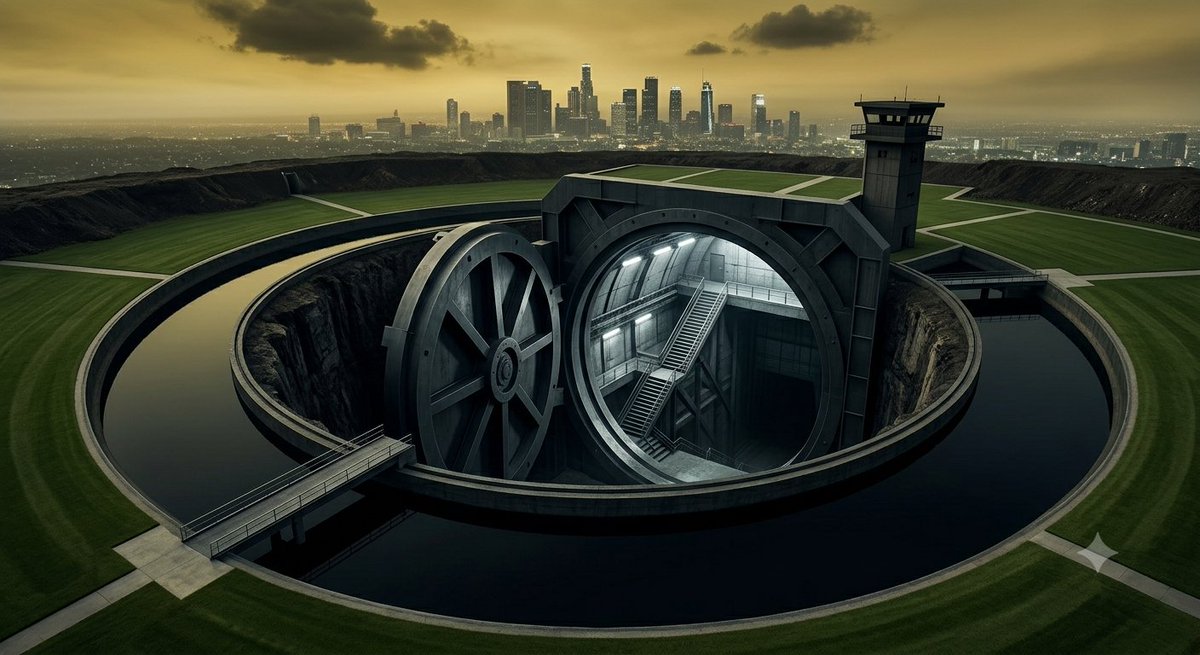
The firm's most spectacular known project -- due to be completed in 2025 -- is an island fortress on a 200-acre US property. The compound can withstand a blast from one mile at ground zero. Its defensive perimeter includes a 30-foot-deep lake surrounding the property skimmed with a lighter-than-water flammable liquid that can be ignited into a ring of fire. The only access is a single swing bridge. Water cannons are mounted to take down "parachuters, Apache helicopters, whatever's coming your way 500 feet in the air." The client is a business mogul whose name has not been disclosed.
.
THE GEOGRAPHY OF ESCAPE
New Zealand -- The Capital of Elite Flight
New Zealand is the undisputed headquarters of billionaire exit planning, and the reasons are not mysterious: political stability, a functioning democracy, geographic remoteness from any likely nuclear exchange, a Westernized culture, and a government willing to sell residency to anyone with enough money. The country offers what amounts to the world's most exclusive insurance policy against the civilization the buyers helped build.
In April 2025, New Zealand launched a revised "golden visa" program: residency in exchange for NZ$5 million to NZ$10 million invested over three years, retained for life once granted. The English language requirement was dropped. The time requirement was relaxed. The applications flooded in. Of the 1,833 people who applied in the program's early months, nearly 40% -- 617 -- were wealthy Americans. One Auckland venture capitalist noted: "Never in my time in New Zealand did I have an applicant reference Biden or Obama -- and then, absolutely, a lot of references to people's feelings towards MAGA and Trump."
New Zealand immigration website visits rose nearly 2,500% immediately after Trump's first election in 2016. They quadrupled after the Supreme Court overturned Roe v. Wade in 2022. After Trump's second election, the golden visa program saw a surge that the government described as a "flood of formal interest."
For reference: visits to New Zealand's immigration website have never spiked in response to a Democrat winning the presidency. The flight instinct, it turns out, is directional.
.
Indian Creek Island, Miami -- The Fortified Enclave
Indian Creek Island is a 300-acre man-made barrier island in Biscayne Bay, developed in the 1920s and incorporated as its own village in 1939 with its own government, police force, and municipal services. It has 41 residential lots, a single guarded bridge as its only land access, radar and thermal surveillance covering the surrounding water, and a private police force that patrols by boat as well as land. The island's motto: "Protect. Serve."
It is not a bunker. But it functions like one: controlled access, private security, legal autonomy, and a population composed entirely of people who can afford to pay whatever it costs to stay inside.
.
Fiji, the Scottish Highlands, and the Czech Countryside
Larry Page bought at least one private island in Fiji's Mamanuca archipelago and the local government suppressed press coverage of his presence. Peter Thiel's New Zealand compound plans were blocked by environmentalists, but not before establishing New Zealand's South Island as something close to the default bunker destination for the American tech class. The Scottish Highlands have emerged as an alternative enclave for wealthy Europeans. The Czech countryside, beneath which the Oppidum sits, was chosen specifically because it lies in one of Europe's geologically and politically stable zones, within manageable distance of financial centers but well away from any obvious nuclear target.
.
THE EUROPEAN DIMENSION
The bunker impulse is not confined to American billionaires. In Europe, the Ukraine war has functioned as a mass accelerant.
Private bunker construction in Spain has risen by 200% since Russia's full-scale invasion in 2022. Germany is seeing surging demand for private "protection rooms" costing up to €150,000, with companies that specialize in converting residential basements or building new fortified structures now operating on backlogs. Italian bunker firm Minus Energie received more inquiries in two weeks following the Ukraine invasion than in its previous 22 years of operation -- and had to rapidly develop cheaper, smaller models for middle-class clients who could not afford the standard luxury units.
In Germany, France, Norway, Finland, and Sweden, governments are distributing war manuals to civilians and urging preparation of 72-hour survival kits. Russia, meanwhile, is mass-producing mobile nuclear shelters for its own population.
Switzerland stands alone as the only country in the world where providing nuclear shelter for the entire population is enshrined in law. It currently maintains approximately 9,000 public shelters and 360,000 private bunkers -- more shelter capacity than it has citizens. Finland has 50,500 shelters with space for 4.8 million people. Norway maintains roughly 20,000 shelters accommodating 2.5 million.
Sweden's civil contingencies agency is conducting a €9 million inspection program to ensure its shelters can be operational within 48 hours. Stockholm's Elefanten bunker -- decommissioned for 17 years -- has been brought back into service.
What is happening in Europe is not billionaires buying comfort. It is an entire continent quietly concluding that the probability of a major armed conflict has crossed some threshold it had not crossed since the Cold War. The billionaires and the European governments are looking at the same data and reaching the same conclusion. The difference is that the billionaires are building private exits and the governments are, at least in some countries, building public ones.
.
THE MOMENT NOBODY WANTS TO TALK ABOUT
In 2022, media theorist and author Douglas Rushkoff was summoned to a private desert resort by five anonymous billionaires for what he was told was a talk on the future of technology. Instead he found five of the world's wealthiest men asking him variations on a single question: How do I survive what's coming? They called it "The Event" -- their collective euphemism for whatever environmental collapse, social unrest, nuclear exchange, solar storm, unstoppable virus, or infrastructure hack would take everything down.
"They were asking me how to insulate themselves from the social unrest, climate change, and technological disruption that their own ventures had helped to cause," Rushkoff later wrote. Their solutions ranged from fortified bunkers to New Zealand to outer space -- all while leaving the rest of humanity to face the consequences.
The meeting's final and most revealing question: How do I maintain control of my security force after my money is worthless? They had all contracted private armed guards. They understood that in a post-collapse world, the man with the gun does not need to follow the orders of the man with the useless currency. They also asked whether disciplinary collars or withheld food rations could be used to ensure guard compliance. They had no answer. Neither did Rushkoff.
NYU professor Scott Galloway relayed a related account from someone close to a prominent AI CEO. That CEO admitted he believes there is a 7 to 10 percent chance AI results in a catastrophic event for humanity -- and that he does not care, because being the person who summoned the new intelligence is more historically consequential than whatever follows. The Venn diagram of people working on AI safety and people investing in bunkers, bolt-holes, and backup citizenships is, as one analyst put it, practically a circle at the top of the tech wealth pyramid.
One elite security firm described its clients without apparent irony: "World events have shifted from political theater to geopolitical crisis. And for those with deep insight and access to elite-level intelligence, the existential implications are undeniable. They're acting accordingly."
A bunker salesperson saying, in plain language, that the people who know most about what is coming are building exits. The rest of us are not invited.
.
THE BOTTOM LINE
There is nothing especially new about what these men are doing. The pharaohs filled tombs with gold, grain, and servants under the impression that the next world would honor the same hierarchies as this one. Medieval lords built fortified keeps and starved out the surrounding peasants when the food ran short. The Soviet nomenklatura kept dachas and special hospitals while telling everyone else they lived in a workers' paradise.
The bunker is the latest iteration of the oldest pattern in human history: the powerful making private arrangements for a future they expect to be worse than the present they are helping to create.
What is different now is scale, speed, and the particular quality of the hypocrisy. These are not feudal lords who claim to be appointed by God. These are men who built their fortunes on platforms that promised to connect humanity, on AI systems that promise to save it, on companies whose stated missions involve the benefit of all people. They give speeches at Davos about existential risk and global responsibility. They run foundations bearing their names. They testify before Congress about the importance of a free and open internet. And then they go home and check on the blast-resistant door.
.
SOURCES
Wired, "Mark Zuckerberg Is Building a Massive Compound on Kauai," December 2023 | Fortune, "Mark Zuckerberg's reported $100 million compound in Hawaii comes with an underground bunker," January 29, 2024 | Bloomberg, Emily Chang interview with Mark Zuckerberg, December 2024 | Hollywood Reporter, "Billionaires' Survivalist Bunkers Go Absolutely Bonkers With Fiery Moats and Water Cannons," February 2024 | The New Yorker, "Doomsday Prep for the Super-Rich," January 2017 | Bloomberg, "The Super Rich of Silicon Valley Have a Doomsday Escape Plan in New Zealand," 2018 | Business Insider, "How wealthy tech leaders have prepped for a possible doomsday," 2024 | Republic World, "Inside the Doomsday Bunkers of Peter Thiel, Mark Zuckerberg and Sam Altman," August 2025 | Interesting Engineering, "Why are billionaires buying islands and building secret bunkers?" May 2025 | NaturalNews. com, "The billionaire escape plan: The secret doomsday bunkers of tech elites," May 8, 2026 | Economic Collapse Report, "Billionaire Bunkers: The Men Building the Apocalypse Are Buying Tickets Out of It," May 9, 2026 | Silicon Canals, "The billionaire bunker problem," February 2026 | Fox Business, "Inside Miami's Indian Creek Village," March 2026 | Fortune, "Meta CEO Mark Zuckerberg reportedly purchasing Indian Creek Island mansion," February 2026 | NBC News, "Amazon founder Jeff Bezos buys home in Miami's 'Billionaire Bunker,'" 2023 | The Guardian, "Rich Americans Fleeing Trump Scramble for Overseas Golden Visa Scheme," 2025 | Euronews, "Construction of private bunkers in Spain rises 200% as fears of war in Europe grow," April 2025 | Irish Times, "Germany's bunker boom: war fears spark demand for protective rooms," November 2025 | Newsweek, "Sweden Bunker Preparation Russia," April 2025 | France 24, "Finland's colossal bomb shelters a model for jittery Europe," April 2025 | Douglas Rushkoff, Survival of the Richest: Escape Fantasies of the Tech Billionaires, W.W. Norton, 2022 |
.
Copyright © 2026 by Robin Riley Reynolds / All Rights Reserved
.
2
6
378
Sam Gulikers retweeted

🇩🇪 Mario Voigt, minister-president of Thuringia, is accused of giving a “100 per cent AI-generated” address in January to commemorate Nazi victims
Read more about the allegations ⬇️
telegraph.co.uk/world-news/2…
12
15
4,622