

Jun 11
The one-command install is cool, no one wants to fight a virtualenv just to try a desktop agent.
44

Jun 10
1. It loves to just write text on forms even if it's an AcroForm.
2. The bundled runtime cannot work on encrypted PDFs. I have to install a virtualEnv with cryptography.
3. It will put too much text in little space, causing wrapping/trunc.
Japanese Tax PDF troubles...
14

Créer et activer un virtualenv pour isoler les scripts | Expert CyberSecurité & DevSecOps :...
3

Jun 10
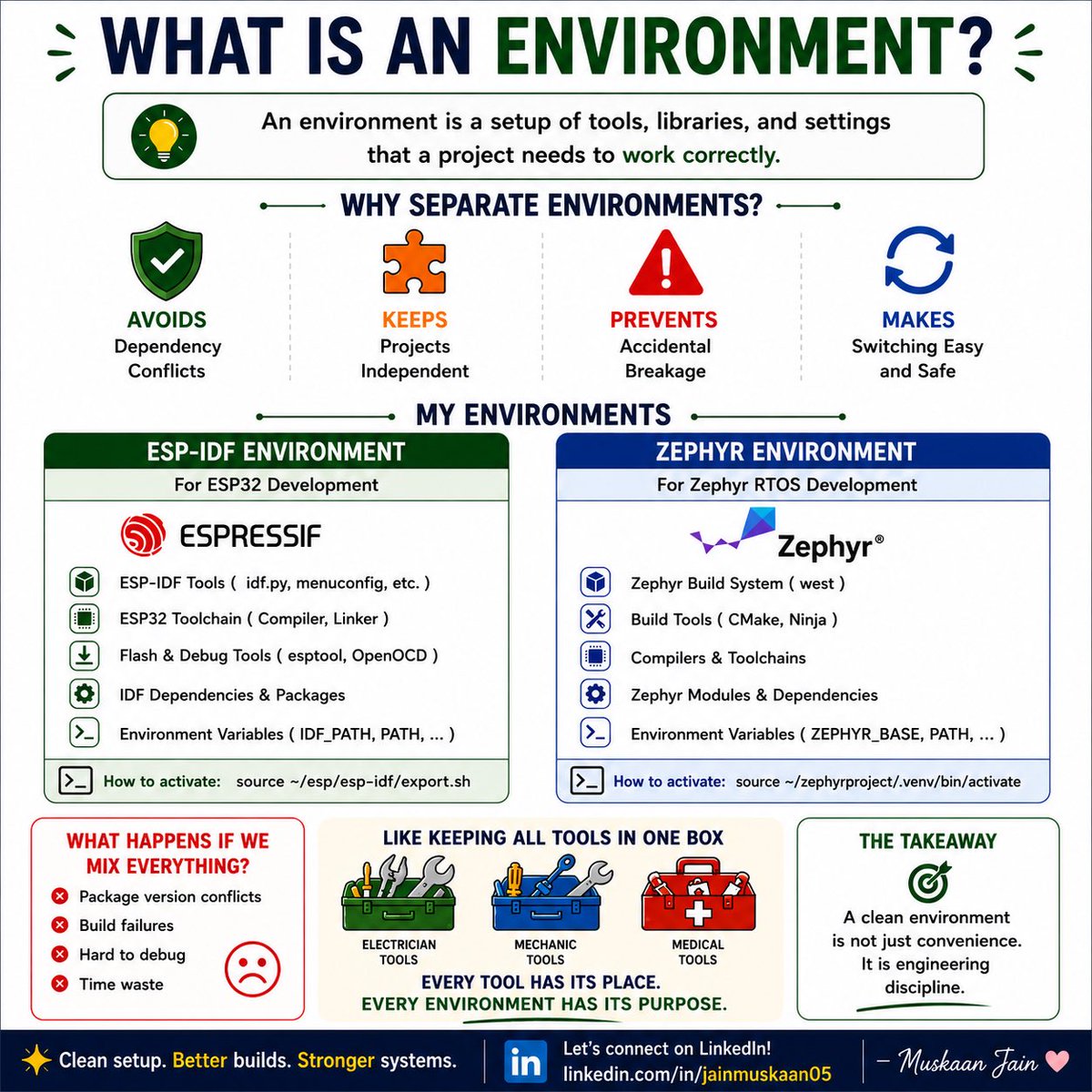
Many devs think “environment” = just Python virtualenv.
Wrong.
An environment is the full consistent setup your project needs.
• ESP-IDF - its own toolchain & flash tools
• Zephyr - its own West RTOS stack
• Python - isolated packages
Mixing them all is like keeping electrician, mechanic, and surgeon tools in one box.
It might work… until it doesn’t. Then debugging becomes hell.
Separate environments = engineering discipline.
Especially important in embedded & firmware.
Clean setup = fewer headaches.
#EmbeddedSystems #ESP32 #Zephyr #Firmware #Python
1
547


May 24
I'm not surprised in the case of proper, self-contained apps;
I have a feeling that the blame of Docker primarily falls on the Python ecosystem, who somehow can't seem to make 2 minor versions of anything cross-compatible, and have whacky tricks like "virtualenv" to "fix" that.
3
33


May 23
A 35-year-old marketer from Hong Kong quit his job and got deeply into AI. Using Claude, he made $360,000 in just ONE month.
He built a perfect BTC price simulation engine with MiroFish. Claude as the algorithm's brain. $5,000-$15,000 profit per trade.
I made $28,200 in 21 days copy-trading him.
I've made the exact build guide. Giving It Free for 24 hours.
To get it:
1. Comment "CLAUDE"
2. Like and Retweet
3. Follow me @codewithimanshu (Only then, i can DM you)
You only need Claude a laptop 1 hour/day.
The wallet that started this.
His Polymarket handle: marketing101. A quiet joke about his old career.
$366K all-time profit. Constantly fades the crowd because his simulation reads the market better than everyone else.
I reverse-engineered his stack. Had Claude rebuild the same simulation engine.
20 minutes. Done.
What the bot actually does:
→ Pulls live BTC data from Binance Coinbase Bybit WebSockets
→ Pulls closed order book depth most retail traders never see
→ Cross-references private OTC desk feeds for institutional flow
→ Feeds the entire context into MiroFish force-graph engine
→ Runs 10,000 simulation cycles before every single trade
→ Detects mispricing the moment Polymarket diverges from real BTC value
→ Executes when simulated edge exceeds 5% probability gap
→ Skips when liquidity thin, signal conflicts, or daily cap hits
→ Auto-rebalances position sizing based on Bayesian win-rate updates
What makes this different from every retail bot:
→ Closed order book data, not just public Binance feed
→ Private OTC desk integration (institutional-grade alpha)
→ 10,000 Monte Carlo cycles per trade (most bots run zero)
→ Claude reasons over every signal in real time
→ Already elite alpha. Already public proof.
Risk controls baked in:
→ Per-trade risk: half-Kelly sizing
→ Daily cap: 2% of bankroll
→ Auto-halt on 5 consecutive losses
→ Paper mode default. Live requires explicit flags.
→ Runs on local terminal. No cloud. No GPU.
The setup checklist:
→ Polymarket wallet on Polygon. USDC funded. $500-$1,000 to start.
→ CLOB API key from docs of polymarket
→ Claude API key for the simulation reasoning
→ MiroFish setup (open source, 18K GitHub stars)
→ Telegram bot for live alerts
The deployment path:
→ Generate the simulation engine with corrected prompt in Claude Code
→ Python 3.11 , virtualenv, pip install
→ Run paper mode for 7 days minimum
→ Need 200 trades, 75% win rate, 0 crashes before going live
→ Deploy to $5/month VPS for 24/7 uptime
→ Start live with $100. Scale after 50 live trades.
The edge:
→ Not "guessing where the chart will go"
→ Pure fusion of AI MiroFish insane math on exclusive data
→ Profit captured from running 10,000 versions of every market reaction before the market moves
The expiry date:
→ Polymarket detects whale convergence patterns
→ Closed order book data leaks into public feeds
→ Multi-simulation setups become standard
→ Window closes within 12 months
He's not predicting the future.
He's running 10,000 versions of every market reaction before the market moves.
You're staring at charts hoping for a setup.
He's running Monte Carlo simulations while you sleep.
Don't want to build it? Copy his wallet directly with even $10:
Polymarket is not legal for US residents. Check your country first.
Save this post. Build the simulation engine this weekend. Start with $100. Scale on evidence.
You Must Follow me @codewithimanshu, so i can send you DM.
130
78
183
51,020

May 20
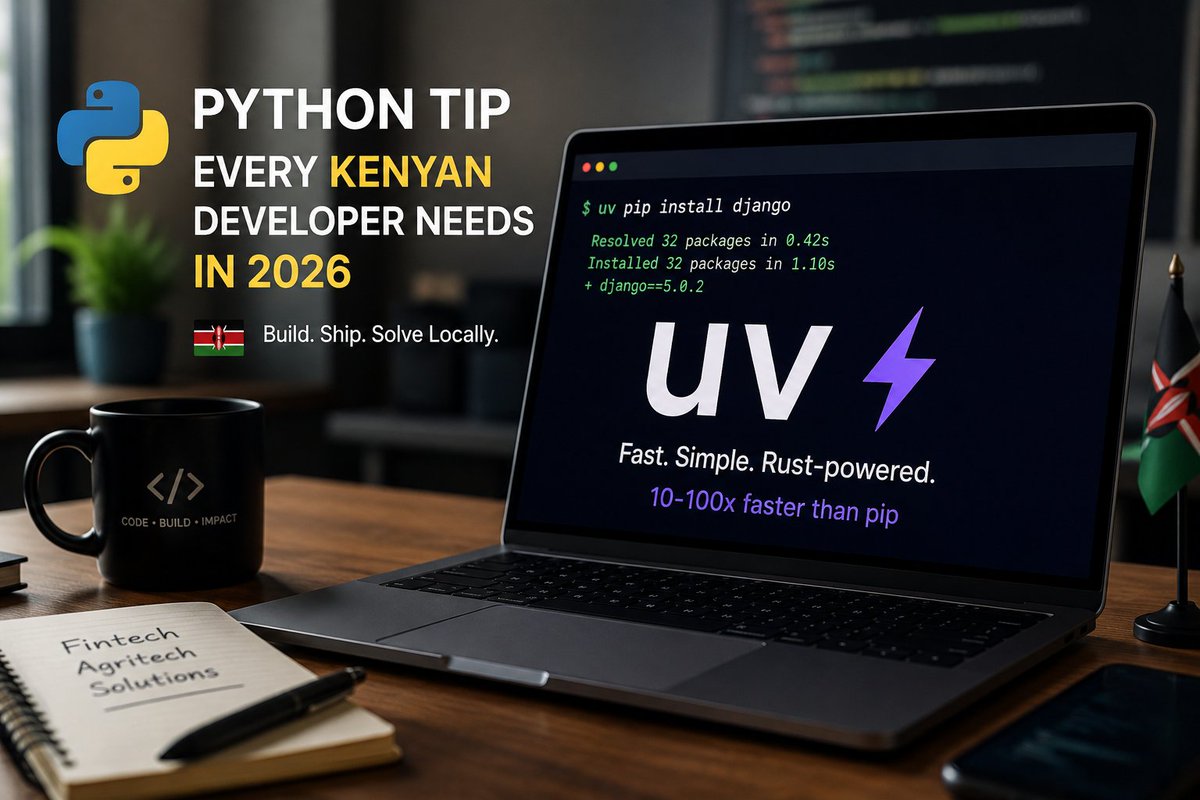
🚀Python Tip for Kenyan Developers 🇰🇪💻
Building apps in Kenya? Try UV the super-fast Rust-powered replacement for pip and virtualenv.
Why devs love it:
Faster installs, even on slow internet
Simple project setup and package management
Great for Django, FastAPI and Flask projects
1
3
54

May 19
If you still use pip virtualenv pyenv poetry separately in 2026, you're doing too much work.
uv replaces most of that with one binary.
uv venv
uv pip install
uv run
uv tool install
That is the API.
2
12

May 19
What are the most popular Python build tools in 2026? 🐍
The landscape has changed quite a bit:
• uv - The new standard. 10-100x faster than pip, replaces pip, virtualenv, pyenv, and pip-tools in one tool
• Poetry - Still solid for library publishing and teams already using it
• pip - The classic default that ships with Python
• Conda - Best for data science and scientific computing
• setuptools - The traditional build backend
• hatch - Modern build tool with good plugin ecosystem
• PDM - Standards-compliant with PEP 582 support
uv has become the go-to for new projects because it handles everything: package installation, virtual environments, Python version management, and lockfiles.
What build tool are you using?
3
1
14
1,822

May 17
🐍 What the Virtualenv?! Python Dependency Management Pitfalls
This is a free 5-day email course for Python developers looking to avoid common dependency management issues with tools like Pip, PyPI, Virtualenv, and requirements files.
realpython.com/dependency-pi…
1
12
1,697

May 16
I learned 3 ways to create a Python virtual environment today:
venv → Built into Python, best for most projects
virtualenv → More flexible, works with older versions
conda → Great for ML/Data Science projects
#python #coding #Programming #Machinelearning #Datascience
2
51

4/4 🛡️ Why it matters
This helps detect if the installed agent source has been swapped, modified, or replaced with an alternate version.
Important: v1 verifies tracked source files. It does not verify runtime secrets, local config, caches, logs, memories, virtualenv dependencies, or untracked files.
Compatible from 0.13.0
Please report any bugs 🙏
2
5
509

May 12
you gotta try poetry bro, you gotta try pipenv. you gotta try uv bro, its written in rust. you gotta try conda bro, just use mamba instead. you dont need any of this shit bro you can just use requirements.txt virtualenv nix guix a fresh EC2 instance. you can use docker bro. you could try pipx you can try pdm you can try huak you can try pixi you can try rye you can sacrifice a goat to baal you can rip out the hearts of python package manager developers on the steps of teotihuacan and feed your dependency solvers the unending rivers of blood. China didnt do Tiananmen Square I did. tank man was holding up my virtual environment. i'm installing pytorch with package managers that dont even exist yet. pipenv is what killed princess diana. this shit is normal bro have you even used pip-tools? it's a great ecosystem bro. cargo has nothing on this. we moved from poetry to uv and our CI actually runs now. it's almost as good as when we moved from pipenv to poetry. last time I installed anything with conda it took 8 hours but they added a feature where an anaconda literally comes out of the PC and sucks your dick while you wait. it's fixed bro. this is a great ecosystem.
4
14
1,016
May 11
A 35-year-old marketer from Hong Kong quit his job and got deeply into AI. Using Claude, he made $360,000 in just ONE month.
He built a perfect BTC price simulation engine with MiroFish. Claude as the algorithm's brain. $5,000-$15,000 profit per trade.
I made $28,200 in 21 days copy-trading him.
I've made the exact build guide. Giving It Free for 24 hours.
To get it:
1. Comment "CLAUDE"
2. Like and Retweet
3. Follow me @codewithimanshu (Only then, i can DM you)
You only need Claude a laptop 1 hour/day.
The wallet that started this.
His Polymarket handle: marketing101. A quiet joke about his old career.
$366K all-time profit. Constantly fades the crowd because his simulation reads the market better than everyone else.
I reverse-engineered his stack. Had Claude rebuild the same simulation engine.
20 minutes. Done.
What the bot actually does:
→ Pulls live BTC data from Binance Coinbase Bybit WebSockets
→ Pulls closed order book depth most retail traders never see
→ Cross-references private OTC desk feeds for institutional flow
→ Feeds the entire context into MiroFish force-graph engine
→ Runs 10,000 simulation cycles before every single trade
→ Detects mispricing the moment Polymarket diverges from real BTC value
→ Executes when simulated edge exceeds 5% probability gap
→ Skips when liquidity thin, signal conflicts, or daily cap hits
→ Auto-rebalances position sizing based on Bayesian win-rate updates
What makes this different from every retail bot:
→ Closed order book data, not just public Binance feed
→ Private OTC desk integration (institutional-grade alpha)
→ 10,000 Monte Carlo cycles per trade (most bots run zero)
→ Claude reasons over every signal in real time
→ Already elite alpha. Already public proof.
Risk controls baked in:
→ Per-trade risk: half-Kelly sizing
→ Daily cap: 2% of bankroll
→ Auto-halt on 5 consecutive losses
→ Paper mode default. Live requires explicit flags.
→ Runs on local terminal. No cloud. No GPU.
The setup checklist:
→ Polymarket wallet on Polygon. USDC funded. $500-$1,000 to start.
→ CLOB API key from docs of polymarket
→ Claude API key for the simulation reasoning
→ MiroFish setup (open source, 18K GitHub stars)
→ Telegram bot for live alerts
The deployment path:
→ Generate the simulation engine with corrected prompt in Claude Code
→ Python 3.11 , virtualenv, pip install
→ Run paper mode for 7 days minimum
→ Need 200 trades, 75% win rate, 0 crashes before going live
→ Deploy to $5/month VPS for 24/7 uptime
→ Start live with $100. Scale after 50 live trades.
The edge:
→ Not "guessing where the chart will go"
→ Pure fusion of AI MiroFish insane math on exclusive data
→ Profit captured from running 10,000 versions of every market reaction before the market moves
The expiry date:
→ Polymarket detects whale convergence patterns
→ Closed order book data leaks into public feeds
→ Multi-simulation setups become standard
→ Window closes within 12 months
He's not predicting the future.
He's running 10,000 versions of every market reaction before the market moves.
You're staring at charts hoping for a setup.
He's running Monte Carlo simulations while you sleep.
Don't want to build it? Copy his wallet directly with even $10:
Polymarket is not legal for US residents. Check your country first.
Save this post. Build the simulation engine this weekend. Start with $100. Scale on evidence.
You Must Follow me @codewithimanshu, so i can send you DM.
May 10

Anthropic's applied AI team just dropped a 24-minute workshop on how to actually prompt Claude properly.
Free. From the people who built it.
You've been prompting Claude for months without the 6 elements they teach in this.
I built a skill that applies them automatically. Full guide below.
Save This. Watch This Today. Start Building This Weekend.
Follow @codewithimanshu for more high-signal content that actually moves your skills forward.
193
149
386
98,891
May 10
I made $26,400 in 18 days copy-trading a 29-year-old sales consultant from Oklahoma who clears $15,000 per day with AI.
Same Claude MiroFish 6-agent swarm setup he used to clear $306,000 in 1 month. Quit his sales job. Now makes his director's full annual salary every 14 days.
I've made the exact build guide. Giving It Free for 24 hours.
To get it:
1. Comment "Agent"
2. Like and Retweet
3. Follow me @codewithimanshu (Only then, i can DM you)
You only need Claude a laptop 1 hour/day.
The wallet that started this.
29 years old. Oklahoma. Used to sell software door to door. Quit when his bot hit $50K in week 3. Now clears $15K/day on Polymarket ETH markets.
His Polymarket wallet: 0x06dc51826bc524d9a83770e7de9dd7e005b0452
I reverse-engineered his system. Had Claude rebuild it.
20 minutes. Done.
What the bot actually does:
→ 6 specialized agents validate every trade independently
→ Macro strategist agent reads global signals
→ Sentiment agent scrapes social and news flow
→ Order book agent watches Binance depth in real time
→ Flow agent tracks whale wallets entering ETH markets
→ Risk agent calculates position sizing per Kelly
→ Execution agent fires the trade only when 5/6 agree
→ MiroFish simulation engine runs 10,000 cycles per decision
→ Skips trades when agents conflict, liquidity thin, or daily cap hits
What makes this different from every other bot:
→ 6 agents in parallel = coverage speed higher than any quant trading desk
→ Memory persists across trades. Every pattern stored. Every reaction logged.
→ Runs 24/7 autonomously. He doesn't touch a button.
→ $15,000/day pulled from pure market inefficiency exploitation
Risk controls baked in:
→ Per-trade risk: quarter Kelly
→ Daily cap: 2% of bankroll
→ Auto-halt on 3 consecutive losses
→ Paper mode default. Live requires manual flag flip.
→ Runs on local terminal. No cloud. No GPU.
The setup checklist:
→ Polymarket wallet on Polygon. USDC funded. $500-$1,000 to start.
→ CLOB API key from polymarket docs
→ Claude API key for agent orchestration
→ MiroFish setup (open source, 18K GitHub stars)
→ Telegram bot for live alerts
The deployment path:
→ Generate the 6-agent system with corrected prompt in Claude Code
→ Python 3.11 , virtualenv, pip install
→ Run paper mode for 7 days minimum
→ Need 200 trades, 75% win rate, 0 crashes before going live
→ Deploy to $5/month VPS for 24/7 uptime
→ Start live with $100. Scale after 50 live trades.
The edge:
→ Not predicting ETH price
→ 6 agents catching inefficiencies single-agent bots miss
→ MiroFish memory stores every pattern and replays it on similar setups
→ Profit captured from precision, not prediction
The expiry date:
→ Polymarket adds copy-trade detection
→ Whale wallets stop being public
→ Multi-agent setups become standard
→ Window closes within 12 months
He doesn't predict the future. The math already knows it.
He just reads the numbers right and takes the money.
Don't want to build it? Copy his wallet directly with even $10:
Polymarket is not legal for US residents. Check your country first.
Save this post. Build the agent stack this weekend. Start with $100. Scale on evidence.
You Must Follow me @codewithimanshu, so i can send you DM.
May 10
Anthropic's applied AI team just dropped a 24-minute workshop on how to actually prompt Claude properly.
Free. From the people who built it.
You've been prompting Claude for months without the 6 elements they teach in this.
I built a skill that applies them automatically. Full guide below.
Save This. Watch This Today. Start Building This Weekend.
Follow @codewithimanshu for more high-signal content that actually moves your skills forward.
175
125
265
41,594
I made $11,200 in 4 Days running this Claude Engine that arbitrages Polymarket against Binance in milliseconds.
The Same bots running this strategy cleared $400K in 2 weeks.
I am Giving Away this Step by Step Build Guide FREE for 24 hours.
To get it:
1. Comment "CLAUDE"
2. Like and Retweet
3. Follow me @codewithimanshu (Only then, i can DM you)
You only need Claude a laptop 1 hour/day.
Use this guide for a clear, step-by-step path from building from scratch to deployment.
Start earning online with a proven system, everything you need is included.
The bots that started this.
Wallets pulling $400K in 2 weeks running latency arbitrage between Binance spot and Polymarket CLOB.
Onchain proof. Public profiles.
Most people don't even know they exist.
I had Claude build the same bot from one corrected prompt.
20 minutes. Done.
Follow @codewithimanshu. I find the bots. I reverse-engineer them. I post the build guides before everyone else catches on.
What the bot actually does:
→ Pulls live BTC and ETH prices from Binance WebSocket
→ Compares against Polymarket CLOB in real time
→ Detects mispriced contracts when Polymarket lags Binance by >5%
→ Executes async in under 800ms from detection to order
→ Captures the gap before the contract reprices
→ 1,000 scans per second across 20 markets
→ Grabs 0.5-1.5% per trade
→ Skips on stale data, thin liquidity, signal conflicts, daily cap hits
→ Auto-reconnects on WebSocket drops with exponential backoff
Risk controls baked in:
→ Per-trade risk: half-Kelly, max 8% of bankroll
→ Daily halt at -20% P&L
→ Permanent halt at 60% drawdown from all-time high
→ 30-min pause after 5 consecutive losses
→ Paper mode default. Live requires 3 explicit flags.
→ Runs on local terminal. No cloud. No GPU.
Follow @codewithimanshu for daily Polymarket bot breakdowns the rest of Twitter is too late to find.
The setup checklist:
→ Polymarket wallet on Polygon. USDC funded. $500-$1,000 to start.
→ CLOB API key from docs. polymarket. com
→ Private key in env variable. Never hardcoded. Never on GitHub.
→ Alchemy free RPC for Polygon. Public nodes too slow.
→ Telegram bot via BotFather for live alerts.
The deployment path:
→ Generate bot with the prompt in Claude Code
→ Python 3.11 , virtualenv, pip install
→ Run paper mode for 7 days minimum
→ Need 200 trades, 75% win rate, 0 crashes before going live
→ Deploy to $5/month VPS for 24/7 uptime
→ Start live with $100. Scale after 50 live trades.
The edge:
→ Not predicting BTC or ETH
→ Exploiting Polymarket's price lag against Binance
→ Profit captured in milliseconds, not days
The expiry date:
→ Polymarket patches the lag
→ Bigger quants enter
→ Edges compress. Window closes within 12 months.
Follow @codewithimanshu for the next AI bot post before Polymarket patches the next edge.
Don't want to build? Copy these wallets directly with even $10:
→ Bot 1: 0x3a847382ad6fff9be1db4e073fd9b869f6884d4
→ Bot 2: 0xe1d6b51521bd4365769199f392f9818661bd907
Polymarket is not legal for US residents. Check your country first.
The 2 questions everyone's asking in community:
→ How big can this bot scale before Polymarket patches the lag?
→ Will the platform ban it?
The answer is simple, use this and start exploiting it as soon as possible, until this gets patched.
Save this post. Build the bot this weekend.
Start with $100. Scale on evidence.
You Must Follow me @codewithimanshu, so i can send you DM.
OpenAI's own engineers just showed how to actually use Codex properly.
60 minutes. Free. From the people who built it.
You've been using Codex like a simple coding tool. It's actually a full software engineering system.
This 62 minutes is worth more than every $900 coding course you almost bought.
Save it. Watch tonight.
Follow @codewithimanshu for more high-signal content that actually moves your engineering career forward.
↓
Below's everything OpenAI engineers cover in this masterclass.
What Codex actually is. Most people use it like ChatGPT for code. It's a full software engineering agent with capabilities most users never touch.
Foundation models powering it. GPT-5.3, Spark, GPT-5.4. The evolution from basic completions to Fast Mode and Websockets. Why latency dropped 10x in months.
Codex app features. Projects. Work trees. The architecture that lets you run multiple parallel coding sessions without context collapse.
Automations. Slack integration. Gmail automation. Codex doesn't just write code. It triggers entire workflows across your stack.
Plugins. Skills. Apps. MCP servers. Same protocol Claude Code uses. The infrastructure layer that turns Codex into your entire engineering team.
Game and web dev plugins. Playwright. Image Gen. Live demos building game studio assets and full web pages from prompts.
Google Drive integration for codebase data. Pulling context from your actual files, not just what you paste into chat.
Code review and GitHub integration. Codex as your automated PR reviewer. Catching bugs before humans see them.
Subagents. The feature 99% of users miss. Parallelizing tasks across multiple AI personas, each specialized for a different job.
Custom subagent creation. Building your own AI engineering team. Each agent with its own personality, role, and specialty.
Bleeding edge features. Guardian approvals. Hooks. Personality settings. Codex security. Cloud Code plugin. The features OpenAI hasn't even marketed yet.
↓
It's the operating manual, not just a tutorial.
Most engineers will watch 5 minutes, get overwhelmed, and click away. The ones who push through learn how to ship 10x faster than everyone else on their team.
People who watch this understand Codex at the engineer level OpenAI builds it for.
People who skip it keep using it like a glorified autocomplete.
Save the video. Watch it tonight. Apply one feature tomorrow.
Follow @codewithimanshu for more high-signal content that actually moves your engineering career forward.
177
104
281
42,843