
Spotlight 🛰 on the mysteries and breakthroughs of science and technology 🚀
Joined October 2025
- Tweets 75
- Following 21
- Followers 5
- Likes 31
69 Photos and videos



A Donut Discovery Just Broke a 150 Years Math Law
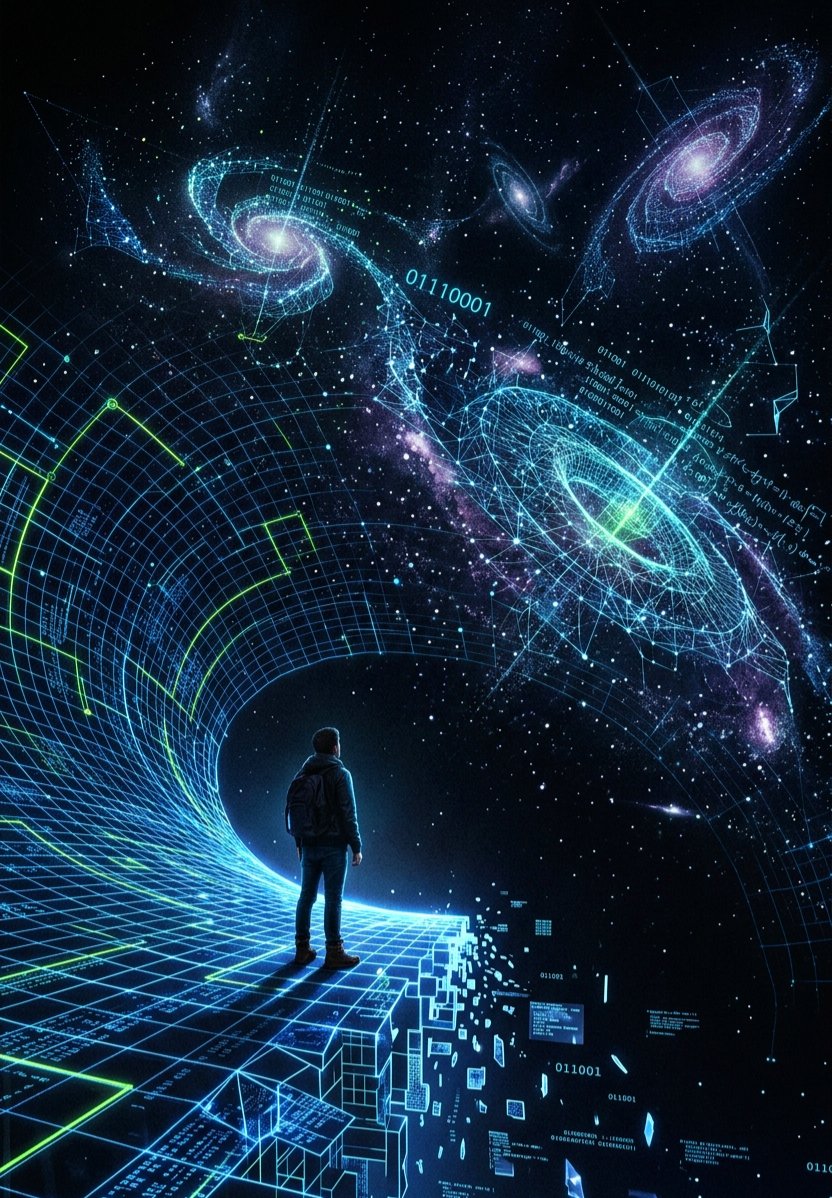
For 150 years, a principle in geometry held firm: if you know how a surface measures distance and how it curves at every point, you know exactly what that surface is. The rule was so reliable mathematicians barely questioned it. A French mathematician named Pierre Ossian Bonnet established it in 1867, and it quietly became one of geometry's unspoken certainties.
Bonnet's rule said that if two key properties of a surface - its metric and its mean curvature - are known at every point, the surface's overall shape can be uniquely determined. The metric captures internal distances. The mean curvature captures how the surface bends. Together, they were supposed to be enough to identify any compact surface completely.
They weren't.
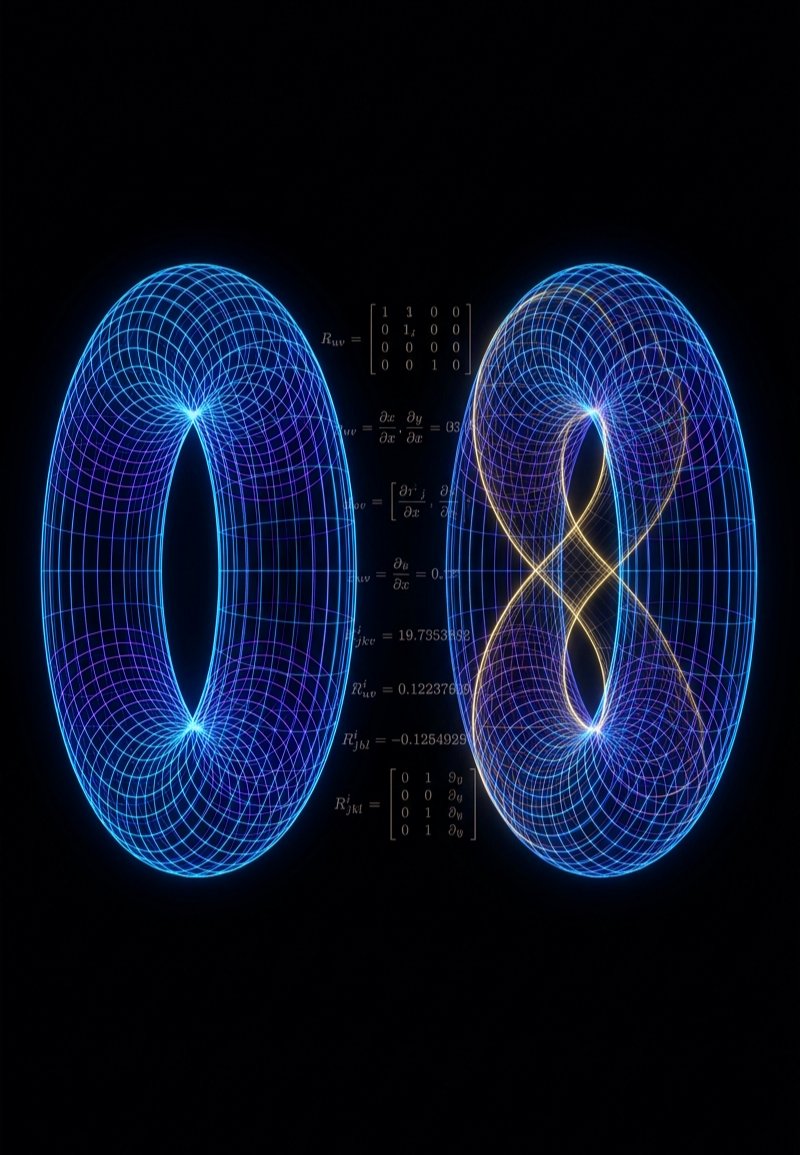
A team of mathematicians from the Technical University of Munich, the Technical University of Berlin, and North Carolina State University managed to disprove this recognized rule. They constructed two compact, doughnut-shaped surfaces - known as tori - which have the same metric and mean curvature, even though they are structurally different on a global scale.
Same local measurements. Different global shapes. A mathematical ghost. The result surprised mathematicians like Rob Kusner of the University of Massachusetts, Amherst. It demonstrates that even tori - among the best-studied surfaces in geometry - cannot always be perfectly described by their local characteristics. "It's an example of something where our intuition wasn't good enough," said Robert Bryant of Duke University.
The team spent years hunting for this example. The breakthrough came through discrete mathematics - pixelated, low-resolution approximations of smooth surfaces - which ultimately provided the tools to construct the pair. The two tori they found are strange objects: they pass through themselves like figure eights. But they exist. And their existence is enough to break the rule entirely.
What makes this unsettling isn't just the math. It's what it implies about identity itself. Two objects can be locally indistinguishable - same distances, same bending, same geometry at every measurable point - and still be fundamentally different things. Local truth doesn't always add up to global truth.
The study was published in the peer-reviewed journal Publications mathématiques de l'IHÉS.
4
The Dead Zone Between Earth and the Moon
Something strange is hiding in the space between Earth and the Moon, and it took a robot on the lunar far side to find it.
China's Chang'e 4 lander has been quietly measuring cosmic ray radiation since 2019, logging data across 31 lunar cycles. What it found rewrites how we think about the invisible particle storm that never stops blowing through the solar system.
Galactic cosmic rays (GCRs) are high-speed charged particles - mostly protons - hurled outward by supernova explosions across the galaxy. They arrive from every direction, all the time, and they're dangerous. On Earth, our atmosphere absorbs them before they reach us. In space, they're a serious threat: ionizing radiation capable of damaging DNA, raising cancer risk, and threatening the health of any astronaut unlucky enough to absorb too much of it.
Scientists assumed GCRs were roughly uniform throughout the Earth-Moon region. They were wrong.
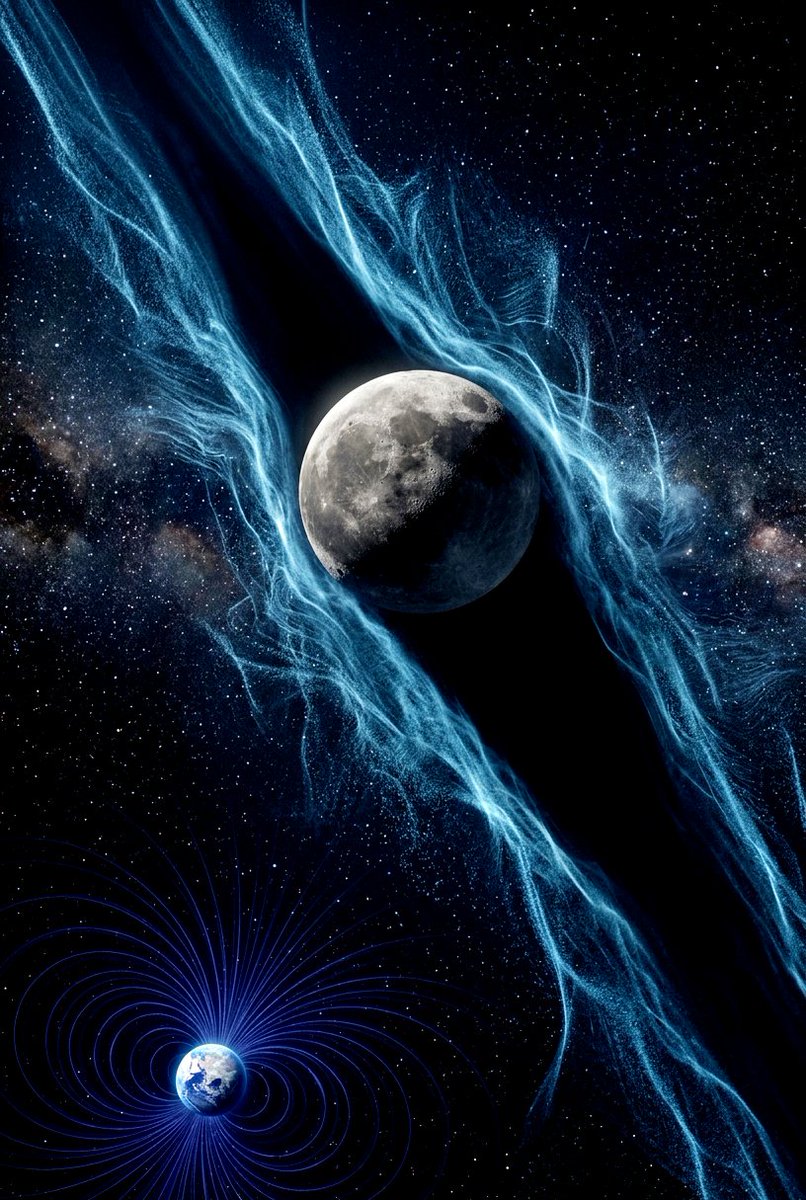
During one specific phase of the Moon's orbit - the prenoon sector, before it crosses local noon relative to the Sun - Chang'e 4 recorded a consistent 20 percent drop in proton flux. The Moon was passing through a cosmic ray cavity. A dead zone in the radiation field.
The culprit appears to be a rare alignment between two magnetic structures: Earth's planetary magnetic field and the Sun's interplanetary magnetic field. As the Sun rotates, its magnetic field spirals outward in a shape astronomers call the Parker spiral.
When this spiral tilts toward Earth in just the right geometry, its field lines connect to Earth's strong magnetic field, and the two together create a kind of radiation shadow. Cosmic ray protons following those field lines get deflected or blocked before they reach the Moon.
The effect lasts roughly two days each lunar cycle. Brief. Predictable. Potentially life-saving.
Researchers say future crewed lunar missions and spacewalks could be deliberately timed to coincide with this protective window, reducing astronaut radiation exposure without any new technology required.
The universe may be relentlessly hostile. But it leaves patterns. And patterns, once found, become tools.
15
The Quantum Clock Is Ticking on Internet Security
Everything you encrypt online - your passwords, your bank account, your private messages - may be far more vulnerable than anyone told you. And the threat isn't decades away. It could arrive within years.
Scientists have long assumed that cracking modern internet encryption would require a quantum computer with millions of qubits. That assumption just collapsed. Researchers have calculated that a widely used encryption method called elliptic curve cryptography could be broken with a quantum computer of just 9,988 qubits, though it would take about 1,000 days.
Push the qubit count higher and the timeline shrinks dramatically. With around 26,000 qubits, the same encryption could be broken in a single day. Another dominant standard, RSA-2048, would require 100,000 qubits and 10 days to break, a target increasingly within reach.
The dramatic downward revision is driven by breakthroughs in quantum error correction. The two papers harness advanced types of quantum error correction called quantum low-density parity check codes, which can produce reliable logical qubits far more efficiently than standard schemes. Just a few years ago, 20 million qubits were thought to be required for the same task.
The implications extend beyond privacy. Bitcoin and other cryptocurrencies that rely on elliptic curve cryptography face existential exposure if quantum computers reach this threshold.
The scientific community is sounding the alarm in plain language. Computer scientist Scott Aaronson called it "an even stronger impetus for people to upgrade now to quantum-resistant cryptography."
The quantum era isn't arriving slowly. It's accelerating and the digital world isn't ready.
16
Ultrafast Quantum Light Measured for the First Time
For the first time in history, scientists have successfully measured the duration of individual pulses of one of quantum physics' most bizarre and elusive forms of light, and what they found is staggering.
Researchers at the Technion, which is the Israel Institute of Technology, have measured the temporal duration of individual bright squeezed vacuum (BSV) quantum light pulses for the first time, revealing pulse lengths of approximately 27 femtoseconds, that's 27 quadrillionths of a second. Welcome to the ultrafast regime.
But what exactly is bright squeezed vacuum? BSV is a unique quantum state of light, although formally considered a vacuum state with zero average electric field, it exhibits enormous quantum fluctuations due to the squeezing effect. In other words, it's technically "empty," yet seething with quantum energy beneath the surface. Reality at its strangest.
To capture these ghostly pulses, the Technion team engineered a new interferometric technique. They combined the BSV light with carefully controlled laser pulses in a beam splitter. When the two light beams overlapped, they produced interference patterns. By recording and analyzing many of these patterns, the researchers reconstructed the time-dependent electric field shape of every single pulse.
The measurements confirmed something deeply quantum: when averaging over many pulses, the electric field of BSV is indeed close to zero, which is a tell-tale sign of a vacuum state of light. Yet each individual pulse carries enormous, real energy fluctuations.
Why does this matter? BSV pulses may enable new approaches to probing extreme light-matter interactions with minimal material damage, opening doors in quantum sensing, quantum computing, and probing the deepest structures of matter at timescales never before accessible.
The universe runs on pulses we're only just beginning to see.
10

Mar 30
Reality Just Got Stranger. Scientists Watched Atoms Exist in Two Places at Once
Quantum mechanics has always made a promise that sounds like pure science fiction, that matter, at the smallest scales, doesn't have to choose a single location. It can exist in two places simultaneously. For a century, this idea lived mostly in equations and thought experiments. Now, for the first time, scientists have watched it happen with actual atoms.
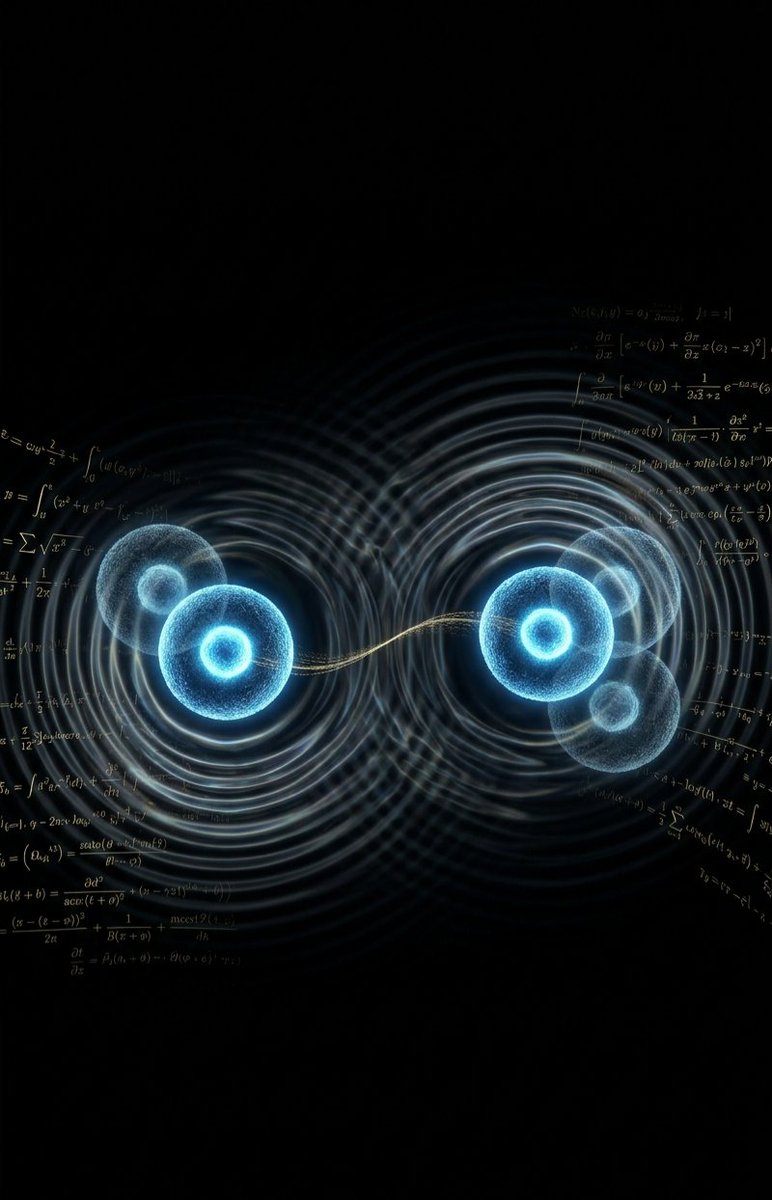
Quantum physicists at the Australian National University have observed pairs of helium atoms entangled in motion, existing in two locations at once simultaneously. Their experiment represents a major advancement over similar experiments previously conducted using photons, which are particles of light.
The distinction matters enormously. Unlike photons, helium atoms have mass and experience gravity. Demonstrating quantum superposition with massless particles is one thing. Showing that physical matter - stuff that weighs something, stuff that gravity pulls on - can inhabit two places at once is something else entirely. It brings the strangeness of quantum mechanics one step closer to the world we actually live in.
Lead researcher Yogesh Sridhar noted that several teams had previously attempted to demonstrate these effects with atoms and had always fallen short. The difficulty of achieving this experimentally cannot be overstated.
The result confirms predictions made over a century ago, that matter can be in two locations simultaneously and can interfere with itself even across those locations. Seeing it happen in a laboratory, with real atoms, is a different category of confirmation entirely.
The implications reach far beyond the experiment itself. The development opens new ways to examine one of the deepest unsolved problems in all of physics: how the small-scale rules of quantum mechanics interact with gravity and general relativity at the universal scale. These two frameworks, both extraordinarily well-tested, have never been reconciled into a single theory.
This experiment may be a step toward that reconciliation. Reality is not what it appears. At its most fundamental level, the universe does not commit to a single location until forced to.
Everything you see exists somewhere between possibility and fact.
20
Mar 30
Scientists Just Figured Out How to Store Entire Data Centers Inside a Beam of Light
The world is drowning in data. Every photo, message, video, and AI query adds to a mountain of information that demands more storage, more energy, and more physical space than we currently have. The hard drive and the data center are running out of room. But a breakthrough from researchers in China may have just pointed to the solution, and it uses light.
Scientists have developed a new holographic data storage method that records and retrieves information in three dimensions by combining three key properties of light simultaneously: amplitude, phase, and polarization. By using all three together, the approach allows dramatically more data to be stored within the same physical space.
Traditional storage writes data onto flat surfaces: hard drives, optical discs, chips. It's fundamentally two-dimensional. Holographic storage is different. Rather than writing on a surface, holographic storage embeds information throughout the entire volume of a material using laser light, creating multiple overlapping light patterns within the same space, significantly increasing storage capacity and enabling faster data transfer.
The challenge has always been reading that data back reliably. Light's phase and polarization are invisible to standard sensors, which can only detect brightness. To solve this, the team used a convolutional neural network - a type of deep learning AI - trained on two complementary diffraction images to simultaneously reconstruct all three dimensions of encoded data from intensity measurements alone.
The AI essentially learned to see what sensors cannot.
With further development, this approach could enable smaller data centers and more efficient large-scale archival storage, while also contributing to optical encryption and advanced imaging.
The implications go beyond storage capacity. As AI systems grow more demanding and global data generation accelerates, the infrastructure holding it all together is becoming a bottleneck. A storage medium that packs exponentially more information into the same space - using light rather than magnetic or electronic signals - could reshape computing infrastructure entirely.
The system is still in the research stage, with future work focused on improving encoding capacity, material stability, and integration between optical hardware and AI decoding algorithms.
The future of data isn't on a hard drive. It's inside a beam of light.
19
Mar 30
Scientists Just Found a Hidden Secret Inside Water — And It May Explain Why Life Exists
Water is the most studied substance on Earth. We have mapped its molecules, measured its properties, and built entire fields of science around understanding it. And yet, for over a century, water has been hiding something.
Researchers at Stockholm University have used ultra-fast X-ray lasers to uncover a long-suspected hidden feature of water, a critical point that appears when water is deeply supercooled to around -63°C under extreme pressure. Even under everyday conditions, this hidden point influences how water behaves, helping explain many of its most unusual properties.
Water has always broken the rules. Most liquids contract and become denser as they cool. Water reaches maximum density at 4°C, then starts expanding again as it gets colder. Ice floats instead of sinking. Compressibility and heat capacity behave in ways opposite to every other known liquid. Scientists have argued for over a century about why.
The answer lies in a secret dual identity.
Under low temperatures and high pressure, water can exist as two distinct liquid phases with different molecular bonding structures. At the critical point, these two forms merge into one, and near this threshold, the system becomes highly unstable, with water rapidly shifting between the two states. These fluctuations ripple outward across a wide range of temperatures and pressures, reaching all the way to normal environmental conditions.
The researchers described the behavior near this critical point as almost inescapable: molecular motion slows so dramatically that one physicist compared it to a black hole: once you enter the critical region, you cannot escape it.
The deeper implication is staggering. One researcher posed the question directly: water is the only supercritical liquid at the conditions where life exists, and there is no life without water. Is this coincidence, or is there essential knowledge still waiting to be uncovered?
Water doesn't just support life. It may be specifically, mysteriously configured for it. The most common substance on Earth is still keeping secrets.
11
Mar 29
Scientists Tried to Confirm a Quantum Computing Breakthrough. What They Found Was Far More Uncomfortable
Quantum computing is one of the most hyped fields in modern science. Breakthroughs are announced. Headlines explode. Stock prices move. And then - sometimes - the breakthrough quietly turns out to be something else entirely.
A team of physicists at the University of Pittsburgh decided to find out how often that actually happens. What they uncovered wasn't just a problem with quantum computing. It was a problem with science itself.
Led by Professor Sergey Frolov, the team carried out a series of replication studies focused on topological effects in nanoscale superconducting and semiconducting devices, an area considered crucial for topological quantum computing, a proposed approach to storing quantum information in a way that naturally resists errors.
The results were sobering. Across multiple experiments, the researchers consistently found alternative ways to explain the same data. Earlier studies had presented these results as major steps forward in quantum computing and were published in leading scientific journals. But when examined more carefully - especially with fuller datasets - the dramatic signals that appeared to confirm breakthroughs could be explained in simpler, less exciting ways.
Then came the second problem, publishing those findings. When the team attempted to submit their replication work to the same journals that had published the original studies, editors repeatedly rejected them. Reasons given included that replication was not novel enough, or that the field had already moved on. But replication studies are resource-intensive and time-consuming, and important scientific questions do not become irrelevant within a few years.
The paper spent a record two years under peer and editorial review after being submitted in September 2023, before finally being published in Science in January 2026.
The researchers are now calling for reform, more data sharing between labs, open discussion of alternative interpretations, and a publishing culture that rewards honest verification as much as it rewards exciting discovery.
The deeper issue is this: if journals only publish breakthroughs and resist publishing the studies that question them, science accumulates errors it cannot correct.
Quantum computing may still transform the world. But first, science needs to be honest about what it actually knows.
Progress built on unverified claims isn't progress. It's a beautiful story waiting to collapse.
17
Mar 28
Life Might Exist in the Darkest, Most Starless Corners of the Universe
Everything we know about life assumes a star. Warmth, energy, liquid water, all of it traced back to a sun sitting at the center of a solar system. But a new study is challenging that assumption in a profound way.
Rogue planets - worlds ejected from their star systems and left to drift alone through interstellar space - may outnumber stars in the Milky Way by 20 to 1. They are cold, dark, and seemingly inhospitable. Yet research from Ludwig-Maximilians-University Munich suggests that moons orbiting these rogue planets could remain habitable for billions of years, no star required.
The key is hydrogen.
When a gas giant is ejected from its star system, powerful tidal forces from the resulting orbital changes compress and deform its moons' interiors, generating heat through friction. This internal heating is enough to maintain liquid water oceans on the moon's surface, but only if the atmosphere can trap that heat.
Carbon dioxide, Earth's primary greenhouse gas, fails under these conditions, it freezes solid in the extreme cold of interstellar space. Molecular hydrogen offers a solution. Under high pressure, collisions between hydrogen atoms allow heat absorption, and hydrogen remains stable even at the brutal temperatures of the interstellar medium.
The implications go deeper than habitability. The tidal forces deforming these moons would also drive water cycles - evaporation and condensation - considered an important mechanism for forming the complex molecules that give rise to life. Tidal forces would not only supply heat but could drive chemical evolution itself.
The lead researcher noted a connection between these distant moons and early Earth, where high concentrations of hydrogen from asteroid impacts may have created the first conditions for life.
If rogue planets are as common as astronomers believe, and their moons can sustain life for billions of years, the universe becomes a far more crowded place than we imagined.
Life may not need a sun at all. It just needs somewhere warm enough to wait.
27
Mar 28
Space Will Kill You in More Ways Than You Can Imagine
Space is not empty. It is not peaceful. It is not the silent, beautiful void that photographs suggest. Space is one of the most hostile environments in the universe, and the closer humanity gets to living there, the more clearly we understand just how many ways it can kill us.
The most immediate threat is the vacuum itself. Without a pressurized suit, exposed human tissue begins to swell within seconds as dissolved gases escape the bloodstream. Unconsciousness follows in about 15 seconds. Death shortly after. There is no dramatic explosion, just a quiet, rapid shutdown of everything that keeps you alive.
Then there is radiation. On Earth, our planet's magnetic field and atmosphere deflect most of the high-energy particles streaming from the sun and deep space. In orbit or beyond, that protection disappears.
Astronauts on long missions accumulate radiation doses that significantly raise their lifetime cancer risk. On a Mars mission lasting two to three years, the exposure could be equivalent to thousands of chest X-rays. There is currently no lightweight shielding that fully solves this problem.
Solar flares make it worse. A major eruption can send a deadly wave of radiation across the solar system within minutes. Astronauts caught outside a shielded habitat during a significant solar event could receive a lethal dose before they have time to react.
Microgravity dismantles the human body from the inside. Bones lose density at roughly 1% per month in space. Muscles atrophy. Fluids shift toward the head, raising pressure on the brain and flattening the eyeballs, causing permanent vision damage in some astronauts. The cardiovascular system weakens. The immune system becomes erratic.
Recent research has added another layer of concern, which is that reproduction itself appears to fail in microgravity, with sperm navigation, fertilization, and embryo development all severely disrupted. Humanity cannot simply move to space. We may have to fundamentally change to survive there.
And beyond all of this is the psychological weight of isolation, confinement, and the absolute certainty that if something goes wrong, no help is coming.
Space doesn't hate us. It simply doesn't notice us at all.
15
Mar 27
A Moon Got Too Close to Saturn. Its Remains Became the Rings
Saturn's rings are one of the most beautiful sights in the solar system. But new research suggests they aren't a feature the planet was born with. They may be the shattered remains of a moon that got too close and paid the ultimate price.
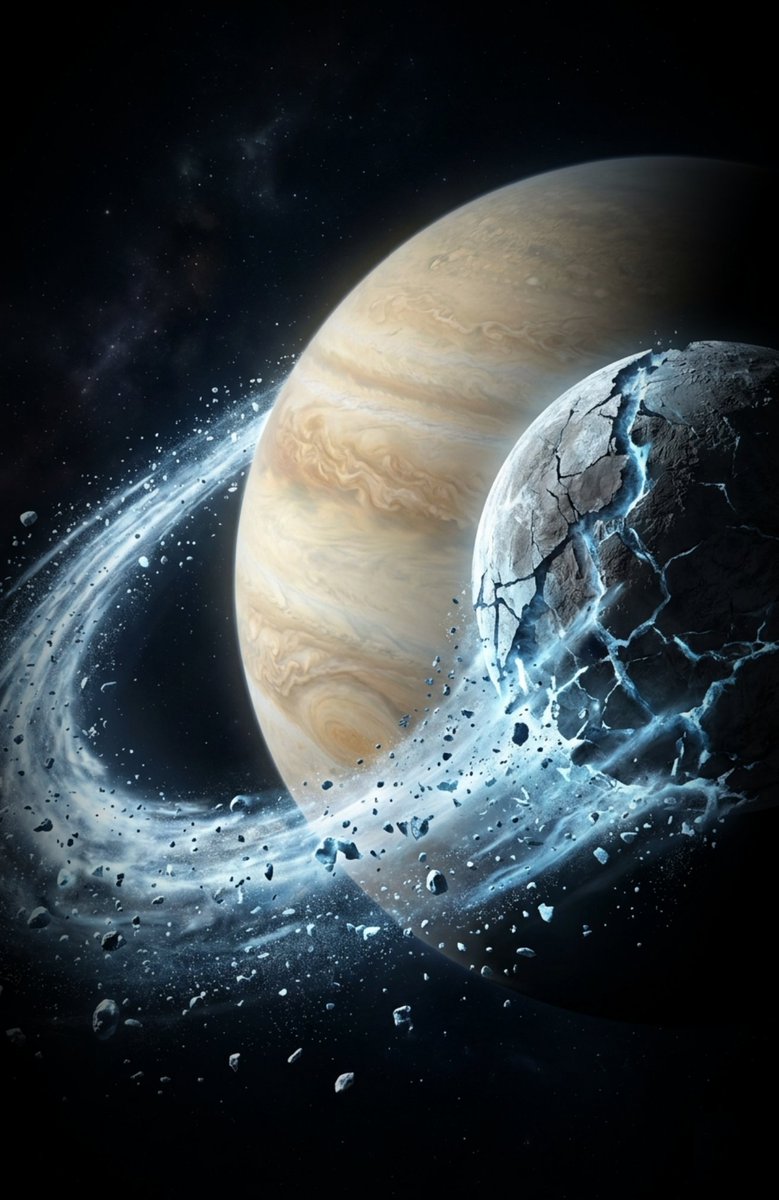
Scientists presented findings at the Lunar and Planetary Science Conference pointing to a hypothetical moon called Chrysalis, which may have ventured too close to Saturn roughly 100 million years ago. Powerful tidal forces then stripped away the moon's icy outer layers, with some of that debris spreading into orbit to eventually form the ring system we see today.
The theory solves two mysteries at once. Saturn is tilted at about 26.7 degrees, and its rings appear far younger than the planet itself, which formed over 4.5 billion years ago. The Chrysalis hypothesis explains both.
Using computer simulations to model the breakup in detail, researchers found that Saturn's tidal forces would have preferentially stripped away the moon's icy mantle while leaving much of its rocky core intact, naturally explaining why Saturn's rings are composed almost entirely of water ice, with very little rock.
The scale of the original destruction was enormous. Gravitational interactions with large moons like Titan may have removed as much as 70% of the initial ring mass over time, suggesting the original ring system was several times more massive than it is today.
Scientists are still investigating what happened to Chrysalis' surviving rocky core, and whether traces of the event might be detectable on nearby icy moons by future spacecraft.
What we call Saturn's rings may simply be a moon's final act, frozen in orbit forever.
The most beautiful thing in the solar system is a tombstone.
18
Mar 27
Christina Koch Spent 328 Days in Space. Now Artemis 2 Is Sending Her to the Moon
Christina Koch already holds the record for the longest spaceflight by a woman — 328 days aboard the ISS. Now Artemis 2 is sending her further.
On April 1, she becomes the first woman in history to leave Earth's orbit, traveling 230,000 miles around the Moon as mission specialist aboard Orion.
No woman has ever gone this far.
She's about to change that forever.
27
Mar 26
The Sun's Most Destructive Storms Are Powered by a Hidden Engine 16 Earths Deep
Every solar flare that disrupts satellites, knocks out radio signals, and threatens power grids on Earth traces back to a single source. And for the first time, scientists know exactly where that source is.
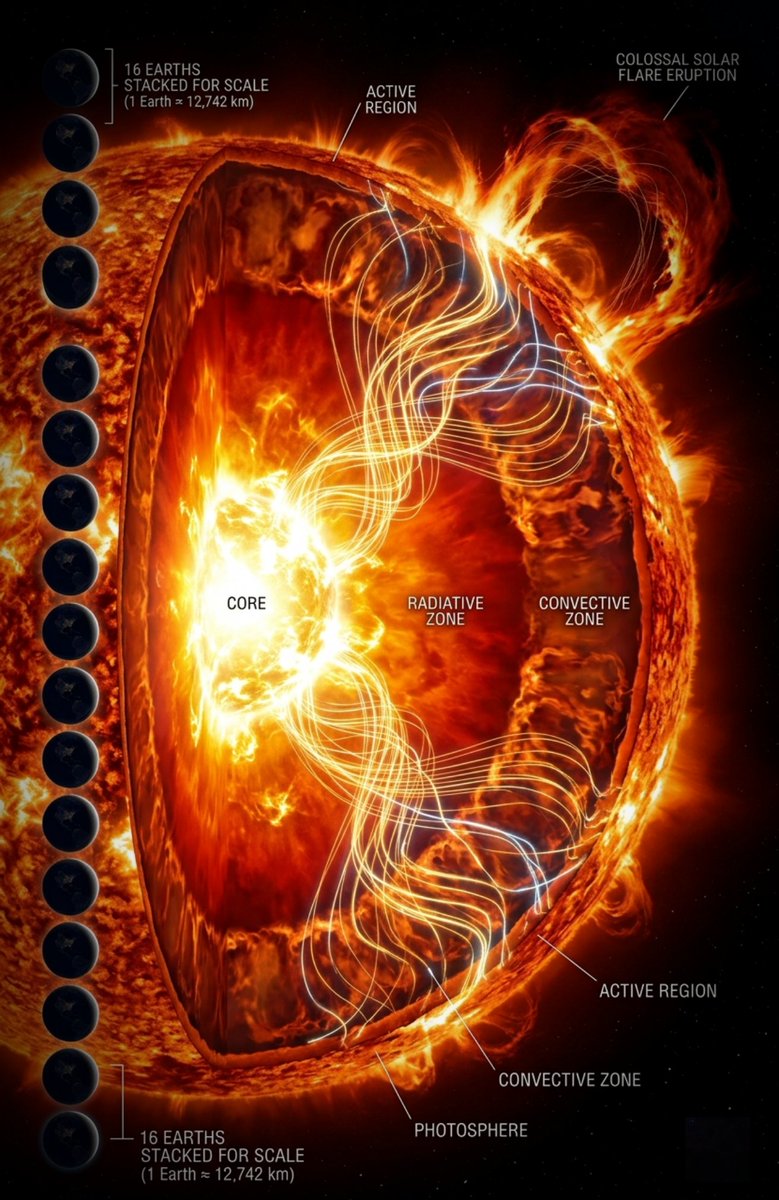
Researchers have confirmed that the sun's magnetic dynamo - the engine powering sunspot activity and the explosive storms that follow - sits 124,000 miles beneath the sun's visible surface, equivalent to 16 Earth widths deep.
That location is called the tachocline, the boundary layer where the sun's turbulent outer convective zone meets the calmer radiative zone below it. Scientists long suspected this region was critical, but direct evidence had remained elusive.
Physicists Krishnendu Mandal and Alexander Kosovichev of the New Jersey Institute of Technology spent nearly three complete 11-year solar cycles analyzing oscillations rippling through the sun's surface, using data from the SOHO spacecraft and a global network of ground-based telescopes.
By studying how these sound waves travel through the sun's interior, they could essentially x-ray the star from the outside.
What they found was striking. Rotating bands of plasma deep inside the sun form a butterfly pattern that precisely mirrors how sunspot locations shift across the solar cycle, and those bands originate from the tachocline, propagating upward to the surface over several years.
The implications go beyond pure science. Solar eruptions send massive clouds of charged particles toward Earth capable of disrupting satellites, communications systems, and energy grids, and a better understanding of where the sun's magnetic field originates could significantly improve space weather forecasting.
Current prediction models focus mostly on near-surface activity, but the research shows the entire convective zone - especially the tachocline - must be factored in for accurate forecasts.
The storm was always deeper than we thought.
31
Mar 26
Science Can Explain Almost Everything About Your Brain — Except Why You're Aware
Your brain processes roughly 11 million bits of information every second. It regulates your heartbeat, interprets language, stores memories, and predicts the future. Neuroscience has mapped its structures, traced its signals, and decoded many of its mechanisms with remarkable precision.
But there is one thing science cannot explain.
Why does any of it feel like something?
When you see the color red, your brain processes specific wavelengths of light. That much is understood. What nobody can explain is why that processing comes with an inner experience, a rich, vivid sensation that is uniquely yours. Why isn't it all just computation happening in the dark, with no awareness, no feeling, no one home?
This is what philosopher David Chalmers called the Hard Problem of Consciousness, and unlike most scientific problems, decades of research haven't brought us meaningfully closer to solving it.
The "easy" problems of consciousness - how the brain integrates information, directs attention, controls behavior - are yielding to science steadily. Hard, but solvable. The hard problem is different in kind. Even a perfect, complete map of every neuron and every signal in your brain would still leave the core question untouched: why is there an experience at all?
Some scientists argue consciousness is simply what complex information processing feels like from the inside, an emergent property of sufficiently advanced brains. Others find that answer deeply unsatisfying. It describes the what, not the why.
A radical alternative called panpsychism suggests consciousness isn't produced by the brain at all, that it's a fundamental property of the universe, like mass or charge, present in some form even in elementary particles. Most mainstream scientists reject this. But they struggle to offer anything better.
Then there's the darkest possibility of all, that consciousness is simply outside the reach of science. That the tools we use to study the universe are themselves products of the very thing we're trying to explain.
We may be too close to the mystery to ever solve it.
12
Mar 26
Physics Has Never Explained Why Light Has a Speed Limit. Simulation Theory Has an Answer
Nothing in the universe can travel faster than light. 299,792 kilometers per second, not one meter more. Physicists call it a fundamental constant of nature. But what if it's something else entirely? What if it's a hard limit built into the code?
This is one of the most compelling intersections between physics and simulation theory, and the more you look at it, the harder it is to dismiss.
In any computer simulation, the processor has a maximum speed, a ceiling on how many operations it can perform per second. That ceiling doesn't show up as a wall or a message. It shows up as lag. As a limit. As something that simply cannot be exceeded no matter what happens inside the simulation.
If matter moving through space is essentially an operation being performed on a variable, then the speed of light represents the maximum causal impact of any single operation: the processing limit of whatever hardware is running our universe.
The constant never changes regardless of the observer's speed, it applies absolutely everywhere, and no known law of physics from within the universe can explain why it exists. It has to be accepted as a given. That's exactly how a hardware constraint behaves.
In a virtual reality, the speed of light would correspond to the processing power limit of the simulator. An overloaded processor slows down computation, and Einstein's general relativity shows that time itself slows near a black hole, mirroring that behavior precisely.
Neil deGrasse Tyson has offered a darker interpretation: the speed limit exists so we can never reach parts of the universe that haven't been rendered yet. Travel too fast and you'd arrive at emptiness — unfinished code.
There are other suspicious clues too. Quantum mechanics tells us there is a smallest discrete unit of energy, length, and time. Elementary particles are the smallest indivisible units of matter. Our world is, in a very literal sense, pixelated.
The skeptics have answers. Even using black holes as the most powerful theoretical processors, the computing power required to simulate our universe at full resolution remains physically impossible to achieve.
The math breaks down before you even get close. But here's the thing about a perfect simulation: you wouldn't be able to prove it from inside. Every test you run, every experiment you design, uses the very tools the simulation provides.
The speed of light may be nature's deepest constant. Or it may be the frame rate of reality. We don't yet have a way to know which.
21
Mar 25
We Might Be Living Inside a Computer — And the Math Suggests It
What if everything you see, touch, and experience isn't real? Not in a philosophical sense, but literally. What if the universe itself is a simulation running on some incomprehensibly advanced computer, and you're nothing more than code?
This isn't science fiction. It's a serious hypothesis that has attracted physicists, philosophers, and tech billionaires alike.
The modern version of the argument was formalized by philosopher Nick Bostrom in 2003. His logic is deceptively simple: if any civilization ever reaches the technological maturity to run detailed simulations of conscious beings, they would likely run millions of them. The simulated minds would vastly outnumber the real ones. Therefore, statistically, you're almost certainly simulated.
The physics makes it stranger. Our universe behaves in ways that look suspiciously computational. Space appears to have a minimum resolution - the Planck length - below which distance loses meaning, like pixels on a screen zoomed too far in. The laws of physics are expressible as clean mathematical equations, as if written by a programmer.
Quantum mechanics only resolves into definite states when observed, which sounds less like nature and more like a rendering engine conserving processing power.
Physicist Silas Beane and his team at the University of Bonn took it further. They suggested that if our universe is simulated on a lattice-based computing structure, we might one day detect it through subtle anomalies in high-energy cosmic rays. We'd find the edges of the grid.
But the theory has cracks. Running a universe-level simulation would require computing power that may be physically impossible to achieve, even for an advanced civilization. And some argue the hypothesis is untestable, which puts it outside the reach of science entirely.
Yet the question lingers. Every time physicists discover another elegant mathematical pattern underlying reality, every time the universe behaves like it's following rules, the thought surfaces again.
What if someone wrote those rules?
What if they can change them?
16
Mar 25
Humanity is Going Back to the Moon, and this Time, it Looks Different.
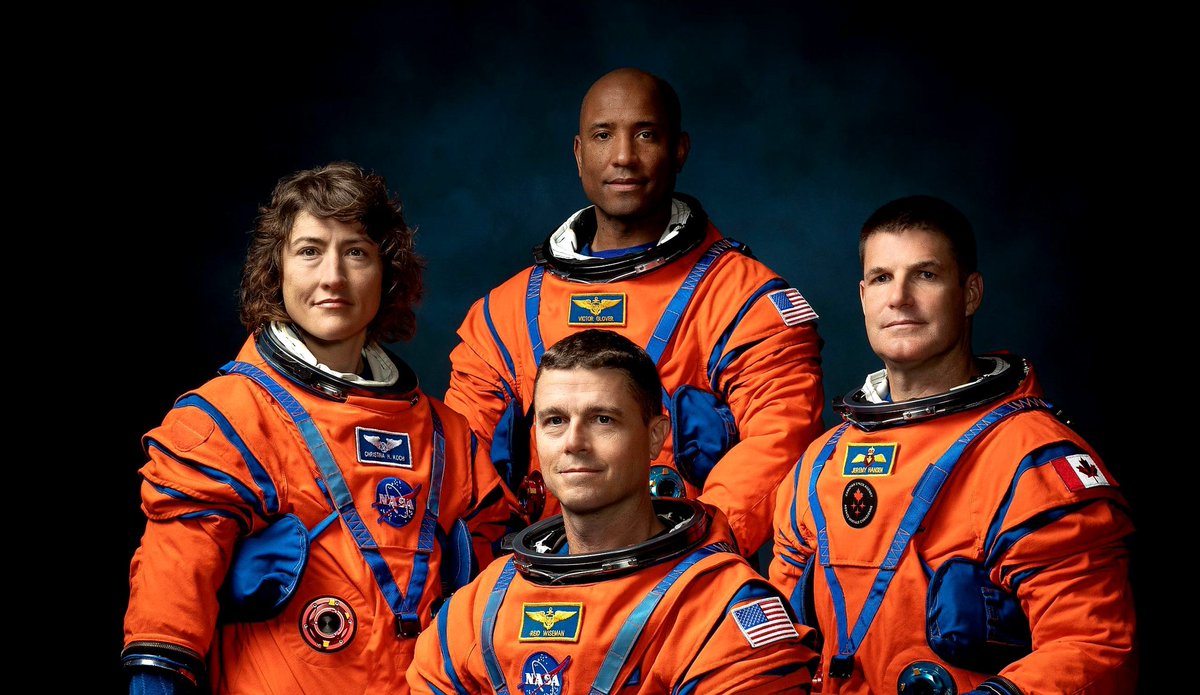
NASA's Artemis II is the first crewed mission to the Moon since the Apollo era ended in 1972. The 10-day mission will carry four astronauts on a free-return trajectory around the Moon and back to Earth: commander Reid Wiseman, pilot Victor Glover, mission specialist Christina Koch, and Canadian Space Agency astronaut Jeremy Hansen. Launch is set for no earlier than April 1.
They won't land. But they'll go further.
Orion's service module will push the spacecraft beyond Earth orbit on a four-day outbound journey around the far side of the Moon in a figure eight pattern extending more than 230,000 miles from Earth. At maximum distance, the crew will fly approximately 4,600 miles beyond the Moon.
The crew itself is historic. Glover will become the first person of color, Koch the first woman, and Hansen the first non-US citizen to leave Earth orbit and travel to the Moon's vicinity.
Each carries a remarkable story. Wiseman, 50, raised two daughters alone after losing his wife to cancer in 2026. Glover once dreamed of being a police officer like his father, until a Shuttle launch on TV changed everything. Koch holds the record for longest spaceflight by a woman at 328 days. Hansen went from fighter pilot to becoming the first Canadian to venture to the Moon.
Artemis II is mostly a test flight, evaluating how well equipment and astronauts function over a crewed deep-space mission before NASA attempts an actual lunar landing.
Fifty-four years after Apollo 17. The return begins now.
33
Mar 25
A Star Visible to the Naked Eye has been Hiding a Secret for 50 years — and Astronomers just Cracked it.
Gamma Cassiopeiae, a bright star in the Cassiopeia constellation, has puzzled scientists since 1976 when they discovered it emits X-rays roughly 40 times more powerful than similar stars. The plasma generating those X-rays reaches temperatures above 100 million degrees, far hotter than anything a lone star should produce. Nobody could explain it.
Now they finally can.
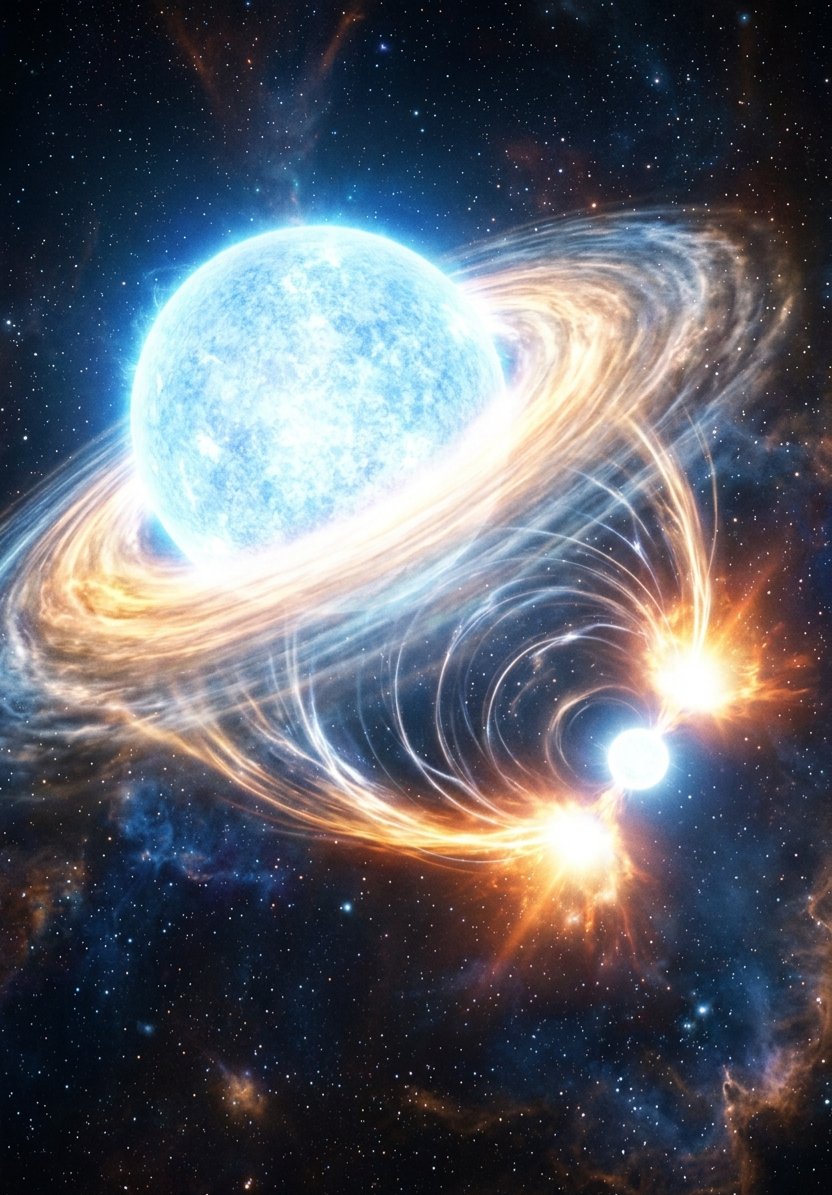
Using Japan's XRISM space telescope - one of the most precise X-ray observatories ever built - a team from the University of Liège tracked the star across its full 203-day orbital cycle. What they found: the extreme X-rays aren't coming from Gamma Cas itself. They're coming from a hidden white dwarf companion orbiting the star and pulling in material from its disc.
As that material falls onto the white dwarf, it superheats to extreme temperatures and releases a torrent of X-ray energy. The telescope detected the plasma's velocity shifting in sync with the white dwarf's orbital motion, direct proof the companion was the source all along.
The data also revealed the white dwarf is magnetic. Its magnetic field cuts off the inner disc and funnels incoming material toward its poles, which explains the unique spectral signatures the team observed.
This discovery doesn't just close one cold case, it confirms an entirely new class of binary star systems that theorists had predicted for decades but never clearly seen. About 10% of massive Be-type stars may have white dwarf companions like this.
And here's the deeper implication: understanding how these binary systems evolve is key to understanding gravitational waves, because it's systems like these, at the end of their lives, that produce them.
The universe keeps its secrets well. But not forever.
22