
You have the vision; we have the engine. Thrive Themes gives you conversion-focused landing pages, funnels, courses and more! No coding or vibe-coding required.
Joined April 2013
- Tweets 8,866
- Following 198
- Followers 4,962
- Likes 457
1,620 Photos and videos
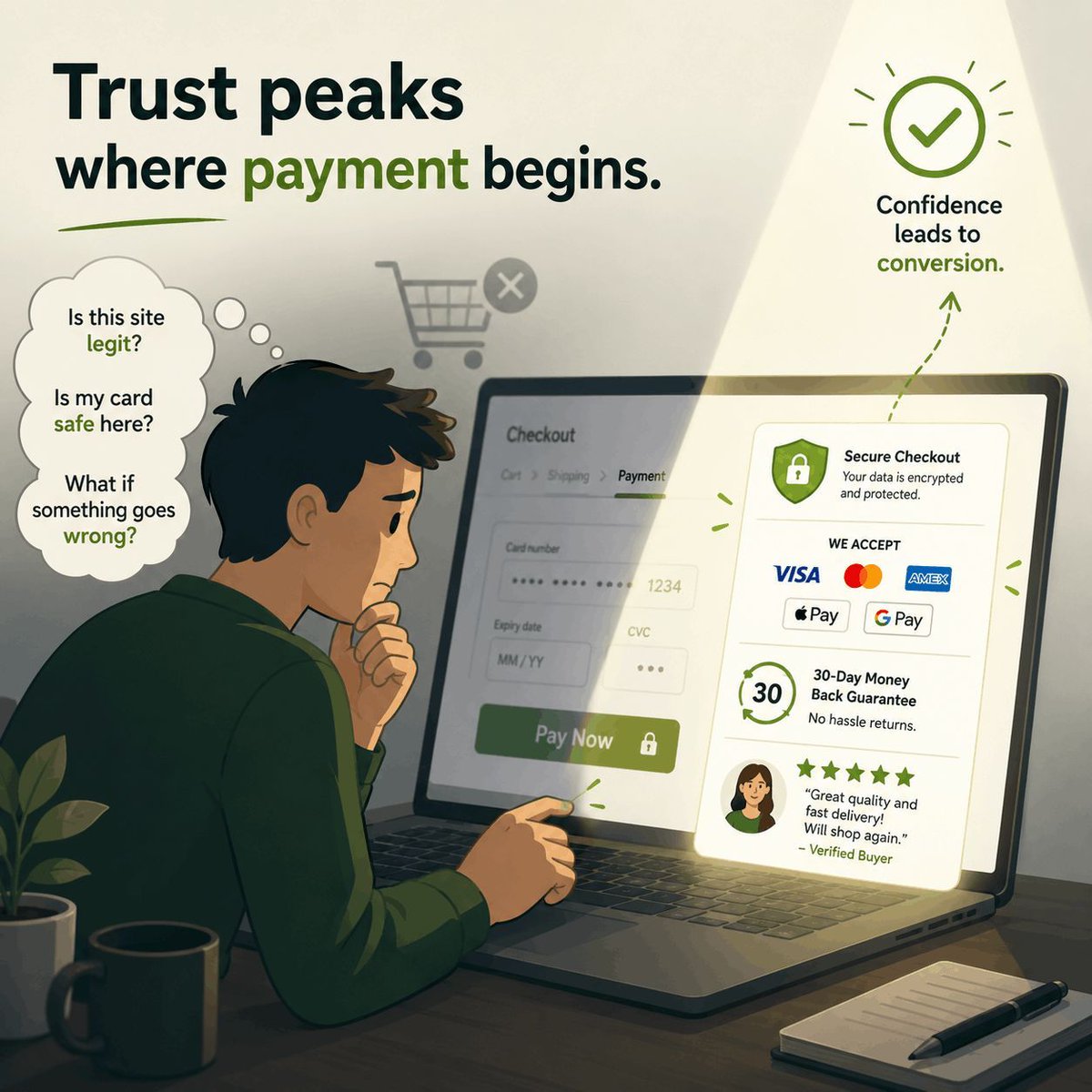
Why do shoppers fill a cart, reach the payment screen, and then vanish? 🤔
Often it's not the price or the product. Nearly one in five abandon specifically because they don't trust the site with their card details (Baymard). The doubt is less about what they're buying and more about who they're handing their card to.
That fear peaks at the exact moment money moves. "Is this site legit, is my card safe here, what happens if something goes wrong," all of it fires at once, and a sterile checkout page answers none of it.
So you answer it right there, in plain sight. A recognizable security seal, the logos of the cards you accept, a clear refund and returns line, and a real customer voice vouching for you, all within eyeshot of the button.
One CRO case study lifted conversion 12.6% just by adding trust badges and card icons near the payment fields. Small, concrete, and exactly where the hesitation lives.
💡A quick warning though: more isn't better. A couple of badges people actually recognize beats a cluttered wall of seals nobody knows, which can make a page feel less trustworthy rather than more.
TL;DR: trust doubt peaks at the payment step, so put your strongest, most familiar reassurance right there, not on an about page.
Pull up your checkout and ask one question: if a first-time buyer landed here cold, what on the page would tell them their card is safe?
2
12

Jun 12
There's a one-cent difference your buyer's brain refuses to treat as one cent. Drop a price from the round number to the .99 just below it and something disproportionate happens to how it reads.
1
2
51
Jun 12
So the ending is a positioning decision, not a default. Cheap-and-cheerful leans on .99, premium leans on round, and the only way to know which fits your audience is to put both in front of them.
1
8
Jun 12
That last part matters more than the rule itself. Test your price endings against each other in Thrive Optimize and let real buyers settle it:
thrivethemes.com/optimize/?u…
6
Jun 11
About 70% of carts get abandoned, and the top trigger is surprise, not a high price: unexpected costs appearing at checkout drive more than half of those walkaways (Baymard).
1
1
65
Jun 11
So show the real, all-in price early, while trust is still intact. Putting full cost up front on the page has been shown to cut late-stage drop-off sharply.
1
1
24
Jun 11
And if you want to learn more about curbing cart abandonment, check out this guide:
thrivethemes.com/how-to-redu…
1
8
Jun 11
A single cent can change how expensive your whole price feels.
It's the left-digit effect. We read prices left to right, so the brain latches onto the first number and files $5.99 much closer to "five" than to "six." UC Berkeley research found people perceive the .99 version as meaningfully cheaper, not by a cent, by far more than that in their heads.
Which is why charm pricing has outlived every prediction of its death. It works at the speed of perception, before the deliberate part of the brain gets a chance to correct the impression.
The standard belief is that .99 pricing is a tired gimmick. The data says the bias is still very much alive.
But the rule has an important edge case. On premium and luxury offers, round numbers tend to win, because a clean $200 reads as confident and deliberate, while $199.99 can quietly whisper "bargain bin" about something you're positioning as high-end.
So the price ending is a positioning choice, not a default you set once and forget. Cheap-and-cheerful leans into .99, premium leans into round, and the honest answer for your audience is usually something you discover rather than assume.
TL;DR: price endings send a signal, use .99 for value and round numbers for premium, so choose yours on purpose.
Run your current price ending against the alternative on a real audience and let the buyers tell you which one fits.
1
3
31
Jun 11
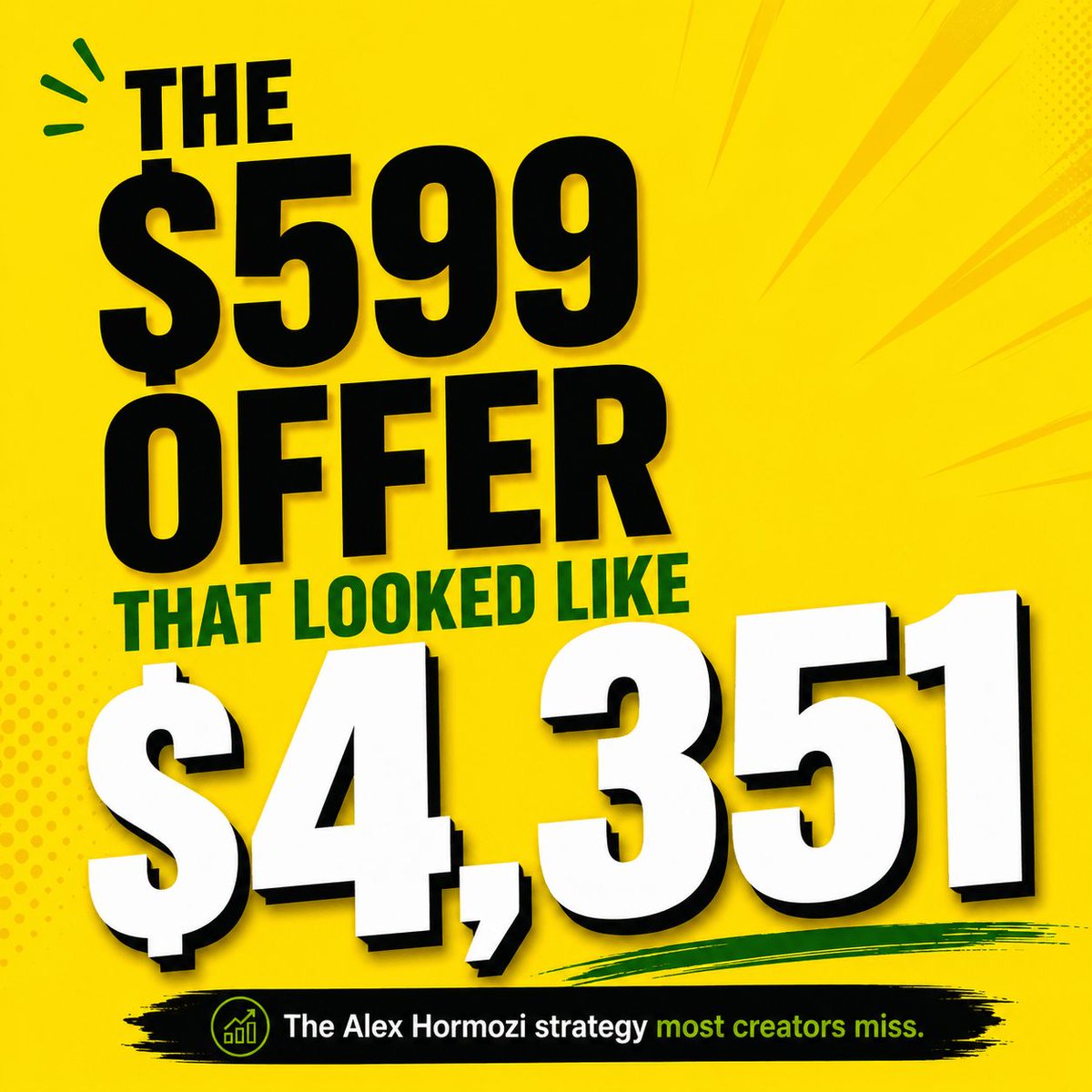
💡👇 Alex Hormozi sells a $599 offer by listing $4,351 worth of stuff on the page.
Same product either way. The difference is how it's presented, and it's a lesson most course creators never learn.
Here's the move, straight from his book $100M Offers:
Most people sell their offer as one thing. "The Course: $599." One name, one price, and the buyer has exactly one question to answer: is this single thing worth $599 to me? That's a coin flip you don't control.
Hormozi does the opposite. In the book, he takes a weight-loss offer, breaks it into its individual deliverables, assigns each one its own value, and stacks them until the total reads $4,351. Then the price lands: $599.
To make that concrete, a stack like that might look something like this (our example, not his exact list):
→ The core program ($997 value)
→ The meal plan library ($248 value)
→ Weekly accountability check-ins ($1,200 value)
→ The grocery shortcut list ($118 value)
Now the buyer isn't asking "is this worth it?"
They're asking "how is this only $599?" You've changed the question, and the question is most of the sale.
Why does this work? Hormozi's whole framework runs on what he calls the Value Equation: people buy based on the outcome they want and how likely they believe they are to get it, weighed against the time and effort it'll take. A single vague product name communicates none of that. A stack does. Every named component is proof of another problem you've already solved for them, which raises the "likelihood this works for me" number in their head with each line.
One warning, because this gets butchered constantly: the stack only works if the parts are real. Padding it with "Bonus: a PDF of the slides ($500 value)" trains people to distrust the whole page. Each item has to solve a problem the buyer knows they have.
If you sell courses or digital products, you already have a stack hiding in your offer. Your templates, your community, your feedback calls, your bonus modules. They're just buried under one product name.
Pull them apart. Name each one. Then rebuild your sales page around the stack in Thrive Architect, and if you're delivering through Thrive Apprentice, bundle the bonuses right into the course so the stack on the page matches what's inside.
The product stays the same. The offer is what changes.
(Source: Alex Hormozi, $100M Offers, 2021)
1
2
97
Jun 11
You can easily get started with Thrive Suite, check it out here: thrivethemes.com/suite?utm_s…
37
Jun 10
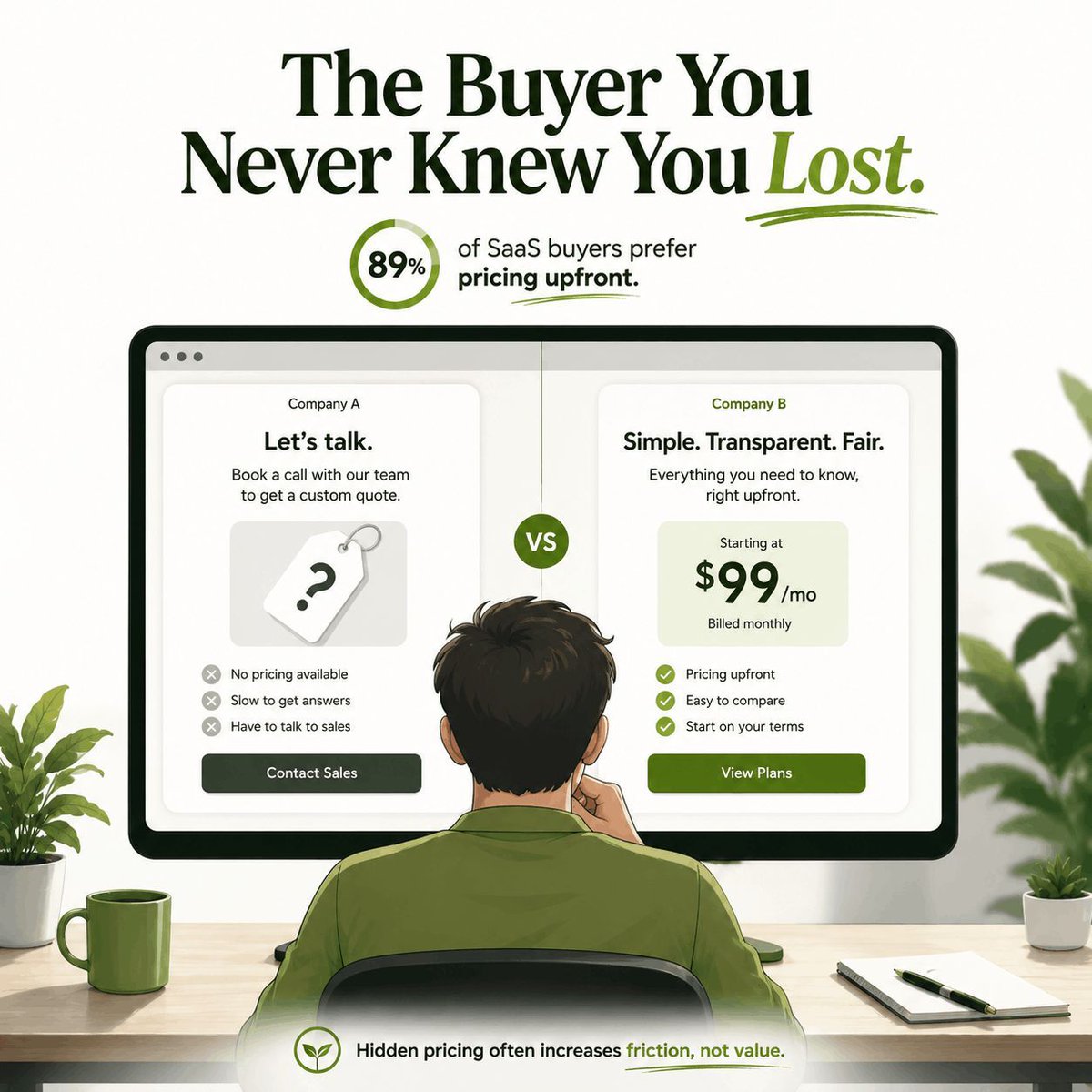
‼️Hiding your pricing behind a "contact us" button costs more than you'd guess. In one G2 study, 89% of SaaS buyers preferred companies that show their pricing upfront.
1
2
75
Jun 10
And the ones who can't find a number don't all email you, they just leave. Hiding pricing has been tied to conversion drops of 23 to 40% versus showing it openly.
1
2
26
Jun 10
Transparency feels risky but usually does the opposite: it filters for fit, builds trust, and respects the buyer's time. Show the number and let the offer work.
1
14
Jun 10
The Economist once ran a pricing page with an option almost nobody would buy.
It might be the smartest pricing decision I've seen.
Three subscription options:
→ Web-only: $59
→ Print-only: $125
→ Print web: $125
Read that middle one again. Print alone costs the same as print AND web. Why would anyone choose it?
They wouldn't. That was the point.
Behavioral economist Dan Ariely was so puzzled by this page that he tested it on 100 MIT students.
With all three options on the table, 84% chose the $125 combo. Only 16% took the cheap web-only plan. The print-only option got zero takers.
Then he deleted the "useless" option and ran it again with a fresh group.
The results flipped. 68% now chose the $59 plan, and only 32% paid for the combo.
Same products. Same prices. The only difference was an option nobody bought.
Here's the lesson: your customers don't evaluate your price in a vacuum. They evaluate it against whatever you put next to it. The print-only option existed to make the combo look like a steal, and it worked, because $125 for "print web" feels obvious when "print alone" costs exactly the same.
Most creators price their offer like it lives alone on the page. One product, one price, take it or leave it. Which means the customer has nothing to compare it to except a gut feeling about whether it's "too expensive."
You're leaving the comparison up to chance. The Economist didn't.
You can run this exact play on your own site.
Build a pricing table with a deliberate anchor option in Thrive Architect, then put it head-to-head against your current page with Thrive Optimize and let your actual audience vote with their clicks.
You don't need an MIT lab. You need two page versions and a few weeks of traffic.
(Source: Dan Ariely, Predictably Irrational, 2008)
1
3
53
Jun 10
And if you want to give Thrive Architect Thrive Optimize a try, get started here: thrivethemes.com/architect/#…
1
22
Jun 9
Here's a number that reframes pricing: opt-in free trials convert to paid at around 18%, but opt-out trials, where a card is required upfront, average closer to 48% (First Page Sage).
1
2
54
Jun 9
And taking on that risk is a signal all by itself. You only offer a strong guarantee when you expect people to be happy, and buyers read it the way you'd hope they would.
1
2
13
Jun 9
So treat risk reversal as part of the offer, not a footnote. Decide what fear is stopping the sale, then build the guarantee or trial that removes it.
2
12