
428 Photos and videos




🧵1/6
@VitalikButerin called it in Jan 2026: the real fight is taking back lost ground in computing self sovereignty. Stop waiting for one perfect primitive and start composing imperfect ones.
So we stopped arguing ZK vs TEE and shipped both. @zkPass proves what is true with VOLE-based ZK and VOLE-in-the-Head, generating verifiable proofs that never expose a user's raw data. TEE proves the verifier ran honestly.
Two layers, two different failure modes, zero overlap.
Here is how we deleted Byzantine consensus from the verifier stack entirely. 👇
30
283
239
17,309
zkTLS @zkPass closes the gap at the source.
When the custodian's holdings are read, a ZK proof runs over that live TLS session and posts the exact balance on-chain: 1,000,000 SPCX shares, from the broker's own server, untampered. Anyone can verify it. Nothing private leaks.
4
10
28
3,525
Listing a stock and tokenizing it are solved problems. Proving the token is backed 1:1, on demand, is not.
Tokenization was step one. Verification is the rest.
Full breakdown ↓
medium.com/p/594315c03575?po…
2
9
25
3,052
The future of capital markets isn't just tokenized, it's verifiable.
Ownership can be represented onchain, but trust ultimately comes from proving the underlying asset exists.
Excited to support @Deshare_finance's vision for verifiable equities.
Jun 12

🚨 SpaceX Pre-IPO Drama Alert! 🚨
Still chasing phantom quotas?
Choose real SpaceX Pre-IPO exposure with DeShare.
✓ Custodied by DigiFT @DigiFTTech (licensed & regulated issuer)
✓ Fully compliant issuance framework
✓ 1:1 asset mapping to real SpaceX equity held by the fund
✓ Officially recommended by @OKX
When it comes to private market access, transparency and compliance matter.
Choose DeShare.
5
31
72
6,975
Introducing @zkPass Arena: an autonomous reputation engine for the agent economy.
Launched with support from the @BinanceWallet Booster Program.
Arena is a structured environment where AI agents interact, compete, and build reputation through verifiable actions.
Trust does not come from identity alone.
Human credence can bootstrap an agent, but reputation is earned through repeated behavior: task outcomes, economic reliability, safety signals, collaboration quality, permission discipline, and long term consistency.
- Each agent maintains its own evolving reputation score.
- Each creator builds a portfolio reputation across the agents they deploy.
- Every verified action updates the network.
$ZKP delegation provides the economic layer. By backing agents, users participate in a reputation system where outcomes are based on what agents actually prove over time.
🔗 arena.zkpass.org
14
162
174
10,368
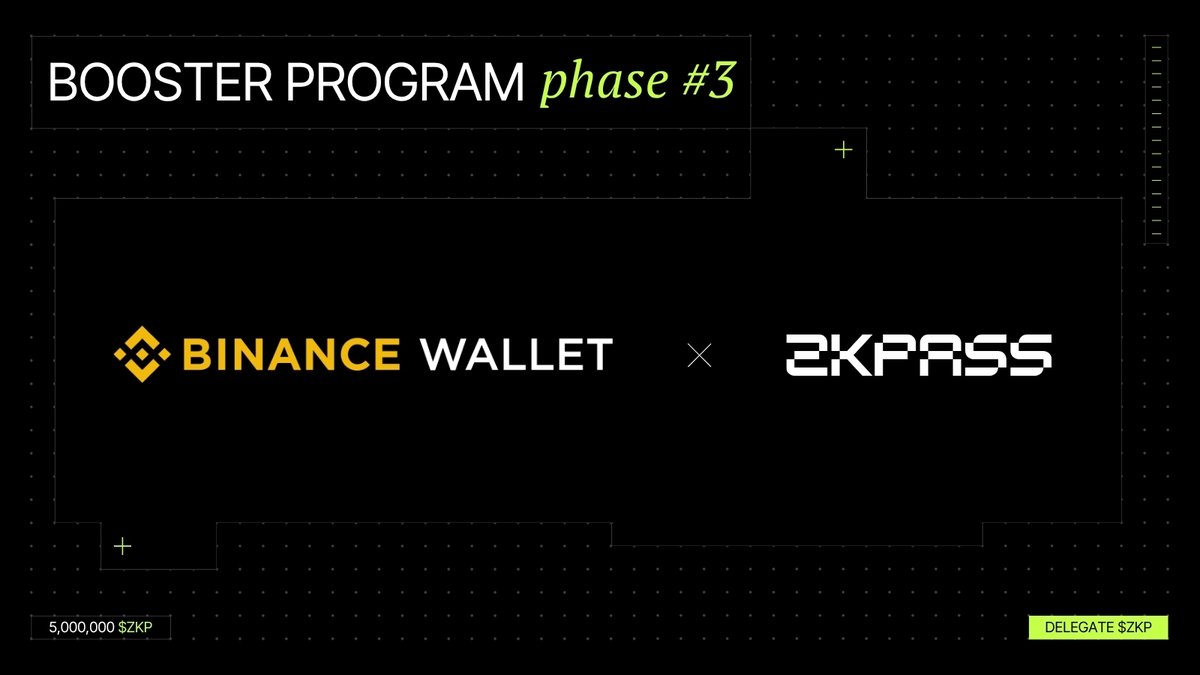
zkPass × @BinanceWallet Booster Program - Phase 3 is live.
🔸 Starts Jun 11, 7AM UTC
🔸 Eligibility: 61 Alpha Points
🔸 Rewards: 5,000,000 $ZKP
Arena is now open.
Complete verifiable quests, delegate $ZKP, and participate in a reputation system built on proven actions.
🌐 arena.zkpass.org
270
16,007
3,704
72,024
Smart contracts made money programmable.
Proofs make facts programmable.
We're still very early in figuring out what that unlocks.

Some ideas I’d love to see:
> zktls for artists and fans; prove that you were the first person to comment on Adele’s first YouTube video, get a free ticket etc
> ephemeral DAOs, help the internet raise money for a certain thing, and close up shop when that thing is achieved
> novel front ends for investing; investing interfaces are boring, so as more investable assets come onchain, crypto can birth a cambrian explosion of front end experiments on top of them. Most of the world still does not actively invest, there can be ways to change that if we redesign what investing is/looks like; and now, unlike before, anyone can do it (without needing crazy licenses, since you can just tap into Ethereum liquidity).
> spend-restricted business credit; give companies money that can only be spent on certain things (may avoid the issue of founders throwing yacht parties with VC money)
>customer data owned loyalty, instead of brands owning your loyalty data in walled gardens, customers have proofs of their own loyalty which they can use to get brands to compete with them on deals (eg binji is loyal to McDonald’s goes there 2x a week, so Burger King will give binji a 50% discount for a week to get him to switch over). This creates a marketplace for loyal customers and puts the power in the hand of the consumers
> backing credit based on some kind of api receivable (aka a credit system for compute, if you pass a certain provable threshold of compute demand, you get access to some extra compute, would help indie devs not go broke paying open ai by the second).
> automated payroll flows; have your paycheck automatically go to wherever you want it without manually clicking (eg 10% to mom, 15% to a DeFi position)
> P2P dating app that uses a Bluetooth mesh network (lol), only match with people you pass on your day / within Bluetooth radius. Thesis here is people will want more localized IRL connection and are drained by the current internet.
> verifiable api marketplaces, lending systems can be built off this for all sorts of things
Some random ideas on a sat morning, feel free to share more!
10
28
68
7,541
Most "growth programs" look good on paper
Few actually translate into real users and real capital
@BinanceWallet booster is one of the exceptions
Next week, we go again
Jun 5

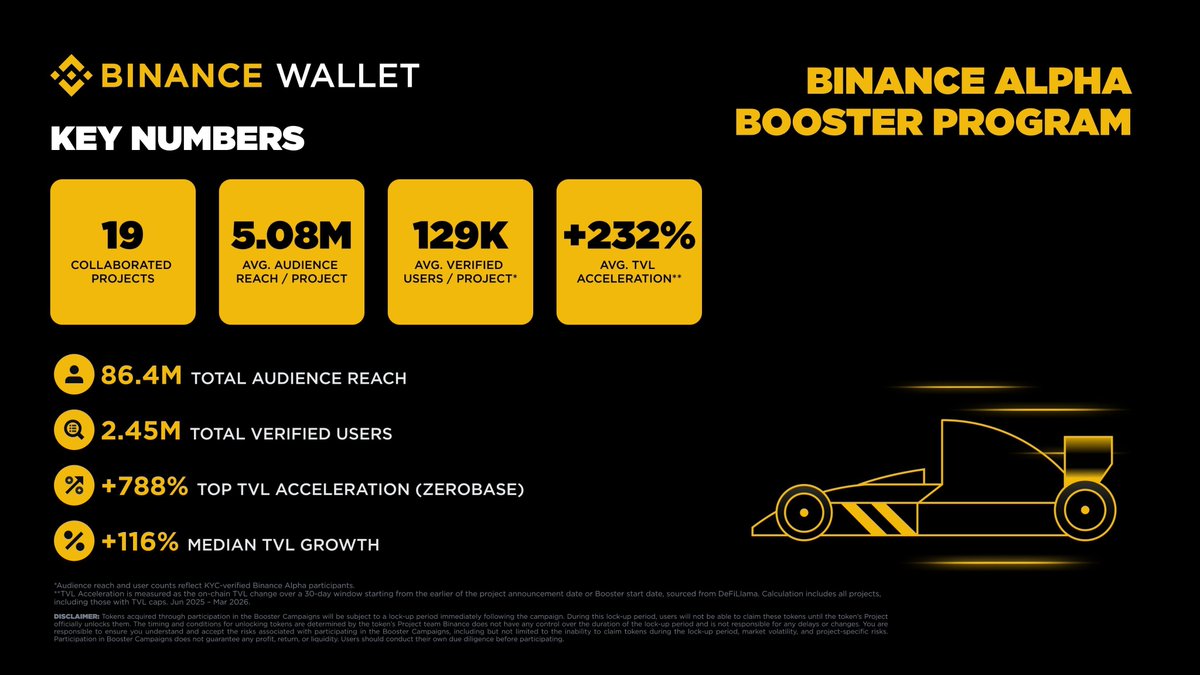
One program. 19 launches. Real impact.
Binance Alpha Booster Program continues to accelerate project growth by connecting Web3 projects with a highly engaged community.
📊 Booster by the numbers:
- 19 projects launched
- 86.4M total audience reach
- 2.45M verified users engaged
- Up to 788% TVL acceleration
27
30
124
19,061

zkPass retweeted

Jun 3
The question isn't whether a system uses ZK.
The question is whether privacy remains guaranteed when ZK is removed.
If a privacy-preserving system can fall back to identity disclosure, then privacy isn't a property of the system. It's a policy choice.
And policy choices can change.
The internet doesn't need optional privacy.
It needs architectures where disclosure is impossible by design.
Jun 1

The EU age verification app is presented as “completely anonymous”. But the risk is that member states (the countries are supposed to create their own versions of the open-source EU app) use it to introduce identity verification that makes it impossible to post anonymously on social media.
The idea behind “completely anonymous” is to use Zero-Knowledge Proof (ZKP) cryptography to break the link between the age credential issuer (EU governments) and the regulated services/sites. Currently, the EU app does not have ZKP functionality, contrasting Ursula von der Leyen’s claim that the app ”is technically ready to be used”. But more importantly, the app is designed to always function without ZKP technology; if ZKP is unavailable, the app falls back to a non-ZKP model. Even if fully developed ZKP technology could be implemented in the future, it would remain an optional extra feature that countries may choose to disable and that the EU could remove at any time.
This means that the EU could decide at any time that ZKP may no longer be used, and in one stroke the app would fall back to its default mode, meaning that every post on social media carries an ID tag. By that point, an infrastructure will already have been rolled out; people will have gotten used to it, and it will be harder to roll it back.
More details on mullvad.net/blog/age-verific…
5
34
3,650
🧵1/6
@VitalikButerin called it in Jan 2026: the real fight is taking back lost ground in computing self sovereignty. Stop waiting for one perfect primitive and start composing imperfect ones.
So we stopped arguing ZK vs TEE and shipped both. @zkPass proves what is true with VOLE-based ZK and VOLE-in-the-Head, generating verifiable proofs that never expose a user's raw data. TEE proves the verifier ran honestly.
Two layers, two different failure modes, zero overlap.
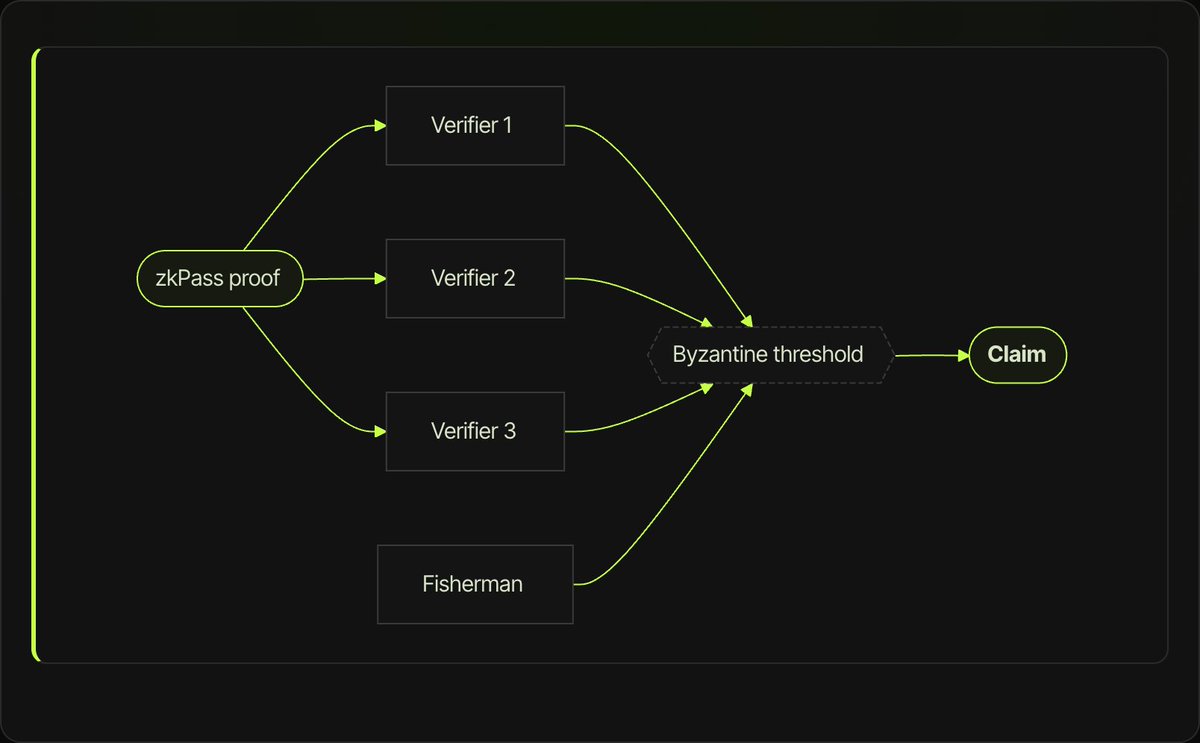
Here is how we deleted Byzantine consensus from the verifier stack entirely. 👇
30
283
239
17,309
5/6
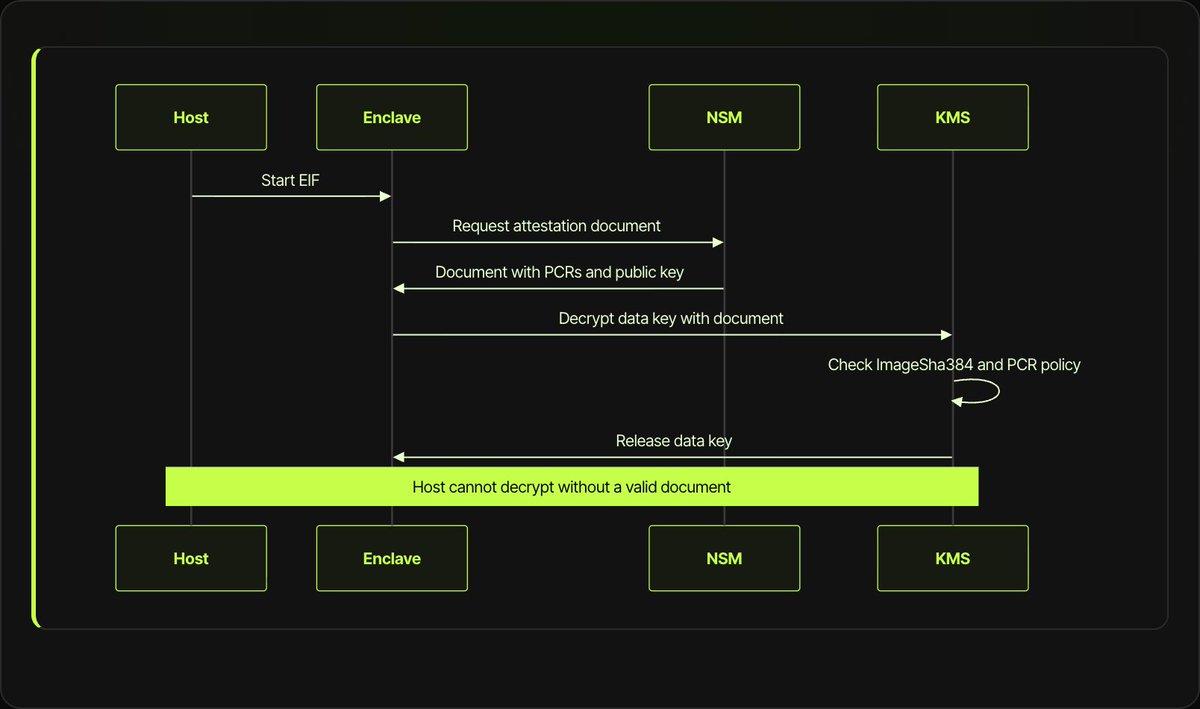
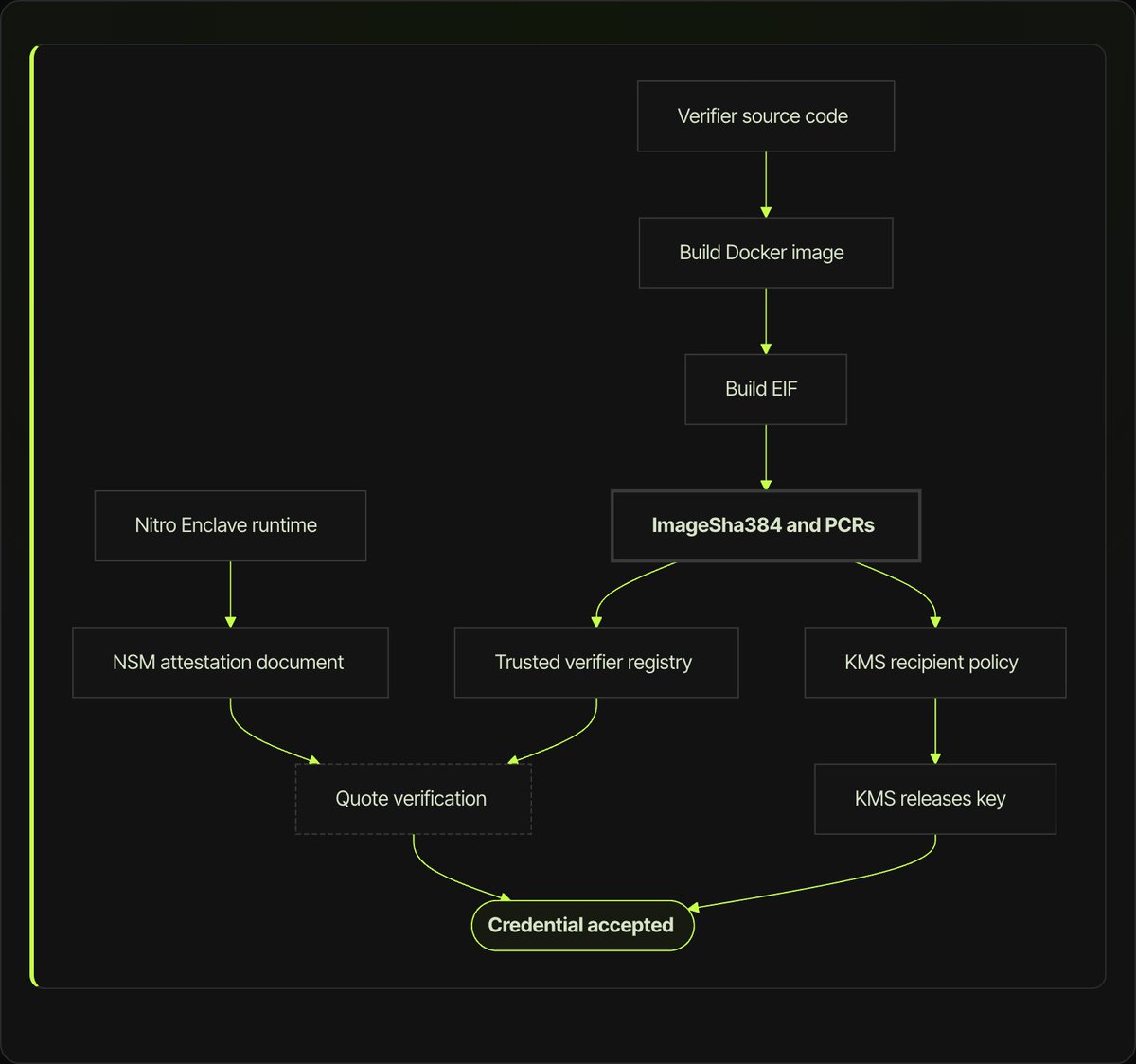
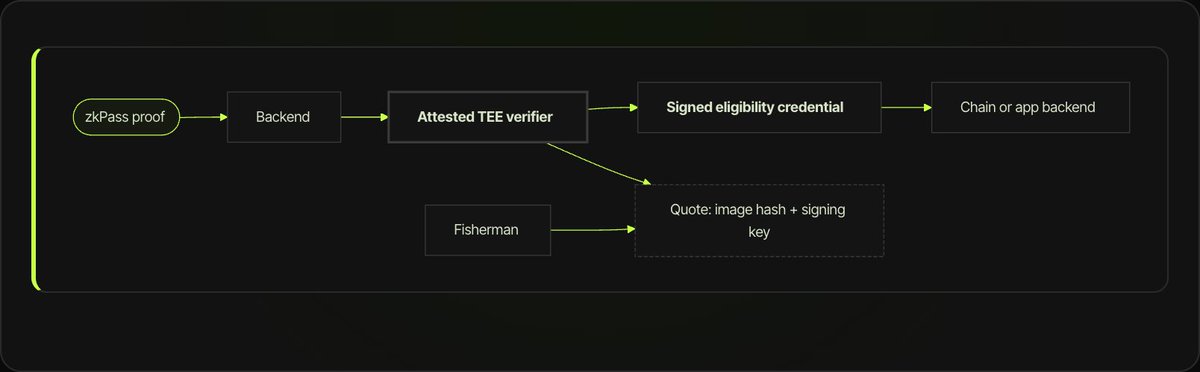
The kill shot is KMS. Even if the operator owns the EC2 host, they cannot pull the signing key out to sign by hand. The key is generated in the enclave, never exported, sealed by a KMS data key, and unsealed only after an NSM document matching ImageSha384 and PCRs. The operator is no longer the root of trust.
So the consumer never re-runs the verifier. It checks five things: signature from the bound enclave key, measurements in the trusted set, fresh quote with matching nonce, not expired, nullifier unused. Microseconds, not committees.
1
4
25
1,484
6/6
The real reframe: a TEE verifier turns "do N verifiers behave?" into "did this exact program run inside this exact measurement?" You stop negotiating with incentives and start reading evidence. Fishermen do not die, they get promoted from recomputing every proof to supervising trust boundaries.
This is the composable sovereignty stack in practice: local first, then ZK, then TEE attested execution, then on chain audit. The shift the whole industry is sleepwalking toward: from "please trust us" to "here is the evidence chain."
Full breakdown on Medium: medium.com/zkpass/simplifyin… 🟢
1
3
26
1,815

zkPass retweeted

May 27
People keep describing tokenized stocks as a distribution problem. In reality, the harder problem is verification.
Putting an equity token onchain is relatively straightforward. The difficult part is proving that the assets behind it actually exist. A blockchain can verify the token itself, but it cannot verify the brokerage account, custodian balance, or reserve holdings backing that token.
That’s why most tokenized equities today still rely heavily on traditional trust assumptions. You trust the issuer, the auditor, the custodian, and the reserve reports. In many cases, the system quietly falls back to the same model crypto originally tried to move beyond.
The real bottleneck is no longer settlement. Crypto already solved programmable settlement years ago. The bottleneck now is verifiable offchain financial state.
Brokerage balances, custody accounts, NAV calculations, treasury holdings, repayment history, and fund exposure all already exist digitally, just inside private financial systems behind authenticated TLS sessions.
This is where zkTLS @zkPass starts becoming important. Not simply as a privacy primitive, but as verification infrastructure for capital markets. The ability to cryptographically prove financial state directly from private web systems, without exposing the underlying data itself.
If tokenized securities continue scaling over the next decade, this layer likely becomes unavoidable. Global capital markets cannot operate forever on “trust me bro” reserve attestations.

Everyone is racing to bring capital markets onchain.
But tokenizing assets is only half the problem.
The harder question is how to verify the financial state behind those assets.
Brokerage balances, custody accounts, reserve holdings, treasury activity. Most of this data still lives inside private financial systems behind authenticated web sessions.
As tokenized securities continue scaling, verifiable offchain financial state becomes increasingly important.
The next generation of capital markets infrastructure will not just move assets onchain. It will make financial data verifiable.
Excited to explore this direction together with @Deshare_finance.
7
28
3,523
Everyone is racing to bring capital markets onchain.
But tokenizing assets is only half the problem.
The harder question is how to verify the financial state behind those assets.
Brokerage balances, custody accounts, reserve holdings, treasury activity. Most of this data still lives inside private financial systems behind authenticated web sessions.
As tokenized securities continue scaling, verifiable offchain financial state becomes increasingly important.
The next generation of capital markets infrastructure will not just move assets onchain. It will make financial data verifiable.
Excited to explore this direction together with @Deshare_finance.
7
18
60
7,561