When analyzing UK Biobank questionnaire responses, you might have noticed that some participants answered "I don't know" and some, "I prefer not to answer". And most likely you'd have excluded those individuals and moved on with your project.
But Andrea and his colleagues didn't. They instead saw a potential opportunity to explore the genetics of a fascinating human behaviour:'non-response'.
The authors wondered why would someone prefer to answer "I don't know" or "I prefer not to answer". Perhaps they didn't understand the question? Or they were not comfortable revealing that information? Or they were just tired and just wanted to get it done by going with the easiest choice? Or they were in a playful mood on that particular data and so, decided to mess up the data? Or perhaps they genuinely didn't know, as the question is about something that happened a long time ago.
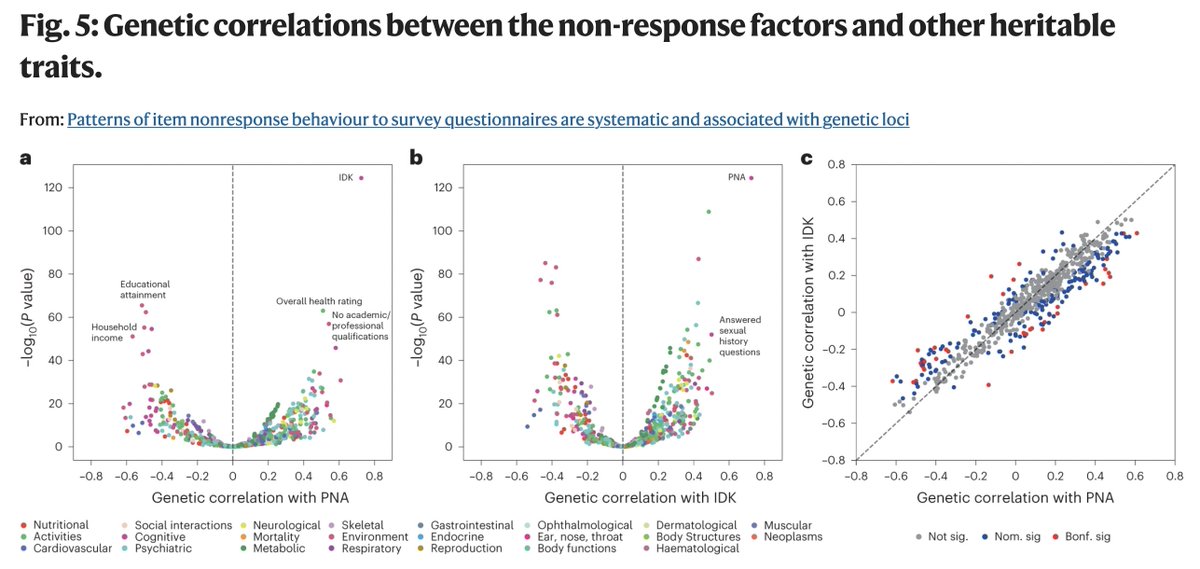
A simple guess would be that it could be any of those things and something else completely random. If so, we wouldn't expect a systematic difference in the phenotypes and genotypes between "non-responders" vs responders. But the authors show otherwise.
The authors show that nonresponse behaviour is significantly associated with cognitive, socioeconomic and mental health phenotypes--both phenotypically and genetically. And nonresponse behaviour itself is heritable and genetic variants associated with nonresponse behaviour likely influence cognitive processes in the brain. And a polygenic score based on this GWAS can predict in an independent sample if someone will be inclined to choose "I don't know" or "Prefer not to answer".
In addition to showing that there is a complex fascinating genetics behind this human behaviour, the authors also highlight how excluding nonresponding participants from your GWAS can bias your interpretation of certain genetic analyses. And a step further, the authors also show there are ways to correct this bias, at least to some extent.
As always, creative work from Andrea and his team. A must-read for anyone who works with UK Biobank questionnaire phenotypes.
- Mignogna, Carey & Wedow et al.
@NatureHumBehav