
Joined April 2022
- Tweets 4,791
- Following 1,589
- Followers 2,236
- Likes 64,852
741 Photos and videos











Pinned Tweet

Apr 13
I experimented with developing a small app using tools from @magicblock .
The idea came to me to build something based on the Private Payments API.
I thought that we really lack privacy on #Solana, and considering that MB is moving in that direction, it would be great to create something. Here is what came out of it:
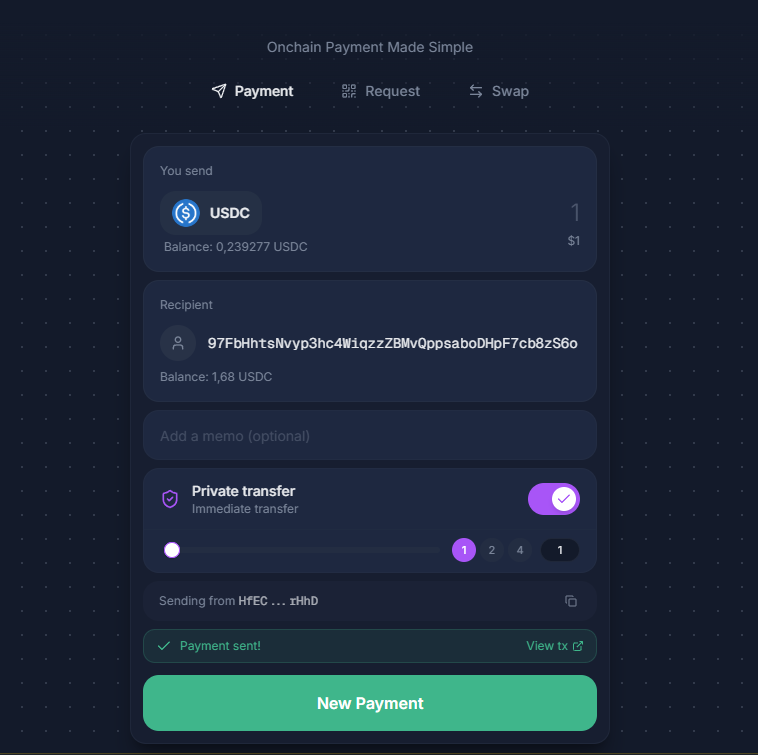
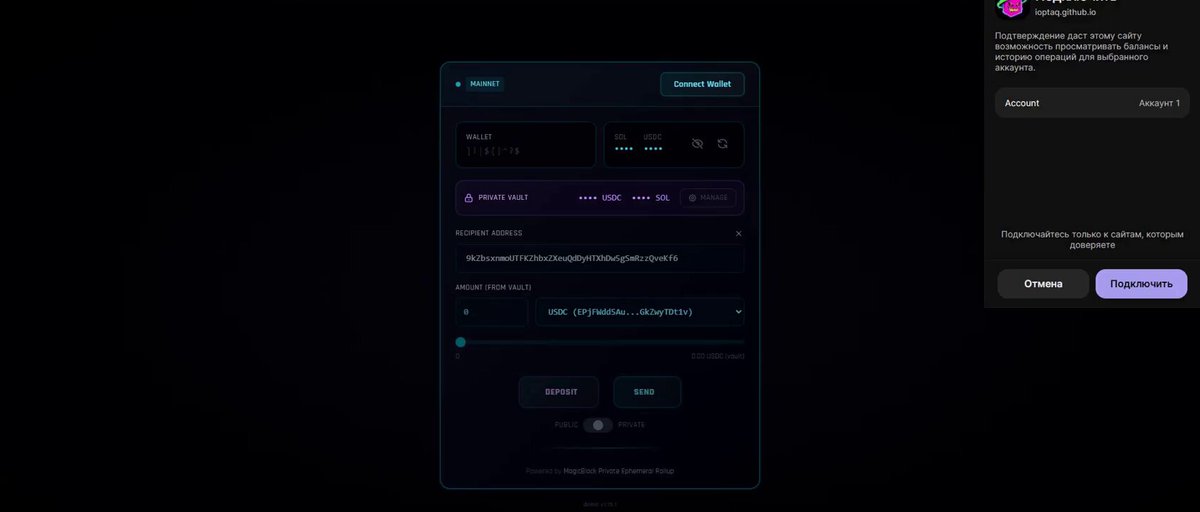
A backendless app, just take it and use it. Deposits into an Ephemeral Private Rollup, private transfers between vaults, and withdrawals. For now, only USDC is supported, but I might add other popular tokens in the future.
How it works:
Connect your wallet (Phantom is highly recommended).
Deposit $USDC into a private vault.
Send from your vault to another user's vault.
The user can withdraw USDC from the rollup to their public address.
Note: The recipient must have an activated vault on their end, meaning they need to make a USDC deposit before you send anything.
The app includes recipient address validation and other logic that makes the UX reasonable.
Honestly, when you build something and it actually works, you just feel amazing.
@16vivz @simpletox26
7
77
2,016
Let it be💜 retweeted

Jun 10
2222 Kitties all broken and chaotic.
Grab your FREE MINT WL
Form - forms.gle/VY52GB9nbyQvtvZSA
(Closes in 48hrs)

94
92
166
3,586
Jun 10
Voble Free Mode 4/7
Score: 900
Would rank #5 today
Would earn $0.55
Try it: voble.fun/free
2
2
38
May 4
Your AI trader 24/7 trades, spins strategies and holds alpha - while the entire chain sees every step.
People privacy optional.
Agents - must-have.
𝐖𝐡𝐨 𝐝𝐢𝐝𝐧'𝐭 𝐮𝐧𝐝𝐞𝐫𝐬𝐭𝐚𝐧𝐝 - 𝐧𝐠𝐦𝐢 𝐢𝐧 𝐭𝐡𝐞 𝐧𝐞𝐰 𝐰𝐨𝐫𝐥𝐝.
𝐓𝐡𝐞 𝐫𝐞𝐬𝐭 - 𝐰𝐚𝐠𝐦𝐢 𝐢𝐧 𝐬𝐢𝐥𝐞𝐧𝐜𝐞
May 2

Hot take:
AI agents need privacy more than humans.
5
27
238
Apr 29
Did you know that agents often break not because of "stupidity"
they break because of reality
latency kills arbitrage
stale state breaks decisions
expensive/slow transactions eat any edge
without real-time execution, an agent simply doesn't keep up with the moment
and in the end the question is not about intelligence
but about the speed at which that intelligence can act
therefore infrastructure like @magicblock starts to look like the condition under which agents can actually act like agents
1
20
135
Let it be💜 retweeted

Apr 29
Less than 2 weeks left in the @Colosseum Frontier hackathon
Win $5,000 in prizes in the Privacy side-track by using MagicBlock in your Solana app, co-hosted with @SuperteamMY and @SNS
Link below 👇
38
9
150
11,028
Apr 23
Looks like a moment when payments become something that’s easier to script than to click.
𝐀𝐈 𝐚𝐠𝐞𝐧𝐭𝐬 𝐰𝐢𝐥𝐥 𝐜𝐥𝐞𝐚𝐫𝐥𝐲 𝐚𝐩𝐩𝐫𝐨𝐯𝐞.
Apr 23
Introducing Mirage: One CLI for private payments on @Solana
Create a wallet, fund it, and send private transfers from your terminal, bot, or AI agent
Built on Private Ephemeral Rollups, installable as a Claude Code skill 🧵👇
4
28
169
Apr 21
I decided once again to read about the @MagicBlock team and share it with you.
And so here's what I learned.
The founders are doing deep tech, and @MagicIntern is pretending that he is just an intern?
Andrea Fortugno @supermarioblock
Italy → China → London → Web3
A route of a person who clearly did not choose "easy mode" in life.
(probably, he didn't even see it in the menu)
Background of Andrea looks like:
Sant’Anna (Italy, sounds like Hogwarts DLC)
Fudan (China, mode "accelerated reality learning")
London (where everything is expensive, including mistakes)
and then it makes sense- he went into blockchain infrastructure
haha classic final boss of a career path?
Role in MagicBlock:
strategy
product
investors
Engineering reality:
"if everything works - don't touch it"
Andrea:
"if everything works - it means it can be improved"
P.S. the most dangerous type of people in startups😀
Gabriele Picco - CTO @PiccoGabriele
IBM Research. AI.
ML.
complex systems.
Translation into crypto language: a person who has already seen pain and decided to scale it in Web3
In MagicBlock he is responsible for:
architecture
core system
Ephemeral Rollups
"if latency exists - it means there is an error somewhere, and we will find it"
and they will find it. and rewrite it. and improve it. and find it again.
I think he will not say "it's hard", he will say that "it is not yet optimized to the state of suffering"😀
In the end, Magic Block is a full system balance
founders:
"we are building serious infrastructure"
engineers:
"it's hard, but solvable"
users:
"where is the button"
And of course
Wizardio @MagicIntern
Formally:
intern
In reality:
community favorite
a person who writes in a way that makes people ask: "is he really an intern?"
if tomorrow it turns out that Wizardio is a collective mind of the whole team, I honestly wouldn't be surprised
9
1
66
944

"I brought money here and want to be able to get it back if it gets stolen."
On behalf of Satoshi Nakamoto, Vitalik Buterin, and other cypherpunks: go fuck yourself along with your money. Open a bank account, buy stocks, and stay the hell out of here.
2
3
28
424
Apr 20
MagicBlock shipped a private demo one.magicblock.app
I went to try it and fell in love with the simple UX💜
I catch myself thinking that in Web3 applications with public payments still prevail, as if we like it, while with @magicblock this is the standard.
And yes this is not a complex system, but a simple API and easy to integrate.
And it’s a bit strange that this is seen as a novelty, rather than something that should have been the standard from the very beginning.
4
46
600
The example is quite simple. Almost any project at the development stage needs financing. In return, they can only offer a derivative product (a token), which holds less value for them at a certain moment than your money. Otherwise, this deal wouldn't have been offered.
Logic suggests that, a priori, your money is more important to you than someone else's token. Similarly, logic suggests that for the project, your money is more important than their token.
In that case, the point of a mutually beneficial deal is lost. All that remains is a bet that the team will create value for the token that exceeds the nominal value of your investment. Otherwise, it doesn't make sense. BUT they offer no guarantees.
It turns out that this is a one-sided risk for the investor. Absolutely no advantages.
In rare cases, public fundraising is organized with the aim of a truly exclusive offer for a limited number of people (genuinely so), and on favorable terms. For example, when a project has achieved PMF.
Most projects today cannot ensure return on investment, yet they offer an opportunity (without even bothering to explain the prospects or the rationale for the investor).
Some might think this is just the way things are, but in reality, it's more like charity.
Ultimately, investors provide value to this token with their money, while value creation should be ensured by market fit and the need for the token (if it is needed at all). Likewise, history shows that for many, it would not have been needed at all.
A small addition. Every other project in EVM can use ETH for DAO and other functions. In the Solana ecosystem, the same can be said about SOL.
But who cares? After all, we love creating money out of thin air.
2
16
440
Let it be💜 retweeted

Apr 15
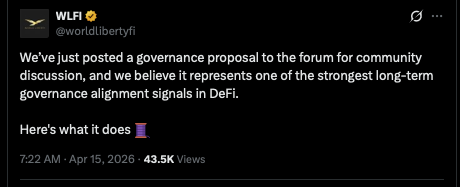
I am the Director of Token Holder Experience at World Liberty Financial.
The dashboard has 13 columns now. The 13th is called Unlock.
We published a governance proposal. It covers 62 billion locked tokens. In plain English: the team that locked your tokens is asking you to vote on whether the team gets to unlock theirs.
There are two groups.
Investors — the wallets that sent real money.
The team — founders, advisors, partners. The wallets that didn't.
Investors paid starting at $0.015 per token. 17 billion tokens. Real money from real accounts. 18 months ago. They cannot sell. Cannot transfer. Cannot earn staking rewards. The tokens are $0.08 now. Down 83%. The proposal gives investors a 2-year cliff and a 2-year vest. That is 4 more years of waiting for something they already bought. They keep all their tokens. We are calling this "full retention."
The team received 45 billion tokens for free. The proposal gives the team a 2-year cliff and a 3-year vest. We burn 10%. That is 4.5 billion tokens. At current prices, $360 million. We paid nothing for them. We could not sell them. We are burning 10% of an asset we got for free and could not move. We are calling this "sacrifice." We keep the other 90%. $3.2 billion. We are calling that "alignment."
The team holds 73% of the locked supply. Investors hold 27%. The people who paid nothing outnumber the people who paid everything nearly 3 to 1.
The vote requires a 1 billion token quorum. Simple majority. In the last governance vote, 76% of the voting power came from 10 wallets. Several of those wallets are ours. The team will vote on whether the team unlocks. The team will pass it. That is governance.
The proposal says 77% of locked holders have never voted. We wrote that as a problem. The 77% did not vote because the 10 wallets decide everything. We built the system that made their votes meaningless. Now we are using their silence to justify our exit.
If you do not opt in within 10 days of the vote passing, your tokens stay locked indefinitely. Accept the schedule we wrote or keep nothing. The proposal calls this "community-driven."
We listed our achievements to prove we earned it. USD1 stablecoin. OCC national bank charter application. Chainlink Proof of Reserves. AgentPay SDK. The stablecoin is the one where the President's family collects 75 cents of every dollar. All of it was built with investor money. The team built value with your capital, then asked your permission to extract it. The vote we will win with our own tokens.
600,000 wallets have been checking every morning for the word "unlock."
It appeared. It does not mean what they think it means.
The distance between "locked indefinitely" and "locked for 2 more years, then vested over 2 more" is not freedom. It is a countdown that the captors set. Column 13 updates in real time. Every column goes in the same direction.
These events are unrelated. I am still the reason they are unrelated.
139
177
811
106,087
Apr 14
How I see @Solana in the coming years with @magicblock😏
MagicBlock already not a tool, but the default execution layer
Ephemeral Rollups in most dApps
Real-time execution: 1-10 ms
Private Payments as the standard for transactions
🟣DeFi:
on-chain faster than CEX, trustless, fully verifiable
🟣Games:
millions of players on-chain
no servers, everything on-chain state
🟣Agents:
AI manages money: payroll, escrow, subscriptions
autonomous and private
🟣DePIN:
infrastructure in real time
no centralized points of failure
🟣Consumer:
Web2 UX
Web3 ownership
#Solana becomes truly usable at a mass scale
#MagicBlock is one of the key drivers of this shift
4
28
571
Apr 13
I experimented with developing a small app using tools from @magicblock .
The idea came to me to build something based on the Private Payments API.
I thought that we really lack privacy on #Solana, and considering that MB is moving in that direction, it would be great to create something. Here is what came out of it:
A backendless app, just take it and use it. Deposits into an Ephemeral Private Rollup, private transfers between vaults, and withdrawals. For now, only USDC is supported, but I might add other popular tokens in the future.
How it works:
Connect your wallet (Phantom is highly recommended).
Deposit $USDC into a private vault.
Send from your vault to another user's vault.
The user can withdraw USDC from the rollup to their public address.
Note: The recipient must have an activated vault on their end, meaning they need to make a USDC deposit before you send anything.
The app includes recipient address validation and other logic that makes the UX reasonable.
Honestly, when you build something and it actually works, you just feel amazing.
@16vivz @simpletox26
7
77
2,016
Apr 8
Apr 8

paid partner tag on a tweet to promote an active ICO
including a 2x price prediction
is crazy work.
for everyone involved.
3
33
446
Apr 8
Right now there are two main approaches in privacy. MPC and TEE.
They do the same thing: hide your data. But they do it completely differently.
MPC keeps the data encrypted all the time.
Even during computations. Nobody sees what you are doing.
But because of this, it’s a bit slower. Sometimes more expensive. And the interface is more complicated.
You might notice this in your wallet, because you need to "wrap" tokens, do extra steps.
TEE works differently. @MagicBlock actually uses it.
The transaction runs inside protected hardware - an enclave.
The data is revealed inside, but not outside.
So the network and validators don’t see it.
And because of this, everything is fast. Almost like a regular Solana transaction. Sometimes even gasless.
And the interface is almost like usual,no wraps, no extra actions.
The difference for a user is simple.
If you care about speed and simplicity, that’s TEE.
If you are anxious and need maximum privacy, where nobody can be trusted, that’s MPC.
In practice, TEE is already used for private payments, swaps, games.
MPC is more for complex DeFi and private AI.
It’s important to understand that they are not competitors.
They complement each other.
Some are needed for convenience and speed, others for absolute cryptographic protection.
5
50
1,055
Apr 4
Yes, @solana has rightly started developing in this direction, although it was initially designed for transparency.
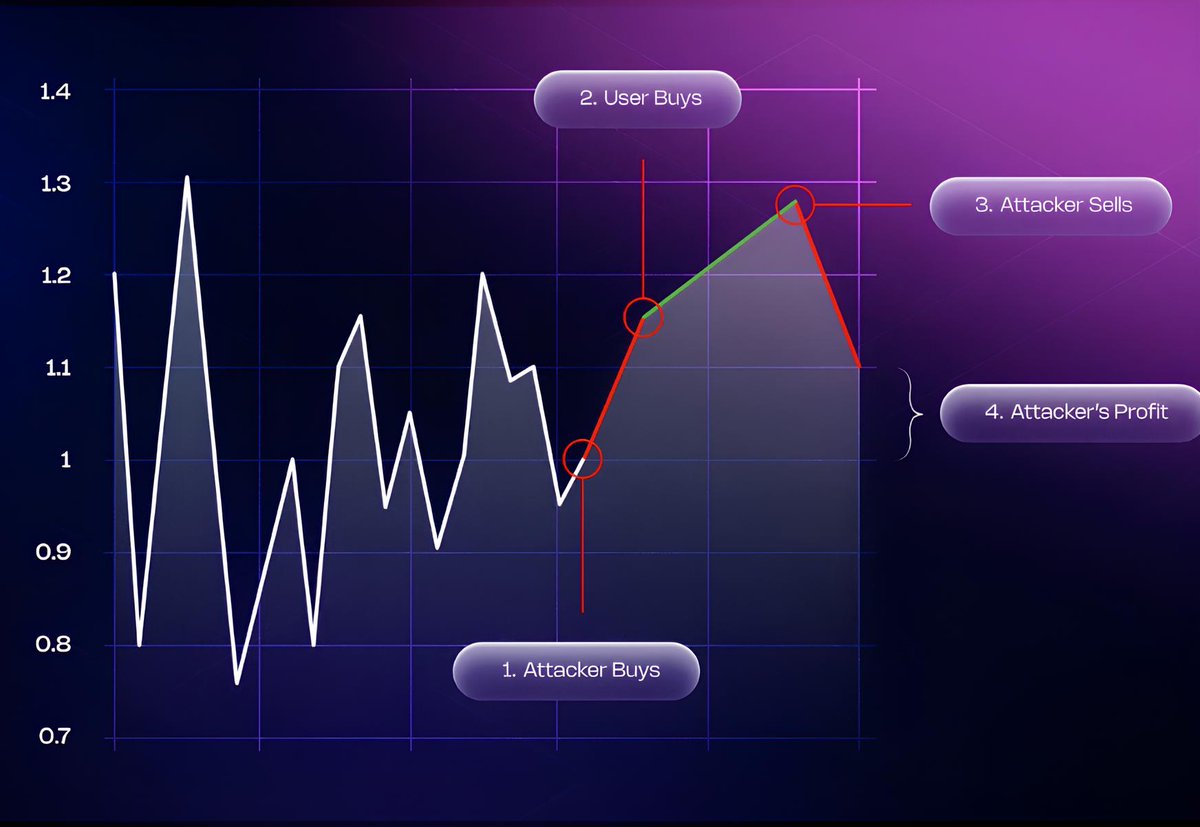
There are many examples that can be analyzed showing why a move towards privacy is the better choice, but I decided to stop at MEV sandwiches. This seems to me the most widespread problem you have faced and perhaps didn’t even know about.
I’ll explain in simple terms how these bots work: you want to buy a certain token, your transaction acts as the filling. The bot makes a purchase before your transaction, you buy at an already inflated price, and the bot immediately sells.
In this way, bots extract millions from users. The average loss for victims is around $8. But with large swaps, it can reach thousands. For example, in October 2025 there were more than 15,000 victims in a month, over 18,000 $SOL extracted.
Therefore, ephemeral rollups based on TEEs are a direct defense against sandwiches, the bot simply does not see that you want to buy. I hope that the privacy narrative around Solana continues to develop and more and more projects will implement @magicblock technologies for this.
Apr 4
Solana without privacy is not Solana
5
1
43
957
Apr 1
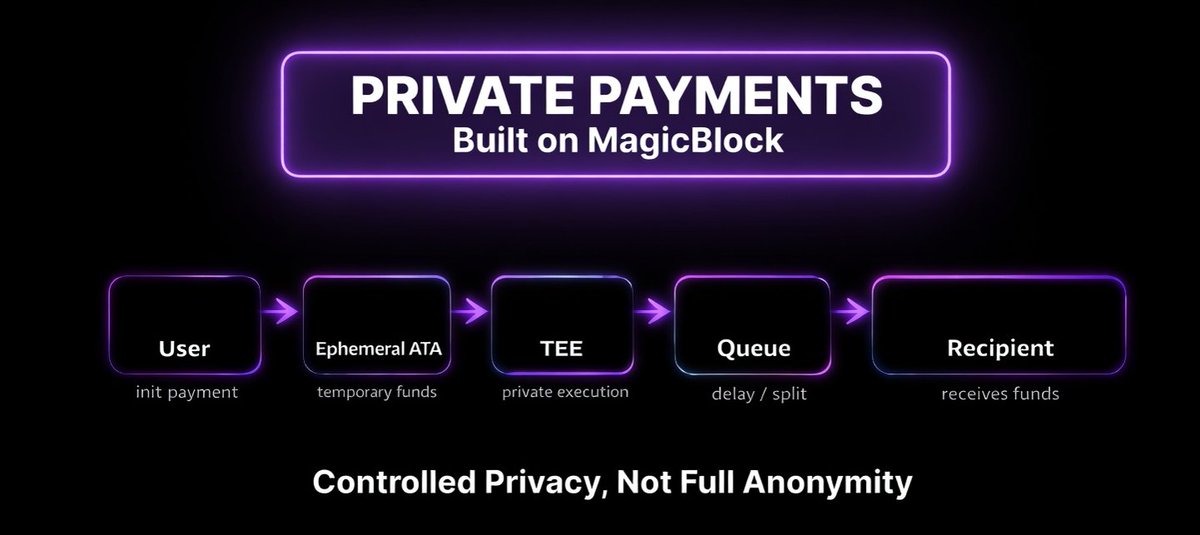
Yesterday @MagicBlock released the Private Payments API on @Solana, and at first glance it sounds like just another dev tool. But if you look a bit deeper, there’s actually something interesting here.
If short: they built a way to send USDC so that the blockchain sees the fact of the transfer, but not the details neither the amount nor the recipient.
Not through zk, not through MPC, but via TEE their own Ephemeral Rollups.
How it feels in practice:
you make a regular SPL payment, but it goes through their layer, where all the sensitive part lives outside of the public state.
Outside - just movement of funds.
Inside - all the mechanics.
How it works:
◽You send USDC to a temporary ATA
◽This account is delegated into their rollup
◽Then everything is executed inside TEE
where the address, amount, and conditions are revealed
◽The transaction goes into a queue
you can set delays or split the payment
◽When conditions are met the result is committed back to #Solana
and the funds are sent to the recipient
On-chain you see the fact.
The context - no.
This is not "anonymity at any cost"
They have a compliance framework built in from the start:
before execution there are checks, restrictions, filters.
So this is not an attempt to build a new #Monero.
This is an attempt to make privacy that won’t get a lawyer knocking on your door a week later.
Where this is actually needed:
salaries
marketplaces
B2B payments
any services where money = sensitive information
And especially now - in agent-based systems where not only humans initiate payments.
Why this makes sense:
blockchains have a weird paradox
transparency is a feature - until you start dealing with real money
at some point it starts working against you
And right now the choice is usually:
either everything is public
or don’t use blockchain at all
MagicBlock is trying to offer a third option.
Now about the trade-offs.
This is not a trustless model.
You are trusting:
TEE
hardware (Intel/AMD )
MagicBlock infrastructure
That’s fine, but it’s important to understand.
And yes, this is not zk-level privacy.
This is controlled privacy.
On the other hand UX.
All of this is integrated as an API.
No need to build your own cryptography, no heavy computations.
And this is where it becomes clear who this is for:
not crypto maximalists, but teams that want to ship products.
If you compare:
zk / MPC - more privacy, more complexity
Token-2022 - native, but limited
MagicBlock - middle ground
Not perfect.
But you can take it and integrate it today.
This is not an attempt to "fix privacy forever".
This is an attempt to make it usable.
And for most products that’s already enough.
3
40
1,150