
BD & partnership Lead @chimpxAi
Joined January 2024
- Tweets 3,216
- Following 161
- Followers 176
- Likes 4,489
87 Photos and videos












ChimpX AMA Reminder
Solana's AI Summer AMA goes live shortly.
Featuring builders and operators from across the Solana ecosystem.
In a few hours, we'll be discussing:
Solana's AI Summer, AI agents, DeFi adoption, and what's next for the ecosystem
Don't miss it.
👇 Set your reminder
x.com/i/spaces/1yGBeeDpQXWKN…
15
4
50
2,710

Jun 1
🔥🤍

Half an hour until we're live.
Join us as we discuss everything from Mojo AI and 33K users to 1000 $CHIMP rewards, upcoming features, staking benefits, and the future of ChimpX on Solana.
We're covering it all.
Bring your questions. 👇
x.com/i/spaces/1DxLddYVkoqxm…
1
22
GOATed retweeted

May 29
Come join us on Monday 1st June 🗓️ 🎙️
We at @ChimpxAI will dive deep into building simpler defi on @Solana for the masses.
That means :
⛽ No Gas
🔁 No Bridge
💰 No 10 Dapps & wallets
New to ChimpX or Mojo AI? 👀
This AMA is for you.
We’ll cover invite codes, wallet setup, Mojo AI prompts, and how to claim your 1000 $CHIMP, what’s next for ChimpX on @solana and much more.
🗓June 1, Monday
⏰1:30 PM UTC / 7:00 PM IST
📍x.com/i/spaces/1DxLddYVkoqxm
Host: @cryptopieee
Featuring :
⚡️CEO : @superchimpX
⚡️CTO : @DhruvalGupta4
Come for the invite codes. Stay for the future of Solana DeFi.

2
3
7
336

May 18
ChimpX is officially LIVE on @solana ⚡️
Waitlist users — your early access starts NOW.
One AI-powered interface to: → Trade → Swap → Stake → Bridge
All through a single prompt.
app.chimpx.ai 🐒🧵👇
1
1
4
74
May 18
Want to swap tokens? Stake assets? Bridge across chains? Open trades?
No complex dashboards. No endless clicking.
Just one prompt → instant execution.
Welcome to the future of DeFi on @solana 🚀
1
2
40
May 18
This is only the beginning.
ChimpX is building the AI command center for crypto.
Faster execution.
Simpler DeFi.
Smarter trading.
Early users are in first — and the next wave is coming soon. ⚡️🐒
app.chimpx.ai
1
1
31
May 17
Over 54,000 users already lined up for @ChimpX_ai 🚀
The momentum is building fast. If you haven’t secured your spot yet, you’re missing out on what’s next for DeFi on Solana.
Get on the list before the doors close. Early access drops are incoming. 🛠️⚡
🔗 app.chimpx.ai
#Solana #DeFi #Web3 #ChimpX
1
36
May 17
Last chance 🚨
Waitlist closes tonight.
Last chance to secure invite codes before launch.
app.chimpx.ai

11

GOATed retweeted

May 8
Hey guys I decided to make my TG channel public.
I wanna build this channel up just in case this accounts gets banned.
I barely post in there, just important announcements and longterm cooks.
t.me/MikasaOnSolana

91
70
193
33,371
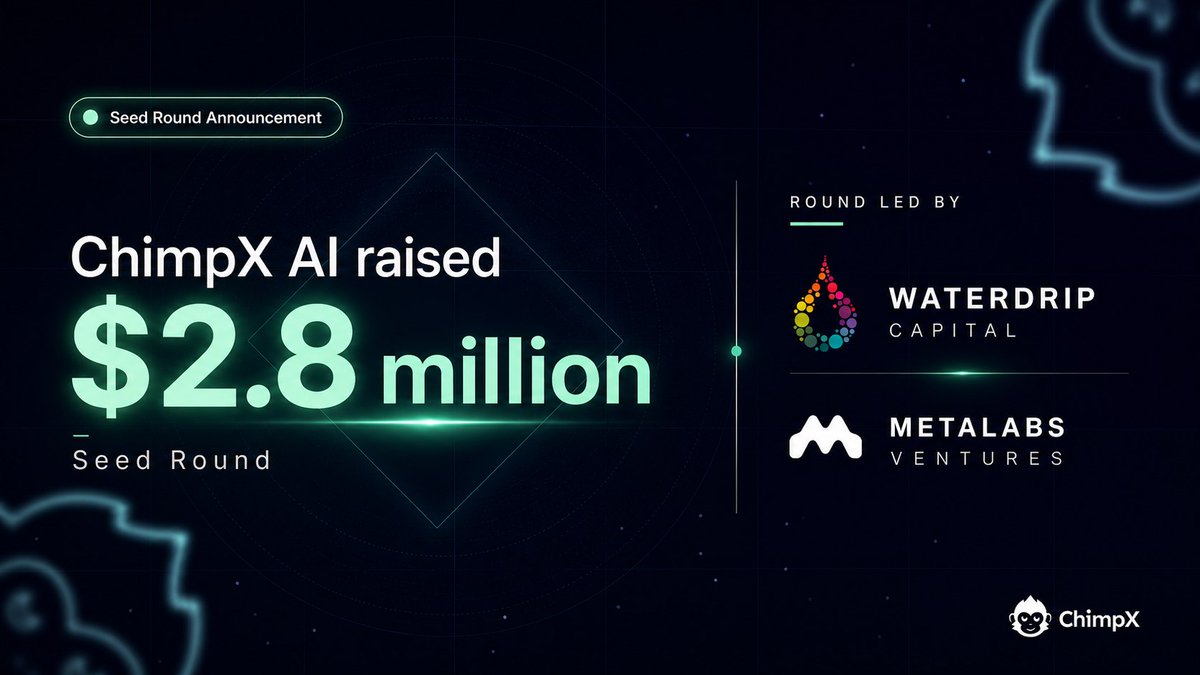
ChimpX AI is proud to announce a $2.8 million raise in Seed, led by @waterdripfund and @MetaLabs_vc.
Building "Mojo AI" to bring DeFi for everyone on Solana in seconds without gas.
Here is what we are Building🧵🐒
ALT ChimpX Raises $2.8 Million Seed Round
104
399
1,205
50,193
4 days to launch.
Are you on the list?
app.chimpx.ai
Waitlist gets in first.
Still time.
Don’t watch from the sidelines.
11
8
22
902
GOATed retweeted

Apr 4
Is your wallet ready for GameFi?
Over 200 million players are earning, with some generating 15% monthly.
My clients have seen over 250% ROI, launching 40 successful projects.
Follow HomeMetaX to see how.
1
1
80
Feb 5
My main Telegram is temporarily frozen due to a false report. I am operating from a backup channel until further notice.
Captain / AMB:
Message my temporary handle immediately: @Goatofdefi_backup
Note: If someone DM u claiming be me without verification here, block them.
2
1
9
216
GOATed retweeted

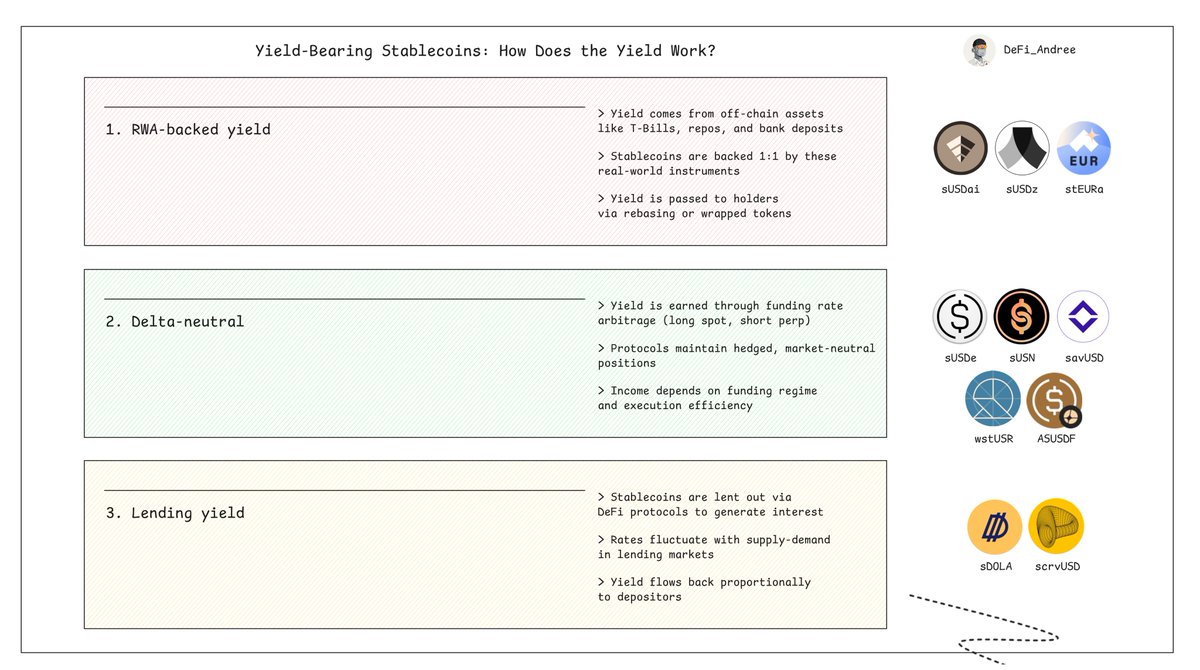
the yield-bearing stablecoin market is a barbell:
-great analogy and breakdown by @DeFi_Andree
tl;dr
$7.8B in top 2 (sUSDS, sUSDe)
vs.
long tail of <$400M experiments
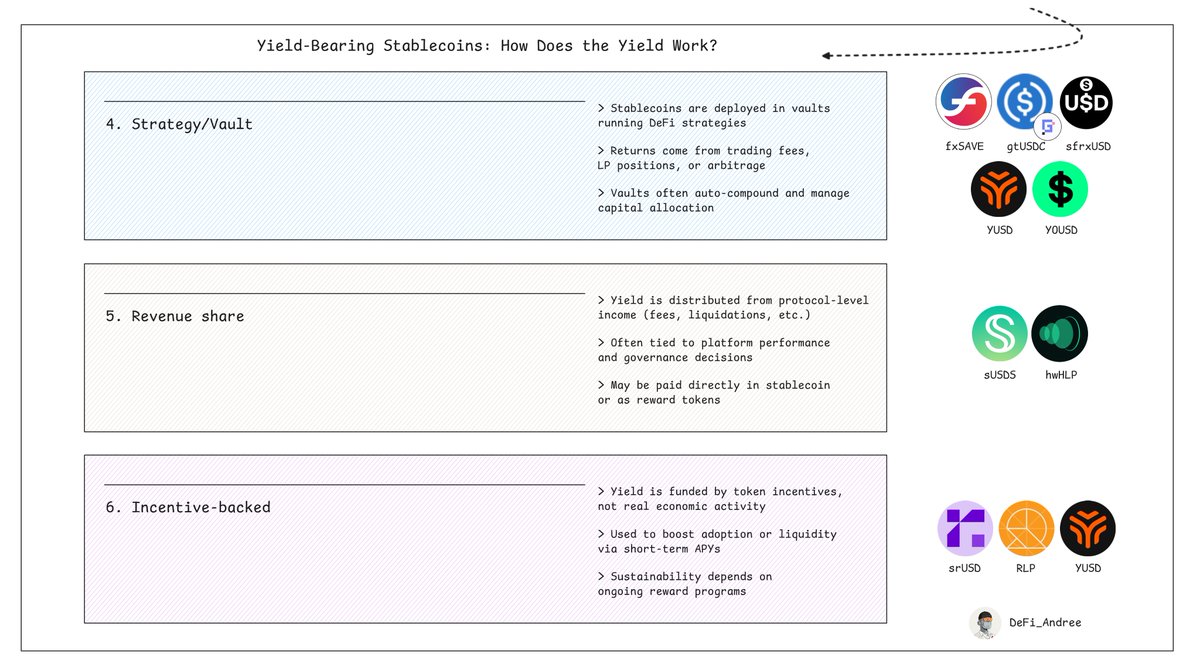
each using 1 of 6 yield engines:
1. rwa backed
→tradfi rates, off-chain income
→stable but capped by real-world yields
2. delta-neutral
→funding rate arbitrage
→market-dependent, execution-sensitive
3. lending
→onchain credit supply/demand
→transparent, cyclical
4.vault strategies
→multi-source packaging
→complexity = risk, convenience = adoption
5. revenue share
→protocol cashflow distribution
→aligned with platform growth
6. incentive-backed
→emissions/points bootstrapping
→temporary, growth-focused
why it matters:
not all yields are at equal risk
8% from transaction bills ≠ 8% from funding rates ≠ 8% from incentives
same APY, but different:
-sustainability
-stress behavior
-liquidity profile
-time horizon
the question isn't "which has highest yield?"
it's "which can scale yield without breaking under stress?"
that's what can determine the default onchain savings account
context = edge.
Jan 26

Yield-Bearing Stablecoins: From USD-pegged Token → On-chain Fixed-Income Infrastructure
Stablecoins mature, they aren't just growing in market cap, they are specializing
What was once a monolithic category is fracturing into distinct yield engines, each representing a unique method of generating on-chain USD cash flow
And like every vertical in crypto: this shift isn't happening evenly. It is defined by a few dominant names, followed by a long tail of experiments trying to catch up
This breakdown covers:
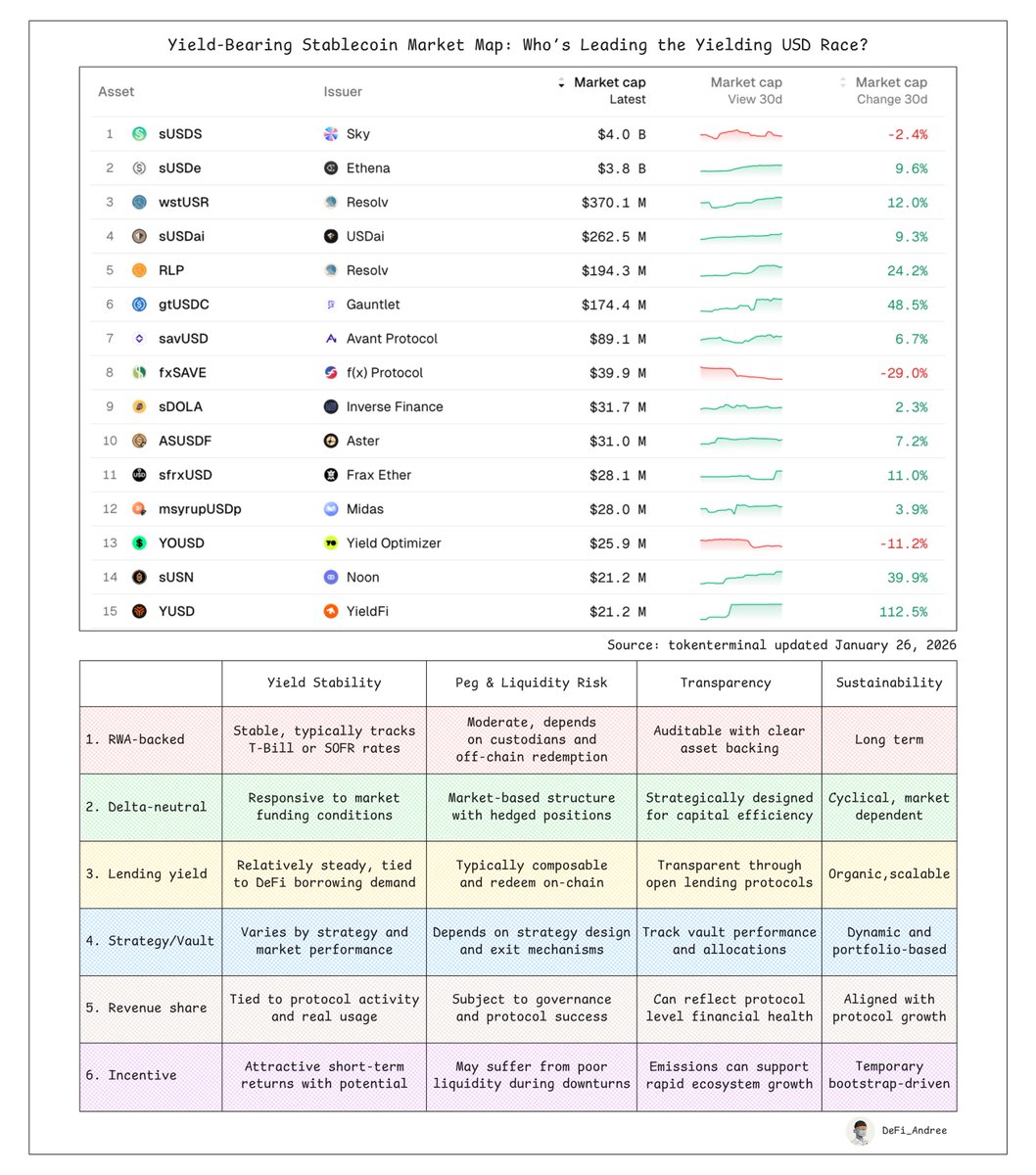
▸ Market map: Who is leading the yielding USD race?
▸ Mapping yield engines against stability, peg/liquidity, transparency, and sustainability
▸ Explaining how the yield works and the underlying assets
Let's Breakdown!! ↷
---
A) The Market is a Barbell: 2 Giants A Long Tail of Innovation
Look at the market map
The Top 2 Assets:
▸ $sUSDS: $4.0B
▸ $sUSDe: $3.8B
Total: $7.8B concentrated in just two products.
Meanwhile, the rest:
▸ The 3rd token ($wstUSR) sits at ~$370M
▸ Then it drops sharply to the $200M → $20M range
This is a classic barbell structure:
▸ One end: Liquidity standards becoming the default yield-bearing USD
▸ The other: A long tail of new designs testing different mechanisms, distribution channels, and growth loops
In stablecoins, liquidity is the moat
Therefore, the real race isn't about who has the highest APY
╰➤ Which stablecoin can scale its yield without compromising peg or liquidity under stress, effectively becoming the system's default savings account?
---
B) Growth Signals: The Long Tail Runs Fast, But Leaders Win on Liquidity
Look at the “Market cap change 30d” column
Smaller caps often see massive % gains because they are early or currently being bootstrapped:
$YUSD: 112.5% | $gtUSDC: 48.5% | $sUSN: 39.9%
$RLP: 24.2% | $wstUSR: 12.0% | $sUSDe: 9.6%
▸ Once in the multi-billions, growth is usually slower and follows market flows
▸ When under $200M, growth is driven by campaigns / points / incentives / distribution routing
╰➤ The long tail is proving PMF (Product-Market Fit) in specific niches, but the leader @ethena still dominates because that is where the deepest liquidity lies
Data source: @tokenterminal
---
C) 6 Yield Engines: Not Just Mechanisms, But 6 Monetary Architectures Driving Growth
① RWA-backed Yield
> Yield comes from off-chain income (T-bills, repo, bank deposits), redistributed on-chain
> Basically on-chain USD with TradFi world interest rates
$sDAI - @SkyEcosystem | $sUSDz - @AnzenFinance
$stEURa - @AngleProtocol
➁ Delta-neutral / Carry
> Yield comes from funding/basis rates via a hedged structure (long spot short perp)
> The deciding factors here are the funding regime hedge execution quality
$sUSDe - @ethena | $sUSN - @noon_capital
$savUSD - @avantprotocol | $wstUSR - @ResolvLabs
③ Lending Yield
> Yield derived from interest in lending markets.
> A very clean mechanism: on-chain credit supply & demand dictates the rate
$sDOLA - @InverseFinance | $scrvUSD - @CurveFinance
④ Strategy/Vault
> Yield comes from a strategy combo: LP fees, arbitrage, auto-compounding, allocation
> Practically, this is the strongest packaging group: turning multiple small yield sources into one user-friendly product
$fxSAVE - @protocol_fx | $gtUSDC - @gauntlet_xyz
$sfrxUSD - @fraxfinance | $YUSD - @GetYieldFi
⑤ Revenue Share
> Yield comes from protocol-level cashflow (fees, liquidations, operations…), paid back to holders/stakers
> This treats stablecoins like equity: the greater the adoption, the stronger the yield engine
$sUSDS - @SkyEcosystem | $hwhLP - @Hyperwavefi
⑥ Incentive-backed
> Yield comes from token incentives/points/emissions to bootstrap liquidity & users
$srUSD - @reservoir_xyz | $RLP - @ResolvLabs
> DApps distributing incentives (e.g., yield markets, lending/looping venues, vaults/aggregators) help route cash flow into stablecoins and amplify APY via campaigns/boosts
@pendle_fi | @aave | @MorphoLabs | @eulerfinance
---
In the New Era, On-chain USD Is Not Allowed to Sit Idle
It must generate profit, it must circulate, it must become working capital
Yield-bearing stablecoins are the upgrade from Cash → Income Asset
➥ And yield isn't just a percentage number. It is a system: encompassing mechanism, risk, transparency, distribution, and the ability to scale when the market shakes.
2
3
9
308
Jan 11
Venezuela operation is the signal: The US is now trading as a predator, not a protector.
When Saudi pulls back on debt support and Powell leaves the building, the floor falls out.
2026 is looking like a trap for Stocks/FX/Crypto.
If Economic security is a thing for u diversify
1
4
98