Brief glimpses into fights, and fighters, of the 20th century; the great, the near great, the very good, the journeymen, the opponents and much more.
Joined April 2025
- Tweets 9,210
- Following 274
- Followers 418
- Likes 5,845
8,402 Photos and videos
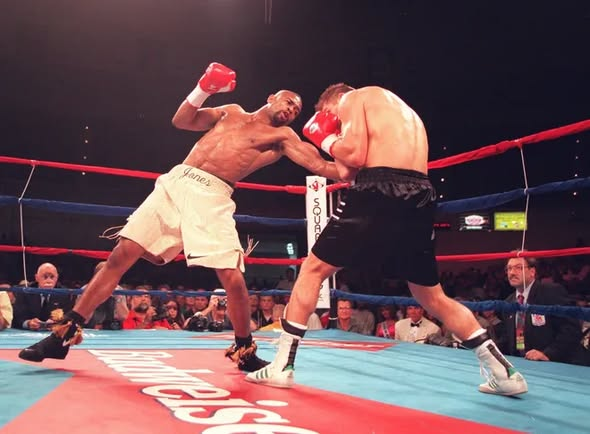
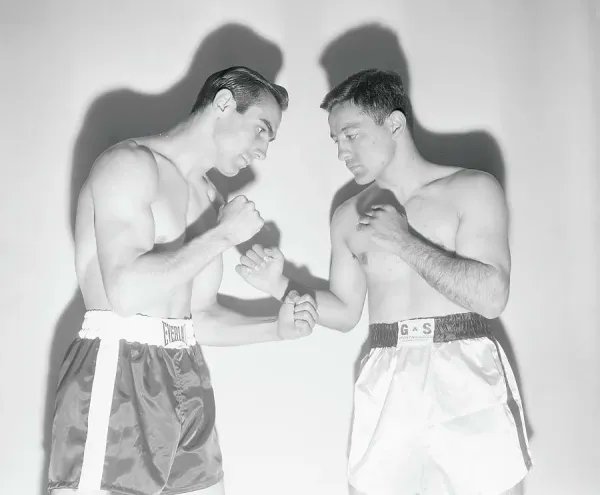

Roy Jones retains his WBU Super Middleweight Ttitle on June 15, 1996 over Canadian Eric Lucas as referee Brian Garry, on the advice of the ringside physician, stops the bout following the 11th round at the Jacksonville Coliseum in Florida.
This was Jones' 4th defense.
Lucas, the future WBC super middleweight champion (2001-2003), was ranked 12th by the IBF and he suffered a broken nose and a cut over his right eye.
Jones won every round but was unable to score a knockdown.
Jones said Lucas was "durable and tough" and subsequently asked him to be a sparring partner for future fights.
About seven hours before the fight, Jones played point guard for the Jacksonville Barracudas of the United States Basketball League.
He played 14 minutes and contributed five points to the Barracudas' 107-94 win against the Treasure Coast Tropics.
27
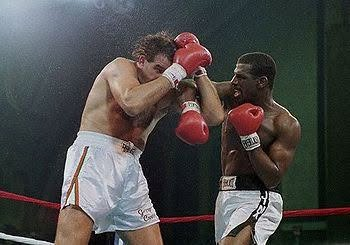
Michael Spinks TKO's Gerry Cooney in the 5th round, on June 15, 1987, in Atlantic City.
Cooney had actually come in as the favorite, 8 to 5 in Vegas, for this fight.
Spinks had been stripped of the IBF heavyweight title, in February of 1987, for refusing to fight Tony Tucker, then the #1 IBF contender.
Don King won the right to promote a Spinks-Tucker title fight with a purse bid of $711,000. In the case of a purse bid, the purse is divided 75 percent to 25 percent in favor of the champion. That would have meant $533,250 for Spinks.
Spinks did some basic math and, instead of fighting Tucker, he'd choose to fight Cooney for a guaranteed purse of $4 million. Cooney was guaranteed $2.5 million.
Spinks was still the lineal World Heavyweight Champion and this bout with Cooney was recognized as a world title fight by 18 states and The Ring Magazine.
Cooney, however, who'd made a habit of inactivity, had been out of the ring for 13 months (at this point) and had fought just three times since losing to WBC Heavyweight Champion Larry Holmes in June of 1982.
Spinks would drop Cooney twice in the 5th round of this fight.
Gerry Cooney was still a young man, 30, yet he had allowed serious bouts of inactivity to slow down his skills.
To say Cooney was rusty when he went into the fight with Spinks was to state the obvious.
Cooney, hampered by a fondness for booze and a host of emotional burdens, trained as hard as he was able to for this fight, but he was no longer the confident power-puncher who had taken out names like Ken Norton, Ron Lyle and Jimmy Young several years earlier. Not that he had been a genuinely confident fighter even then. Cooney, in his own words, was “fighting through a fog” when he tried to get the better of Spinks, and years later he would say that he asked repeatedly to be able to withdraw from this fight.
Cooney tried to land some powerful left hooks in the early going but Spinks was too smart to be trapped in one place. Cooney couldn’t catch the constantly moving target Spinks frustrated him with and he was also being stung by crisp shots to the face.
Reddened around the face and tiring, Cooney was then decked twice in the fifth and it was all over.
Somewhat surprisingly, one judge had the fight all-even at 38-38 at the time of the ending.
Cooney was done, though he would come back in 1990 to fight George Foreman, and Spinks was set to pull in millions in his “Once And For All” fight with Mike Tyson.
None of us knew it on the night of June 15, 1987, but both 30-year-old heavyweights Michael Spinks and Gerry Cooney would each fight only once more after their “War at the Shore.”
1
6
66
On June 15, 1985, WBC Heavyweight titlist Pinklon Thomas, making his first defense, TKO's former WBA champion Mike Weaver in the 8th round in Vegas.
Before an assortment of world champions, former world champions and alphabet champions, the undefeated Thomas (25-0-1) brought some order to the heavyweights with his performance, capped by a right hand that traveled 6 inches to Weaver's temple and ended the scheduled 12-round bout at 1 minute 42 seconds of the eighth round.
Sugar Ray Leonard, the former welterweight champion, had decried the "disgraceful lack of pride" displayed by many of the division's so-called leading contenders at the time. he lauded Thomas who, at the least, showed up in shape unlike several others seeking or claiming alphabet titles at the time.
"Maybe there ought to be a 225-pound weight limit," said Leonard, referring to David Bey, Tim Witherspoon, James Broad, Greg Page (Witherspoon and Bey had appeared on the undercard) and a few other heavyweights whose weights seemed to yo-yo from fight to fight, "or at least no one should be permitted into the ring with fat hanging down the sides of his trunks."
Thomas, seen as a potential and capable caretaker of the title for a time, at the very least, and maybe the best of the lot at the time, would lose his WBC title to Trevor Berbick in his 1st defense.
Leonard added that the many heavyweights showing "disrespect" for the sport by fighting in much less than their best condition were hurting boxing and the division.
1
4
74
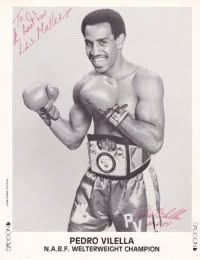
Pedro Vilella (pictured, 17-0-1 coming in) scores an upset 12-round majority decision over Marlon Starling on June 15, 1984 at Madison Square Garden to take the NABF Welterweight Title.
From The New York Times:
Starling Is Upset
Pedro Vilella upset Marlon Starling in a 12-round majority decision last night at Madison Square Garden, taking the North American Boxing Federation welterweight championship from Starling in the main live preliminary to the closed-circuit telecast of the Thomas Hearns-Roberto Duran bout.
Vilella was taken to St. Vincent Hospital after the fight with what was believed to be a broken nose that caused blurred vision and some breathing problems. Vilella, a 25-year-old southpaw with an 18-0-1 record, was quicker and did the most scoring. It was only the third loss against 32 victories for Starling, the harder puncher, whose only previous defeats were to Donald Curry, the undefeated World Boxing Association champion.
----------------------------------------------------------
As an amateur Pedro Vilella had won three New York Daily News Golden Gloves Championships (at 126 in 1976 & 77, and 135 lbs in 1980 beating future world titlist Davey Moore enroute to that title).
Southpaw Pedro Vilella would go on to lose his next fight after surprising Starling, a 12-round UD to Milton McCrory in a challenge for the WBC Welterweight Title, but finished his career with six straight losses (the final one a 10-round UD to Starling) to end up at 18-6-1 (5 KO's).
55
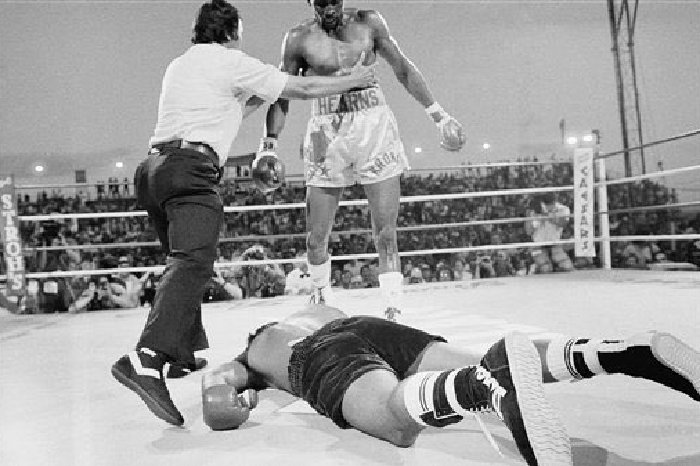
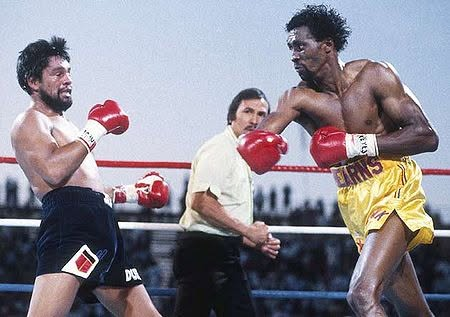
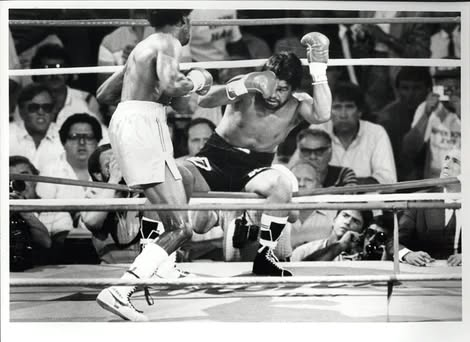
WBC Super Welterweight Champion Thomas "Hitman" Hearns, sometimes unfairly defined by his memorable defeats; losses to Sugar Ray Leonard, Marvelous Marvin Hagler and Iran "Blade" Barkley, scores one of the defining KO wins of his career, and one of the most memorable Ko's in boxing history, with a 2nd round knockout of Roberto Duran, on June 15, 1984, at Caesar's Palace.
Since his defeat to Leonard in 1981 Hearns had rebounded to win six in a row, including a decision over Wilfred Benitez for his second world title. And with Leonard retired, talk of a Hagler-Hearns battle, a clash between arguably the two finest champions in the game, was on the minds of virtually all boxing fans.
Without this stunning KO of Duran, the anticipation for Hagler vs Hearns would never have captured the public’s imagination.
Duran's showing against Hagler the previous November, which made his match with Hearns viable, also began to put thoughts in the minds of more than a few that the marvelous one was nearing the end of his dominat reign.
A huge underdog, the 32-year-old Duran had become the first of Hagler’s challengers to hear the final bell, while giving the marvelous one a surprisingly competitive fight. If Hagler took the win over the savvy veteran and all-time great lightweight, the victory did nothing to enhance his stature. It was that rare instance where the loser of a high-profile match may have come out looking better than the winner.
----------------------------------------------------------
From The Fight City:
Once Duran’s big paycheck from the Hagler fight had landed in his bank account, Roberto the party animal re-emerged with a vengeance. In a mood to celebrate after months of training and restraint, Duran hired his own personal orchestra to tour with him around Latin America so he could dance and sing and carouse night after night. The adulation of his fans, made more ardent for his having been lost and now found, went to his head, and all the whiskey and filet mignon to his belly. Reportedly, Duran entered training camp for the Hearns fight most reluctantly, and once there had to focus on losing weight more than anything else.
In stark contrast, Hearns had perhaps the most intense and productive camp of his entire career. Indeed, Emanuel Steward ranked it as such years later. “We had the best preparation in the world,” he told author Pete Hamill. That year Steward was involved in helping to prepare the national amateur team for the Olympics and so Hearns found himself working with such elite talents as Mark Breland, Pernell Whitaker and Frank Tate, along with world champions Milton McCrory and Mike McCallum. “It must have been one of the best camps in boxing history,” said Steward.
Thus, in retrospect, what transpired on that June night in Las Vegas isn’t so shocking. But at the time, it was, for one simple fact: no one, not even a deadly puncher like “The Hit Man,” knocks out Roberto Duran. It had never been done and no one expected it to happen now. The Panamanian they called “El Cholo” was renowned for his toughness, had never been stopped, and there was little reason to think Hearns might do serious damage to the same chin that Hagler couldn’t dent.
But then again, Duran had never faced a boxer with the unique gifts of Thomas Hearns, who knew how to make the most of his lanky frame and the leverage it could provide. Despite having scored just two stoppage wins in six contests since his defeat to Leonard in 1981, Hearns appeared extraordinarily confident in the days leading up to the match, and in fact, at one of the final press conferences, he openly predicted he would knock out the great “Manos de Piedra” in the second round.
And so he did, in large part because Hearns and Duran were at diametrically opposed positions on the arcs of their respective careers. Duran, at 33, came into the ring past his peak and something less than highly motivated, while Hearns, just 25, was primed and never sharper. From the opening bell, “The Hitman” took control, backing up the smaller man with aggressive footwork and a hard left jab, making excellent use of his twelve inch reach advantage. Generally a slow starter, Duran looked to take his time and find his rhythm but the taller, stronger, more assertive Hearns never gave him a chance.
With a minute left in the opener Hearns struck with two hard rights and chased Duran into the ropes. While the clearly uncomfortable Panamanian smiled and mugged, Hearns stalked and threw heavy punches with abandon, opening a cut over Roberto’s left eye. All in all, it was a disheartening opening round for Roberto and his fans, but it was about to get much worse.
Forcing Duran to retreat, Hearns got home a hard right to the head followed by a left to the body, and the combination clearly shook the smiling Panamanian. A jab to the belly landed flush and a second one brought Roberto’s hands down to parry it. Anticipating the opening, Hearns instantly smashed Duran on the jaw with a vicious straight right that floored the former lightweight terror for only the third time in his long career.
Duran beat the count but his body language and facial expression betrayed the fact he was in deep trouble. His legs looked to be gone, a fact confirmed when he tumbled to the canvas a second time as Hearns threw a relentless torrent of punches. Duran rose and, saved from further punishment by the bell, provided a comic image as he waved defiantly at Hearns while marching on unsteady pins to the wrong corner.
Round two saw the fulfillment of Hearns’ prediction. Give Roberto credit: he bravely stood his ground with his bigger, stronger and more powerful foe, even throwing a few right hands with bad intentions in an attempt to turn things around. But in addition to heart and courage, Duran was known for his defensive skill and against Hearns, this was absent. Instead of protecting his chin and using upper body and head movement, Duran stood straight up, his jaw a target Tommy couldn’t miss.
Thirty seconds into the round and the Panamanian legend was being swarmed by “The Hit Man” who, with his greater size and complete lack of respect, looked like a teenage bully sadistically tormenting a kid from grade school. Another right hand buckled Roberto’s legs and pinned him to the ropes and when he tried to force Hearns back, he found himself eating more leather. Dazed and looking to avoid punishment, Duran briefly clinched before backing into perfect punching range.
What followed was one of the single most devastating right hand missiles ever thrown by “The Motor City Cobra.” It detonated on the side of Roberto’s jaw, snapping his head like it was a speed bag, and the triple-crown champion, who had never come close to being stopped in his entire career, instantly went limp and collapsed to the canvas.
The feared warrior who had defeated Sugar Ray Leonard and battled Marvelous Marvin for fifteen back-and-forth rounds had been rendered helpless by Thomas Hearns in just four minutes, left face down in the resin dust, a sight few had imagined they might ever behold. The shocking victory instantly revitalized Hearns’ faded aura of menace, his past image as “The Hitman,” a deadly knockout artist.
It also transformed a prospective Thomas Hearns vs Marvelous Marvin Hagler contest from a major attraction to the fight absolutely everyone wanted to see, and all involved had one man to thank. It was Roberto Duran who made the Hagler vs Hearns match supremely viable and profitable. As his handlers worked to revive him in his corner, and as the scribes on press row composed their obituaries for the legendary career of “Manos de Piedra,” the drums were already beating in earnest for boxing’s next big superfight. And Hearns wasted no time in throwing down the gauntlet.
“I challenge Marvin Hagler,” said Tommy at the post-fight press conference. “I can see him in my mind now, shaking like a leaf on a tree.”
1
3
181
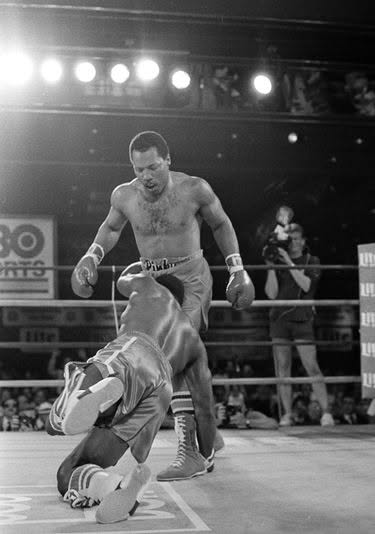
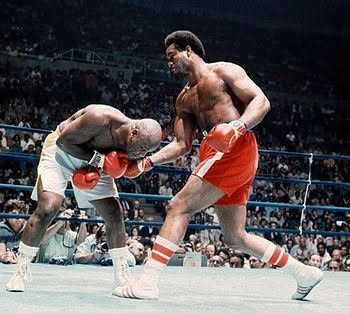
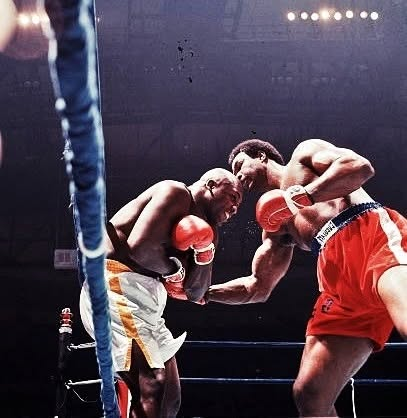
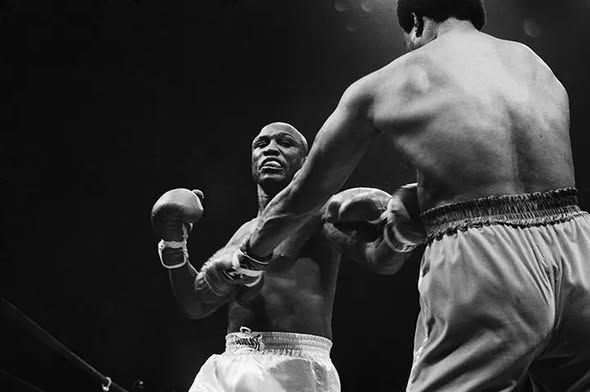
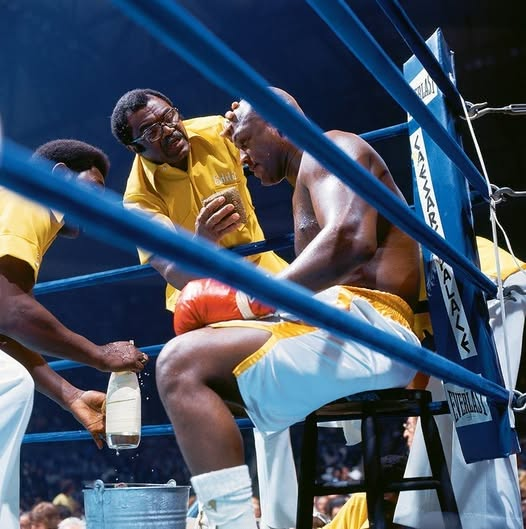
George Foreman, five months removed from his epic NABF Heavyweight Title fight war with Ron Lyle, scores a 5th round TKO of Joe Frazier, on June 15, 1976, at The Nassau Veterans Memorial Coliseum in Uniondale, Long Island, New York.
In their previous encounter, Foreman had steamrolled the then-champion Frazier, scoring six knockdowns in less than two rounds to capture the Heavyweight Championship.
After his defeat at the hands of Muhammad Ali in Zaire, Foreman was out of boxing for over a year, sitting out all of 1975.
He returned in January 1976 to defeat Lyle and capture the NABF Heavyweight Title before agreeing to face Frazier.
Foreman hoped a victory over Frazier would propel him to a rematch with Ali, while Frazier, who was coming off of Manila, hoped to avenge the blowout loss Foreman had scored three years prior.
Several hours before the fight, for reasons known only to him, Frazier shaved his head on pure impulse.
As for the fight itself:
Frazier abandoned his usual aggressive approach at the start and utilized a more defensive style to avoid a repeat of his previous fight with Foreman. He kept his distance throughout the first four rounds and even taunted Foreman by dropping his hands and daring him to land a punch. Foreman, however, took control of the action, getting Frazier against the ropes and weakening him with powerful body shots. In the fifth, Foreman finally broke through and landed a combination with Frazier against the ropes with the final punch being a devastating left hook. Frazier immediately returned with a jab, but slipped and fell down to the canvas. Frazier got back up and continued the fight, but Foreman quickly sent him back down with a powerful right hand. Frazier pulled himself back up at the count of seven, but his trainer Eddie Futch jumped on the ring apron and ordered the referee to stop the fight to prevent further punishment.
"George Foreman: Too big! Too strong! In perfect shape! The punches crisp from the very beginning! Frazier: As game as ever. But now, inevitability, the boxing career over." said Howard Cosell, during the live broadcast of the fight.
This fight was a significant point in the careers of both men; for Foreman it symbolized that he likely was the biggest threat to Ali in the division, while for "Smokin' Joe" it only convinced many of what Frazier was loathe to admit, that his boxing career, and days as a top contender even, were clearly at an end.
Foreman, of course, would win three more fights before his career, and life, altering bout with Jimmy Young in San Juan.
Frazier would hang up the gloves, for over five years at least, before a regrettable comeback bout with Floyd "Jumbo" Cummings in December of 1981 that would end in a draw.
2
50
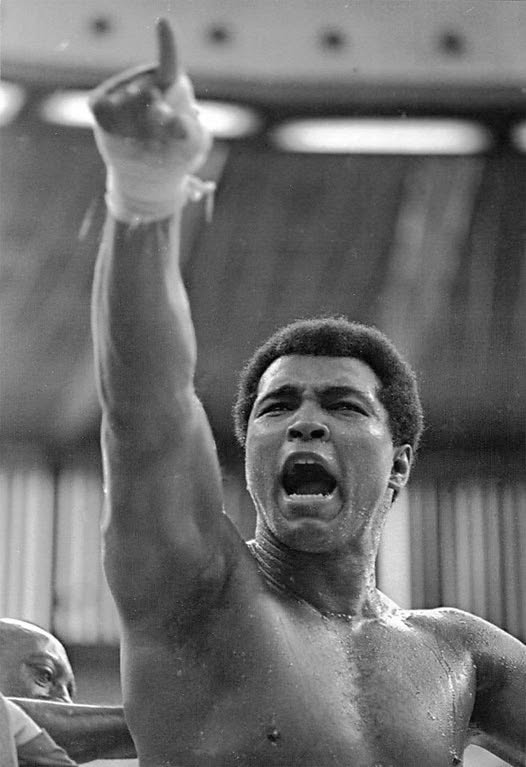
Heavyweight Champion Muhammad Ali, on June 15, 1975, training for his title defense, the 3rd of his 2nd reign, against Joe Bugner in Malaysia on the 30th.
Ali is coming off of his 11th round TKO of Ron Lyle on May 16th, while European Heavyweight Champion Bugner is coming in off of a 5th round TKO of Dante Cane in February.
6
36
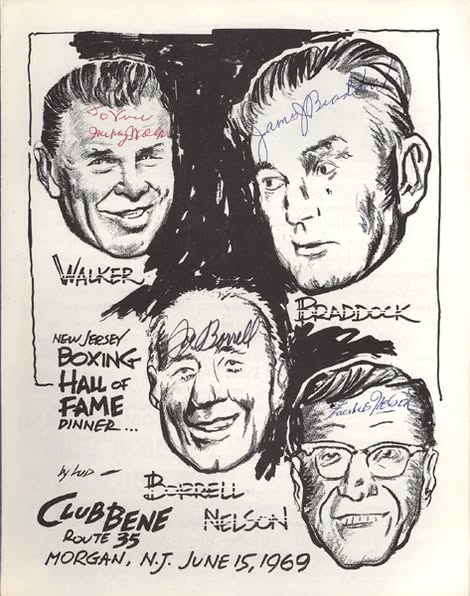
Dinner program for the induction ceremony on June 15, 1969 into the New Jersey Boxing Hall Of Fame.
The cover has depictions of inductees, former heavyweight champion Jimmy Braddock, former welterweight champion Mickey Walker, former middleweight contender Joe Borrell, and former contender Frankie Nelson.
20
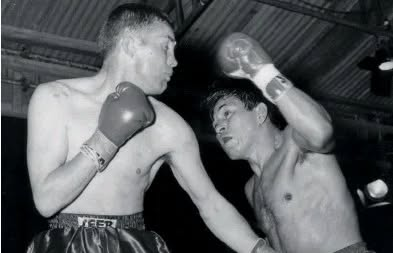
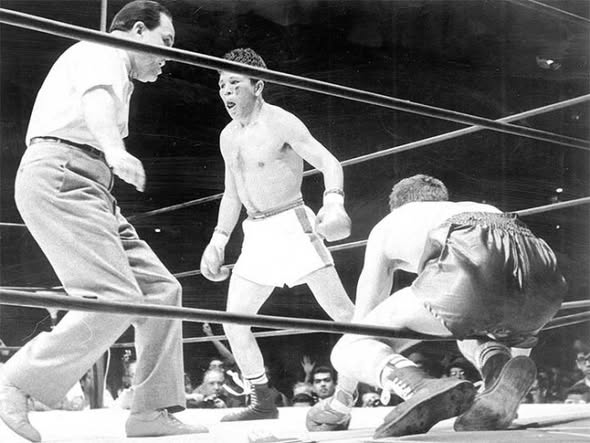
Featherweight Champion Vicente Saldivar (light trunks with stripe) retains his title with a 15-round points win over Howard Winstone, on June 15, 1967, at Ninian Park in Cardiff, Wales, UK.
This was the second of three title defenses Saldivar would sucessfully make against Winstone and he'd drop him twice in the 14th round to put an exclamation point on his victory.
The AP report on this bout, which called it, "almost an exact duplicate of their first fight.", would read:
"Vicente Saldivar of Mexico began a well-earned two month rest today when he left for Paris after successfully defending his world featherweight title last night on a narrow 15 round decision over Welshman Howard Winstone. Saldivar came on strong in the final rounds against Winstone to take the decision, which was greeted with displeasure by a large section of the crowd. Winstone used a stinging left jab and good combinations to pile up points in the first eight rounds, but he slowly began to tire and the stronger Saldivar took advantage of the opportunity. Saldivar almost finished Winstone in the 14th round after he had floored the Welshman with a non-stop attack to the body. Winstone arose from the onslaught with his hands at his sides and took another savage beating but somehow managed to stay upright."
Saldivar and WInstone would meet a third time, four months later, with "El Zurdo de Oro" winning via 12th round TKO in Mexico City.
The southpaw Saldivar would announce his retirement shortly afterwards.
----------------------------------------------------------
Vicente Saldivar, 37-3-0 with 26 KO wins, is a name that is forgotten by some but he was Mexico's first great Featherweight Champion well over a decade before the legendary Salvador Sanchez came along.
Born in one of the barrios on the outskirts of Mexico City, Vicente Saldivar at an early age would often get into fights both on the streets and in school, and developed a reputation around the area. Fearing that Vicente would head down the wrong path, his father decided to try to guide his energy into a sport where you could get recognition and praise for fighting: Boxing. So he took Vicente into a boxing gym where he would fall in love with the sport and became a successful amateur, winning the Mexican Golden Gloves as a Bantamweight.
That victory would grant the 17-year-old Saldivar a spot on the Mexican Olympic team for the 1960 Olympics in Rome(The same Olympics where a young man named Cassius Clay would win a gold medal at Light Heavyweight). His Olympic dream wouldn't last long as he would be eliminated in the first round of the tournament against Ernst Chervet of Switzerland.
In his first few years as a pro, Saldivar built up a record of 16-0 (13 KOs) before he would suffer defeat at the hands of Cuba's Baby Luis via DQ in 1962. The following year he fixed the wrong by knocking out Luis in the 8th round of their rematch. He fought 3 more times that same year before, in 1964 he would get a chance to win the Mexican Featherweight title against Juan Ramirez, knocking him out in 2 rounds. He had defended the title once when he got an opportunity he couldn't refuse, a fight with the #1 ranked Featherweight at the time, Ismael Laguna of Panama, with the winner receiving a shot at the title.
By the time he faced Saldivar, Ismael Laguna's record was at 34-1 and he had already won the Panamanian Featherweight title.
In the battle of the two Ffeatherweight prospects, Saldivar would take a 10 round decision and, with the victory, get his shot at the world title.
That same year, he would fight the then WBC and WBA Featherweight Champion, Cuban-Mexican Sugar Ramos.
The fight was at El Toreo de Cuatro Caminos in Mexico City and most experts chose Ramos to win the fight, believing Ultiminio's experience would ultimately win the day over Saldivar's raw aggression and power.
However, in an epic and thrilling war between the two men fighting out of Mexico City, Saldivar surprised many by taking the initiative and wearing down the Cuban-Mexican with his vicious body attack. It was simply too much for Ramos, and after the 11th round, he retired on his stool. Vicente Saldivar was now the new WBA and WBC Featherweight Champion.
Saldivar would make seven title defenses, retiring after his third win over "The Welsh Wizard", Howard Winstone, in 1967
----------------------------------------------------------
From boxrec:
Upon Vicente's retirement, the WBA & WBC declared the Featherweight Championship vacant and ordered their top contenders to fight for their respective titles. For the WBA, the top 2 contenders were Saldivar's former opponent Raul Rojas, & Enrique Higgins of Colombia. In the beginning, Rojas took the lead against Higgins with bulling, lunging tactics that broke the guard of the Colombian multiple times. But in the middle rounds, Enrique came back and started to put on a boxing clinic on Raul. By the 12th round, Rojas had multiple welts and mouses around his eyes and bleeding heavily by the nose. But just like Vicente, Raul persevered and in the 12th, he caught Higgins with a right hand, followed by a left and another right, and with that Enrique hit the canvas. he rose to his feet at the count of 8, came back out, and went toe-to-toe for the remainder of the round. For the next two rounds, Higgins attempted to regain what he had in the middle rounds, but it was gone and Rojas continued to batter him for the remainder of the fight. When the end came, it was almost too close to call, but in the end, it was a unanimous decision for Raul. And with that Raul Rojas was the new WBA Featherweight Champion...If only for a little while. A few months after he won the title, he would lose it in his first defense against Japan's Shozo Saijo. From then on, the WBA Featherweight title would transition to multiple legends such as Ernesto Marcel of Panama, Ruben Olivares, Nicaguragan Legend Alexis Arguello, Panama's Eusebio Pedroza & Barry McGuigan of Ireland.
Meanwhile, for the WBC, the top 2 contenders were none other than Saldivar's toughest opponents; Howard Winstone & Mitsunori Seki. For both men, it was their 4th attempt at trying to capture the Featherweight title, for Seki, it was his 5th attempt for a world title overall, and for Winstone, it was his first attempt at the title without Vicente there to defend it. With Saldivar watching among the crowd at the Royal Albert Hall in London, the Welshmen & the Japanese battled for the vacant WBC title. Both men put forth a gutsy effort, but Winstone was overall the better fighter, and he managed to cut Seki over his right eye. Upon being cut, the referee called a halt to bout to have look at the eye, which he decided was too dangerous to continue, and just like that, Howard Winstone was finally the Featherweight Champion of The World...But just like Raul Rojas, his reign wouldn't last long. After a non-title fight against BBBofC Super Featherweight Champion Jimmy Anderson, Howard would defend the title for the first time against a former opponent: Cuban-Spaniard, Jose Legra.
Known as "Pocket Cassius Clay" for having an uncanny resemblance to Ali, both physically and in his fighting style, and born in Baracoa, Cuba, Legra turned pro in 1960 and spent his first four years fighting in Cuba, Mexico, & Miami, Florida. When Fidel Castro slapped on the ban on professional boxing, Jose found himself in the same predicament that Sugar Ramos, Jose Napoles, and many other Cuban boxers found themselves in. But unlike other Cuban boxers who escaped to either Mexico or the U.S, Legra decided to go to Spain instead. That's where he went and that's where he stayed, gaining Spanish citizenship in 1966. from 1963 to 1965, Jose fought 27 times, winning 25 and drawing 2. That unbeaten streak was broken by none other than Howard Winstone, before his first fight with Saldivar. After the loss to Winstone, Legra would bounce back and go on a four year, 50 fight winning streak, winning the vacant EBU Featherweight title in the process. Then in 1968, he finally got his shot at the Featherweight title, as well as a chance at revenge as the WBC title was in the hands of Winstone. The effects of the fights with Vicente finally came out for Howard, as Jose knocked him down 2 times in the 1st round with looping overhand rights which also caused Winstone's left eye to swell quickly. For the next 4 rounds, Legra batter Howard from pillar to post, landing punches almost at will, and most of them hitting the swollen left eye. Then finally in the 5th round, with Jose landing multiple rights & Winstone almost completely helpless, referee Harry Gibbs decided enough was enough and mercifully stopped the fight. For Howard, it would be his last fight as he retired afterward, leaving a record of 61-6(27 KOs), and Legra, he was now the new WBC Featherweight Champion.
But it seemed as if the Featherweight Championship had some kind of curse on it. After two non-title fights in Spain & Paris, France, Jose decided to make his first defense of the title. For his 1st defense, he would head into neutral territory as he would take on a fighter he was fairly similar to him in terms of style and backstory; French-Australian, Johnny Famechon. Born as Jean-Pierre Famechon in Paris, France, Johnny was a highly skilled boxer whose greatest strength was his defense. He came from a prestigious boxing family. His father Andre Famechon was French Lightweight Champion, while his uncle Ray Famechon was French and EBU Featherweight Champion, and even challenged Willie Pep for the world Featherweight title in 1950, losing by unanimous decision. In 1948 Famechon's father and uncle Ray were offered to move to Australia and fight out of there. Andre took the offer and 2 years later brought the rest of his family over including Johnny. Once again, that's where he went & that's where he stayed. In 1961, with no amateur experience, Famechon decided to follow in his father and uncle's footsteps and made his professional debut, with his first bout ending up a draw. from 1961 to 1969, Johnny would build up a record of 47-4-6 (18 KOs), winning the Australian-Victorian State Featherweight title, the Australian Featherweight title, & the Commonwealth Featherweight title before getting his shot against Legra for the WBC title. In the battle between the talented dual nationality boxers, Famechon's defense carried him to victory as Jose couldn't find his range & got outboxed by the French-Australian.
With all the activity happening within the Featherweight division, Saldivar must've grown restless. Even though he had retired as Featherweight Champion, and with an almost perfect record, that wasn't enough for him. He wanted more, he was a born fighter and born fighters can he hear every second of every day tick by as they search for purpose again. Within the 2 years the Featherweight division lapsed into chaos, Saldivar assessed whether or not he still had the drive, the ability, and the hunger to still compete at the highest level of the sport. And in end, he concluded that he still had those things. And so on July 18th, 1969, Vicente returned to the ring. For his first comeback fight, Vicente decided to take a risk and face Jose Legra at the Inglewood Forum in Los Angeles, California.
At first, it seemed that the comeback would be a failure as Legra continuously tagged Saldivar with multiple right hands early rounds, and it seemed that it was all but confirmed when Jose floored him in the 3rd round with a right to the chin. But like always, Vicente persevered, he got up and in the 4th round, Saldivar returned to his old ways as he began hitting Legra's body with his ferocious body attack. It would prove to be the difference as Jose tired and Vicente grew stronger and sharper, tagging the Cuban-Spaniard with multiple left hands and staggering him in the 9th and 10th rounds. When the scorecards were read, it was a unanimous decision for the Mexican. It was official: Vicente Saldivar was back. Two weeks after Vicente's comeback win, Johnny Famechon made his first defense of the WBC Featherweight title. For his first defense, Johnny decided to have a homecoming bout as he would return to Australia against Fighting Harada of Japan.
Born as Masahiko Harada in Tokyo, Japan, Harada began his career as a Flyweight in 1960 and amassed a record of 26-1 with 10 KOs(Among his first opponents would be respected Japanese official Ken Morita & future Flyweight Champion Hiroyuki Ebihara) before receiving his first title shot in 1962 against Thailand legend Pone Kingpetch, knocking him out in the 11th round. His reign as Flyweight king wouldn't last long as Kingpetch would regain the title a year later, beating Masahiko by majority decision. Harada would then move up in weight, and in 1965 would become Bantamweight Champion, making 4 successful defenses before losing that title to another Australian, Lionel Rose. Masahiko decided to move up in weight again and go after the Featherweight title, the only thing standing between him and the championship was Famechon.
Their fight would be an intense one as Harada floored Johnny in rounds 2, 11, & 14, while Famechon would score his own down in round 4. At the end of the fight, Willie Pep, the referee and the only judge, initially declared the fight a draw, much to the dismay of Johnny's hometown crowd. It was then that Pep changed his scorecard, awarding Famechon the fight & allowing him to retain the title. Following a non-title victory over future Bantamweight Champion, Arnold Taylor, Famechon decided to give Masahiko another shot, going into Harada's hometown. This time Johnny would leave no doubts as he outboxed Masahiko, and in the 14th, knocked him out. It would be Harada's last fight as he would retire afterwards with a record of 55-7 (22 KOs).
With the threat of Fighting Harada gone, the stage was now set for Famechon vs Saldivar. The fight would in neutral territory as it would take place at the Palazzetto dello Sport in Roma, Italy. Vicente started strong, throwing his left hands and pounding away at Johnny's body while Famechon boxed from the outside and kept his jab constant. As the fight wore on, Saldivar started having trouble with Famechon who'd decided to pick up the pace, making Vicente miss with his defensive tactics and coming back with his own punches which caused Saldivar's right eye to swell, it was as if Vicente had entered the ring with Howard Winstone for the 4th time. In the 10th, Johnny turned up the tempo of his attack, targeting Saldivar's already swollen right eye. But Vicente, like he always had, persevered and in the 13th, he finally caught his man as Johnny's foot got tangled with Saldivar's, Vicente used the opportunity to land a left hook and with those combined forces, Famechon fell to the canvas. He took the mandatory-eight count, got up, & continued on. Once the referee waved him back in, Saldivar went straight at Johnny and fired away with shots, Famechon refused to back down and fired some of his own shots until the end of the round. The last two rounds mostly followed the same pattern; Vicente pressuring Johnny and firing away with body shots and left hands, while Famechon boxed from the outside throwing jabs to ward off Saldivar. With Vicente's early lead, Johnny's late rally, & the knockdown in the 13th, the fight was almost too close to call, but ultimately, the two judges, & the referee decided that Saldivar had done to warrant him the decision. With that, history was made in Italy when Vicente Saldivar became once again, the Featherweight Champion of the World. It would also be Johnny Famechon's last fight at he would retire afterwards at the age of only 25 with a record of 56-5-6(20 KOs).
But unlike last time, his reign wouldn't be long as 7 months later, he would make his first defense of his newly reclaimed title at the Auditorio Municipal in Tijuana against a relatively unknown Japanese fighter by the name of Kuniaki Shibata. Born in Hitachi, Japan, Shibata had turned pro in 1965 and built up a record of 23-1-1(15 KOs) before fighting for his first championship, the OPBF Featherweight title, against Hubert Kang of South Korea, losing by 6th-round KO. Kuniaki rebounded from the loss and won 6 fights before claiming the vacant Japanese Featherweight title against Yasuo Sakurai. He immediately vacated that title to pursue the world title, getting his first shot against Vicente. Shibata seized the opportunity for as soon as the bell rang to begin the fight, he came out of the corner, touched gloves with Saldivar, and went guns blazing, pitting Vicente in the neutral corner and firing away at his head and body. Saldivar got out of the corner and started box Kuniaki, firing jabs and his signature left hand, attempting to ward off the young, aggressive Japanese challenger. This was the pattern the first half of the fight followed; Shibata applying the pressure much like how Vicente used to while Saldivar himself used his boxing skills from the outside, and for a while, that pattern worked in Vicente's favor. But even though he had the lead, Kuniaki would not bend like Saldivar's previous opponents & Shibata gradually took control of the fight in the mid rounds, causing a cut on Saldivar's right cheek and punishing him heavily in the 10th. To Vicente's credit, he managed to come back and rally in the 11th, but even then, Shibata was still landing with jabs, right hands, & left hooks. Then in the 12th, Saldivar got caught with a straight right counter that hurt him. He managed to stay on his feet and finish the round, but it was clear that Vicente, cut underneath the right eye and also bleeding from the nose, was a beaten man, he was just not the same fighter he was back when he rallied to win against Howard Winstone or Mitsunori Seki; the only thing he had at this point was the heart and guts as he wanted to continue, but his trainer Adolfo Peres (Who had worked with former Bantamweight Champion, Raul Macias) wouldn't allow him to gain further punishment and didn't let him go out for 13th round. For the first time since Baby Luis all those years ago, and for the first time in a championship fight, Vicente Saldivar had lost, and now Kuniaki Shibata was the new WBC Featherweight Champion.
After the loss to Shibata, Saldivar stayed out of the ring for seven months, before returning in July of 1971 against contender and former world title challenger "Irish" Frankie Crawford. Born in Los Angeles (Other sources say Cleveland, Ohio), Crawford turned pro in 1965 and rose up the Featherweight rankings quickly, becoming a fan favorite in the city of angels where he fought often. He'd built up a record of 21-5-1 with 11 KOs before catching his big break when he was matched with up and coming Mexican-American Mando Ramos. Despite being outweighed by seven pounds(Frankie was just above the Featherweight limit at 127 lbs while Mando was just underneath the Lightweight limit at 134 lbs), Crawford put fourth a tremendous performance, opening up a cut over Ramos' left eye and keeping it a bloody mess en route a competitive majority decision victory. The two would have a rematch four months later, only this time Mando would have complete control of the fight, keeping Frankie at bay with his long jab and consistently landing with his right hand, winning the fight via unanimous decision.
Following the bouts with Ramos, Crawford would 15 times in 2 years (going 9-3-3 and winning the USA California State Featherweight title) before receiving another major break: A title shot against then WBA Featherweight Champion, Shozo Saijo. Initially, it looked as if Frankie would finally achieve his dream of becoming champion as he managed to drop Shozo with a left hook in the first round. To his credit, Saijo would get up and managed to stagger Crawford in the 9th and 10th rounds, the latter opening up a cut nearing Frankie's left ear. By the final round, both fighters were exhausted and clinched frequently. Crawford put fourth a tremendous effort, but in the end it was majority decision in favor of Shozo. Like with Mando Ramos, the two would have a rematch a year later. In a fight that was even closer than their first one, Saijo once again retained his title via unanimous decision. The bouts with Shozo would be the only time Crawford would fight for a world title. By the time Frankie faced Vicente at the Olympic Auditorium, he was on a 3 fight winning streak. In the beginning of the fight, Saldivar piled up an early lead by doing what had neglected to do against Kuniaki Shibata: Close the distance, cut off the ring, and bang the body of Frankie. The strategy worked well for the first 3 rounds and into the 4th round. Then seemingly out of nowhere, Crawford managed to get Vicente in the corner, and unleashed the same left hook that dropped Shozo Saijo. It didn't drop him, but the punch badly staggered Saldivar. Frankie, sensing an opportunity, slightly hesitated, then went in for the kill. But Saldivar, like he always had, preserved. Using all his experience, he managed to avoid the knockout blow and made it to the end of the round. Vicente regained his senses in between rounds, and in the 5th, he regained control of the fight,keeping it for the rest of the bout. When the bell rang to end the fight in the 10th round, Saldivar danced to his corner knowing he had scored a victory, and indeed he had, winning by unanimous decision.
The fight with Frankie Crawford, in all likelihood, should've been the final curtain call for Vicente and initially, it was as he retired again soon after. He had nothing left to prove or do in the sport of boxing; he had won the Featherweight title twice, he had beaten all the top names, and he had all but cemented his legacy as one of the best Featherweights of all time... But despite everything, he still craved to fight as he had almost his whole life; It was all he knew. So, three years after his last fight, he stepped into the ring once again for another shot at the world title.
In between his fight with Crawford and his second return to the ring, the Featherweight division was once again seeing frequent changes. Kuniaki Shibata, the man that beat Saldivar for the title, had made 2 defenses of the WBC crown (including a draw against future champion, Ernesto Marcel) before losing it to another Mexican named Clemente Sanchez by 3rd round knockout. After being stripped of the title for not making weight, Sanchez would lose to former champion Jose Legra, getting knocked down 11 times en route to a 10th round TKO, and making Legra a two-time champion. But just like his last reign, Jose's time at the top would be brief as he would lose the title to another former champion in the form of Brazil's Eder Jofre.
2
331
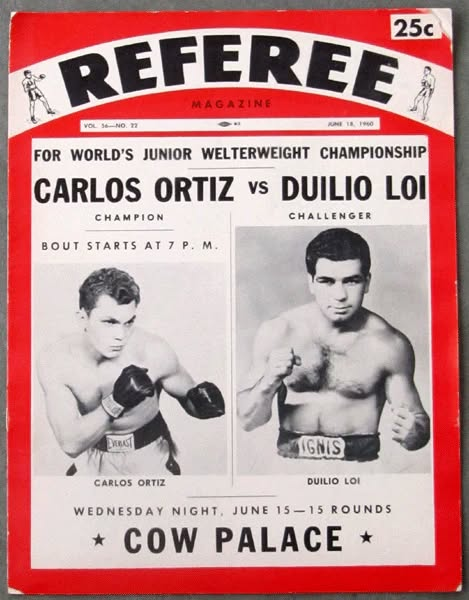
Carlos Ortiz retains his Junior Welterweight Title with a 15-round split decision over Duillio Loi on June 15, 1960 at the Cow Palace in Daly City, California.
The AP reports:
"Carlos Ortiz fought the toughest fight of his career Wednesday night to win a split decision over Italy's Duilio Loi and retain his world junior welterweight boxing title. Loi, the rugged 31 year old European welterweight champion, won the cheers of the Cow Palace crowd in this nationally televised 140 pound championship fight that was close all the way. Ortiz jabbed and hooked his way to an early lead. But the experienced Italian, who had lost only once in 111 professioanl fights, began to get the range in the 3rd and 4th rounds. Despite the fast pace there were no knockdowns and no cuts, although both boxers showed slight puffing near the eyes."
On the unofficial scorecards the AP has it 145-143 for Ortiz, the UPI saw it 144-143 also for Ortiz and Eddie Muller of The San Francisco Examiner scored it 145-144 in favor of Loi.
They'd rematch in September in Milan, Italy with Loi taking the title on a majority decision.
Loi would retain the title with a 15-round uD over Ortiz in May of 1961, and Ortiz would make the unusual move of going down in weight to seek, and eventually capture, the Lightweight Championship.
----------------------------------------------------------
Duilio Loi went an impressive 115-3-8 with 26 KO's during his career beating the legendary Carlos Ortiz in two of their three matches.
You're not likely to read about boxers like Duilio Loi anywhere else but 20thCB:IM&M where we delve into boxing history like no other group on FB, Instagram or X.
Perhaps most impressively, Duilio Loi avenged all three of his career defeats and 5 of his 8 draws.
Loi is considered one of the greatest fighters of all time at his weight and one of the best fighters to ever come out of Italy.
He was inducted into the International Boxing Hall of Fame in 2005.
60
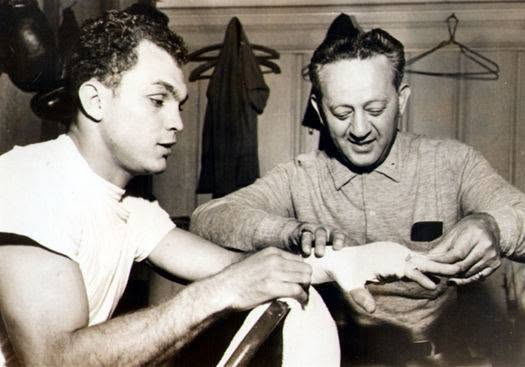
Carlos Ortiz with Sammy Cherin on June 15, 1960 as Ortiz prepares to defend his Junior Welterweight title against Duillio Loi at the Cow Palace that evening.
Sammy Cherin trained Maxie Docusen, Lightweight Champion Jimmy Carter, and the great Carlos Ortiz, among others.
42
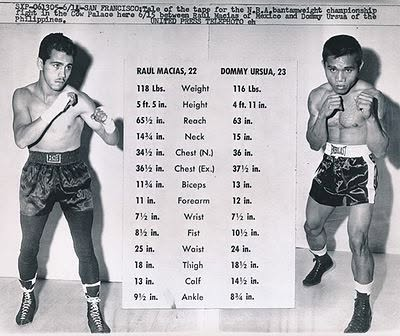
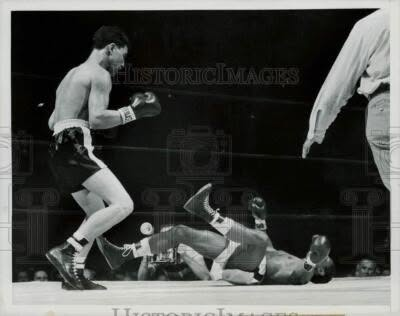
NBA Bantamweight Champion Raul Macias retains his title on June 15, 1957 with an 11th round TKO of Dommy Ursua, of the Philippines, at the Cow Palace in Daly City, California.
----------------------------------------------------------
Mexico's Raul "Raton" Macias began his amateur career at age fourteen, winning the National Junior Flyweight, Flyweight and Bantamweight titles. He won a bronze medal at the Pan American Games. Raton also represented Mexico as a bantamweight at the 1952 Helsinki Olympic Games, losing in the second round.
Macias was considered perhaps Mexico's first boxing "idol."
As a professional, he won the North American Bantamweight title, defeating Olympic Flyweight Gold Medalist Nate Brooks in front of a crowd of more than 50,000 fans in Mexico City in 1954.
He won the vacant NBA -- which late became the WBA -- World Bantamweight Title over Thailand's Chamrern Songkitrat in 1955 and successfully defended the world title twice before losing it to Alphonse Halimi on a split decision in 1957.
After retiring from boxing, 41-2-0 with 25 KO wins, Macias became a well-known movie actor. (See, e.g., El Raton.) He was inducted into the World Boxing Hall of Fame. Raton died at the age of 74 in 2009 of prostate cancer.
1
32
Featherweight Cherif Hamia (left) wins a 10-round unanimous decision over Miguel Berrios (down in the 4th round) on June 15, 1956 at Madison Square Garden.
The AP, which unofficially scored it 6-4 for Hamia, would report:
"Cherif Hamia of Algeria has qualified for a featherweight title shot at champion Sandy Saddler in the early fall if terms can be arranged. The battler from overseas convinced a crowd of 2,000 MSG fans and a national television audience of his ability Friday night while winning a unanimous 10-round decision over Miguel Berrios. Although Hamia was hurt in the 1st, 5th and 6th rounds, he took charge of the fight down the stretch after dropping the stocky Puerto Rican for the first time in his career in the 4th round. It was an interesting match between Hamia with his long jab and boxing skill against the booming left hook of Berrios. Still, Hamia's right hand was the biggest of the night, dropping Berrios for an eight-count in the 4th. Berrios' hooks had Hamia in trouble three times but he never followed up his advantage."
1
69
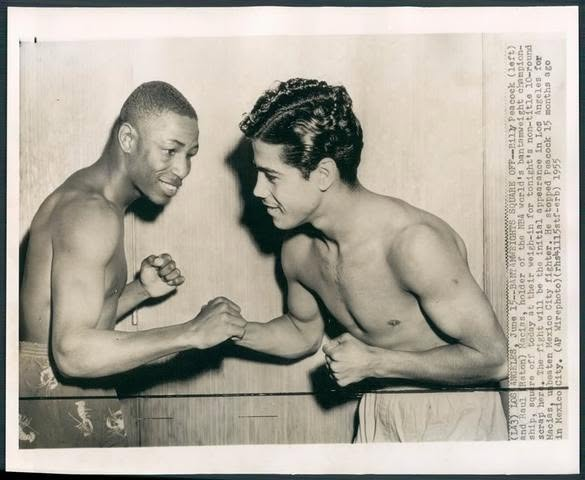
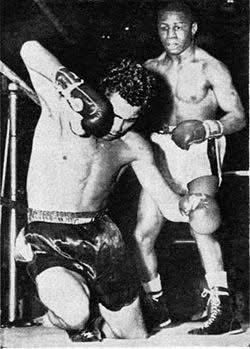
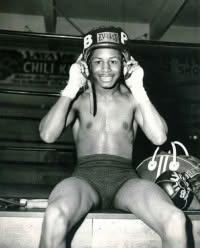
Billy "Sweet Pea" Peacock (pictured with headgear on) scores a stunning one-punch KO of reigning, and undefeated (19-0) World Bantamweight Champion Raul Macias, on June 15, 1955, at The Olympic Auditorium in Los Angeles.
Peacock, the 1951 National AAU Flyweight Champion as an amateur, avenges a 7th round TKO loss he'd suffered to Macias, in Mexico City, in March of 1954.
----------------------------------------------------------
Billy Peacock would win 16 of his first 17 fights, including capturing the California State Bantamweight Title, but never replicated his amateur sucess as a pro.
On a 9-fight win streak, which included this KO of Macias (whose jaw was broken by the punch), Peacock would drop a decision to future three-time Bantamweight Championship challenger Alphonse Halimi in Paris in March of 1956.
His career would be a series of peaks and valleys following that loss; a 1st round KO of the solid Nate Brooks in his next fight, a mix of wins and losses followed, and then his career would end miserably as "Sweet Pea" would lose his final 18 fights to finish his career at 43-34-1 (19 KO's).
1
36
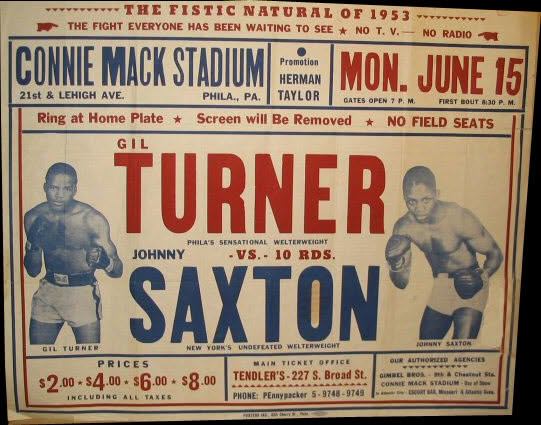
Gil Turner hands undefeated (39-0-1) Johnny Saxton his first loss on June 15, 1953, winning a 10-round split decision at Connie Mack Stadium in Philadelphia.
The AP, which unofficially scored it 5-3-2 in favor of Turner, would write:
"Gil Turner won a split 10 round decision in a fast and furious fight at Connie Mack Stadium over Johnny Saxton. The action-packed bout was a thriller from start to finish and the crowd of 14,676 went home satisfied it had got its money's worth. Turner fought hard for 10 rounds and with a slashing body attack and occasional jolting right hand to the face gained the split verdict. Saxton proved his class. The fast, shifty counter-puncher stayed with Turner all the way."
----------------------------------------------------------
Gil Turner, the 1949 Philadelphia Golden Gloves Champion at Welterweight and the 1950 National AAU Champion as well, went 56-19-2 with 35 KO's as a pro.
From The Boxing Glove:
Gil Turner was one of the most exciting and popular fighters ever to come out of Philadelphia. He had, what would in later years, come to be seen as the stereotypical Philadelphia fighting style; an ultra aggressive, all-action, whirlwind of a fighter. The 1950s era in which he fought was the era where TV fell in love with boxing, and Gil Turner was to become one of the most popular and widely televised fighters of that generation.
Born in Philadelphia, Pennsylvania, on October 9, 1930, Turner turned professional in 1950, and became a sensation from the start. The fans loved Turner’s high energy fighting. His fists would blaze away, as if he were trying to punch his way through a wall. He appeared to be tireless and impervious to his opponent’s punches. Like most ’sluggers’ of his era, Turner knew how to box and had a useful jab, but he was a fighter who seemed to love going to war and the fans quickly loved him for it. Turner was making a charge up the welterweight rankings, and for such a young professional, he was matched tough. It seemed to make no difference, as he collected victory after victory in exciting fashion. By the middle of 1951, having been professional for barely a year, Turner was already a rated contender at welterweight, with wins over former lightweight world champions Beau Jack, Ike Williams, and top contenders Charley Fusari and Vic Cardell.
By the beginning of 1952 Turner was 27-0, and hankering after a shot at the World welterweight championship that was held by “The Cuban Hawk” Kid Gavilan. In hindsight, it seems audacious to say the least, that Turner’s management could feel that their boy was ready to take on the formidable and battle-hardened Gavilan, with his record of 82-12-4, after barely two years as professional and just 27 contests. Yet, this is what they did after Turner had posted 4 more wins in early 1952 to bring his record up to 31-0. On July 7, 1952, Turner was given his shot at the Hawk.
The fight itself was eagerly anticipated. The champion was persuaded to defend his crown at Philadelphia’s Municipal Stadium; in other words, in the challenger Turner’s own backyard. A crowd of more than 39,000 created a record gate of 269,667 dollars, making the contest the richest ever for the World welterweight title up to that time.
In regards to action and excitement, the fight did not disappoint, although the majority of the fans there that night, most of whom had come to cheer on their home town fighter Turner, were destined to be deflated by the contest’s conclusion.
In what has become one of the more overlooked classics of the ring, challenger and champion blazed away at each other for 11 rounds until someone finally broke. Turner went after the champion for most of the fight, showing a good jab, and then firing away with both hands, at the body, the head, anywhere he could land. Gavilan seemed content to counter with fiery combinations of his own. After 10 rounds, both men were about even on the judge’s scorecards, but Gavilan, had been waiting, biding his time, keeping his attacks measured, while his challenger was going for broke every round. While Turner had been past 10 rounds just once so far in his career (and then only into the 11th round) Gavilan was an expert in going the distance and out- lasting his opponents in grueling fights. Although Gavilan was only 4 years older than Turner was, he had seven years ring experience over him, and at 26 years old, was in his prime. Perhaps most crucially for Turner, who was used top knocking most of his opponents out, Gavilan had one of the best chins in all of boxing, and would end his career having never been stopped or knocked out.
In short, Turner’s constant blazing attacks upon the champion were nothing short of suicidal. He was never going to stop or KO Gavilan, nobody would. Then again, nobody knew that in 1952.
At times during the fight’s first 10 rounds it did seem as though “The Cuban Hawk” would wilt under the ferocity of his challenger’s vicious attacks. For certain periods it seemed as if Turner would overwhelm Gavilan. Then the moment was gone, as Gavilan fired back another combination of counter punches.
By the 11th round Turner’s white mouthpiece was glaring through his lips as he tried desperately to find more air. He was tired and exhausted, yet, he continued to carry the fight to the champion, and with even more fury than in the earlier rounds.
Finally, Gavilan was done waiting. Around the 2.00-minute mark of the 11th, as Turner continued to try and tear into him with both fists, Gavilan answered with one of those combinations. This time, however, there was an added weight and purpose in the combination. Turner was suddenly hurt, wobbled, and as he fell against the ropes Gavilan opened up with a seemingly never-ending fusillade of punches that landed with unforgiving accuracy upon the challenger’s head and face. Turner staggered around the ring under the attack, looking like he would go down at any moment, but somehow keeping his feet. The referee watched as he took punch after punch, then Turner was hanging on the ropes, drooping, but still on his feet. Gavilan was still firing mercilessly upon him, only then did the referee finally step in and stop it.
Turner had lost but lost valiantly, in the true tradition of the Philadelphia warrior, going down all guns blazing. What Turner and nobody else knew at that point was that this would turn out to be his one and only shot at a world title.
Some fighters lose something when they are beaten for the first time, especially when they had been almost invincible until that point in time.
Gil Turner would remain a huge draw and score some great victories in the coming years, but the losses would also come more often now; the sparkle of invincibility that Turner had felt before the Gavilan contest was gone.
In his first fight after the loss to Gavilan, Turner was out-pointed by Bobby Dykes.
The Dykes fight was another war for Turner and he came out of if needing ten stitches to close up cuts over his left eye, on his right cheek, and in his mouth.
Turner came back to win 10 out of 12 contests over the next 12 months, including a revenge win over Dykes on points. His two losses during this time were on points to Joey Giardello and Rocky Castellani. By now, Turner had moved up to middleweight, a move that meant that he was often giving away weight. Against Giardello he gave away 7 pounds. With hindsight, Turner’s move up to middleweight was not the greatest of ideas, even when he put on extra poundage to weigh close to the middleweight limit, he was never a true middleweight. If anything, Turner was probably a natural light middleweight by this point in his career. Unfortunately, in the 1950s, no such division existed. With the move up to middleweight every fight became evermore of a war for Turner.
1954 proved to be a turning point for Turner’s career, as he went 4-3. Being out- pointed and then stopped by Bobby Jones in two fights and then, being knocked out in 3 rounds by Al Andrews. Despite ending the year with two wins, Turner’s days as a genuine top contender was over.
However, television and the fans (and indeed the promoters) continued to love Turner, win or lose, he always gave value for money. You could always count on an action- packed (and often bloody) contest when Turner was in the ring. From the mid-1950s onwards, he started being seen more as an opponent, and a fringe contender.
As always, Turner was never matched easy, one wonders what might have happened had he been given a softer run at some point, or even (heaven forbid!) more than a month or two off between fights sometimes. But, this was the 50s when fighters fought, where only the very best and the very well managed, rose to the top.
During the last four years of his career Turner’s opposition reads like a whose-who of the top welterweights, where Turner still flirted occasionally, and middleweights of that time. Fighters such as Joe Miceli, Gene Fullmer, Carmen Basilo, Isaac Logart, Johnny Saxton, Yama Bahama, Joey Giambra, Del Flanagan, Vigil Atkins, Vince Martinez, and Ralph Dupas were some of his competition.
Victories over Fullmer (who would later beat Turner twice on points), Atkins, and Flannigan, would keep Turner upon the fringes of contendership, and he was never an easy opponent for anyone.
Turner went 13-12-2 in his last 27 contests from 1955 to 1958, and finally retired after losing on points to Del Flanagan, on November 20, 1958. Turner was only 28 years of age, but in true Philadelphia style. He had blazed bright, and burnt out young.
Gil Turner may not have reached the absolute heights and won a world title, but he came close, and gave it his best shot against one of the greatest fighters of his and any other era. In today’s multi-titled era, a fighter like Turner could more or less count on winning a number of world titles, at different weights. But, Turner fought in an era when the champions were few and just to reach the status of being a contender was enough to prove that you were something special.
----------------------------------------------------------
Johnny Saxton, 55-9-2 with 21 KO's, would outpoint Kid Gavilan to win the World Welterweight Title on October 20, 1954.
The decision was very controversial and Gavilan complained bitterly about getting "the business."
His accusations were bolstered by rumors of a fix that had swirled prior to the match. The Saxton-Gavilan outcome appeared to be widely known in advance and bookmakers in New York reportedly refused to accept wagers on Saxton.
"It was an open secret," writer Budd Schulberg would later say to The Observer:
"All the press knew that one--and other fights--were fixed."
Saxton lost the title by knockout to Tony DeMarco on April 1, 1955 but regained it on March 14, 1956 by outpointing Carmen Basilio. That decision raised as many, if not more, eyebrows as the Gavilan fight had in 1954.
The New York Times reported that when the decision was announced, "The reading of these tallies...set off a derisive din that shook the stadium rafters."
Saxton, the 1948 New York Golden gloves Champion at Lightweight and the 1949 titlist at welterweight, had been banned from fighting in New York State due to his underworld associations (Saxton was managed by the infamous "Blinky " Palermo). Saxton's career was often marred by rumors of shady dealings. However, Julius Helfand, Chairman of the New York State Athletic Commission, consented to stage the second Basilio bout in Syracuse because he was convinced their couldn't be a fair decision given anywhere else.
Basilio knocked out Saxton in the ninth round to regain the title.
Five months later, Basilio would defend the title against Saxton with a second round knockout.
Saxton would lose three of his last four fights and retire at the age of 28.
In retirement, Saxton found himself adrift and broke. According to an April 7, 1959 newspaper article, Saxton had been confined to a mental hospital after his second arrest for burglary in a month. "He was placed in the State Mental Hospital at Ancora, N.J. after attempting to hang himself in an Atlantic City jail cell. He had been charged with attempting to rob a variety store. In Queens yesterday, the 28-year-old boxer, who earned an estimated total of $250,000 in the ring, was indicted for the March 4 theft of $6.20 in cash and a $100 coat from a Jamaica apartment."
Saxton had been declared "punch-drunk and legally insane" at the time of his arrest.
In the 1990s, Saxton was found living in squalor in a New York City apartment without electricity. Eventually, he wound up in a retirement home in Lake Worth, Florida, where he was diagnosed with Dementia Pugilistica.
He died in 2008, in Florida, at the age of 78.
206
Lightweights Armand Savoie (left) and Eddie Compo pose on June 15, 1953 before their scheduled 10-round bout at Eastern Parkway Arena in Brooklyn, New York.
Savoie will score a 5th round TKO on cuts.
Armand Savoie would go 61-40-6 (33 KO's) during his twenty one year (1948-69) pro career and win the Canadian Lightweight and Welterweight Championships. He had represented Canada, at Featherweight, in the 1948 Olympic Games in Melbourne, Australia.
He met numerous world champions during his career with wins over Sandy Saddler (DQ3), a 10-round split decision over then reigning Lightweight Champion Jimmy Carter in February of 1953, and a 10-round UD over highly regarded contender Glen Flanagan.
He'd suffer losses to Willie Pep, Paddy DeMarco, Ralph Dupas, and in his only world title shot he was KO'd in the 5th round, in 1953, in a return with Carter in November of 1953.
By the mid to late 1950's, Savoie had become a stepping-stone for other fighters and the losses would pile up after a respectable start to his pro career.
In 1954-55 he would lose ten of sixteen fights - among those were losses to Carter, Kenny Lane, Cisco Andrade, Ralph Dupas, Teddy Davis and Larry Boardman.
Savoie would be inactive in 1956 and return in 1957, only to lose five of his eight bouts (losses to Lauro Salas and Joe Brown among those).
He lost all five of his bouts in 1958-59 and now was being stopped in bouts after all of his previous losses had been decisions.
He would only fight a dozen more times from 1961-69, going 5-6-1, before retiring.
Savoie would pass in 1988 at the age of 58.
17
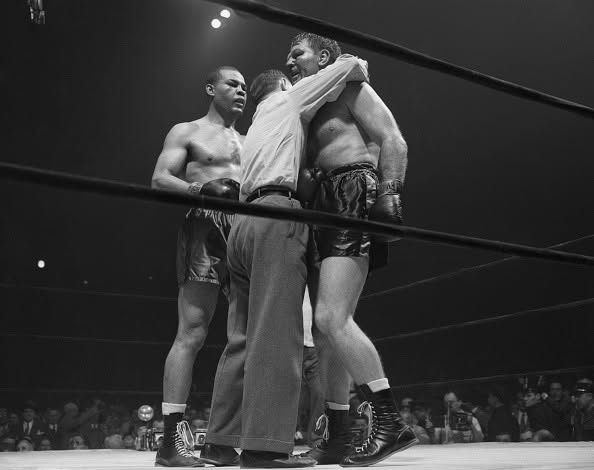
Referee Ruby Goldstein steps in to protect Lee Savold, on June 15, 1951, as former Heavyweight Champion Joe louis looks on at Madison Square Garden.
Louis will KO Savold in the 6th round.
The fight was originally scheduled to take place outdoors at the Polo Grounds on June 13. However, after two postponements due to rain, the fight was moved indoors to Madison Square Garden.
Savold entered the fight recognized as World Heavyweight Champion by the British Boxing Board of Control.
After Louis knocked him out, the organization decided to recognize Ezzard Charles, who had decisively defeated Louis the previous year, as the Heavyweight Champion of the World.
The Associated Press reported:
"It was strictly a one-sided battle all the way as Louis snapped Savold's head back with jarring left jabs and belted him to the head and body with short rights and uppercuts. From the second round on Savold gushed blood from his nose. Only in the fifth, when he shook the Bomber with two overhand rights to the head, did the Englewood (N.J.) veteran inflict any damage. Louis said the rights did not bother him. 'I knew what I was doing all the time,' said Louis. He sure showed it in the sixth. He ripped away at Savold with both hands and did something he could not accomplish in his five previous victories. He put away Savold with a right to the body and as beautiful a left hook to the jaw as you will ever see."
This would be the last KO win of Louis' legendary career. He'd win two decisions, over Cesar Brion and Jimmy Bivins, before facing prospect Rocky Marciano in his final bout.
1
50
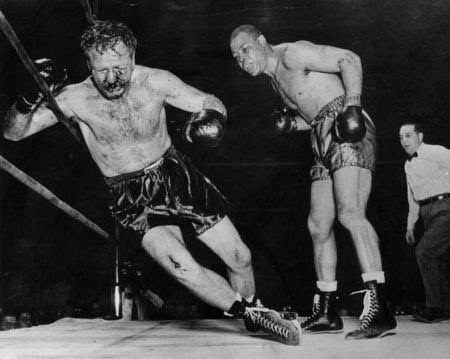
Former heavyweight champion Joe Louis Ko's Lee Savold, on June 15, 1951, in the 6th round at Madison Square Garden.
The fight was originally scheduled to take place outdoors at the Polo Grounds on June 13th. However, after two postponements due to rain, the fight was moved indoors to Madison Square Garden.
Savold entered the fight recognized as World Heavyweight Champion by the British Boxing Board of Control. After Louis knocked him out, the organization decided to recognize Ezzard Charles, who had decisively defeated Louis the previous year, as the Heavyweight Champion of the World.
The Associated Press reported:
"It was strictly a one-sided battle all the way as Louis snapped Savold's head back with jarring left jabs and belted him to the head and body with short rights and uppercuts. From the second round on Savold gushed blood from his nose. Only in the fifth, when he shook the Bomber with two overhand rights to the head, did the Englewood (N.J.) veteran inflict any damage. Louis said the rights did not bother him. 'I knew what I was doing all the time,' said Louis. He sure showed it in the sixth. He ripped away at Savold with both hands and did something he could not accomplish in his five previous victories. He put away Savold with a right to the body and as beautiful a left hook to the jaw as you will ever see."
43
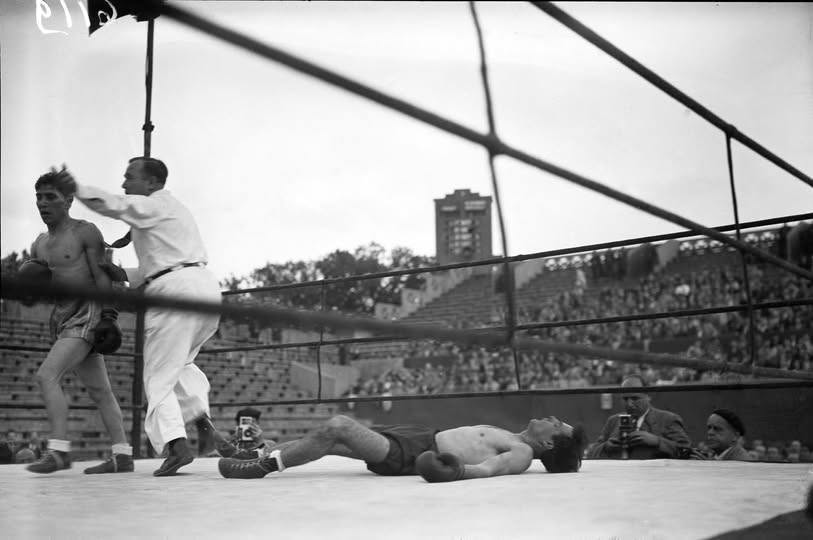
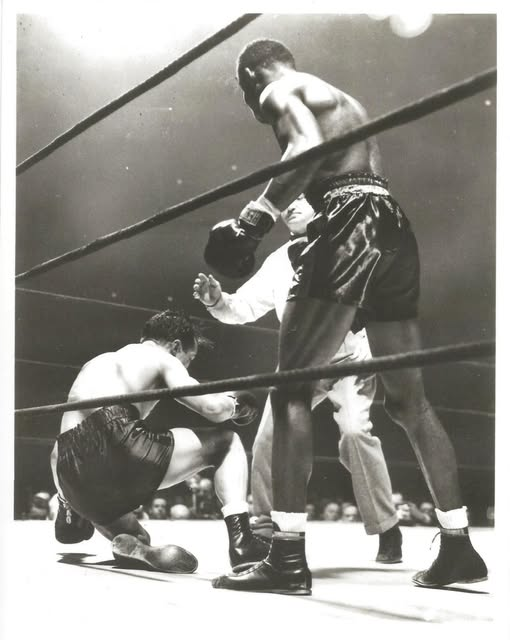
Laurent Dauthuille drops Gustave "Gus" Degouve, on June 15, 1947, enroute to a 10-round points win at Roland Garros Stadium in Paris, France.
Roland Garros Stadium, of course, is more well known as the site of the French Open Tennis Championships than as a boxing arena, though Carlos Monzon would make a title defense there against Jean-Claude Bouttier in 1973.
--------------------------------------------------------------------------
Laurent Dauthuille, "The Tarzan of Buzenval", was featured on the covers of the November 1949 and February 1951 editions of The Ring magazine.
45-13-4 with 24 KO wins, his lone world title shot came in September of 1950 in a memorable challenge of Middleweight Champion Jake LaMotta at Olympia Stadium in Detroit.
Dauthuille would come as close, perhaps, as any fighter ever had to winning a world title only to see it vaporize in a matter of seconds.
Dauthuille had previously won a convincing unanimous 10-round decision over LaMotta in February of 1949 at The Montreal Forum.
The Ring described Dauthuille's ring style as "methodical and accurate counter-punching."
Dauthuille, well ahead on all three official scorecards (72-68, 74-66, 71-69) heading into the 15th, and final, round chose instead to try to finish Lamotta and would be KO'd with just 13 seconds remaining before the scorecards would have made him the World Middleweight Champion.
The November, 1950 edition of The Ring would report:
"All Dauthuille required when the bell sounded for the final round was to play safe, and had he boxed he would have come through triumphantly." It was a good fight for the first eleven rounds, but full of drama and excitement in the last four."
The Ring would name LaMotta-Dauthuille it's 1950 "Fight of the Year."
1
23
Sugar Ray Robinson (54-1-1 coming in) KO's Jimmy McDaniels (40-18-9 coming in) in the 2nd round at Madison Square Garden on June 15, 1945.
McDaniels was dropped in his own corner by a smashing right to the chin shortly before the first round ended. Referee Benny Leonard had reached the count of three when the bell rang. Reporter Jack Cuddy wrote, "It is doubtful if Los Angeles Jimmy could have risen before the count of ten." Robinson put McDaniels down for the count with a left hook to the chin in the second round.
"He's not merely a good fighter, he's great and I mean every word of it," McDaniels said afterwards. "This was the first time in all my fights I've been hit and didn't know what hit me."
Hard to believe in this day and age of boxers retiring with two dozen pro fights on their resume, but Robinson was still eighteen fights away from his first world title shot in which he decisioned Tommy Bell for the vacant Welterweight Championship in December of 1946.
By the time of that first title shot, Sugar Ray had already accumulated (some of them multiple) wins over Jake LaMotta, Tommy Bell, Marty Servo, Sammy Angott, California Jackie Wilson, George Costner and Fritzie Zivic.
1
3
67