
Joined July 2023
- Tweets 53
- Following 3
- Followers 4
- Likes 0
34 Photos and videos







Mar 10
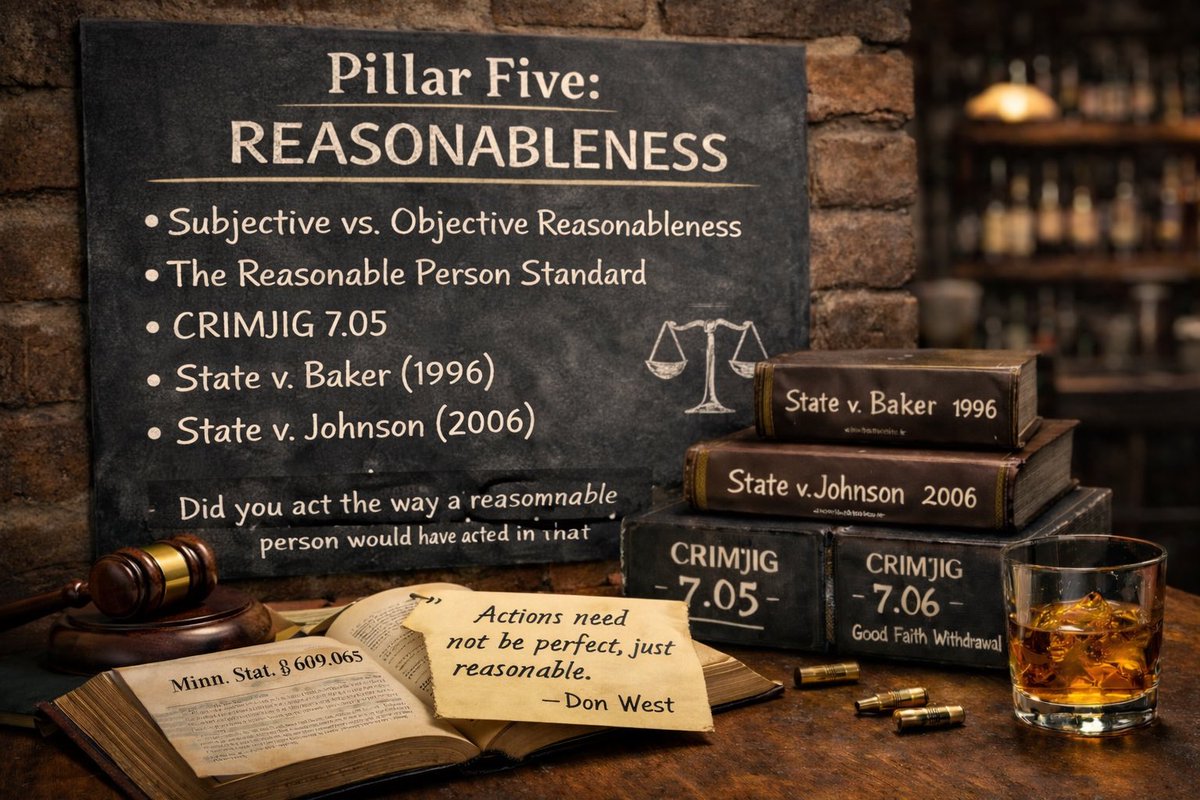
Pillar Five: Reasonableness — The Standard That Decides Everything
Reasonableness is the pillar everyone talks about, but it’s also the one most people misunderstand. If innocence asks who started the conflict, imminence asks whether the threat was about to happen, proportionality asks whether the force matched the threat, and avoidance asks whether safe retreat was available, reasonableness asks the question that ultimately decides the case.
Would a reasonable person have seen the situation the same way you did?
That question sounds simple, but legally it contains two ideas that work together. The first is subjective reasonableness — what you actually believed at the time. Did you genuinely believe you were facing death or great bodily harm? Self-defense law does not require perfect judgment, but it does require that the fear be real.
The second layer is objective reasonableness. This is where the jury comes in. The question becomes whether a reasonable person standing in the same position, seeing what you saw and experiencing the same unfolding moment, would have shared that belief. The law protects genuine human reactions under stress, but it does not allow deadly force based on fear society would consider unreasonable.
There’s an important point here that trial lawyer Don West has explained well. People sometimes believe they must do everything perfectly during a use-of-force event. That’s not the standard. The law does not require perfect judgment in a moment of fear. It requires reasonable judgment. The question is not whether every action was perfect, but whether the actions were reasonable given what was happening in that moment.
Minnesota law reflects that balance directly. Under Minn. Stat. §609.065, deadly force may only be used when necessary to prevent death, great bodily harm, or the commission of a violent felony in one’s abode. Courts interpret that necessity through the lens of reasonable belief. A person must actually believe deadly force was required, and that belief must also be reasonable under the circumstances. Minnesota’s general force statute, Minn. Stat. §609.06, works the same way for ordinary force.
Jurors hear this most clearly through CRIMJIG 7.05, Minnesota’s self-defense instruction. It tells jurors the defendant must have acted with an honest belief that force was necessary to prevent death or great bodily harm, and that the belief must have been reasonable when viewed under the circumstances at the time.
Minnesota appellate courts reinforce this repeatedly. In State v. Baker and State v. Johnson, the courts explain that jurors must evaluate events from the defendant’s perspective at the time the force was used, not from the calm hindsight of a courtroom months later.
This is why reasonableness ties the other pillars together. If you were the aggressor, reasonableness disappears. If the threat was not imminent, reasonableness disappears. If the force used was wildly disproportionate, reasonableness disappears. If safe retreat was clearly available and ignored, reasonableness becomes much harder to defend.
It’s also why prosecutors attack this pillar so aggressively. They slow everything down and dissect every detail — distance, timing, body language, lighting, escape routes. Their job is to make split-second decisions look, in the calm light of a courtroom, like errors a reasonable person wouldn’t have made.
In the end, the jury is not just evaluating what happened. They are evaluating what you believed was happening, what you saw, what you perceived, what you thought was about to occur.
And that leads to the quiet question at the center of every self-defense case:
Did you act the way a reasonable person would have acted in that moment, or did your fear go beyond what the law considers reasonable?
That answer often decides everything.
18
Feb 27
I had to invent a word because the English language apparently tapped out.
The word is Intellicide.
Intellect plus “-cide,” as in homicide. It means killing your own ability to reason. Not because you’re dumb. Not because you skipped school. But because the truth started making you uncomfortable and instead of adjusting, you suffocated it with a pillow. Ignorance is fixable. Intellicide is elective surgery.
It’s that moment when you’re in an argument and you feel the internal speed bump. You know the one. That little voice that says, “Hold on… maybe define that term before you go nuclear.” And instead of slowing down, you hit the gas because your tribe is watching and you can’t afford to look unsure for six seconds. Boom. Intellicide. You didn’t lose your intelligence. You executed it.
This isn’t a left problem. It isn’t a right problem. It’s a human problem. The second your ideology becomes your identity, you’re screwed . Now disagreement feels like a personal attack. Now facts aren’t facts, they’re threats. Now reasoning isn’t a searchlight; it’s a shield. And if the shield cracks, you don’t repair it. You declare the mirror racist.
Intellicide shows up when you label before you define. When you assume intent because it’s faster than asking questions. When “winning” the argument matters more than actually being right. When you’d rather get applause from your side than risk a moment of intellectual humility.
And here’s the kicker: smart people are often better at Intellicide than dumb people. A high IQ just gives you better justifications for shutting down your own reasoning. You can rationalize anything if you’re clever enough and sufficiently emotionally invested.
We’ve got polite academic terms for this. Motivated reasoning. Cognitive bias. Those sound like something you fix with a clipboard and a TED Talk. Intellicide sounds like what it is. You murdered your own capacity to think because your identity couldn’t survive five minutes of honest examination.
So next time you feel that little internal friction, that moment where you could pause, clarify, maybe even admit you don’t know everything and instead you double down with moral fireworks, just own it. You didn’t defend truth. You defended ego.
That’s Intellicide.
And if you’re honest, you’ve probably committed it sometime between breakfast and your third scroll of Facebook.
10
Feb 3
Keith Ellison is the Minnesota Attorney General, the chief legal officer for the State of Minnesota. He went on Don Lemon’s YouTube show and argued that the FACE Act is designed to protect reproductive rights, suggesting that applying it to interference with a church service would be a stretch.
Here’s the quote:
“And the FACE Act, by the way, is designed to protect the rights of people seeking reproductive rights… so that people for a religious reason cannot just use religion to break into women’s reproductive health centers.”
The problem is that the actual statute (18 U.S.C. § 248) explicitly protects both: access to reproductive health services, and people lawfully exercising their First Amendment right to religious freedom at a place of religious worship.
That language is not ambiguous. Churches are covered. Congress added that protection intentionally.
This came up after protesters disrupted a service at Cities Church in St. Paul. You can argue politics or enforcement priorities all day, but pretending the religious-worship provision isn’t written into the law isn’t legal interpretation. It’s narrative.
And when that narrative comes from the Attorney General of Minnesota, people are right to notice.
21
Feb 2
For the people saying, “That’s not how the law works,” here’s the short version of how it actually works, without turning this into a law school exam.
The Supreme Court has been clear for decades that the press does not get special rights that ordinary citizens don’t have. In Branzburg v. Hayes, the Court said outright that journalists don’t have a constitutional privilege that gives them access or immunity beyond everyone else. Holding a camera doesn’t lift you above neutral laws.
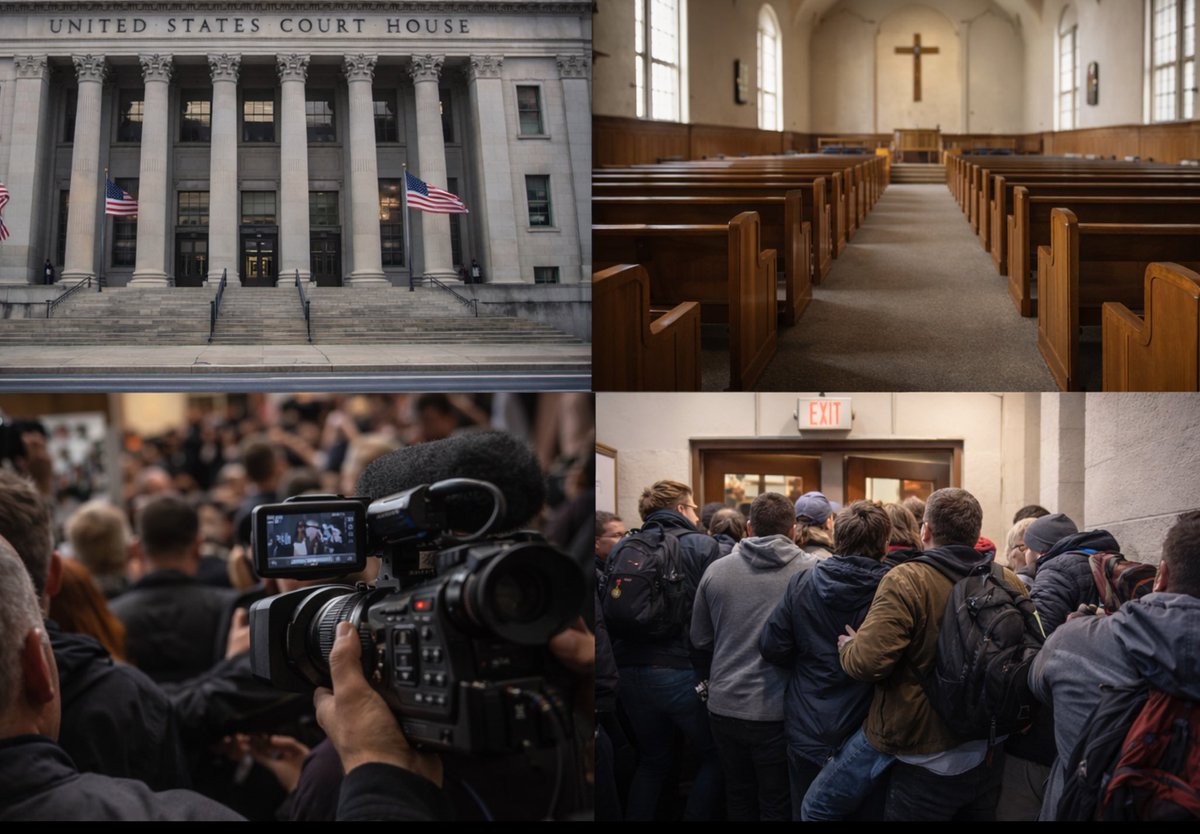
That matters here because the FACE Act isn’t about opinions or viewpoints, it’s about conduct. It protects people from force, intimidation, and physical obstruction when they’re exercising certain rights, including religious worship. It doesn’t matter why someone is blocking aisles or exits; it matters that people can’t move freely or feel trapped.
Then there’s the civil-rights conspiracy law, often called the “KKK Act”, which exists precisely because group actions are designed to blur responsibility. You don’t have to be the person physically blocking the door; if you know what’s happening, place yourself inside it anyway, and your presence helps sustain or escalate the interference, the law doesn’t let you hide behind “I was just there.”
Courts don’t ask what label you give yourself. They look at knowledge, positioning, refusal to disengage, and whether your conduct made the situation more coercive for the people whose rights were being exercised. That’s how they decide when observation ends and participation begins.
None of this stops anyone from reporting. You can criticize publicly, document from lawful vantage points, and publish whatever you saw afterward, what you can’t do is step into the middle of a protected space, help turn worship into a pressure cooker, and then argue that your role entitles you to override everyone else’s rights.
That’s not press freedom.
That’s privilege wearing a camera.
Sponsored by 2A Self-Defense Law
We don’t avoid nuance — we weaponize it.
9
Feb 2
This is about Don Lemon and a mindset that a lot of people quietly hold,the idea that if you call yourself “the press,” the rules somehow bend around you.
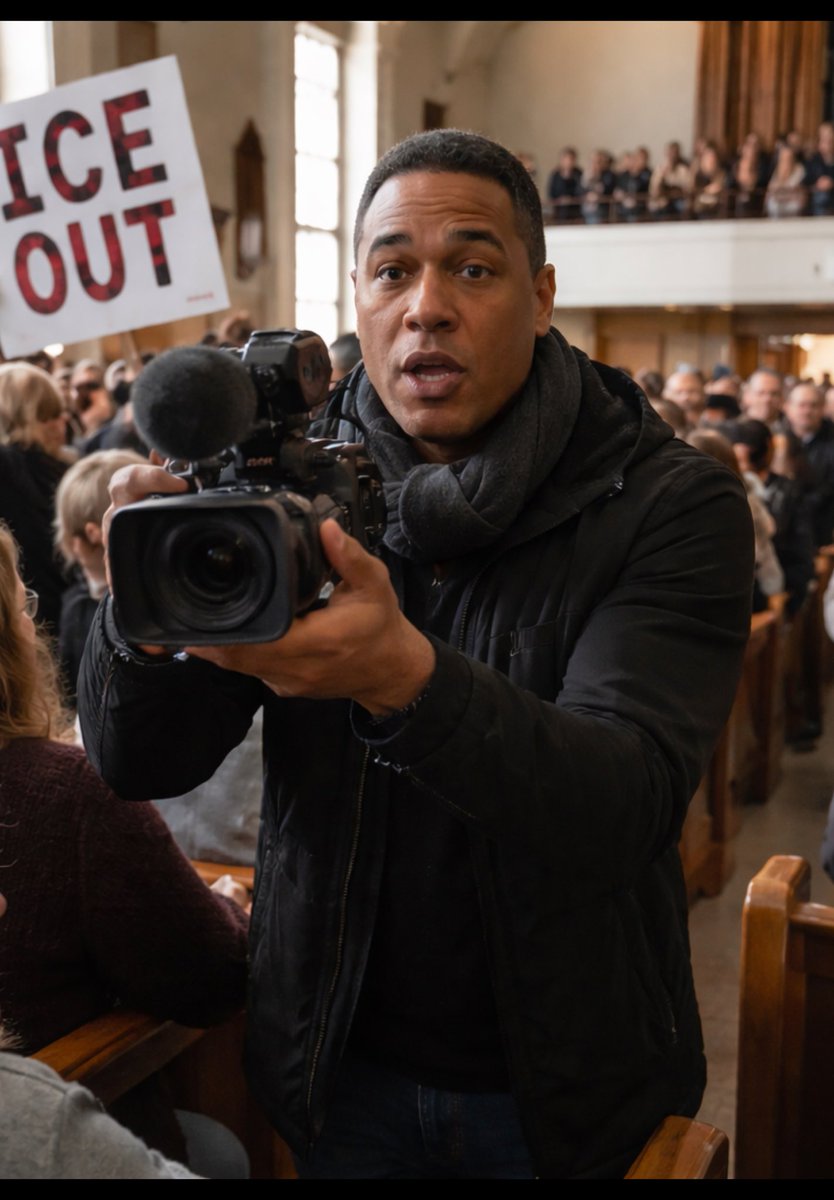
Don Lemon doesn’t work for CNN anymore. He wasn’t embedded, he wasn’t credentialed by the church, and he didn’t have permission to be inside that sanctuary. At that point, he’s not operating under some special status, he’s just a citizen with a camera, same as anyone else.
And that’s where the line gets crossed.
The First Amendment absolutely protects speech and reporting, but it does not give anyone the right to insert themselves into a confined, emotionally charged space during a worship service, contribute to crowd pressure, block movement, or make it harder for people to leave and still claim they’re just “observing.” In real life, in real rooms, cameras aren’t neutral props, they can escalate tension, embolden crowds, and add intimidation, whether that’s the intent or not.
If people can’t get out, that’s obstruction. If panic sets in, that’s intimidation. If someone gets hurt trying to escape, we’re not talking about journalism anymore.
What really bothers me here is the quiet hierarchy being asserted, the idea that Don Lemon’s First Amendment rights as “press” somehow sit above other people’s First Amendment rights to worship freely and peacefully. That religion becomes interruptible, secondary, something you can push through because you think your cause or your role is more important.
That hierarchy doesn’t exist. There’s no constitutional caste system where cameras outrank churches, and there’s no version of press freedom that turns participation into immunity. Everyone knows this instinctively, because no one seriously believes a reporter could walk inside a bank robbery, stand next to the vault, and claim they’re protected just because they’re documenting it.
This isn’t anti-press. It’s anti-entitlement.
The Constitution doesn’t bend for cameras, and it definitely doesn’t bend for ego.
Sponsored by 2A Self-Defense Law
We don’t avoid nuance — we weaponize it.
9
Jan 25
4
Jan 24
m.facebook.com/story.php?sto…
The ICE “Death Card” Story: Slow Down Before You Decide
An unverified image is driving big conclusions. Before reacting, it’s worth asking who this actually helps, who it hurts, and why this has only appeared in one place. Full breakdown at the link.
13
Jan 8
17
Jan 6
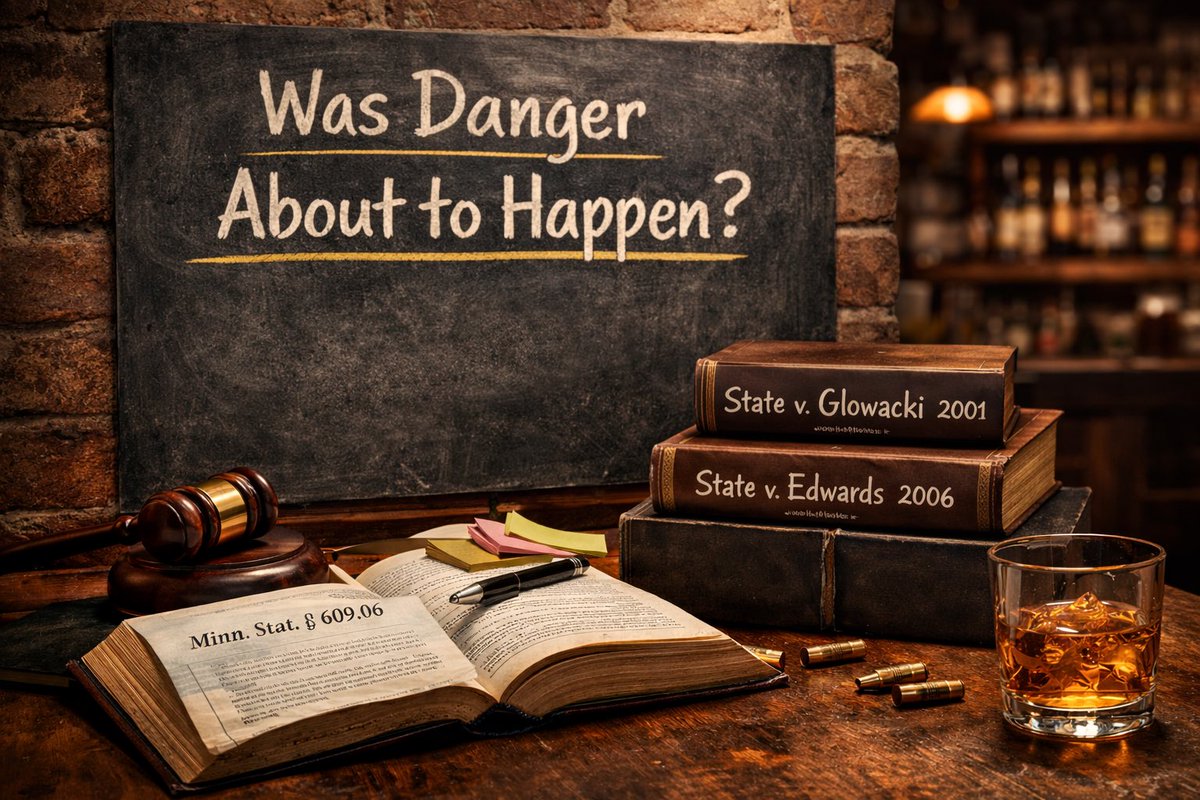
If Innocence is about who lit the fuse, Imminence is about whether the bomb was actually about to go off or whether you decided it might go off and acted on that. And that distinction matters way more in Minnesota than people expect. A lot of self-defense conversations start and end with fear. I was scared. I thought something bad was coming. And sure, fear is human. Nobody disputes that. But Minnesota law doesn’t treat fear as the deciding factor. It treats timing as the deciding factor.
When you read Minn. Stat. § 609.065 closely, you notice it never says deadly force is justified because a situation feels dangerous. It says deadly force is justified only when it’s necessary to prevent an offense you reasonably believe exposes you to death or great bodily harm. That word “exposes” isn’t abstract. It’s immediate. It’s right now.
That’s where imminence comes from. It’s Minnesota’s way of saying, we’re not going to play the “what might have happened” game. Glowacki is the case that really locks that idea in place. When you read State v. Glowacki, what the court is doing isn’t philosophical, it’s practical. The court draws a hard line between fear of future harm and a threat that’s actually unfolding. The message is pretty clear: you don’t get to use deadly force to stop something that hasn’t arrived yet.
Glowacki doesn’t say fear is irrelevant. It says fear has to line up with something concrete and immediate. If the danger isn’t pressing in right now, deadly force stops being “necessary” under the statute.
Then Edwards comes along and tightens the focus even more. State v. Edwards basically says, “Freeze the frame.” Imminence gets judged at the exact moment force is used, not based on what happened earlier, not based on what the defendant later explains, and not based on how the story feels when it’s told in hindsight.
That’s why testimony gets tricky fast. When someone says, “I thought he was going to…” Minnesota courts hear speculation, not imminence. The law is asking whether a reasonable person in that spot would have believed harm was about to happen, not eventually, not possibly, but about to.
And that’s also why jury instructions matter so much more than people realize. Jurors aren’t told to rely on gut instinct or common sense alone. They’re given written instructions, CRIMJIG 7.05 and 7.06, that spell this out in very plain language. The defendant must have reasonably believed bodily harm or death was about to be inflicted.
Those words aren’t flexible. Jurors are required to use them. So when jurors go back and replay the evidence, they’re not asking whether the situation was tense. They’re asking things like: what was the other person doing at that exact moment? Were they advancing or backing off? Was there a pause? Was there a break where things stopped moving forward?
Because that pause matters. Even a short one. This is where a lot of self-defense claims quietly collapse. Not because the situation was harmless, but because the danger changed. It peaked, stalled, or shifted, and then force happened anyway. Minnesota courts are very comfortable saying that once the threat is no longer immediate, deadly force stops being justified, even if the person is still terrified.
That’s the part that feels unfair to people. Fear doesn’t turn off instantly. Adrenaline lingers. But the law doesn’t grade emotional residue. It grades necessity at the moment force was used.
Minnesota doesn’t reward anticipation. It doesn’t reward getting ahead of a bad outcome. It rewards necessity and necessity only exists when harm is unavoidable and happening now.
That’s what imminence really is in Minnesota. Not emotion. Not instinct. Just timing.
41
Jan 6
Pillar One: Innocence
(or: how Minnesota decides who screwed this up first)
If you strip all the chest-thumping out of self-defense law in Minnesota, Innocence comes down to one brutally simple question:
Did you start the physical problem you later claim you had to solve?
That’s it. Everything else people argue about—fear, adrenaline, training, vibes—comes after that question.
Minnesota’s force statute, Minn. Stat. § 609.06, doesn’t even bother defining “aggressor.” It just says you’re allowed to use reasonable force when you’re resisting an offense against the person. The courts fill in the rest. And they do it with a very adult tone: if you’re the one who provoked or initiated the assault, you don’t get to hide behind self-defense when it goes bad.
That’s not a political opinion. That’s straight out of State v. Basting. The court doesn’t dance around it. It says, in plain English, that someone who provokes an assault can’t claim self-defense unless they clearly stop and communicate that they’re done. Not hint. Not hope. Clearly inform the other person that the fight is over.
Which already tells you something important: Minnesota assumes adults can tell the difference between a misunderstanding and someone pulling the pin on a grenade.
Now here’s where people screw this up.
They hear “provokes” and think it means anything. A smart remark. A dirty look. Being an asshole. That’s not how Minnesota reads it. Courts care about conduct, not tone. Words alone don’t usually make you the aggressor. They start caring when the situation moves from argument to action—when someone takes that step that turns talk into force.
That’s why CRIMJIG 7.05 and 7.06 don’t ask juries whether the defendant was “nice” or “polite.” They ask whether the defendant was not the aggressor, or if they were, whether they withdrew in good faith and clearly communicated that withdrawal.
And that language matters. Juries don’t get the internet version of self-defense. They get that sentence. Over and over.
State v. Devens drives the point home even harder. The court makes it clear that being the initial aggressor poisons the well. You don’t cleanse that poison by calming down internally. You cleanse it by actually disengaging in a way the other person understands. And whether that happened isn’t up to you—it’s up to the jury, looking at your behavior through a microscope after the fact.
Here’s the uncomfortable part nobody likes admitting:
Once a jury decides you were the aggressor, they stop giving you the benefit of the doubt on everything else. Your fear sounds exaggerated. Your timing sounds suspicious. Your memory gets picked apart. Innocence is the lens through which all the other pillars get judged.
That’s why Minnesota self-defense cases so often collapse before the moment of force. Not at the trigger pull. Not at the punch. But at the point where someone could have walked away, shut up, stayed in the car, or just let it go—and didn’t.
The law isn’t asking you to be perfect. It’s asking you not to be the person who made the situation worse and then tried to blame fear when it blew up.
If you weren’t innocent when the force started, Minnesota isn’t interested in the rest of your story.
And that’s Pillar One.
15